
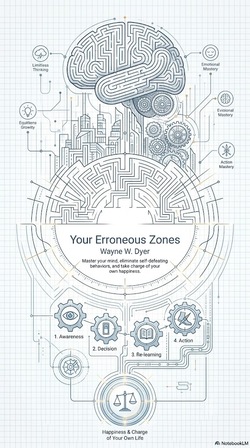
Your Erroneous Zones
Loading…

Your Erroneous Zones

Wayne W. Dyer

4.51119 learners

Wayne W. Dyer’s *Your Erroneous Zones* is a timeless self-help classic that dismantles the self-defeating mindsets holding you back from true happiness and personal freedom. Dyer argues that many of our daily struggles—from constant anger and paralyzing guilt to relentless approval-seeking and chronic procrastination—stem from false, ingrained beliefs: that emotions are controlled by external events, that our worth depends on others’ opinions, or that we’re trapped by past labels. Through relatable real-life anecdotes and practical, actionable strategies, he guides readers to take full responsibility for their feelings, embrace the present moment, and reject rigid societal 'shoulds' that stifle authenticity. The book emphasizes that true fulfillment comes from self-acceptance, breaking free from psychological dependence, and choosing to live on your own terms rather than conforming to others’ expectations. Whether you’re stuck in cycles of worry, trapped in toxic relationships, or struggling to prioritize your own joy, this book offers a clear roadmap to rewrite your thought patterns and build a life rooted in confidence and inner peace.


Emotional ControlProcrastinationself-acceptanceSelf-defeating mindsetsPresent-moment living
End Procrastination Now
Loading…

End Procrastination Now

William Knaus

3.51054 learners

End Procrastination Now by William Knaus delivers a science-backed, actionable guide to breaking the crippling cycle of delay. Knaus first unpacks procrastination into distinct, relatable types—deadline-driven, personal task avoidance, simple instant delay, and complex multi-factor patterns—revealing their hidden psychological roots: cognitive biases, emotional avoidance, self-sabotaging thought loops, and fear-based defense mechanisms. He then provides a toolkit of targeted strategies spanning cognitive, emotional, and behavioral domains: the five-step change method to shift from delay to action, the ABCDE framework to challenge irrational procrastination thoughts, the PURRRRS plan to build emotional tolerance for discomfort, and even adapts military strategist Clausewitz’s principles to foster decisive decision-making. For workplace procrastinators, he introduces the SWLO self-analysis tool to align strengths with tasks, reducing delay triggers. Packed with real-world examples and practical exercises, this book empowers readers to dismantle automatic procrastination habits, build lasting productivity, and reclaim control over their time and goals.

Emotional RegulationProcrastination TypesCognitive ShiftsABCDE MethodPURRRRS Plan
Eat That Frog!
Loading…

Eat That Frog!

Brian Tracy

4.3913 learners

Brian Tracy’s *Eat That Frog!* is a timeless guide to beating procrastination and mastering time management, anchored by the vivid metaphor: if you eat a live frog first thing in the morning, nothing worse will happen the rest of your day. This means tackling your most critical, daunting task first to build momentum and wipe out overwhelm. Tracy lays out actionable, no-nonsense strategies to supercharge productivity: a 7-step goal-setting framework that turns vague wishes into concrete plans, leveraging the 80/20 Principle to focus on the 20% of tasks driving 80% of results, and the ABCDE prioritization system to sort tasks by urgency and impact. He also shares creative procrastination to cut low-value work, task breakdown techniques for large projects, and tips to balance productivity with personal well-being—prioritizing family, health, and rest to sustain long-term success. Packed with real-world examples and easy-to-implement steps, this book transforms how you approach each day, helping you build discipline, reduce stress, and achieve your biggest goals faster.

time managementProductivityWork-Life BalanceGoal Setting80/20 Principle
Concept

SWLO Analysis

Strengths, Weaknesses, Limitations, Opportunities. Identifies where you excel (less procrastination) and where to improve.

career developmentSelf-Assessment
Gold

Ben Franklin Quote

"Commit only to what you'll do, then do it immediately." Avoids conflicting promises that lead to procrastination.

ActionQuotes
Concept

Deadline Procrastination

Putting off tasks with clear due dates (like a company half-year report). You choose short-term comfort over finishing, especially if the task is boring. Fix it by splitting into small chunks with mini-deadlines and rewards.

Procrastination TypesDeadline PressureTask Chunking
Scenario

Procrastinating Writer Case

A writer delayed his book for ‘perfect conditions’. When he wrote 10 mins daily, he finished it in 6 months.

ConsistencyProcrastination
Method

5-Minute Plan

Commit to working on a procrastinated task for just 5 minutes. Most times, you'll keep going once started; if not, you've still taken a step forward.

Action StrategyProcrastination Fix
Method

Thought Stopping

When a procrastination thought hits, yell 'STOP!' mentally to break the cycle. Brings focus back to the task.

Procrastination FixCognitive Tool
Insight

Bad Start Beats No Start

Waiting for perfection traps you in 'waiting-to-die mode'. A bad start breaks the cycle—you learn from mistakes, adjust, and move forward. Even a rough plan is better than nothing.

GrowthActionProcrastination
Concept

Self-Observation vs Immersion

Self-immersion traps you in emotions (worrying about failure) leading to procrastination. Self-observation is objective: notice you're avoiding tasks without getting stuck in feelings.

Cognitive PerspectiveProcrastination Mindset
Concept

Complex Procrastination

Mixes self-doubt, perfectionism, etc. Like avoiding bills → gambling → TV to escape. Needs systemic change: mindset, emotion tolerance, action habits.

Procrastination TypesComplex Issues
Method

PURRRRS Plan

7 steps: Pause, Use willpower, Reflect, Reason, Respond, Review, Sustain. Slows procrastination impulses and builds discomfort tolerance.

Emotional RegulationProcrastination Strategy
Concept

Self-Handicapping

Setting up excuses (delaying a meeting) to blame failure on others. Protects self-esteem but leads to long-term mediocrity.

Self-ProtectionProcrastination Causes
Insight

Time Management Limits

Time management works for non-procrastinators but fails to fix deep psychological causes (emotions, cognitive biases) of stubborn procrastination.

time managementProcrastination Myths
Method

Beat Procrastination: 5-Minute Rule

When you’re stuck, tell yourself to work for just 5 minutes. Most people keep going once they start—this breaks the mental barrier of procrastination and builds momentum.

FocusProductivityProcrastination
Insight

Positive Procrastination

Preparatory procrastination is positive—Wright designed Fallingwater in 2h after 10 months of subconscious thinking. It allows ideas to mature.

CreativityProductivityProcrastination
View

Procrastination is Self-Created

Procrastination isn’t caused by others—it’s your choice to delay. Using ‘later’ as an excuse only increases anxiety.

ProcrastinationSelf-Discipline
Method

Beat Procrastination

1. Do one small task now (5 mins). 2. Ask: What’s the worst that can happen? 3. Replace ‘later’ with ‘now’.

ActionProductivity