Everything is a Contract
Loading…

Everything is a Contract

Nie Huihua

3.81306 learners

"Everything is a Contract" redefines how we navigate the world by framing every economic and social relationship as a contract—from job offers and corporate mergers to marriages and government regulations. Drawing on relatable real-world examples, from Tesla’s CEO compensation structure to Haidilao’s failed KPI experiments and Geely’s successful Volvo acquisition, this book breaks down core contract theory concepts like information asymmetry, incentive compatibility, and moral hazard. It explains why cash rewards sometimes kill intrinsic motivation, how to fix unfair performance ratcheting in the workplace, and why most corporate mergers fall apart. Whether you’re navigating office politics, running a business, or managing personal relationships, this book provides a rational decision-making framework to cut through complexity and make smarter choices aligned with your goals.
Moral HazardInformation AsymmetryContract TheoryIncentive CompatibilityAdverse Selection
The Economic Naturalist
Loading…

The Economic Naturalist

Robert H. Frank

4.21255 learners

Robert H. Frank’s *The Economic Naturalist* turns dry economic theory into a captivating exploration of everyday life. Using relatable real-world examples—from why ATM keyboards have braille to why bars serve free peanuts but charge for water—Frank demystifies core principles like cost-benefit analysis, supply-demand dynamics, property rights, and signaling theory. Unlike traditional textbooks relying on abstract models, this book teaches readers to think like "economic naturalists": observing the world around them to uncover hidden decision-making logic behind seemingly trivial choices. Drawing on his Cornell University teaching experience, Frank shows how economic thinking isn’t just for experts—it’s a tool to understand product design, workplace rules, relationship dynamics, and social norms. By the end, readers gain a new lens to interpret the world, making smarter decisions and recognizing the economic forces shaping their daily lives.

Property RightsCost-benefit analysisSupply-demand dynamicsSignaling theoryOpportunity cost
Why Nations Fail
Loading…

Why Nations Fail

Daron Acemoglu;James A. Robinson

4.6996 learners

Why Nations Fail dismantles pervasive myths about global inequality—from geographic determinism to cultural stereotypes—and argues that the root of national prosperity or poverty lies in institutional systems. Using vivid case studies, from the divided border city of Nogales (where U.S. inclusive systems drive wealth while Mexican extractive ones trap poverty) to the rise and fall of Venice, the book contrasts two core models: inclusive systems, which distribute power broadly, protect property rights, and encourage innovation, and extractive systems, which concentrate power in elite hands, exploit the majority, and stifle progress. It explores how historical path dependence amplifies small initial institutional differences over time, creating self-reinforcing cycles of prosperity or stagnation, and shows that breaking extractive cycles requires grassroots empowerment and institutional reform, not top-down fixes or foreign aid.

Path DependenceProperty RightsColonial LegacyExtractive InstitutionsEconomic inequality
Xue Zhaofeng's Economics Lectures
Loading…

Xue Zhaofeng's Economics Lectures

Xue Zhaofeng

4.4749 learners

Forget dry textbooks stuffed with jargon—Xue Zhaofeng’s Economics Lectures turns everyday moments into accessible masterclasses in economic thinking. Tailored for regular people, not just finance experts, this book uses relatable scenarios: why train tickets sell out during peak travel seasons, why rent climbs in desirable neighborhoods, and even why we pick one coffee order over another. Xue breaks down core concepts like scarcity, opportunity cost, property rights, and transaction costs into simple, actionable lessons, showing how these ideas shape every choice we make—from career moves to grocery runs. Ditching complex equations, it teaches you to view the world through an economist’s lens, helping you spot hidden incentives, make smarter decisions, and cut through noise in debates about policy, business, and daily life. Whether you’re a student, professional, or curious learner, this book turns economics from an intimidating subject into a practical tool for navigating modern life.

Property RightsScarcityOpportunity costTransaction costsSupply-Demand Model
Institutions, Institutional Change and Economic Performance
Loading…

Institutions, Institutional Change and Economic Performance

Douglass C. North

4.4741 learners

Douglass C. North’s seminal work redefines our understanding of economic success by centering institutions—the formal rules (laws, constitutions) and informal constraints (norms, cultural traditions) that structure human political, economic, and social interaction. Departing from neoclassical economics’ frictionless market assumptions, North argues transaction costs (which account for over 45% of U.S. national income) and institutional frameworks are the true drivers of long-term economic performance. He unpacks three core puzzles: why institutional change deeply impacts economic outcomes, why inefficient institutions persist despite competitive pressures, and why nations diverge into growth or stagnation paths due to path dependence. Using real-world examples—from 19th-century America’s rise to Latin America’s stalled development, and the QWERTY keyboard’s lock-in effect—North explains how organizations shape and are shaped by institutions, and introduces adaptive efficiency as the key to sustained prosperity. This cornerstone of new institutional economics provides a framework to explain global economic disparities and guide policy.

Path DependenceProperty RightsInstitutional changeTransaction costsFormal constraints
The Economic Way of Thinking
Loading…

The Economic Way of Thinking

Paul Heyne;Peter J. Boettke;David L. Prychitko

3.9716 learners

Tired of viewing economics as a jargon-heavy, inaccessible field? *The Economic Way of Thinking* demystifies core economic principles by grounding them in everyday, relatable scenarios—from rush-hour traffic coordination to your morning grocery run. This book teaches you that economics isn’t just about graphs and numbers; it’s a practical framework for analyzing how individuals make choices based on trade-offs, opportunity costs, and self-interest. You’ll discover why voluntary trade creates wealth for both parties, how price controls and government interventions often backfire with unintended consequences, and why clear property rights are essential for a thriving market. It also delves into macroeconomics, breaking down GDP, inflation, and the roots of economic cycles, plus explores why some nations achieve long-term prosperity while others remain trapped in poverty. Whether you’re a student, professional, or curious reader, this guide equips you to spot hidden economic logic in daily decisions and avoid common misconceptions about markets and governance.

Economic GrowthExternalitiesComparative AdvantageProperty RightsSunk Cost
The Rational Optimist
Loading…

The Rational Optimist

Matt Ridley

4.4673 learners

In *The Rational Optimist*, Matt Ridley dismantles nostalgic myths and doomsday prophecies to make a compelling case that we’re living in humanity’s best era—and it’s only getting better. Drawing on centuries of historical data, archaeological evidence, and economic analysis, Ridley argues that human progress isn’t a fluke: it’s driven by our unique ability to trade, specialize, and share ideas, creating a 'collective brain' that fuels endless innovation. He debunks claims that the past was simpler or more moral, highlighting how even today’s global poor enjoy comforts 19th-century billionaires could only dream of. From the rise of agriculture to the industrial revolution, from falling global poverty rates to improving environmental health, Ridley shows how exchange and division of labor have lifted living standards across the globe. He addresses critics’ biggest concerns—Africa’s development challenges and climate change—arguing that with better institutions, free trade, and continued innovation, these issues can be solved without sacrificing prosperity. A refreshing counterpoint to pervasive pessimism, this book celebrates human ingenuity and the power of market-driven progress.

Comparative AdvantageProperty RightsFossil FuelsMalthusian TrapCreative Destruction
Urban and Rural China
Loading…

Urban and Rural China

Qiren Zhou

3.5598 learners

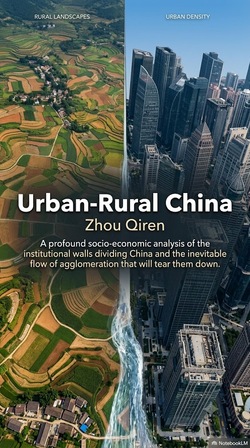
Zhou Qirun’s *Urban-Rural China* delivers a rigorous, accessible exploration of the historical, systemic, and economic forces shaping China’s urban-rural divide. Starting with a comparative analysis of global urbanization drivers—using Tokyo and Seoul as benchmarks—it unpacks why China’s industrialization outpaced its urbanization, fueled by mid-20th century policies restricting rural migration. The book traces the evolution of migration rights, from the 1954 Constitution’s initial recognition of free movement to the 1958 hukou system that entrenched a rigid, hereditary urban-rural hierarchy. It further examines the lopsided "land urbanization" phenomenon, where city expansion outpaces rural-to-urban population integration, rooted in state-controlled land ownership and compulsory land acquisition. Through on-the-ground case studies of Chengdu’s "empowerment through property rights" reform, Chongqing’s innovative land ticket system, and Shenzhen’s urban renewal efforts, Zhou illustrates grassroots and policy-driven solutions. He also debunks common misconceptions about land supply, property rights, and urban governance, arguing that balanced, sustainable development hinges on market-oriented land reform and restoring equitable property rights for rural residents.

Land ReformProperty RightsHukou Systemrural-urban migrationLand Urbanization
Quote

Chen's Property Rights Quote

"We are not slaves; we are the owners of our houses." (Chen Zhongdao fighting demolition.)

ResistanceProperty RightsChen Zhongdao
Scenario

Botswana's Success

Botswana grew 13x richer post-independence. Key: strong property rights, stable democracy, no heavy colonial interference.

Economic GrowthProperty RightsBotswana
Concept

Family Property Rights

Children couldn’t have private property or split the family while parents alive. Tang/Song: 3 years jail for violation; Ming/Qing: 100 lashes.

FamilyTraditional ChinaProperty Law
Insight

Why Whales Are Endangered

Whales are public—no one owns them, so overfished. Chickens are private—farmers keep them alive for profit.

Property RightsConservation
Scenario

Park Cherries Are Sour

Park cherries are public—everyone picks early to get some, even if unripe. Private cherries are owned, so farmers wait till ripe.

Property RightsPublic Goods
Scenario

Maiqili Demolition Fight

Chen Zhongdao ('Mayor Chen') uses a gas tank to stop demolition teams. His house was torn down, but he still fights for property rights.

ResistanceDemolitionChen Zhongdao
Quote

Weiqi's Economic View

"A lot of capital is wasted on useless projects. People move assets overseas due to property insecurity." (Weiqi, analyst.)

EconomyProperty RightsWeiqi