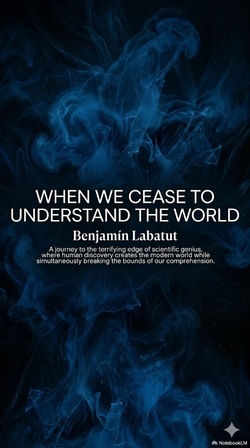
When We Cease to Understand the World
Benjamin Labatut’s *When We Cease to Understand the World* weaves spellbinding tales of scientific breakthroughs that blur the line between progress and catastrophe. From the accidental invention of Prussian blue—an affordable dye that democratized art, yet birthed deadly cyanide—to Fritz Haber’s ammonia synthesis, which ended global famine but prolonged WWI and enabled Nazi atrocities, each story exposes the dual-edged nature of human curiosity. It follows Carl Schwarzschild, who derived the first exact solution to Einstein’s general relativity from a WWI trench, only to be haunted by the singularity he uncovered until his death. The book also dives into the chaotic birth of quantum mechanics, pitting Einstein’s belief in a deterministic universe against Bohr and Heisenberg’s radical uncertainty principle. More than a science history, it forces readers to confront the limits of human understanding: when unraveling the universe’s secrets, we often find truths that shake the foundations of how we see the world.