Art as Experience
Loading…

Art as Experience

John Dewey

4.21064 learners

John Dewey’s *Art as Experience* revolutionizes traditional aesthetics by dismantling the artificial divide between "high art" and everyday life. Rejecting the notion that art is a rarefied object locked in museums, Dewey argues that art springs from the same lived moments that structure our daily routines—from a skilled mechanic’s focused craft to a caregiver’s gentle tending of plants. At the core of his pragmatic theory is the "single experience": a complete, unified moment where doing and undergoing merge, creating fulfillment that transcends fragmented daily tasks. Dewey explores how rhythm, rooted in biological and natural patterns, forms the backbone of aesthetic experience, and how artists use mediums not as tools, but as extensions of their minds to translate raw emotion into tangible, shared meaning. He also challenges philosophical dualisms, showing how art bridges subject and object, and examines art’s role in expanding human experience, fostering cultural cohesion, and pushing civilization toward greater wholeness. This seminal work redefines art not as a luxury, but as the fullest expression of what it means to be alive.
aesthetic experiencerhythmexpressionsingle experienceartistic medium
Ludwig Wittgenstein
Loading…

Ludwig Wittgenstein

Ray Monk

4.21060 learners

Ray Monk’s definitive biography traces Ludwig Wittgenstein’s extraordinary life—from his privileged yet tormented Viennese childhood, marked by family tragedy and a lifelong obsession with moral truth, to his ascent as one of the 20th century’s greatest philosophers. We follow his journey from engineering student to Bertrand Russell’s protégé at Cambridge, the creation of his groundbreaking *Tractatus Logico-Philosophicus* amid WWI trenches, his post-war rejection of vast wealth to teach rural Austrian children, and his dramatic late-career shift to the pragmatic, language-centered philosophy of *Philosophical Investigations*. Monk vividly captures Wittgenstein’s volatile spirit: his relentless self-scrutiny, religious awakening, struggles with loneliness and identity, and uncompromising commitment to resolving the deepest philosophical puzzles. This biography isn’t just a chronicle of ideas—it’s a portrait of a man whose life and thought were inextricably woven, driven by a desperate quest to live honestly and make sense of the world.

Family ResemblanceAspect PerceptionTractatus Logico-PhilosophicusPhilosophical InvestigationsLanguage Games
Austerlitz
Loading…

Austerlitz

W. G. Sebald

4.5974 learners

Spanning decades of chance encounters, W.G. Sebald’s *Austerlitz* follows the quiet, obsessive journey of its eponymous protagonist, an art historian haunted by a fragmented past. What begins as meandering conversations about architecture—from Antwerp’s grand colonial-era train station to London’s labyrinthine subway systems—unfolds into a profound reckoning with identity. Austerlitz, raised in Wales by Calvinist missionaries, gradually uncovers his hidden origins: a Jewish boy sent to Britain on a Kindertransport during WWII, separated from his parents who perished under Nazi rule. Sebald weaves together architectural analysis, philosophical meditations on time, and raw, suppressed trauma, framing buildings as silent witnesses to history’s atrocities. The novel blurs the line between memory and reality, inviting readers to confront the lingering weight of unspoken grief and the ways the past infiltrates the present. More than a story of personal discovery, it’s a haunting exploration of how history is etched into the spaces we inhabit and the lives we lead.

Time PerceptionTraumatic MemoryArchitectural HistoryNazi PersecutionIdentity Reclamation
A Treatise of Human Nature
Loading…

A Treatise of Human Nature

David Hume

4.4780 learners

David Hume’s *A Treatise of Human Nature* is a landmark empirical philosophy work that upends traditional views of human cognition, emotion, and morality. Starting with a rigorous breakdown of perception—distinguishing vivid "impressions" (sensory experiences, raw emotions) from faint "ideas" (mental reflections)—Hume argues all simple ideas originate from corresponding impressions, rejecting innate knowledge claims. He redefines causality not as an objective law, but as a mental habit forged by repeated event associations. For emotions, he explains pride, humility, love, and hate through dual links of ideas and shared impressions. Finally, Hume anchors morality in sentiment rather than reason: moral judgments stem from feelings of pleasure or pain, shaped by humanity’s innate capacity for sympathy. Alongside this, he explores skepticism about rational certainty, challenging reason’s supposed primacy in human life and laying groundwork for modern empirical psychology and ethics.

SkepticismImpressions and ideasCausal habit theorySympathy principleMoral sentimentalism
You Are What You Risk
Loading…

You Are What You Risk

Michele Wucker

2.9708 learners

Most of us see risk as something to avoid—a threat to our safety, success, or stability. But in *You Are What You Risk*, risk expert Michele Wucker turns that idea on its head. She argues that risk isn’t just a challenge to navigate; it’s a core part of who we are. Each of us has a unique “risk fingerprint,” shaped by our life experiences, cultural background, values, and even our biology. Wucker uses real-world stories—from entrepreneurs betting on startups to parents making family decisions—to break down how our risk preferences drive every choice we make. She shows readers how to identify their own risk fingerprint, understand why they make certain risky calls, and leverage this self-awareness to make smarter decisions in career, finance, and daily life. Instead of fearing risk, you’ll learn to see it as a tool for growth, self-discovery, and thriving in an uncertain world.

Behavioral Economicsdecision-makingRisk PerceptionRisk PreferenceIdentity formation
Three Days to See
Loading…

Three Days to See

Helen Keller

4698 learners

In *Three Days to See*, Helen Keller recounts her extraordinary journey from a silent, dark world—plunged into deafblindness at 19 months—to a life of profound learning, connection, and purpose. Through the transformative guidance of her teacher Anne Sullivan, Keller unlocks the power of language with the iconic 'water' lesson, sparking a lifelong hunger for knowledge. She navigates the sting of the 'Frost King' plagiarism controversy, masters speech against all odds, and becomes the first deafblind person to graduate from Radcliffe College. Beyond academic triumphs, Keller shares her unique sensory world: how touch, smell, and vibration let her 'see' sunsets, hear music, and connect with nature and loved ones. Her memoir is a testament to resilience, the boundless potential of the human spirit, and a reminder to cherish every moment of perception, inspiring readers to find light even in the darkest circumstances.

Spiritual GrowthHelen KellerAnne SullivanRadcliffe CollegeDeafblindness
Philosophical Investigations
Loading…

Philosophical Investigations

Ludwig Wittgenstein

4.5677 learners

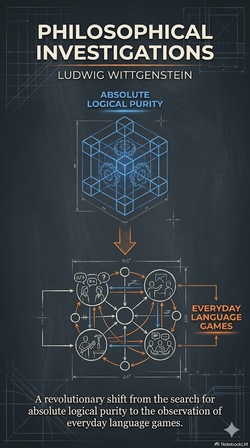
Ludwig Wittgenstein’s *Philosophical Investigations* upends traditional theories of language and meaning, rejecting his own earlier "picture theory" to argue that words gain significance not by corresponding to abstract entities, but through their use in everyday "language games"—interwoven acts of speech and action tied to specific life forms. Using vivid examples like Augustine’s account of language learning, the builder-assistant dialogue, and the duck-rabbit illusion, Wittgenstein dismantles the myth of a universal language essence. He introduces "family resemblance" to explain how concepts like "game" lack a shared core, linking instead through overlapping similarities. The work debunks private language, showing meaning depends on shared rules and public context. Ultimately, Wittgenstein frames philosophy not as a theory-building discipline, but as a "therapy" to dissolve confusion caused by linguistic misuse, guiding readers back to concrete, everyday word uses that give language its true purpose.

Language GameFamily ResemblancePrivate Language ArgumentPhilosophical TherapyAspect Perception
Public Opinion
Loading…

Public Opinion

Walter Lippmann

4.2651 learners

First published in 1922, Walter Lippmann’s *Public Opinion* remains a landmark work exploring how humans perceive the world and form collective judgments. Lippmann argues that we don’t engage with the real world directly—instead, we navigate a "pseudo-environment": a simplified, biased mental construct shaped by limited information, stereotypes, social cues, and media framing. Using vivid examples from World War I political scandals, military propaganda, and everyday misperceptions, he demonstrates how these mental models distort our understanding of events, leading to flawed public opinions and misguided political decisions. He critiques traditional democratic theory, which assumes citizens can make informed choices about distant or complex issues, pointing out most people lack the time, access, or expertise to grasp full truths. Finally, Lippmann proposes a pragmatic solution: an organic intelligence system of independent experts to gather and analyze factual data, bridging the gap between the public’s limited knowledge and the complex realities of modern society.

Cognitive BiasPublic OpinionStereotypesSocial Perceptionmedia influence
Stories of Your Life and Others
Loading…

Stories of Your Life and Others

Ted Chiang

4.1608 learners

From the Hugo Award-winning 'Story of Your Life'—where a linguist’s study of alien Heptapods rewires her perception of time and fate—to the mind-bending 'Tower of Babylon' that reimagines the universe’s structure, Ted Chiang’s *Stories of Your Life and Others* is a collection of seven provocative sci-fi tales. Each story acts as a rigorous thought experiment, blending cutting-edge science, philosophy, and theology to challenge fundamental assumptions about human understanding. Whether exploring the limits of superintelligence in 'Understanding,' the collapse of mathematical logic in 'Division by Zero,' or the moral dilemmas of a world where God’s miracles are mundane in 'Hell Is the Absence of God,' Chiang crafts narratives that are both intellectually stimulating and emotionally resonant. These stories don’t just entertain; they force readers to question how we see time, truth, faith, and the very nature of existence.

Free WillSuperintelligenceHeptapod Language BNonlinear Time PerceptionMathematical Consistency
Night Submarine
Loading…

Night Submarine

Chen Chuncheng

3.5549 learners

Night Submarine, the debut short story collection from Chinese writer Chen Chuncheng, weaves intimate, surreal tales that blur the line between dream and everyday life. Each story is a quiet dive into the hidden corners of human imagination: a boy who spends his nights commanding a tiny submarine through the rivers of his mind, an elderly scribe guarding a lost language buried in ancient texts, a man who stumbles upon a temple holding secrets tied to his forgotten childhood. Rooted in lyrical prose and gentle whimsy, these narratives explore themes of memory, time, and the quiet magic that lingers in ordinary moments. Perfect for readers who crave stories that feel like half-remembered dreams, it invites you to slow down and rediscover the wonder hiding in the mundane.

MemoryTime PerceptionImaginationNight SubmarineZhufeng Temple
Strategy and Path
Loading…

Strategy and Path

Huang Qifan

3.9463 learners

Authored by Huang Qifan, a leading Chinese economic policymaker, *Strategy and Path* delivers an insider’s analysis of China’s economic transformation, from its landmark 13th Five-Year Plan achievements to its 2035 development roadmap. The book breaks down core national strategies: the dual circulation pattern balancing domestic and global markets, the '30·60' carbon peak and neutrality goals, digital economy advancement, common prosperity initiatives, and open cooperation frameworks like RCEP and the China-Europe Railway Express. It also addresses critical geopolitical dynamics, including Sino-U.S. economic relations and Hong Kong’s role in global finance. For international readers, it demystifies China’s policy logic, explains how these strategies reshape global supply chains, trade flows, and climate action, and highlights opportunities for global businesses to engage with China’s evolving economy.

Digital EconomyRCEPDual Circulation StrategyCarbon NeutralityCommon Prosperity
Scenario

Intercepted on Work Way

Police stopped my bus to the refinery, ordered all Jews off. We thought it was a check—never guessed it was the start of our camp journey.

unexpectedArrestHolocaust Journey
Concept

Targeted Therapy

Drugs like Gleevec and Herceptin attack specific molecular targets in cancer cells—effective with fewer side effects.

Targeted TherapyPrecision MedicineCancer Drugs
Quote

British Distance Perception

Bryson notes: 'The English have a special relationship with distance—they make a short drive sound like a cross-country trip, talking about potholes and pubs along the way.'

humorDistanceBritish Culture
Quote

Perception Shapes Reality

"There is nothing either good or bad, but thinking makes it so." Your mindset determines how you see the world—if you think you're not creative, you won't be.

MindsetPerceptionCreativity
Concept

Mental Models

Mental models are deep-seated assumptions shaping how you see the world. They’re invisible but influence decisions without you noticing.

Cognitive BiasPerceptionDecision Making
Concept

Arbitrary Coherence

Consumers don’t know absolute value—they use anchors (past experience, comparisons) to build price perception. Like peanut butter shrinking from 18oz to16.3oz at same price; people don’t notice the absolute change.

Consumer BehaviorPrice PerceptionAnchors
Quote

See but Do Not See

"We are not blind. We are people who see but do not see." The doctor's wife means people often ignore truth even when it's right in front of them.

HumanityTruthPerception