The Presentation of Self in Everyday Life
Loading…

The Presentation of Self in Everyday Life

Erving Goffman

4.51261 learners

Erving Goffman’s seminal work *The Presentation of Self in Everyday Life* redefines social interaction through his groundbreaking dramaturgical theory, framing daily human encounters as theatrical performances. Using vivid, relatable examples—from Shetland Island innkeepers navigating class performances to hospital nurses managing patient perceptions, café waiters embodying their roles to corporate teams coordinating a unified image—Goffman breaks down how we craft, maintain, and adjust our public selves to guide others’ views. He introduces core concepts: frontstage (the curated space where we put on our polished "show"), backstage (the private area where we drop our facades), and the "dramaturgical cast"—groups that collaborate to uphold a shared definition of a situation. The book also explores impression management strategies, the tension between authentic identity and performed roles, and the impact of "discrepant roles" (like therapists or trainers) who hold behind-the-scenes knowledge. More than a sociological text, it’s a practical lens to understand the unspoken rules shaping every conversation, workplace interaction, and social gathering, revealing how we all balance being ourselves with meeting others’ expectations.
Social InteractionDramaturgical TheoryImpression ManagementFrontstageBackstage
The Coaching Habit
Loading…

The Coaching Habit

Michael Bungay Stanier

4.4862 learners

For busy managers drowning in endless requests and ineffective leadership training, The Coaching Habit offers a game-changing solution: 7 simple, powerful questions that turn coaching from a time-consuming formal task into a daily, instinctual habit. Drawing on decades of research and real-world experience, author Michael Bungay Stanier addresses the three vicious cycles plaguing modern teams—over-reliance on managers, overwhelming stress, and disorientation from meaningless work—and shows how these questions break those cycles. He also lays out a science-backed framework to build this coaching habit, covering five core elements: purpose, triggers, concise actions, deep practice, and flexible planning. Whether you’re leading direct reports, collaborating with colleagues, or even connecting with family, these questions transform conversations, empower others to solve their own problems, and free you to focus on high-impact work. This book isn’t just about coaching—it’s about redefining leadership to be more efficient, empowering, and sustainable.

Coaching Habit7 Core Coaching QuestionsTERA CoefficientDrama TriangleDouble-Loop Learning
The Brothers Karamazov
Loading…

The Brothers Karamazov

Fyodor Dostoevsky

4.5733 learners

Fyodor Dostoevsky’s magnum opus, *The Brothers Karamazov*, plunges readers into the chaotic, soul-baring world of the Karamazov family in 19th-century Russia. At its core lies the brutal murder of Fyodor Karamazov, a greedy, neglectful patriarch who pits his three sons against one another: hot-headed Dmitri, consumed by rage and lust; Ivan, a brilliant nihilist grappling with the question of God’s existence; and Alyosha, a gentle, devout monk-in-training clinging to faith amid chaos. As the murder investigation unfolds, the novel transcends a simple whodunit, delving into searing debates about morality, free will, redemption, and the nature of evil. Through intense dialogue, vivid characters, and a gripping trial, Dostoevsky lays bare the contradictions of human nature—how virtue and vice coexist in every soul—and challenges readers to confront their own beliefs about faith, guilt, and what it means to be human.

FaithRedemptionFyodor KaramazovDmitri KaramazovIvan Karamazov
Rendezvous with Rama
Loading…

Rendezvous with Rama

Arthur C. Clarke

4.3707 learners

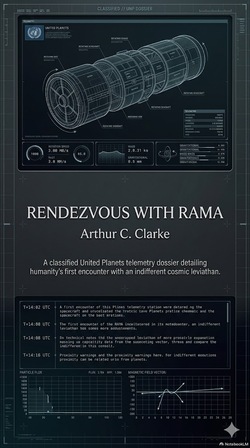
In 2077, a devastating asteroid strike on northern Italy shatters humanity’s false sense of security, spurring the launch of the Spaceguard program to track cosmic threats. Fifty years later, astronomers detect Rama—a massive, cylindrical interstellar object hurtling through the solar system. Captain Norton and the crew of the *Endeavour* are dispatched to make first contact, venturing into the hollow alien vessel to uncover its secrets. Inside, they discover a vast, engineered world with artificial gravity, frozen oceans, and strange cybernetic organisms maintaining the ship. Tensions escalate when Mercury launches a nuclear missile to destroy Rama, fearing it poses an existential threat. Norton defies orders to disable the warhead, preserving the alien artifact. As Rama reaches the sun, it reveals its true purpose: refueling using solar energy before departing for the Large Magellanic Cloud, leaving humanity with lingering questions about the enigmatic Ramans and their interstellar mission.

First ContactRamaEndeavourSpaceguardinterstellar ark
Blindness
Loading…

Blindness

Jose Saramago

4.5592 learners

When an ordinary man suddenly loses his sight to a strange, milky white blindness—his eyes physically unharmed—the phenomenon spreads like wildfire across an unnamed city. As panic erupts, the government quarantines all the blind and their contacts in a derelict psychiatric hospital, cutting them off with brutal rules and armed guards. Inside the camp, societal norms crumble: hunger drives theft, power corrupts into violence and exploitation, and humanity’s darkest impulses take hold. Yet amid chaos, glimmers of compassion persist—most notably in the doctor’s wife, who secretly retains her sight, sacrificing her dignity to protect fellow inmates. When the quarantine collapses, survivors navigate an anarchic city, clinging to fragile bonds. As blindness mysteriously lifts, they emerge with sight restored, but haunted by a question: have they truly seen human nature’s depths, or are they still blind to the world’s unspoken cruelties?

Compassionwhite blindnessquarantine facilityhuman moralitysurvival instinct
Quote

Drama Over Lives

Jenkins explains: 'Every mission needs a redshirt death—writers do it to keep the audience hooked.'

Narrative DramaRedshirt DeathWriter's Choice
Quote

Ants and Steamroller

"We are like ants watching a steamroller pass by." This metaphor shows how small humans are compared to Rama’s scale and advanced tech.

MetaphorHuman ScaleRama's Size
Quote

Not Alone Quote

"We may never know who the Ramans are, but we know we are not alone." This line gives hope—first contact proves humanity isn’t the only one in the universe.

HopeAlien ContactKey Quote
Scenario

First View of Rama Interior

When Norton first entered Rama, he saw a vast curved world. The centrifugal force made him feel like he was standing on a wall—with a frozen sea stretching far away.

Rama InteriorCentrifugal GravityFirst View
Quote

Writers' Indifference

Jenkins says: 'The writers don't see us as real—we're just tools to make their show more dramatic.'

Narrative ControlRedshirt FateWriter's Perspective
Scenario

Crew vs Producers

The crew confronts the show's producers, demanding they stop killing redshirts for drama.

Fourth WallRedshirt RebellionNarrative Change
Scenario

Country Retreat

Marguerite and Armand escape to a quiet country house. For a while, they’re happy—no Paris drama, just each other. She even stops wearing red camellias here.

HappinessRetreatCamellia Change
Scenario

Modern Multicultural Jerusalem

Today, Jerusalem has Jewish, Arab, Christian communities. Hebrew, Arabic, English are spoken; Hanukkah, Ramadan, Easter coexist.

CoexistenceMulticulturalModern Jerusalem
Scenario

Crystal Hall Discovery

The crew cut open a Rama building and found a hall with crystal columns. Inside were holographic templates of tools, machines, and even a Raman uniform—hinting at their appearance.

Crystal HallHolographic TemplatesRamans' Clues
Scenario

Rama's Departure

Rama accelerated away from the solar system, using a mysterious propulsion system. It didn’t communicate—just refueled and left, leaving humans with more questions than answers.

Rama's DeparturePropulsionSilent Encounter
Scenario

Dragonfly Crash

Jimmy’s 'Dragonfly' (a small aircraft) crashed in Rama’s southern region. He survived, but the biots quickly dismantled the wreckage.

Dragonfly CrashJimmy's AdventureBiot Activity
Scenario

Rama's Gravity

Rama spins fast, so centrifugal force creates gravity on its curved walls. The closer you get to the wall, the stronger the gravity becomes.

GravityCentrifugal GravityRama's Spin
Scenario

Estonia's E-Gov Success

Estonia built a unified national citizen database, 95% of people file taxes in 5 clicks, all administrative services run online, it cuts public cost dramatically and becomes the Nordic Silicon Valley.

EfficiencyEstoniaDigital Government