
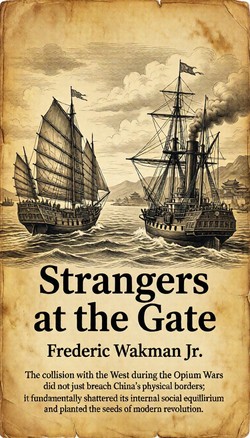
Strangers at the Gate
Loading…

Strangers at the Gate

Frederic Wakeman Jr.

4.1854 learners

Frederic Wakeman Jr.'s *Strangers at the Gate* delves into the turbulent transformation of 19th-century Guangdong, starting with the 1841 Sanyuanli Uprising—often celebrated as a grassroots victory over British invaders, yet rooted in local gentry leadership. The book traces the complex interplay between imperial authorities, foreign powers, local elites, peasant militias, and secret societies amid the Opium Wars and subsequent rebellions. It unpacks how the Qing court’s failed efforts to curb opium trade and defend its territory shifted power to provincial gentry, who leveraged age-old militia systems to fill security vacuums. From the anti-British entry protests that dominated post-Opium War diplomacy to the chaos of the Red Turban and Taiping Rebellions, Wakeman reveals how these conflicts reshaped local governance, laid the groundwork for later nationalist movements, and exposed the fragility of imperial control in China’s southern frontier.
Taiping RebellionSecond Opium WarRed Turban RebellionLocal GentrySanyuanli Uprising
Crimson Rain
Loading…

Crimson Rain

William T. Rowe

2.8461 learners

Set in Macheng, a strategic mountain town in eastern China’s Dabie Mountains, *Crimson Rain* traces centuries of violence, rebellion, and social upheaval from the late Yuan Dynasty to the mid-20th century. William T.Rowe unpacks how Macheng’s pivotal location, rigid social hierarchies (including a brutal hereditary slave system), and deep-seated cultural tensions fueled recurring chaos—from bandit raids and clan feuds to slave uprisings, anti-Qing rebellions, and the fiery Communist revolution of the 1920s. Through vivid stories of key figures like the Ming loyalist Mei Zhihuan, the Qing official Yu Chenglong, and Communist leader Wang Shusheng, the book reveals how local conflicts intertwined with national political shifts, shaping Macheng’s identity as a hotbed of resistance. It offers a nuanced look at how violence wasn’t just a breakdown of order, but a persistent force that defined the town’s social structure, cultural memory, and place in China’s turbulent history.

MachengRed Turban RebellionHereditary SlaveryHuangma UprisingYu Chenglong
Concept

Red Turban Rebellion

1854 anti-Qing uprising led by Triads, surrounding Guangzhou to establish their own dynasty.

Anti-QingRed TurbanTriads
Scenario

Ye Mingchen's Purge

After suppressing Red Turban Rebellion, Ye Mingchen arrested thousands, killing over 70k in Guangzhou.

Ye MingchenRed TurbanPurge
Scenario

Red Turban Rebellion

In 1854, Triads launched the Red Turban Rebellion, surrounding Guangzhou. The city panicked—shops closed, trade stopped.

GuangzhouRebellionRed Turban
No more