Ordinary World
Loading…

Ordinary World

Lu Yao

4.7709 learners

Set against China’s rugged Loess Plateau during the 1970s-80s transition from the Cultural Revolution to economic reform, *Ordinary World* follows two brothers navigating hardship and hope. Sun Shaoan, the steadfast elder, stays home to support his impoverished family, risking everything to launch a brick factory that rises and falls with shifting village fortunes. Sun Shaoping, the restless younger brother, leaves his rural roots to work as a day laborer and coal miner, clinging to books and dignity amid brutal conditions. The novel weaves tales of unrequited love, family loyalty, and small-town drama, capturing the quiet heroism of ordinary people fighting to survive and thrive in a rapidly changing world. It’s a raw, heartfelt portrait of rural China’s transformation, where every choice carries weight and every struggle reveals the strength of the human spirit.
Rural Chinafamily resiliencereform eraTragic Romancecoal mining
Urban and Rural China
Loading…

Urban and Rural China

Qiren Zhou

3.5598 learners

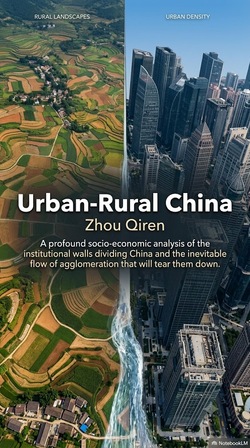
Zhou Qirun’s *Urban-Rural China* delivers a rigorous, accessible exploration of the historical, systemic, and economic forces shaping China’s urban-rural divide. Starting with a comparative analysis of global urbanization drivers—using Tokyo and Seoul as benchmarks—it unpacks why China’s industrialization outpaced its urbanization, fueled by mid-20th century policies restricting rural migration. The book traces the evolution of migration rights, from the 1954 Constitution’s initial recognition of free movement to the 1958 hukou system that entrenched a rigid, hereditary urban-rural hierarchy. It further examines the lopsided "land urbanization" phenomenon, where city expansion outpaces rural-to-urban population integration, rooted in state-controlled land ownership and compulsory land acquisition. Through on-the-ground case studies of Chengdu’s "empowerment through property rights" reform, Chongqing’s innovative land ticket system, and Shenzhen’s urban renewal efforts, Zhou illustrates grassroots and policy-driven solutions. He also debunks common misconceptions about land supply, property rights, and urban governance, arguing that balanced, sustainable development hinges on market-oriented land reform and restoring equitable property rights for rural residents.

Land ReformProperty RightsHukou Systemrural-urban migrationLand Urbanization
Country Driving
Loading…

Country Driving

Peter Hessler

4.1545 learners

Peter Hessler’s *Country Driving* takes readers on a vivid, eye-opening road trip across early 2000s China, using his newly obtained driver’s license as a key to unlock the nation’s hidden corners. Split into three interconnected parts, the book begins with a meandering journey along the Great Wall, where Hessler encounters rural villagers, crumbling historical sites, and the quiet erosion of traditional life amid desertification. Next, he dives into China’s burgeoning auto industry, shadowing Chery’s test drives and meeting young engineers eager to build a domestic car brand from scratch. Finally, he settles in Sancha Village, documenting a farmer’s transition to running a guesthouse, and later explores southern industrial zones—from bra adjuster factories to art “workshops” churning out paintings for export. Through intimate portraits of ordinary people, Hessler captures the chaos, hope, and contradictions of a country racing toward modernity, offering a nuanced alternative to Western stereotypes of China.

Migrant WorkersEconomic TransitionRural ChinaGreat WallChinese Auto Industry
The Death of Woman Wang
Loading…

The Death of Woman Wang

Jonathan Spence

4.1472 learners

Jonathan Spence’s *The Death of Woman Wang* pulls back the curtain on 17th-century rural China, using the remote Shandong county of Tancheng as a raw, intimate microcosm of chaos and resilience. Set against a relentless cycle of catastrophic earthquakes, brutal famines, warlord raids, and Qing Dynasty conquests, the book weaves together official gazettes, magistrate Huang Liuhong’s memoirs, and tales from Pu Songling’s *Strange Tales* to bring ordinary people’s struggles to life. At its core is the tragic story of Woman Wang, a young wife whose desperate elopement and eventual murder expose the suffocating constraints of gender norms, poverty, and familial violence in a society shattered by decades of crisis. Spence doesn’t just recount disasters—he explores how local officials fought to restore order, how widows clung to dignity amid systemic oppression, and how marginalized people navigated a world where survival often meant making impossible choices. This vivid narrative turns dry historical documents into a compelling portrait of human endurance, offering American readers a rare, unflinching look at a forgotten corner of early modern China.

Qing DynastyNatural DisastersLocal GovernanceRural ChinaTancheng County
Floating Wood
Loading…

Floating Wood

Yang Benfen

3.1452 learners

Floating Wood, by Yang Benfen, delivers raw, intimate first-person narratives of life in rural China spanning decades. Through unflinching, vivid storytelling, it chronicles the author’s family’s brutal struggles: her mother’s relentless labor to raise six children, the heart-wrenching loss of infant brother Yang Rui to untreated illness, and her older brother’s persecution during the Cultural Revolution for standing against corruption. It also weaves in tales of neighboring villagers—from a disfigured mother who rejects her daughter to a childless woman’s tragic end—painting a rich portrait of ordinary people clinging to hope amid hardship. Later chapters shift to the author’s own journey: raising her kids through financial strain, caring for her ailing husband, and finding quiet joy in her golden years with her granddaughter and elderly partner. These stories aren’t just about suffering; they’re a testament to the quiet resilience, deep love, and unbreakable bonds that sustain people through life’s darkest tides.

ResilienceRural ChinaGrief and LossFamily BondsMaternal Love
Golden Sentence

Rural Is Top Crisis Stabilizer

For China's economic operation, the vast rural area is the largest, most reliable stabilizer that can never be replaced by any urban policy.

CrisisRural ChinaStabilizer
Concept

Jia: Extended Family Unit

Jia refers to an extended family in Kaixiangong village, including parents, married sons, and their families. It’s a unit of shared property, labor, and living, focused on lineage continuity.

KinshipFamily StructureRural China
Scenario

Great Wall for Mobile Signal

Villagers in Xingwuying stand on the Great Wall to get mobile signal—ancient structure meets digital age.

Rural ChinaDigitalGreat Wall
Scenario

Zaozhuang Wedding Chaos

Zhao's nephew's wedding: firecrackers trigger car alarms, the couple is forced to kiss, villagers watch.

WeddingRural ChinaCultural Clash
Insight

Rural Contribution to Industrialization

Chinese farmers contributed at least 17.3 trillion yuan to national industrialization through three channels: price scissors between industrial and agricultural products, ultra-low wage labor, and low-cost land transfer.

IndustrializationRural ChinaHistorical Contribution
Insight

Rural as Core Crisis Stabilizer

China achieved soft landing of most economic crises by transferring excess urban labor and cost to rural areas. As long as the collective land ownership system remains intact, rural areas can absorb urban risks without triggering large-scale social unrest.

Crisis ManagementRural ChinaSocial Stability
Scenario

Doll Engagement Custom

Yuexiu and Qian Chengcheng were engaged as little kids, arranged by their fathers after Qian’s dad saved Yuexiu’s dad from a wolf attack on the road years ago.

EngagementRural Chinalocal custom
Scenario

Villagers Hide In Mountain Gully

When Kuomintang troops marched into the village, all villagers hid in remote Black Crow Gully, where a woman gave birth to a baby in a temporary earthen cave.

Rural ChinaChildbirthWar Refugee
Scenario

New Brother's Birth

In 1955 spring, the 14-year-old narrator helped her mom give birth to little brother Ruiyang at home, only boiling water and disinfecting scissors over fire. The mom said softly the baby came at a bad time for the starving family.

Childhoodfamily memory1950s Rural China
Scenario

Escaped To Deep Mountains

The persecuted brother fled the village with 5 Jin food stamps and 3 yuan, walked for 3 full days over mountains, and finally met his sister in a remote county in Jiangxi province.

hardshipEscapeRural China
No more