
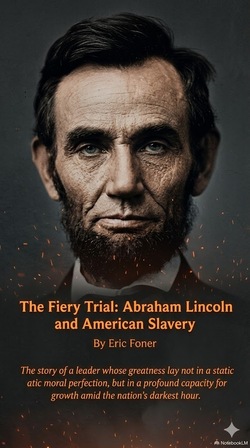
The Fiery Trial
Loading…

The Fiery Trial

Eric Foner

4.41238 learners

Eric Foner’s *The Fiery Trial* traces Abraham Lincoln’s evolution from a frontier boy with an instinctive hatred of slavery to the president who led America through its bloodiest conflict to dismantle the institution. Drawing on extensive primary sources, Foner reveals how Lincoln’s early experiences—witnessing slave auctions in Kentucky and New Orleans, living in free territories shaped by the Northwest Ordinance—laid the groundwork for his moral opposition. As a politician, Lincoln navigated 19th-century America’s treacherous political landscape, balancing anti-slavery convictions with the urgent need to preserve the Union. He moved from opposing slavery’s expansion as a Whig to joining the Republican Party, crafting strategies to secure border states, and eventually issuing the Emancipation Proclamation after the Battle of Antietam. Foner explores Lincoln’s compromises, like his early support for colonization, and his unwavering commitment to permanent abolition, culminating in his push for the Thirteenth Amendment. This definitive work illuminates the fiery trial that forged Lincoln’s legacy and redefined America’s promise of freedom.
SlaveryAmerican Civil WarUnion ArmyAbraham LincolnEmancipation Proclamation
Empire of Cotton
Loading…

Empire of Cotton

Sven Beckert

4.41030 learners

Sven Beckert’s *Empire of Cotton* unspools the sweeping, brutal history of how a humble fiber reshaped global capitalism over five centuries. Starting with cotton’s independent domestication across India, Peru, and East Africa, the book traces how European powers seized control through 'war capitalism'—a system built on slavery, colonial plunder, and militarized trade. It reveals how the U.S. South’s slave-driven cotton plantations fueled Britain’s Industrial Revolution, creating an interdependent global network that enriched elites while exploiting millions of enslaved people, child laborers, and colonized farmers. The U.S. Civil War shattered this system, forcing Europe to diversify cotton sources and paving the way for industrialization in the Global South. Beckert exposes how state power, corporate greed, and worker resistance shaped every phase of the cotton empire, from its 19th-century peak to its modern iteration, where inequality and exploitation persist in global supply chains.

Industrial RevolutionColonialismCotton GinWar CapitalismChattel Slavery
Crimson Rain
Loading…

Crimson Rain

William T. Rowe

2.8465 learners

Set in Macheng, a strategic mountain town in eastern China’s Dabie Mountains, *Crimson Rain* traces centuries of violence, rebellion, and social upheaval from the late Yuan Dynasty to the mid-20th century. William T.Rowe unpacks how Macheng’s pivotal location, rigid social hierarchies (including a brutal hereditary slave system), and deep-seated cultural tensions fueled recurring chaos—from bandit raids and clan feuds to slave uprisings, anti-Qing rebellions, and the fiery Communist revolution of the 1920s. Through vivid stories of key figures like the Ming loyalist Mei Zhihuan, the Qing official Yu Chenglong, and Communist leader Wang Shusheng, the book reveals how local conflicts intertwined with national political shifts, shaping Macheng’s identity as a hotbed of resistance. It offers a nuanced look at how violence wasn’t just a breakdown of order, but a persistent force that defined the town’s social structure, cultural memory, and place in China’s turbulent history.

MachengRed Turban RebellionHereditary SlaveryHuangma UprisingYu Chenglong
Scenario

Ohio River Slavery Gap

On the free state side of Ohio River, population is dense, industry is prosperous. On the slavery Kentucky side, land is underdeveloped, productivity is far lower, showing slavery kills work initiative.

Slaveryeconomic gap
Quote

House Divided Speech

"A house divided against itself cannot stand. I believe this government cannot endure permanently half slave and half free." —Lincoln’s 1858 warning about national division.

SlaveryLincolnSpeech
Scenario

Britain Bans Indian Cotton

Britain banned Indian printed cotton to protect local wool/linen industries—punishing people who wore it. But they allowed Indian cotton for slave trade, showing self-serving protectionism.

Indian CottonProtectionismBritish Industry
View

Slavery Fuels Industrial Revolution

British industrialization relied on cheap cotton from US slaves. Without this supply, factories would have lacked raw material—slave labor and industrial capitalism were interdependent.

Industrial RevolutionSlaveryCotton Supply
Insight

Lincoln's Early Anti-Slavery

Lincoln grew up seeing slavery in Kentucky—field work, market sales, whippings. He hated it instinctively as a kid, even without a clear anti-slavery plan yet.

ChildhoodSlaveryLincoln
Insight

Border State Strategy

Lincoln prioritized keeping border states (Kentucky, Maryland) in the Union. He avoided radical anti-slavery moves to prevent them from joining the Confederacy.

Civil WarBorder StatesLincoln
Concept

Dred Scott Decision

1857 Supreme Court ruling: Black people (free or enslaved) weren’t U.S. citizens, and Congress couldn’t ban slavery in territories.

SlaveryCitizenshipSupreme Court
Insight

Fossil Fuels Ended Slavery

Fossil fuels made slave labor uneconomical. Steam power replaced human work, so Wilberforce's anti-slavery bill could actually work.

Industrial RevolutionSlaveryFossil Fuels