
The Age of Extremes
Loading…

The Age of Extremes

Eric Hobsbawm

4.41177 learners

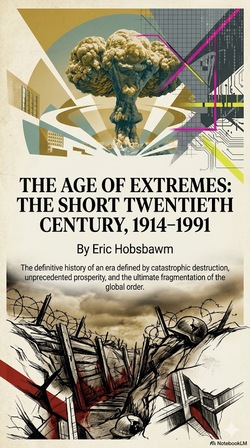
Eric Hobsbawm’s *The Age of Extremes* dissects the turbulent 'short 20th century'—a 77-year period spanning from the outbreak of World War I in 1914 to the collapse of the Soviet Union in 1991. This definitive historical work traces the era’s defining extremes: the catastrophic global wars that shattered 19th-century liberal order, the seismic revolutions that birthed socialist states, the Great Depression that upended capitalist systems, and the decades-long Cold War that divided the world into opposing camps. Hobsbawm also explores the era’s social and cultural upheavals—from decolonization and the rise of youth culture to the transformation of science and art. He analyzes how these interconnected crises reshaped global politics, economies, and societies, leaving a legacy of inequality, ideological fragmentation, and ecological challenges. A masterful synthesis of historical analysis, the book offers critical insights into the forces that defined modernity and warns of the risks of repeating the era’s violent mistakes.
Great DepressionCold WarSoviet CollapseShort 20th CenturyWorld War I
The Grand Chessboard
Loading…

The Grand Chessboard

Zbigniew Brzezinski

4.2973 learners

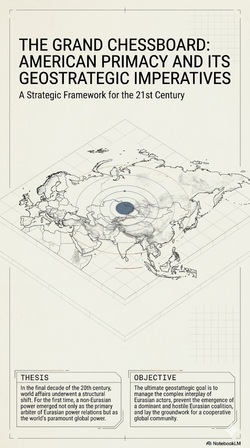
In Zbigniew Brzezinski’s seminal geopolitical work *The Grand Chessboard*, he frames Eurasia as the critical battleground for sustaining America’s status as the world’s first true global superpower. Brzezinski traces the evolution of U.S. hegemony, contrasting it with historical empires like Rome, China, and Mongolia to highlight its unique democratic, economic, and cultural foundations. He breaks down Eurasia into a strategic 'chessboard,' identifying core geostrategic players (France, Germany, Russia, China, India) and pivotal states (Ukraine, Azerbaijan, Turkey) that shape regional dynamics. The book dissects America’s key challenges: fostering a unified yet aligned Europe, guiding Russia toward integration rather than imperial revival, balancing power in Central Asia’s volatile 'Eurasian Balkans,' and managing the delicate U.S.-China-Japan triangle in East Asia. Brzezinski concludes that America must act as a stabilizing arbiter, building a cooperative framework to share global responsibility while preserving its leadership for at least a generation, noting it may be the last global superpower in history.

US-China RelationsSoviet CollapseEurasian geopoliticsglobal hegemonygeostrategic players
Scenario

1991 Soviet Collapse

In 1991, the Soviet Union dissolved—Gorbachev's reforms weakened the old system, leading to its end.

Soviet UnionCollapse1991
Insight

Soviet Failure Not Socialism

Hobsbawm says Soviet collapse wasn't socialism's fault, but its rigid central planning model.

Soviet UnionSocialismCollapse
Concept

Short 20th Century

Hobsbawm defines the 'Short 20th Century' as 1914 (WWI start) to 1991 (Soviet collapse), marked by extreme war, revolution, and change.

20th CenturyHistoryHobsbawm
No more