
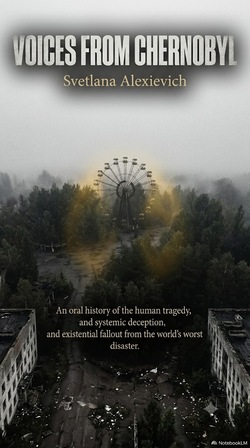
Voices from Chernobyl
Loading…

Voices from Chernobyl

Svetlana Alexievich

4.31188 learners

In Svetlana Alexievich’s Pulitzer Prize-winning oral history *Voices from Chernobyl*, the world’s worst nuclear disaster isn’t just a statistic—it’s a collection of raw, unfiltered stories from those who lived through it. Drawing on hundreds of interviews with cleanup workers, displaced residents, grieving parents, scientists, and Soviet officials, Alexievich gives voice to the forgotten victims. Readers hear of elderly villagers sneaking back to their radioactive homes, soldiers forced to clean the reactor without proper protection, parents burying children born with severe birth defects, and officials covering up the disaster’s true scale to avoid panic. These stories don’t just detail the physical toll of radiation; they lay bare the psychological scars, the betrayal of government lies, and the quiet resilience of people clinging to their roots, their memories, and their humanity. More than a historical account, this book is a haunting reminder of the cost of hubris and the enduring power of human storytelling.
Soviet Unionoral historyNuclear FalloutChernobyl nuclear disasterradiation exposure
The Whisperers
Loading…

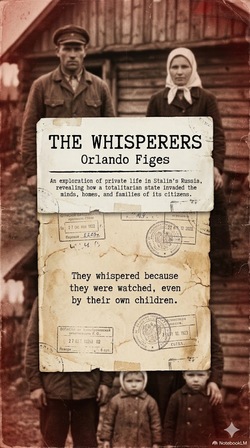
The Whisperers

Orlando Figes

4.7886 learners

Orlando Figes’ *The Whisperers* delivers an intimate, unflinching portrait of ordinary Soviet families navigating the brutal tides of totalitarian rule, from the 1917 Bolshevik Revolution to the post-Stalin thaw. Drawing on personal diaries, letters, and oral histories, Figes centers stories like poet Konstantin Simonov’s tangled loyalty to the regime, peasant families destroyed by forced collectivization, and “enemies of the people” survivors grappling with lifelong trauma. The book exposes how Stalin’s regime infiltrated every corner of private life—eroding family bonds, fostering a culture of betrayal and whispered secrecy, and forcing individuals to choose between survival and conscience. It humanizes the grand, brutal history of the Soviet Union, revealing the quiet resilience, guilt, and longing that defined daily life for millions under oppressive rule.

StalinismSoviet UnionGulagCollectivizationGreat Terror
Quote

Chernobyl Collapse Quote

"Chernobyl was the real start of the collapse of the Soviet Union." - Gorbachev, linking the disaster to USSR's fall.

ChernobylGorbachevUSSR Collapse
Scenario

1991 Soviet Collapse

In 1991, the Soviet Union dissolved—Gorbachev's reforms weakened the old system, leading to its end.

Soviet UnionCollapse1991
Insight

Soviet Failure Not Socialism

Hobsbawm says Soviet collapse wasn't socialism's fault, but its rigid central planning model.

Soviet UnionSocialismCollapse
View

Soviet Union Cooperation

Sun realized he needed help. He cooperated with Soviet Union and allowed CCP members to join KMT. This gave his revolution new strength, like arms for Whampoa.

RevolutionSoviet CooperationKMT-CCP Alliance
Concept

What Is KGB

The KGB was the Soviet Union’s all-powerful security agency, acting as both domestic political police and global intelligence collector. At its peak, it had over 1 million agents, informants and staff, and top members enjoyed elite exclusive privileges.

Cold WarSoviet UnionKGB
View

Criticize Soviet Exploitation

Guevara argued the Soviet Union was no different from imperialist countries. It sent aid to developing nations and immediately sent out bills for payment, acting as a new type of exploiter.

CriticismSoviet UnionSocialism
Concept

The Shot Heard Round World

The historic 1951 Giants-Dodgers game-winning home run, which happened the exact same day the Soviet Union tested its first nuclear bomb, forever binds American baseball nostalgia to Cold War nuclear fear.

Cold Warcollective memoryBaseball
Scenario

Gorbachev’s Failed Reform

Gorbachev did not execute rival Yeltsin when he expelled him from the Politburo. Yeltsin later took power, and the entire Soviet Union collapsed as a result.

ReformSoviet UnionRegime collapse
Concept

Containment Policy

Cold War core US strategy proposed by George Kennan. The US would use firm force to block every Soviet expansion attempt, and wait for internal changes to happen inside the Soviet Union.

Cold WarUS Strategy
Concept

Triangular Diplomacy

Nixon's diplomatic strategy that used Sino-US rapprochement to form a two-vs-one situation against the Soviet Union. It helped the US get rid of the Vietnam quagmire and regain global initiative.

Nixoncold war strategy
Scenario

1972 Nixon Visit to China

Nixon's 1972 visit to China and the Shanghai Communiqué completely reshaped the Cold War landscape. The US broke the 20-year isolation of China, and gained huge strategic advantage against the Soviet Union.

Cold WarSino-US Relations
Scenario

Soviet Industrialization

Soviet Union had short-term industrial growth via extractive institutions but stagnated due to lack of innovation.

GrowthSovietExtractive
No more