
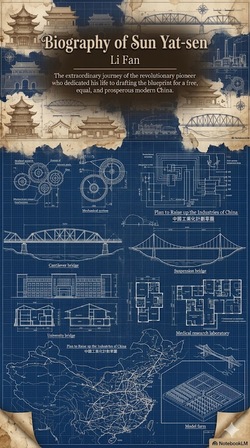
Biography of Sun Yat-sen
Loading…

Biography of Sun Yat-sen

Li Fan

4.5941 learners

This definitive biography traces Sun Yat-sen’s extraordinary journey from a poor peasant boy in rural Guangdong to the 'Father of Modern China.' Born in 1866, Sun was inspired by tales of the Taiping Rebellion and later exposed to Western education in Hawaii, sparking his vision for a reformed China. After his petition to Qing official Li Hongzhang was ignored, he abandoned gradual reform and embraced revolution, founding the Revive China Society in 1894 and later the Chinese United League. Leading a series of uprisings, he finally saw success with the 1911 Wuchang Uprising, becoming China’s first provisional president. Though forced to step down to Yuan Shikai, Sun continued fighting against warlords and imperialists, eventually adopting the Three Principles of the People and forging alliances with the Soviet Union and Chinese Communists. His life, marked by relentless struggle and unyielding idealism, laid the groundwork for China’s modern democratic movement, ending with his iconic final call: 'Peace—Struggle—Save China.'

Sun Yat-senThree Principles of the PeopleRevive China SocietyChinese United LeagueWuchang Uprising
Quote

"Revolution Not Yet Done"

Sun's last will: "The revolution is not yet successful; comrades must continue to strive." It reminds later generations to fight for China's freedom and equality.

Sun Yat-senRevolutionLast Will
View

Reform vs Revolution Shift

Sun first tried reform (writing to Li Hongzhang) but failed. He realized Qing was too corrupt—only revolution could save China. This shift shaped his life's work.

ReformSun Yat-senRevolution
View

People's Livelihood Priority

Sun believed people's livelihood was foundation. He proposed land reform (average land rights) and capital control to reduce inequality, wanting everyone to have a good life.

Sun Yat-senPeople's LivelihoodLand Reform
Quote

"Public Servant of People"

Sun said: "The president is a public servant of the people. When he leaves office, he is just a common person." This showed his republican ideals.

Sun Yat-senRepublicPublic Servant
Scenario

London Kidnapping Incident

In 1896, Sun was kidnapped by Qing agents in London. He asked a British servant for help. His teacher campaigned, press exposed it—Sun was freed, making his revolution famous globally.

Sun Yat-senLondon KidnappingRevolution
Method

Card-Based Research

Wang Di made lots of cards when researching Sun Yat-sen's diplomatic ideas. He read 'Sun Yat-sen Complete Works' and organized notes on cards to support his arguments.

Academic WritingNote-TakingResearch Method
View

Anti-Imperialism Stance

Sun later focused on anti-imperialism. He wanted to abolish unequal treaties, saying foreign powers were behind China's chaos. Key to his later revolution.

Sun Yat-senAnti-ImperialismUnequal Treaties
Scenario

Land Reform Idea

Sun proposed 'average land rights'—fix land price, any increase goes to state. He wanted to end land monopoly so farmers could have land and reduce poverty.

Sun Yat-senLand ReformAverage Land Rights
Concept

Three Principles of the People

Sun Yat-sen's core ideology: Nationalism (overthrow Qing, anti-imperialism), Democracy (end monarchy, people's rights), People's Livelihood (land reform, fair wealth). It guided China's revolution.

Sun Yat-senIdeologyThree Principles
No more