
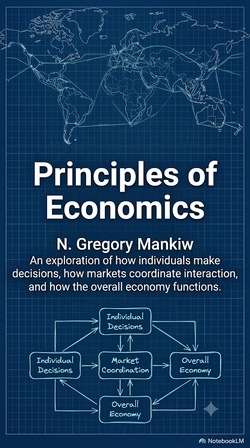
Principles of Economics
Gregory Mankiw’s *Principles of Economics* is the definitive introductory guide for anyone seeking to understand how economies function at every level—from individual choices to global markets. Anchored by 10 core principles grouped into three pillars—individual decision-making, interpersonal trade, and macroeconomic performance—the book demystifies complex concepts with relatable, real-world examples: from why airlines sell last-minute tickets cheap to how Reagan-era tax policies reflected the Laffer Curve. It covers foundational models like the circular-flow diagram and production possibility frontier, dives into microeconomics (supply and demand, market structures, consumer choice) and macroeconomics (inflation, unemployment, economic growth), and explores critical topics such as trade policy, market failures, taxation, and income inequality. Designed to be accessible yet rigorous, it equips readers to decode daily economic decisions, evaluate policy impacts, and think critically about how resources are allocated in society.