
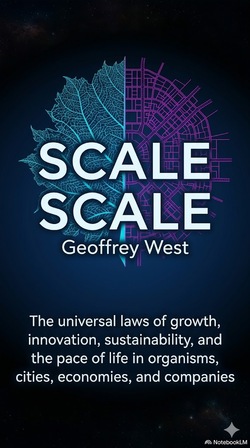
Scale
Loading…

Scale

Geoffrey West

4.2980 learners

Geoffrey West’s *Scale* unlocks the hidden mathematical laws governing everything from tiny bacteria to sprawling megacities, and from startup firms to global economies. Blending physics, biology, sociology, and economics, this landmark work reveals how nonlinear scaling—sublinear for biological systems and urban infrastructure, superlinear for urban innovation and corporate risks—shapes growth, resilience, and mortality. Through vivid, relatable examples, from the fatal miscalculation of LSD doses for elephants to the flawed linear logic of children’s Tylenol dosage, West shows why ignoring scale laws leads to costly, even deadly, mistakes. He explores how cities thrive on superlinear gains in creativity and wealth (alongside rising crime and disease), while companies follow biological-like sublinear growth that dooms most to collapse within a decade. Ultimately, *Scale* offers a unified framework to confront humanity’s biggest challenge: building sustainable systems that balance exponential growth with Earth’s finite limits, using innovation to avoid the "finite-time singularity" that threatens unchecked expansion.
SustainabilityScale LawsAllometric ScalingKleiber’s LawDunbar Number
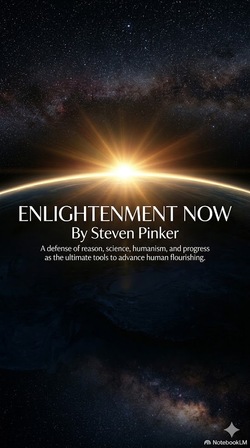
Enlightenment Now
Loading…

Enlightenment Now

Steven Pinker

4.3819 learners

In Enlightenment Now, Steven Pinker delivers a sharp, data-backed defense of the Enlightenment’s core values—reason, science, humanism, and progress—against rising pessimism and anti-Enlightenment backlash. Drawing on cross-disciplinary research, Pinker dismantles the myth of global decline, highlighting tangible improvements: eradicated diseases, plummeting extreme poverty, reduced war deaths, and expanded civil rights. He addresses critics from romanticists to religious conservatives, explaining how their rejection of rationality ignores decades of human progress. Pinker also confronts modern threats like nuclear war, populism, and climate change, arguing that doubling down on Enlightenment principles is the only way to navigate future challenges. This isn’t just a celebration of the past; it’s a blueprint for sustaining humanity’s upward trajectory by prioritizing evidence, empathy, and collective rationality.

ScienceHumanismProgressReasonEntropy
Method

Measure Impact

3 metrics: 1) Social impact (equity/access), 2) Environmental footprint (carbon/waste), 3) Economic sustainability (long-term profit).

MetricsSustainabilityImpact Measurement
Insight

Local vs Global Impact

Future engines need to balance global scalability with local needs—like renewable solutions fitting different climates and communities.

LocalizationGlobal ImpactSustainability
Scenario

Perfect Meal Preparation

Pollan makes a meal with hunted boar, foraged mushrooms, home-grown veggies—connecting all food chains.

SustainabilityFood Experience
Method

Spot Future Engines

3 steps to spot future engines: 1) Look for unmet human needs, 2) Check if tech can scale to solve it, 3) Ensure long-term sustainability.

problem solvingInnovation ProcessFuture Strategy
View

Industrial Ag Unsustainable

Industrial farming uses fossil fuels (fertilizers), depletes soil, pollutes, and produces unhealthy food—it’s not long-term viable.

SustainabilityIndustrial Food
Insight

Sea Women’s Sustainability

Japanese sea women take only what they need from the ocean, keeping balance.This is a model for modern people to interact with the sea.

SustainabilityOcean Stewardship
Golden Sentence

Growth Has Limits

"Growth is not infinite; it’s bounded by physical laws." (Geoffrey West) Reminds us all systems face scale constraints.

LimitsSustainabilityScale Law
Concept

What Is a Company of One?

A business that stays small intentionally—prioritizing freedom, profitability, and sustainability over rapid scaling. Not just solo work, but choosing manageable size for control.

Small BusinessCompany of OneAnti-Scaling
Method

Price for Sustainability

Don’t underprice. Calculate costs + profit margin. Charge what you’re worth—clients pay for quality.

SustainabilityPricing StrategyProfit Margin
Insight

Waters on Food

Alice Waters believes food should be local and organic, connecting to land and farmers.

SustainabilityfoodAlice Waters