
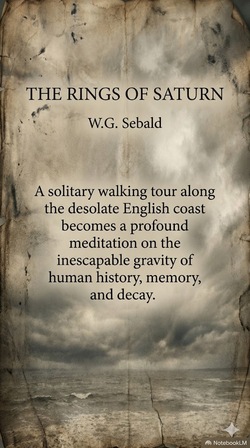
The Rings of Saturn
Set against the windswept coast of Suffolk, W.G. Sebald’s *The Rings of Saturn* unfolds as a meandering, meditative walk through time, memory, and decay. As Sebald traverses desolate marshes, crumbling manors, and ghostly coastal towns, his journey weaves together fragments of forgotten history, literary ghosts, and intimate encounters. He delves into the life of Thomas Browne, whose skull was exhumed and reburied decades after death; Joseph Conrad’s formative years in Lowestoft, where he found his voice in English; and Edward FitzGerald’s reclusive life translating the Rubaiyat. Along the way, he confronts the collapse of herring populations, the scars of war and colonialism, and the quiet erosion of nature—from dying forests to abandoned radar stations. Blending travelogue, biography, and philosophical reflection, the book captures the haunting weight of time, where the past lingers in every ruin, every fading memory, and every stretch of desolate shore.