
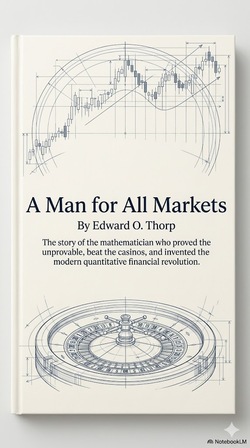
A Man for All Markets
Loading…

A Man for All Markets

Edward O. Thorp

4.11307 learners

Edward O. Thorp’s memoir, *A Man for All Markets*, is a riveting journey of how a numbers-obsessed kid turned math into a superpower—first beating Las Vegas casinos at their own game, then revolutionizing Wall Street with the first quantitative hedge funds. Raised during the Great Depression, Thorp honed his love for experiments and critical thinking early on, cracking 21-point with a card-counting strategy that proved the “unbeatable” game could be won with logic. He teamed up with Claude Shannon to build a wearable computer predicting roulette outcomes, then brought his data-driven approach to finance, founding Princeton-Newport Partners, a hedge fund that delivered consistent returns even during market crashes. Along the way, he exposed Bernie Madoff’s Ponzi scheme years before it collapsed, shared hard-won lessons on compound interest, index funds, and risk management, and reflected on using wealth to fund stem cell research and education. More than a memoir, it’s a playbook for rational decision-making, showing how math and discipline can turn odds in your favor—whether at the casino or in the stock market.

Index FundsQuantitative InvestingCompound interestPonzi SchemeCard Counting
Attitude
Loading…

Attitude

Wu Jun

41049 learners

Attitude is a warm, practical collection of life advice from tech veteran Wu Jun to his daughter, covering every corner of adulthood—from finding lasting joy and managing money wisely to navigating relationships, mastering learning, and building a successful career. Drawing on his own rags-to-riches journey, insights from iconic figures like Napoleon and Warren Buffett, and real-world anecdotes, Wu breaks down complex life lessons into actionable strategies. He emphasizes that true happiness stems from inner resilience, not wealth; teaches how to avoid get-rich-quick traps and build long-term financial security; and shares how to cultivate leadership, spot toxic people, and communicate effectively. More than a parenting guide, this book is a timeless roadmap for anyone looking to develop a growth mindset, make intentional choices, and navigate life’s challenges with grace and purpose.

Leadership DevelopmentProfessional Ethicslife wisdomInvestment PrinciplesWealth Management
Savage Growth
Loading…

Savage Growth

Feng Lun

3.2712 learners

As a co-founder of Wantong Group, Feng Lun pulls back the curtain on the wild, unregulated rise of China’s private sector since reform and opening up. In *Savage Growth*, he shares hard-won lessons from navigating crisis—from the heated "original sin" debate over early private enterprise legitimacy to the messy, necessary evolution of partner dynamics (like his own split with Pan Shiyi). He breaks down the tricky dance of government-business relations, contrasts successful leaders like Wang Shi (who prioritized systems over personal gain) with cautionary tales like Mu Zhongzhong, and dives into investment wisdom, corporate governance, and even life’s big questions: balancing desire and happiness, facing mortality, and building businesses that outlast their founders. Packed with real-world anecdotes and sharp insights, this book is a must-read for anyone looking to understand China’s business landscape or build resilient, ethical enterprises.

Corporate GovernanceInvestment StrategyWealth ManagementOrganizational TransformationPrivate enterprise evolution
Concept

72 Rule For Compound Interest

A quick math trick to estimate how long an investment doubles in value. Divide 72 by the annual return rate, you get the approximate number of doubling years.

MathCompound interestWealth Management
Concept

New vs Old Money

Feng Lun distinguishes new money (short-term, e.g., Jiangnan Chun’s 4-year wealth) from old money (long-term, e.g., European family funds)—new money is direct, old money has complex rules.

Wealth ManagementNew MoneyOld Money
Insight

Gentleman Wealth Management Rule

A gentleman should form the habit of saving 10% of income from young age, buy real estate as asset, avoid overdraw with credit card and unnecessary debt.

WealthPersonal FinanceGentleman
Concept

3 Elements Of Capital

Real capital is not just stacks of cash. It consists of 3 core parts: sufficient amount, long available time window, and the correct wisdom to use it properly.

CapitalInvestmentWealth Management
Method

Simple Wealth Valuation Method

Calculate total fair market value of all your assets (house, stock, car etc.), subtract all outstanding debts (mortgage, loan etc.), the result is your actual net wealth.

Wealth ManagementPersonal FinanceNet worth
Method

Keep Prosperity Stable

Zeng's way to avoid over-prosperity disaster: leave some unpaid debt at home, don't buy extra luxury fields, give part of your salary to poor relatives every year, never save too much cash at home in chaotic times.

FamilyWealth Managementself-preservation
Scenario

Seneca's Stoic Practice

Wealthy philosopher Seneca practiced pre-loss simulation, regularly imagining losing all his fortune, so he never got trapped by the fragility that comes with wealth.

StoicismMindsetWealth Management
No more