
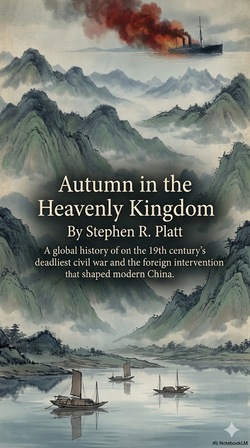
Autumn in the Heavenly Kingdom
Loading…

Autumn in the Heavenly Kingdom

Stephen R. Platt

4.2427 learners

Stephen R. Platt’s *Autumn in the Heavenly Kingdom* delivers a vivid, immersive account of the 19th-century Taiping Rebellion, one of China’s deadliest civil wars. At its core is Hong Rengan, cousin of Taiping leader Hong Xiuquan, whose escape from imperial forces led him to Hong Kong, where he absorbed Western political and scientific ideas. Upon joining the Taiping in Nanjing, he drafted the *Zizheng Xinpian*—a radical modernization blueprint advocating railroads, banks, and equal foreign relations. Platt masterfully interweaves Hong’s story with the tangled role of Western powers: British officials wavered between curiosity about the Taiping’s Christian-inspired ideology, neutrality, and eventual support for the Qing Dynasty to protect trade interests. The narrative also intersects with the Second Opium War, the burning of the Summer Palace, and the rise of Zeng Guofan, the scholar-warrior who led the Xiang Army to crush the rebellion. It reveals how foreign interference and internal strife reshaped China’s trajectory, setting the stage for decades of upheaval.

Taiping RebellionHong RenganZeng GuofanBritish InterventionSummer Palace
Concept

China's Non-Expansionist Past

China, despite historical power, never engaged in overseas conquest like Western powers—Zheng He's voyages didn't occupy land.

Zheng HeNon-ExpansionChina History
Insight

Developing Countries' Industrial Trap

Almost all post-colonial developing countries that copied their suzerain's industrialization model fell into the development trap, because they could not complete primitive capital accumulation through colonial plunder like western powers.

IndustrializationGlobal SouthDevelopment Trap
Insight

Flaw of Balance of Power

Li Hongzhang’s “using foreigners to control foreigners” diplomatic strategy was deeply flawed, because all Western powers prioritized their own interests over China’s benefits.

Late QingLi HongzhangDiplomatic Strategy
Concept

Unequal Treaty System

A series of unfair agreements signed between Qing China and Western powers after the Opium War, which severely damaged China’s sovereignty over tariff, jurisdiction and territorial integrity.

Colonial HistorySino-Western RelationsTreaty System
Insight

Sugar Trade Funded Industrialization

The transatlantic sugar trade supported by massive African slave labor is the core foundation of modern European industrial capital. The profit from selling sugar directly funded the industrial revolution and the rise of Western powers.

Industrial RevolutionSlave TradeSugar Industry
Quote

No Good Foreigners

After repeated betrayals by Western powers, disillusioned Hong Rengan shouted: "I have never met a single good foreigner in all my life."

Hong RenganDisillusionmentTaiping Downfall
View

Munich Appeasement Failure

Chamberlain's appeasement policy only fueled Hitler's ambition, instead of bringing permanent peace. The weak response of Western powers made Hitler convinced that they would never dare to fight a full-scale war.

WWIIAppeasement
No more