Year Zero: A History of 1945
Loading…

Year Zero: A History of 1945

Ian Buruma

4.51247 learners

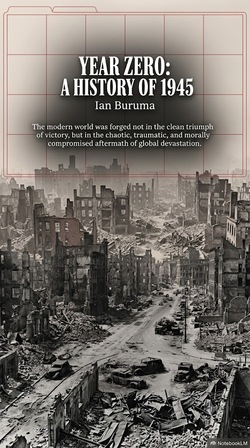
Ian Buruma’s *Year Zero: A History of 1945* frames the end of World War II as a raw, chaotic "zero year"—a moment where old empires collapsed, moral certainties shattered, and the modern world struggled to take shape. Weaving intimate personal narratives with sweeping historical analysis, Buruma takes readers across war-ravaged Europe and Asia: from Dutch civilians starving through the brutal "Hunger Winter" to Japanese "Panpan girls" navigating survival under U.S. occupation, from Jewish survivors facing hostility in their former hometowns to German refugees expelled en masse from Eastern Europe. He unpacks the cycle of vengeance—Polish pogroms against Jewish survivors, Soviet atrocities in Germany, French purges of collaborators—and the messy compromises of justice, where war criminals were sometimes spared to prioritize economic recovery or political stability. Buruma also explores the fragile idealism of the era: the rise of welfare states in Western Europe, the founding of the United Nations, and the quiet seeds of the Cold War that would soon divide the globe. More than a chronicle of defeat and recovery, this book captures the raw humanity of a year that redefined global order, where hope and despair walked hand in hand.

Post-WWII ReconstructionDisplaced PersonsNuremberg TrialsCold War OriginsRevenge and Retribution
Voices from Chernobyl
Loading…

Voices from Chernobyl

Svetlana Alexievich

4.31188 learners

In Svetlana Alexievich’s Pulitzer Prize-winning oral history *Voices from Chernobyl*, the world’s worst nuclear disaster isn’t just a statistic—it’s a collection of raw, unfiltered stories from those who lived through it. Drawing on hundreds of interviews with cleanup workers, displaced residents, grieving parents, scientists, and Soviet officials, Alexievich gives voice to the forgotten victims. Readers hear of elderly villagers sneaking back to their radioactive homes, soldiers forced to clean the reactor without proper protection, parents burying children born with severe birth defects, and officials covering up the disaster’s true scale to avoid panic. These stories don’t just detail the physical toll of radiation; they lay bare the psychological scars, the betrayal of government lies, and the quiet resilience of people clinging to their roots, their memories, and their humanity. More than a historical account, this book is a haunting reminder of the cost of hubris and the enduring power of human storytelling.

Soviet Unionoral historyNuclear FalloutChernobyl nuclear disasterradiation exposure
Fooled by Randomness
Loading…

Fooled by Randomness

Nassim Nicholas Taleb

4.31089 learners

In *Fooled by Randomness*, Nassim Nicholas Taleb dismantles the myth that success equals skill through vivid, relatable stories—like cautious trader Nero Tulip, who survives market crashes, and flashy John, whose luck-fueled wealth collapses overnight. Taleb exposes how our brains are wired to misinterpret randomness: we confuse luck with talent, fall prey to survivorship bias (ignoring hidden failures), and underestimate catastrophic "black swan" events. He breaks down cognitive flaws, from our inability to grasp probability to our obsession with linear cause-and-effect, while offering practical frameworks like the Monte Carlo method to visualize alternative outcomes. Rooted in philosophy (Popper’s falsification, Stoic resilience), this book isn’t just for traders—it’s a wake-up call for anyone navigating an unpredictable world, teaching us to prioritize long-term survival over short-term glory and embrace skepticism as a shield against randomness’s hidden traps.

Cognitive BiasStoicismNonlinearityRandomnessBlack Swan Event
The Art of Thinking Clearly
Loading…

The Art of Thinking Clearly

Rolf Dobelli

4.2466 learners

In *The Art of Thinking Clearly*, Rolf Dobelli demystifies the hidden cognitive biases that skew our daily decisions—from the survivorship bias that makes us overestimate success odds to the sunk cost fallacy that traps us in bad choices. Using relatable real-world examples, from business failures to everyday mistakes, he breaks down dozens of common thinking errors, explaining how our evolutionary instincts and social conditioning lead us astray. Dobelli doesn’t just highlight these flaws; he offers practical, actionable strategies to recognize and counteract them, helping readers make more rational, informed choices in career, finance, relationships, and life. Whether you’re avoiding the bandwagon effect or escaping the confirmation bias echo chamber, this book is a toolkit for sharpening your critical thinking and navigating the world with greater clarity.

Survivorship BiasLoss AversionSunk Cost FallacyThinking BiasesOverconfidence Effect
Scenario

Flood Survivor Faith

Flood survivor Maria lost her home but found hope in God, leading her to start a support group for other survivors.

FaithHopeSurvivor
Insight

Revenge as Natural Desire

Revenge is as natural as hunger or desire. At Dachau’s liberation, survivors lynched Nazi guards; US soldiers stood by.

Human NatureRevengePost-War Accountability
Concept

Survivorship Bias

This is the cognitive trap where you only see successful cases, while systematically ignoring all hidden failed examples. It makes you wildly overestimate your own chance of succeeding at new ventures.

SuccessCognitive BiasDecision Making
Insight

Don't Trust Only Success Stories

All popular success guides you see only come from survivors. People who failed never write books or give speeches, so their stories are completely hidden from the public.

SuccessCritical thinkingReal Probability
Scenario

Walmart Hurricane Katrina Rescue

Walmart let frontline store managers make their own decisions during Hurricane Katrina. They delivered 2000 containers of supplies to survivors 1 full day earlier than the federal government.

RetailLeadershipCrisis Management