Best Books on Comparative Advantage

Comparative Advantage Total 6 books

The Rational Optimist summary and key insights by Matt Ridley
Loading…

The Rational Optimist

Matt Ridley

4.4678 learners

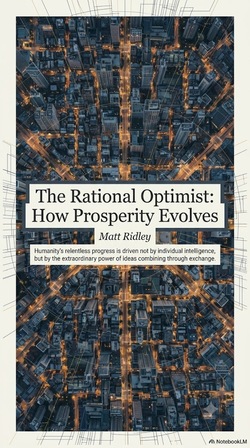
In *The Rational Optimist*, Matt Ridley dismantles nostalgic myths and doomsday prophecies to make a compelling case that we’re living in humanity’s best era—and it’s only getting better. Drawing on centuries of historical data, archaeological evidence, and economic analysis, Ridley argues that human progress isn’t a fluke: it’s driven by our unique ability to trade, specialize, and share ideas, creating a 'collective brain' that fuels endless innovation. He debunks claims that the past was simpler or more moral, highlighting how even today’s global poor enjoy comforts 19th-century billionaires could only dream of. From the rise of agriculture to the industrial revolution, from falling global poverty rates to improving environmental health, Ridley shows how exchange and division of labor have lifted living standards across the globe. He addresses critics’ biggest concerns—Africa’s development challenges and climate change—arguing that with better institutions, free trade, and continued innovation, these issues can be solved without sacrificing prosperity. A refreshing counterpoint to pervasive pessimism, this book celebrates human ingenuity and the power of market-driven progress.
Principles of Economics summary and key insights by N. Gregory Mankiw
Loading…

Principles of Economics

N. Gregory Mankiw

4.3803 learners

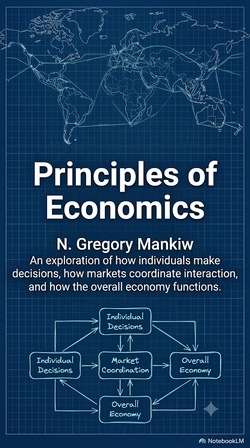
Gregory Mankiw’s *Principles of Economics* is the definitive introductory guide for anyone seeking to understand how economies function at every level—from individual choices to global markets. Anchored by 10 core principles grouped into three pillars—individual decision-making, interpersonal trade, and macroeconomic performance—the book demystifies complex concepts with relatable, real-world examples: from why airlines sell last-minute tickets cheap to how Reagan-era tax policies reflected the Laffer Curve. It covers foundational models like the circular-flow diagram and production possibility frontier, dives into microeconomics (supply and demand, market structures, consumer choice) and macroeconomics (inflation, unemployment, economic growth), and explores critical topics such as trade policy, market failures, taxation, and income inequality. Designed to be accessible yet rigorous, it equips readers to decode daily economic decisions, evaluate policy impacts, and think critically about how resources are allocated in society.

The Economic Way of Thinking summary and key insights by Paul Heyne;Peter J. Boettke;David L. Prychitko
Loading…

The Economic Way of Thinking

Paul Heyne;Peter J. Boettke;David L. Prychitko

3.9716 learners

Tired of viewing economics as a jargon-heavy, inaccessible field? *The Economic Way of Thinking* demystifies core economic principles by grounding them in everyday, relatable scenarios—from rush-hour traffic coordination to your morning grocery run. This book teaches you that economics isn’t just about graphs and numbers; it’s a practical framework for analyzing how individuals make choices based on trade-offs, opportunity costs, and self-interest. You’ll discover why voluntary trade creates wealth for both parties, how price controls and government interventions often backfire with unintended consequences, and why clear property rights are essential for a thriving market. It also delves into macroeconomics, breaking down GDP, inflation, and the roots of economic cycles, plus explores why some nations achieve long-term prosperity while others remain trapped in poverty. Whether you’re a student, professional, or curious reader, this guide equips you to spot hidden economic logic in daily decisions and avoid common misconceptions about markets and governance.

New Structural Economics summary and key insights by Justin Yifu Lin
Loading…

New Structural Economics

Justin Yifu Lin

4.41300 learners

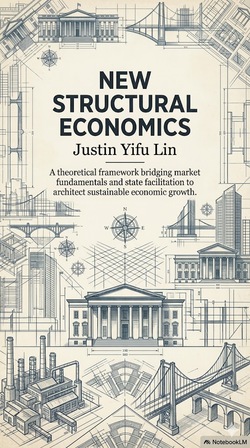
Developed by Justin Yifu Lin, *New Structural Economics* redefines how developing nations achieve sustainable, inclusive growth by moving past failed ideologies of either heavy government intervention or unfettered market liberalization. At its core, the theory argues that a country’s optimal industrial structure is determined by its unique factor endowment structure—land, labor, capital, and infrastructure. By aligning industries with these inherent strengths, firms gain competitive viability, generate economic surpluses, and accelerate capital accumulation to drive gradual industrial upgrading. The book introduces the Growth Identification and Facilitation Framework (GIFF), a step-by-step tool for governments to identify promising industries, address bottlenecks like poor infrastructure or limited financing, and support pioneer firms without distorting markets. Real-world case studies, including Nigeria’s economic transition and East Asia’s rapid growth, illustrate how balancing market efficiency with targeted government guidance can unlock catch-up advantages, reduce poverty, and create stable employment.

How An Economy Grows and Why It Crashes summary and key insights by Peter D. Schiff;Andrew J. Schiff
Loading…

How An Economy Grows and Why It Crashes

Peter D. Schiff;Andrew J. Schiff

4.5556 learners

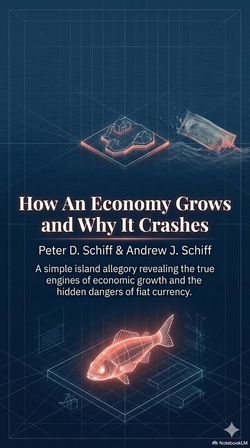
Using a playful, easy-to-follow story of a tropical island community starting from hand-to-mouth fishing, How An Economy Grows and Why It Crashes demystifies complex economic principles. Authors Peter and Andrew Schiff contrast the Austrian School’s focus on savings, productivity, and free markets with the flawed Keynesian policies that dominate modern economics. The book exposes how government intervention—from excessive money printing and deficit spending to trade barriers and artificial credit expansion—creates false prosperity, bubbles, and eventual crashes. Through relatable analogies, it connects the island’s journey to real-world crises like the 2008 housing bubble and quantitative easing, arguing that sustainable growth only comes from prioritizing production, responsible saving, and unshackling markets from harmful political meddling. Perfect for readers tired of confusing jargon, it cuts through economic myths to reveal the straightforward truths behind growth and collapse.

Demystifying the Chinese Economy summary and key insights by Justin Yifu Lin
Loading…

Demystifying the Chinese Economy

Justin Yifu Lin

4.1643 learners

Justin Yifu Lin’s *Demystifying the Chinese Economy* breaks down China’s extraordinary economic rise since its 1978 reform opening. Starting with deep dives into historical puzzles like the Needham Mystery—why pre-modern China led in technology but fell behind after the Industrial Revolution—Lin connects ancient institutions (such as the imperial exam system) to modern growth trajectories. He unpacks how China leveraged its late-comer advantage, adopting comparative advantage strategies to transition from a poverty-stricken agrarian nation to the world’s second-largest economy, lifting over 200 million people out of poverty. The book also confronts pressing challenges: widening income gaps, environmental degradation, and state-owned enterprise inefficiencies. Lin introduces the critical concept of "firm viability" to explain why catch-up strategies fail in many developing nations, while China’s dual-track reform balanced stability and growth. He concludes with a roadmap for China’s future, arguing it still has potential for 20 more years of robust growth if it addresses structural issues, offering valuable lessons for other emerging economies.