
Best Books on Cybernetics

Cybernetics Total 3 books

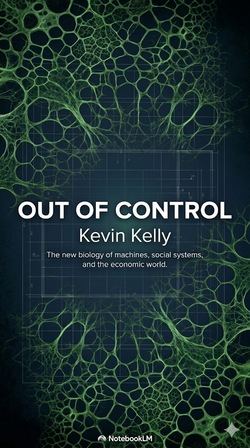
Out of Control summary and key insights by Kevin Kelly
Loading…

Out of Control

Kevin Kelly

4.11144 learners

Kevin Kelly’s *Out of Control* redefines our understanding of complex systems by exploring the dynamic fusion of nature and technology. Drawing on vivid real-world examples—from bee swarms’ decentralized decision-making to the Biosphere 2 experiment, from Rodney Brooks’ insect-like robots to networked global economies—Kelly argues that the most resilient, innovative systems emerge not from top-down control, but from distributed, self-organizing components. He introduces the concept of "living systems," where machines adopt biological logic and organisms are engineered to serve human needs, and reveals how letting go of rigid control unlocks emergent intelligence, adaptability, and evolutionary potential. This seminal work challenges traditional engineering and management paradigms, offering a blueprint for a future where technology and nature coevolve, and chaos becomes a catalyst for progress.

In Our Own Image: Savior or Destroyer? The History and Future of Artificial Intelligence summary and key insights by George Zarkadakis
Loading…

In Our Own Image: Savior or Destroyer? The History and Future of Artificial Intelligence

George Zarkadakis

3.8643 learners

Drawing on archaeology, philosophy, neuroscience, and computer science, *The Ultimate Fate of Humanity* traces the evolution of human consciousness from the 40,000-year-old Lion Man sculpture—our earliest known artistic creation—to the cutting edge of artificial intelligence. It unpacks the cognitive revolution that unlocked human creativity, explores age-old debates about mind-body dualism and the nature of consciousness, and dives into the history of computing and AI, from Turing’s foundational tests to modern neural networks. The book also confronts pressing questions: Can AI achieve true consciousness? Will digital immortality become a reality? What does the rise of superintelligence mean for humanity’s future? By bridging ancient human origins and futuristic tech, it offers a compelling framework to understand our mental roots and navigate the uncharted territory of the AI era.

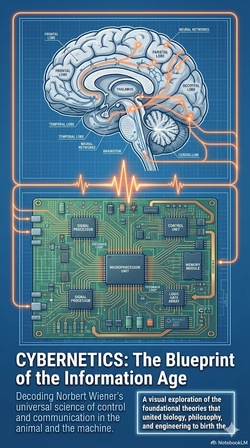
Cybernetics summary and key insights by Norbert Wiener
Loading…

Cybernetics

Norbert Wiener

4.41045 learners

Norbert Wiener’s *Cybernetics*—the cornerstone of the information age—revolutionizes our understanding of control, communication, and order across machines, biological systems, and societies. First published in 1948 (with a revised 1961 edition), this seminal work breaks down disciplinary silos by identifying shared feedback-driven mechanisms governing everything from human motor functions to automated engineering systems. A polymath blending math, engineering, biology, and philosophy, Wiener introduces core concepts like negative entropy (information as a counterforce to disorder), black box analysis, and the statistical nature of control. The revised edition expands into cutting-edge territory, exploring learning machines (early AI prototypes that outperform their designers) and self-organizing systems, where order emerges spontaneously from nonlinear interactions. Beyond technical innovation, *Cybernetics* challenges mechanical determinism, laying the groundwork for fields like artificial intelligence, robotics, biocybernetics, and social systems theory, while prompting critical reflections on automation’s ethical and societal impacts.