Business & Management Book Summaries & Key Insights

Business & Management Total 34 books

Company of One summary and key insights by Paul Jarvis
Loading…

Company of One

Paul Jarvis

4.51250 learners

Paul Jarvis’s Company of One redefines entrepreneurial success by challenging the pervasive myth that growth is the only measure of a thriving business. Targeted at solopreneurs, small team leaders, and aspiring business owners tired of hustle culture’s endless scaling demands, this book advocates for building sustainable, profitable ventures that prioritize lifestyle, control, and purpose over expansion. Jarvis draws on real-world examples of successful small businesses that chose to stay small—from freelance designers to niche product makers—to illustrate how focusing on niche markets, setting revenue-based goals instead of headcount, and avoiding overgrowth pitfalls can lead to long-term fulfillment and financial stability. He provides actionable strategies for identifying ideal customers, optimizing operations without unnecessary complexity, and redefining success on your own terms, offering a refreshing alternative to the growth-at-all-costs model.
Gamification Marketing summary and key insights by Hu Huacheng
Loading…

Gamification Marketing

Hu Huacheng

2.7958 learners

Gamification Marketing taps into humanity’s innate love of play to transform stale, pushy advertising into immersive, engaging experiences that drive customer action. Unlike traditional marketing that makes consumers feel pressured, this approach leverages core game mechanics—including instant feedback loops, flow states, achievement recognition, and social connection—to meet deep psychological needs. The book breaks down how to design effective gamified campaigns, from crafting compelling challenges to building layered incentive systems that balance extrinsic rewards (like discounts) and intrinsic motivation (like pride and belonging). It features real-world examples that resonate with U.S. audiences, from Barack Obama’s groundbreaking in-game campaign ads targeting young voters to McDonald’s and Tesla’s successful gamified strategies that boost brand loyalty and sales. Whether you’re a marketer, business owner, or entrepreneur, this guide shows you how to turn passive customers into active participants, foster emotional brand connections, and unlock measurable growth across industries.

Zero to One summary and key insights by Peter Thiel;Blake Masters
Loading…

Zero to One

Peter Thiel;Blake Masters

4.1901 learners

In *Zero to One*, PayPal co-founder Peter Thiel upends conventional business wisdom by arguing that true progress doesn’t come from copying existing models (scaling from 1 to n via globalization)—it stems from zero-to-one innovation: creating something entirely new that reshapes markets. Thiel breaks down why monopolies, not cutthroat competition, drive sustainable profits and societal advancement, using real-world examples like Google and PayPal to illustrate his points. He explores the power law’s transformative role in investing and life, urging readers to focus on high-impact opportunities rather than spreading efforts thin. The book also dives into critical startup fundamentals: building cohesive, mission-driven teams (like the legendary PayPal Mafia), mastering sales (even for tech-focused founders), leveraging human-machine collaboration, and avoiding pitfalls seen in the 2000s clean tech bubble. Thiel’s unorthodox insights offer a playbook for entrepreneurs and thinkers to reimagine the future by uncovering hidden truths and building lasting, unique businesses.

Your Strategy Needs a Strategy summary and key insights by Martin Reeves;Knut Haanaes;Janmejaya Sinha
Loading…

Your Strategy Needs a Strategy

Martin Reeves;Knut Haanaes;Janmejaya Sinha

4.5965 learners

In today’s volatile, global business landscape, one-size-fits-all strategic approaches no longer deliver results. Martin Reeves’ *Your Strategy Needs a Strategy* introduces the groundbreaking Strategy Palette framework, designed to help leaders align their strategic choices with the unique demands of their operating environment. Anchored on three critical environmental dimensions—predictability, malleability, and harshness—the framework defines five distinct strategic archetypes: Classic, Adaptive, Visionary, Shaping, and Renewal, each tailored to specific market conditions. Reeves uses real-world case studies (from Mars and Zara to Novartis and American Express) to illustrate how each strategy drives success, backed by data showing that strategy-environment matched firms deliver 4-8% higher total shareholder returns. The book also addresses dual innovation for complex, multi-environment enterprises, outlines common strategic traps, and empowers leaders to build flexible, adaptive strategy portfolios that balance short-term performance and long-term resilience.

The Minimalist Entrepreneur summary and key insights by Sahil Lavingia
Loading…

The Minimalist Entrepreneur

Sahil Lavingia

4.3933 learners

Tired of the Silicon Valley hype chasing billion-dollar unicorns? Sahil Lavingia’s *The Minimalist Entrepreneur* offers a refreshing alternative: a bootstrapped, profit-first approach to building a sustainable business on your own terms. Drawing from real-world stories—from Peter Asch’s Vidalia onion direct-to-consumer brand to Examine.com’s community-driven nutrition resource and Lavingia’s own journey building Gumroad—this book breaks down the core principles of minimalist entrepreneurship: prioritize profitability over rapid growth, start with a trusted community to identify real needs, validate ideas with small, iterative steps, and focus on serving your first 100 loyal clients instead of chasing viral fame. It also guides readers through the creator-to-entrepreneur path, showing how turning personal projects into paid offerings can lay the groundwork for long-term success. Whether you’re a side hustler, aspiring founder, or frustrated by traditional startup norms, this book gives you actionable tools to build a business that fits your life, not the other way around.

Principles summary and key insights by Ray Dalio
Loading…

Principles

Ray Dalio

4.51117 learners

From a Long Island kid who bought his first stock at 12 to the founder of Bridgewater Associates—the world’s largest hedge fund—Ray Dalio lays bare the hard-won lessons that shaped his success in *Principles*. This memoir-meets-playbook traces his journey: the gut-wrenching losses that shattered his ego in the 1980s, the systematic principles he forged from failure, and the radical culture of radical truth and radical transparency that turned Bridgewater into a powerhouse. Dalio breaks down his core frameworks: the five-step process for achieving goals, radical open-mindedness to avoid blind spots, and risk parity strategies for steady investing. More than just finance advice, this book offers actionable rules for navigating life, building high-performing teams, and making decisions that stand the test of time. It’s a raw, honest guide to turning pain into progress and building systems that outlast individual brilliance.

Crossing the Chasm summary and key insights by Gerffrey A. Moore
Loading…

Crossing the Chasm

Gerffrey A. Moore

4.4774 learners

Geoffrey A. Moore’s *Crossing the Chasm* is the definitive playbook for high-tech startups and established firms struggling to move beyond early adopter success to mainstream market dominance. Moore introduces the groundbreaking Technology Adoption Lifecycle, a framework breaking consumers into five distinct segments: innovators, early adopters, early mainstream, late mainstream, and laggards. The core challenge he addresses is the "chasm"—a critical, high-risk gap between risk-taking early adopters and pragmatic early mainstream buyers who demand proven, problem-solving products. Moore doesn’t just diagnose the problem; he delivers actionable strategies to bridge this divide. He emphasizes focusing on a narrow niche within the early mainstream, tailoring messaging to prioritize their specific pain points over cutting-edge features, and building distribution channels aligned with their buying habits. Packed with real-world tech industry case studies, this book has become a cornerstone for marketers, founders, and product leaders, offering a roadmap to turn niche innovations into widely adopted, profitable products.

The Leadership Pipeline summary and key insights by Ram Charan;Stephen Drotter;James Noel
Loading…

The Leadership Pipeline

Ram Charan;Stephen Drotter;James Noel

4.41250 learners

Based on decades of corporate research and real-world case studies, *The Leadership Pipeline* lays out six critical, sequential leadership transitions that guide individual contributors to CEO-level leaders. Each stage requires distinct shifts in core skills, time management priorities, and work mindsets—from moving from managing personal tasks to leading teams, all the way to overseeing enterprise-wide strategy and stakeholder relationships. Unlike generic leadership guides, this framework helps organizations diagnose role misalignment (where leaders operate at the wrong tier), build robust internal talent pipelines, and design effective succession plans. Adaptable for both large corporations and small businesses, it offers actionable tools like performance-potential matrices and coaching frameworks to nurture leaders at every level. By focusing on mindset transformation over just skill-building, the model reduces promotion risks, cuts external hiring costs, and drives sustainable organizational growth by developing leaders tailored to each unique leadership stage.

Activating the Organization summary and key insights by Chen Chunhua
Loading…

Activating the Organization

Chen Chunhua

3.8942 learners

In an era of constant market shifts, technological disruption, and blurred industry lines, *Activating the Organization* delivers actionable strategies to turn uncertainty into competitive advantage. Drawing on decades of research and real-world case studies—from global leaders like Amazon, IBM, and Starbucks to trailblazing firms such as Huawei and Alibaba—this book outlines how businesses can move beyond rigid, top-down management to unlock individual potential and build symbiotic value communities. It breaks down core principles: adopting a growth-oriented mindset that prioritizes external customer needs over internal constraints, fostering a self-driven change culture that embraces failure as a stepping stone to innovation, and redefining leadership roles as evangelists, designers, and trusted partners. You’ll learn to navigate structural uncertainty, activate employee creativity through agile, decentralized teams, and build ecosystems where every stakeholder thrives. Whether you’re a startup founder or a corporate executive, this guide provides the framework to future-proof your organization and drive sustained, non-linear growth.

The 21 Irrefutable Laws of Leadership summary and key insights by John C. Maxwell
Loading…

The 21 Irrefutable Laws of Leadership

John C. Maxwell

4.5594 learners

John C. Maxwell’s *The 21 Irrefutable Laws of Leadership* distills decades of hands-on leadership experience into actionable, timeless principles that redefine effective leadership. Through vivid real-world case studies—from Ray Kroc scaling McDonald’s to Winston Churchill rallying Britain in WWII, and Steve Jobs reviving Apple—Maxwell breaks down each law, starting with foundational truths like the Law of the Lid (leadership caps personal and organizational potential) and the Law of Influence (leadership is measured by followership, not title). He progresses to advanced strategies, including the Law of Explosive Growth (developing leaders multiplies impact exponentially) and the Law of Legacy (a leader’s true value lies in their successors). Whether you’re a new manager, seasoned executive, or community leader, this book provides practical steps to elevate your leadership skills, build high-performing teams, and create lasting influence that extends far beyond your tenure.

Built to Last summary and key insights by Jim Collins;Jerry I. Porras
Loading…

Built to Last

Jim Collins;Jerry I. Porras

4.61241 learners

Over six years, Jim Collins and Jerry Porras conducted a landmark study of 18 enduring visionary companies—industry titans that outperformed the broader market by 15x and their peer "silver medal" firms by 6x. Built to Last dismantles pervasive myths: visionary companies don’t depend on charismatic leaders or brilliant initial ideas; instead, they focus on building enduring organizational systems, or "building the clock" rather than "telling time." The book lays out their core principles: unshakable core ideologies that guide decisions without stifling adaptability, a relentless drive to stimulate progress, and tangible mechanisms like Big Hairy Audacious Goals (BHAGs), cult-like cultures that reinforce shared values, evolutionary experimentation, internal leadership succession, and systematic self-improvement. Filled with real-world examples from HP, Disney, 3M, and more, it provides actionable frameworks for entrepreneurs, managers, and leaders to build companies that thrive across generations, not just quarterly earnings reports.

The Five Dysfunctions of a Team summary and key insights by Patrick Lencioni
Loading…

The Five Dysfunctions of a Team

Patrick Lencioni

4.4531 learners

Through a gripping fictional narrative of DecisionTech, a once-promising Silicon Valley startup spiraling into chaos due to a fractured leadership team, Patrick Lencioni reveals the five interconnected dysfunctions that derail team performance: absence of trust, fear of conflict, lack of commitment, avoidance of accountability, and inattention to results. Follow new CEO Katherine Petersen as she uses no-nonsense team-building exercises—from vulnerability-sharing sessions to heated, constructive debates—to dismantle these barriers and rebuild a cohesive, high-performing team. Beyond the engaging story, the book breaks down each dysfunction with clear, actionable strategies, including team assessments, conflict-resolution tools, and accountability frameworks. Ideal for leaders, managers, and team members alike, it turns abstract team theory into a practical guide, showing how overcoming these universal hurdles can transform underperforming groups into units that prioritize collective success over individual gain.

Blue Ocean Strategy summary and key insights by W. Chan Kim;Renée Mauborgne
Loading…

Blue Ocean Strategy

W. Chan Kim;Renée Mauborgne

4.2945 learners

Blue Ocean Strategy redefines business competition by shifting focus from fighting over shrinking market share in crowded "red oceans" to creating untapped "blue oceans"—new, non-competitive market spaces where demand is generated rather than contested. At its core is value innovation, a framework that breaks the long-held trade-off between differentiation and low cost, enabling companies to deliver exceptional customer value while maintaining strong profitability. Using iconic examples like Cirque du Soleil, Southwest Airlines, and Yellow Tail Wine, authors W. Chan Kim and Renée Mauborgne outline six systematic paths to redefine market boundaries, paired with practical tools such as the Strategy Canvas and Four Actions Framework to visualize and refine strategies. They also address execution hurdles with proven methods: Tipping Point Leadership to overcome organizational barriers, and the 3E Fair Process principles to align employee efforts. Backed by data showing blue ocean initiatives drive 61% of total profits despite making up just 14% of new ventures, this book offers an actionable roadmap for sustainable growth beyond cutthroat competition.

Competitive Strategy summary and key insights by Michael E. Porter
Loading…

Competitive Strategy

Michael E. Porter

4.7963 learners

As the cornerstone of modern business strategy, Michael E. Porter’s *Competitive Strategy* delivers a rigorous, actionable framework for navigating industry dynamics and building sustainable competitive advantage. At its core is the Five Forces Model, which breaks down competition into five critical drivers: threat of new entrants, bargaining power of suppliers and buyers, threat of substitutes, and rivalry among existing firms. Porter further outlines three core generic strategies—cost leadership, differentiation, and focus—that businesses can leverage to outperform rivals. The book also explores competitor analysis, strategic groups, and tailored strategies for diverse industry contexts, from fragmented and emerging markets to mature, declining, and global industries. It guides leaders through high-stakes decisions like vertical integration, capacity expansion, and new market entry, equipping them to anticipate shifts, mitigate risks, and drive long-term profitability. For executives, entrepreneurs, and strategy professionals, this classic text remains an indispensable tool for mastering competitive landscapes.

The Practice of Management summary and key insights by Peter F. Drucker
Loading…

The Practice of Management

Peter F. Drucker

4.2985 learners

Peter F. Drucker’s *The Practice of Management* redefined organizational leadership by framing management as the vital core of every social institution—from corporations to hospitals and universities. Drucker outlines three non-negotiable management tasks: delivering tangible economic results, fostering meaningful work and employee fulfillment, and upholding social responsibility to avoid harming communities. He debunks the myth that profit is a business’s purpose, arguing instead that the true mission is to create customers, illustrated by case studies like Sears and IBM that centered customer needs over short-term gains. The book introduces foundational concepts like objective management, the five key jobs of a manager, and strategies for structuring organizations to adapt to evolving workforces—especially the rise of knowledge workers. Drucker also addresses critical challenges, from managing service institutions to balancing innovation with existing operations, emphasizing that effective management turns individual efforts into collective, productive results benefiting both the organization and society.

Team of Teams summary and key insights by Stanley McChrystal;Tantum Collins;David Silverman;Chris Fussell
Loading…

Team of Teams

Stanley McChrystal;Tantum Collins;David Silverman;Chris Fussell

4.21146 learners

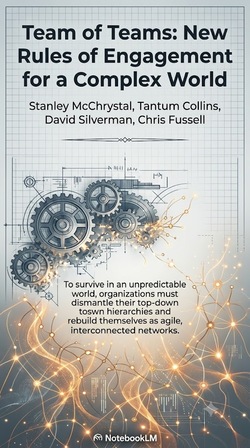
In *Team of Teams*, retired General Stanley McChrystal reveals how America’s elite Joint Special Operations Task Force (JSOTF) overhauled its rigid, hierarchical structure to defeat Abu Musab al-Zarqawi’s decentralized al-Qaeda in Iraq. Facing an enemy that outmaneuvered them with rapid, autonomous attacks, McChrystal’s team realized their decades-old Taylorist management model—built for efficiency and predictability—was obsolete in a hyper-connected, chaotic 21st-century battlefield. Drawing lessons from NASA’s Apollo program, airline crew resource management, and even ant colonies, they broke down silos with radical information sharing, embedded cross-team members to build trust, and empowered frontline operators to make critical decisions without top-down approval. This isn’t just a military memoir; it’s a playbook for any organization struggling to thrive in uncertainty, proving shared awareness and decentralized leadership can turn unwieldy teams into a unified, unstoppable force.

Good Strategy Bad Strategy summary and key insights by Richard Rumelt
Loading…

Good Strategy Bad Strategy

Richard Rumelt

4.31205 learners

In *Good Strategy, Bad Strategy*, Richard Rumelt dismantles the myth that strategy equals lofty visions or vague goals, drawing on decades of research and real-world examples to define what makes a strategy effective. A good strategy isn’t about empty buzzwords—it’s about pinpointing core challenges, crafting a clear guiding policy, and aligning coordinated, focused actions to cut through complexity. Rumelt uses iconic cases like Admiral Nelson’s Trafalgar victory, Steve Jobs’ turnaround of Apple, and DARPA’s groundbreaking innovations to illustrate how concentrated resources and sharp analysis drive success. Conversely, he exposes bad strategy’s pitfalls: vague statements that mask inaction, unrealistic goal piles, and leaders who avoid tough trade-offs, as seen in the collapses of Lehman Brothers and General Motors. The book also outlines actionable frameworks for building good strategy—from identifying strategic proximate goals to leveraging competitive asymmetries—and teaches readers to overcome cognitive biases, corporate inertia, and herd mentality to make smarter, more impactful strategic decisions.

Crossing the Chasm summary and key insights by Geoffrey A. Moore
Loading…

Crossing the Chasm

Geoffrey A. Moore

4.71219 learners

Widely regarded as the definitive guide for tech product marketing, *Crossing the Chasm* demystifies the critical gap between early tech adopters—risk-taking innovators who embrace new tools—and the mainstream market, where pragmatic buyers prioritize reliability and proven value. Drawing on decades of Silicon Valley startup insights, the book breaks down why countless promising tech products fail to move beyond early enthusiasts: the 'chasm' is a psychological and market-based divide that requires targeted strategies to cross. It outlines actionable frameworks, like the 'bowling pin' approach of dominating niche segments before scaling, and teaches readers how to reframe product messaging to resonate with risk-averse mainstream buyers. Packed with real-world case studies and practical tools, this book is essential for tech entrepreneurs, marketers, and product leaders looking to turn innovative ideas into widely adopted, successful products.

Organizational Capability summary and key insights by Arthur Yeung
Loading…

Organizational Capability

Arthur Yeung

3.3848 learners

For global business leaders navigating China’s dynamic market or seeking to build enduring competitive advantage, *Organizational Capability* by Arthur Yeung delivers actionable insights rooted in China’s 40+ years of corporate growth. The book frames sustainable success as the product of clear strategy and robust organizational capabilities—arguing that while strategy can be copied, capabilities built through people, culture, and systems are nearly impossible to replicate. Drawing on real-world cases from Huawei, Gree, Lenovo, and global giants like GE and IBM, Yeung breaks down organizational capability into three interdependent pillars: employee skills (recruiting, developing, and retaining top talent), mindset alignment (shaping shared values to drive action), and governance systems (designing structures and processes to enable collaboration). He also addresses the unique challenges Chinese firms face as they transition from low-cost manufacturing to global leadership, outlining four critical strategic shifts and practical steps to build global management capabilities. Whether you’re leading a startup or a multinational, this book provides a playbook to turn strategic goals into tangible results.

Management Challenges for the 21st Century summary and key insights by Peter F. Drucker
Loading…

Management Challenges for the 21st Century

Peter F. Drucker

4.6611 learners

Peter F. Drucker’s *Management Challenges for the 21st Century* dismantles the outdated management assumptions that dominated the 20th century, arguing they no longer fit the realities of globalization, rapid technological change, and the rise of knowledge workers. The book introduces a new management paradigm that expands organizational responsibility beyond internal operations to all factors influencing performance, including external partnerships, global markets, and customer needs. Drucker outlines actionable frameworks for navigating key challenges: crafting strategies aligned with demographic and economic shifts, leading intentional change rather than reacting to it, leveraging information to drive value creation instead of just cost control, boosting knowledge worker productivity through autonomy and clear purpose, and empowering individuals to practice self-management for long-term career success. Packed with real-world examples and timeless insights, this book equips leaders and knowledge workers to thrive in an era of constant disruption, redefining management as a tool for sustainable, results-driven growth.