
12 Rules for Life: Complete Chapter-by-Chapter Summary

Welcome to our deep dive into Jordan Peterson's masterpiece, *12 Rules for Life*. Look at this striking image: on one side, we have the rigid, structured lines of a city, representing the order we crave for safety. On the other, chaotic, swirling storms symbolize the unpredictable chaos of life. Standing right in the middle, a figure holds a beam of light, bridging these two worlds. This visual perfectly captures the book's core promise: to discover ancient wisdom and scientific truths that provide structure in an unpredictable world. Peterson argues that life isn't about escaping chaos, but finding the right balance between the safety of known structures and the infinite possibilities of the unknown. It's about building a life where you can stand firm against the storm while still exploring the horizon.

The slide before you isn't just a diagram; it's a blueprint of the human condition. It captures the fundamental reality we all navigate: the eternal tension between Chaos and Order.
On the left, we have **Order**. This is the realm of the known. It's the structure, safety, and tradition that give us a stable foundation. It's the familiar routine, the predictable job, the family rules we rely on. But the slide warns us of its danger: if we cling too tightly to this, order can fossilize into tyranny and rigid conformity, trapping us in a box where nothing new can grow.
On the right lies **Chaos**. This is the unknown. It represents nature, freedom, and the terrifying potential of novelty. It's the sudden loss of a job, the unexpected breakup, the blank page of a new chapter. While chaos brings fear and the risk of destruction, it is also the only source of true possibility. Without it, we never evolve.
But where do we stand? The glowing golden line in the center points to **Meaning**. The slide defines this as the narrow path of balance. It's not about choosing one side over the other; it's about the active engagement of walking the boundary between them. It is the state where humanity thrives: grounded enough in stability to function, yet open enough to the unknown to learn and grow.
Think of your life as this yin-yang. Too much order, and you become stagnant. Too much chaos, and you become lost. The wisdom lies in standing right on that dividing line, using the safety of what you know to explore the vast, scary, and beautiful unknown. That is where real life happens.

Look at this blueprint of success. It visualizes a stark divide between the defeated and the victorious, using the fascinating biology of the lobster as our metaphor. On the left, we see the "defeated." Their biochemistry is a recipe for misery: low serotonin and high octopamine. This chemical cocktail triggers a heightened stress response, making them defensive, anxious, and constantly on edge. Their brain's ancient "dominance calculator" assigns them a low status, treating every unexpected event as an existential threat. They hunch their shoulders, shrinking into themselves.
On the right stands the victorious. Their biochemistry is the opposite: high serotonin and low octopamine. This balance creates a state of calm, competence, and resilience. Notice how the lobster here is standing tall, and the human figure has an upright posture with energy radiating from their spine. This isn't just about feeling good; it's about being perceived as capable and commanding respect.
So, how do we move from the left side to the right? The slide gives us a clear, actionable rule right at the bottom: Stand up straight with your shoulders back. It sounds simple, but it's profound. Assuming physical responsibility by opening your posture literally rewires that ancient dominance calculator in your brain. When you take up space, you signal competence to yourself and others. You stop shrinking from the chaos of life and start opening the door to respect and success. It's a biological hack to change your reality from the inside out.

Look at this blueprint of the self. It's not just a house; it's the architecture of who you are. Notice how the text maps specific rules to structural levels.
Starting at the foundation, Rule 2 says: Acknowledge your value. This is your Floor 1. It's about treating yourself like someone you are responsible for helping, shifting from self-neglect to objective self-respect. Without this base, the whole structure wobbles.
Move up to Floor 2 for Grounding. Here, Rule 4 teaches us to Calibrate the Critic. Stop comparing yourself to who someone else is today, and instead, compare yourself to who you were yesterday. Transform that internal tyrant into a constructive guide that helps you build, rather than tear down.
Finally, look at the roof, Floor 3. Rule 6 demands that we Eradicate Resentment. The text reminds us to set our house in perfect order before we criticize the world. You must acknowledge your own capacity for malice before blaming society for the tragedies of existence.
Think of this as a renovation project for your soul. You can't have a stable roof if your foundation is cracked. By respecting your value, calibrating your inner voice, and letting go of resentment, you stop being a victim of your own mind and start becoming the architect of a life you actually want.

Look at this blueprint-style diagram. It breaks down a critical shift in how we view our lives: the difference between a **Horizontal Focus** on others versus a **Vertical Focus** on ourselves.
When we look outward at everyone else's achievements in this hyper-connected world, we fall into what the slide calls "The Zero-Sum Trap." We start seeing life as a competition where someone's gain is our loss. This mindset breeds resentment, nihilism, and a deep sense of unfairness. It's exhausting because you're constantly measuring yourself against a moving target that never stops winning.
But on the right side, we have the **Vertical Focus**. This is about looking downward at your own baseline from yesterday. Instead of comparing yourself to others, you're comparing yourself to who you were just a moment ago. The result? **Compounding Growth**. This approach fosters patience, incremental improvement, and true personal accountability. You aren't fighting the world; you're building your own reality.
The bottom half of the slide visualizes this with a powerful concept: "What you aim at determines what you see." Think about the famous invisible gorilla experiment. Our brains filter reality based on our goals. If you aim at resentment, your brain filters out opportunities and highlights enemies. But if you aim at self-improvement, you suddenly see opportunities everywhere.
So, the choice is yours. Will you stay trapped in a horizontal race that leaves you bitter, or will you embrace a vertical path of continuous growth? Your focus dictates your reality.
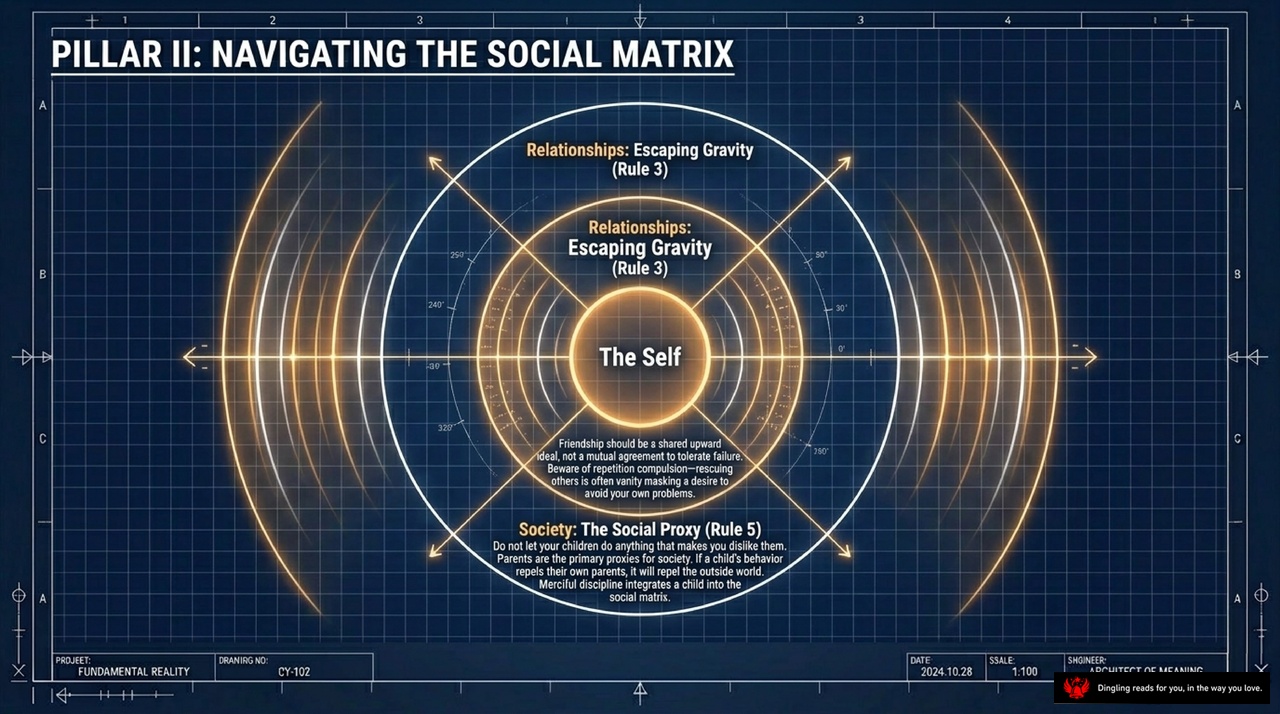
Pillar Two is all about navigating the social matrix—understanding how we relate to others and how society shapes us. At the very center of this diagram is "The Self." Everything radiates from there.
Look at the top section: "Relationships: Escaping Gravity." This is Rule Three. It's a powerful reminder that true friendship shouldn't just be about tolerating each other's failures or falling into a trap of "rescuing" one another. Often, that desire to save someone is just vanity masking our own unresolved problems. Real connection is a shared upward trajectory, not a mutual agreement to stay stuck.
Moving to the bottom, we see "Society: The Social Proxy," which is Rule Five. This is crucial for parents. Think of your children as your proxies in the world. If they see you doing things you dislike, they will likely do them too. You are the primary model for society. If your behavior repels the outside world, it will repel your children. That's why merciful discipline is so important—it's not about punishment, but about integrating them into the social matrix so they can thrive.
So, how do we navigate this? By being conscious of our own behavior and recognizing that our relationships and our parenting are deeply intertwined. We can't escape gravity, but we can choose to fly upward together, modeling the integrity and strength we want to see in the world.

Imagine two distinct paths for how we connect with the world around us. The first is an ego-driven monologue, a circuit where signals bounce off a wall and explode outward. Its purpose is to establish dominance, its mechanism is simply waiting for your turn to speak, and the outcome? It only solidifies existing ignorance. It's a closed loop where no real understanding ever happens.
But there is a better way, a collaborative exploration we call Rule 9. Here, the circuitry transforms into a complex, interconnected network. The purpose shifts from dominating to mapping the unknown. The mechanism changes from waiting for your turn to active listening, assuming the other person knows something you don't. This transforms the interaction from a battle for status into a safe space where we can outsource our thinking to a collective network. By truly listening and exploring together, we don't just talk; we solve complex problems and unlock new perspectives that neither of us could reach alone.

Pillar III: Confronting Reality. Look at this split screen. On the left, we have "The Fog of Deceit." It represents the terrifying, swirling chaos we feel when we refuse to tell the truth or define our failures. When we lie to ourselves, we corrupt the very map we use to navigate life. Refusing to name a failure doesn't stop it from happening; it just guarantees we'll never learn from it. We stay trapped in the fog, unable to see the path forward.
But on the right, we have "The Dragon Under the Carpet." This is the solution. The dragon on the left is a vague, monstrous fear that seems insurmountable. The dragon on the right? It's a precise, wireframe model. That's the power of precision. When a crisis hits, vague fears collapse the world into chaos. But when you articulate your problem with exactness, you shrink that unnameable terror into a defined, solvable obstacle. You stop staring at the monster in the dark and start drawing its blueprint.
So, here is your challenge: Be precise in your speech. Stop hiding the dragon under the carpet. Define your failure, name your fear, and draw the dragon in the light. Only then does the chaos transform into a challenge you can actually solve.

Look at this blueprint. We aren't just looking at two lines; we are looking at the fork in the road that defines every human life. On the left, you have the Path of Expedience. It's the easy way out. It's impulsive, conflict-avoidant, and built on blame-shifting. It whispers that existence is inherently flawed, so why not embrace destruction and nihilism? That's the Mephistopheles' creed. The result? You get trapped in a vortex of hellish resentment. You amplify the tragedy of life until it consumes you, turning your existence into a chaotic mess where nothing matters.
But look at the other path. The Path of Meaning. This one requires discipline. It demands that you delay gratification and embrace voluntary sacrifice. It accepts radical responsibility. The philosophy here is bold: you consciously decide to balance Order and Chaos to actually improve the world. It's not about escaping reality; it's about engaging with it. When you choose this path, meaning becomes the ultimate antidote to suffering. It's that psychological symphony that occurs when all levels of your existence finally harmonize.
The visual shows the divergence perfectly. The expedience path spirals inward, a dark knot of confusion and self-pity. The meaning path rises, climbing through the grid like a circuit board leading to a bright, golden star. That star represents the clarity and purpose that only comes when you stop blaming the world and start building it. So, the diagnostic is clear: are you choosing the safety of resentment, or the hard work of meaning? Your choice determines whether you spiral into chaos or ascend toward the light.

Look at this curve: "Embracing Vulnerability and Resilience." It maps the delicate balance between our competence and the risks we face. On the left, we have "The Superman Problem." It warns us against over-protection. Just like the advice to "not bother children when they are skateboarding," shielding kids from every scrape creates fragility. True competence is built only by encountering and mastering manageable danger. A hero with no limits isn't a hero at all because there is no struggle.
Now, look at the right side: "Pockets of Grace." This is Rule 12. It suggests that to survive life's inherent tragedy, we must consciously focus on micro-moments of beauty. For example, "pet a cat when you encounter one on the street." Existence requires limitation. We need these small pockets of grace to balance the suffering.
The center of this graph is "The Optimal Zone," where exposure to risk meets the right amount of competence. Too little risk, and you stagnate; too much, and you break. The sweet spot lies right here, in the middle. It's about finding that zone where you are challenged enough to grow, but safe enough to thrive. Don't try to be Superman, and don't hide from the world. Instead, live in this optimal zone, embracing both the struggle and the grace.

To live a meaningful life is to stand upright on the razor's edge between order and chaos. It's about carrying the heavy burden of truth, personal responsibility, and continuous self-improvement. Think of it as a conscious decision to confront the darkness of existence and extract light from it.
If you stopped using lies to hide from your own potential, what kind of world could you build with the truth?
The book challenges us to stop hiding behind comfort zones or false narratives. Instead, we must embrace the tension between the safety of known structures and the terrifying but necessary unknown. True growth happens not when we eliminate all pain or confusion, but when we face them head-on. By choosing honesty over convenience and action over avoidance, we transform our internal chaos into a purposeful order. This isn't about becoming perfect; it's about becoming real. When we align our actions with the truth of who we are, we unlock a freedom that no lie could ever provide.