
2049: Possibilities of Next 10000 Days: Complete Chapter-by-Chapter Summary

Welcome to a glimpse of the year 2049. Imagine a skyline where futuristic towers like the Aquilon Tower, running on net-zero energy, stand alongside the Neo-Kyoto Hub, acting as a quantum network node. This isn't just science fiction; it's the blueprint for the next 10,000 days.
In this world, the smart glasses you might wear today have evolved into the primary interface for reality. They don't just show you the world; they layer it with a digital twin. You could walk past a Biosynth Park capturing 98% of carbon emissions, or glance at a friend and instantly see their name and context, all powered by AR data streams.
This vision, "2049: The Possible Futures," by Kevin Kelly and Wu Chen, explores a life defined by artificial allies and a new era of global abundance. It's a story about how the mirror world merges the physical and digital, making the impossible feel as tangible as the air we breathe. Let's dive into what lies beyond the horizon.

Imagine intelligence not as a single, human-like ability, but as a vibrant zoo of specialized "aliens." This slide brilliantly captures that shift. On the left, we see Artificial General Intelligence, or AGI, depicted as a Swiss Army knife. It's a general-purpose tool, yes, but look at the labels: "Excess Complexity" and "Imprecise Tools." It tries to be mediocre at everything, juggling too many functions until none are perfect.
But the real future lies on the right, with Artificial Capable Intelligence, or ACI. This is the scalpel, the laser, the purpose-built instrument. It offers extreme precision and flawless execution for specific tasks. The text reminds us that intelligence is multi-dimensional, not a linear volume knob. Instead of chasing a singular, human-like AGI, we are evolving toward diverse, specialized tools that do not think like us, yet outperform us in their specific domains. As the slide concludes, the ultimate tool isn't a universal do-it-all device, but a perfect, specialized solution designed to solve one specific problem with absolute mastery.

Imagine walking down a bustling city street, but instead of just seeing buildings and people, you see a vibrant digital layer overlaid on reality. This is the "Mirrorworld," a concept where spatial computing completely replaces our reliance on handheld screens.
As the slide illustrates, this shift begins with the "Death of the Smartphone." Think about how often you reach for your phone just to check a message or navigate. In the future, smart glasses will merge the physical world with a pervasive digital overlay, eliminating the need for those clunky handheld devices entirely. You won't need to stop and pull out a screen; the information will simply float right in your field of view.
This transformation creates a "1:1 Digital Twin" of our entire planet. Every physical object, from the car parked next to you to the streetlamp overhead, possesses a digital counterpart governed by AI and real-world physics engines. It's like having a live, interactive map of reality that updates in real-time.
Finally, we achieve "Immersive Transparency." The internet as we know it—flat and two-dimensional—transforms into a fully immersive, first-person 3D spatial experience. You aren't just reading about a place; you are standing inside it. Whether you're checking a recipe in your kitchen or collaborating with a colleague across the globe, the barrier between the digital and physical worlds dissolves. This isn't just an upgrade to our devices; it's a fundamental rewiring of how we experience life itself.

Let's talk about where creativity actually lives in our future. The slide breaks it down into two distinct types: lowercase "c" creativity and Uppercase "C" Creativity. Think of lowercase "c" as efficiency and optimization. This is the realm of AI. It excels at rapid replication, finding the best answer within known parameters, and doing things faster than any human ever could. It's about making the familiar work better.
But then there's Uppercase "C" Creativity. This is where humans hold the crown. It's about breakthroughs and discovery. Humans excel at the highly inefficient act of venturing into the unknown and defining entirely new paradigms. We don't just optimize what we know; we invent what we don't yet understand.
The real magic happens in the synergy between them. As AI frees us from the grind of productivity metrics, it allows us to focus on the unquantifiable pursuits of innovation, art, and meaning. In a world dominated by smart glasses and digital twins, our job isn't to be faster machines. It's to be the explorers who dare to step off the map and create something that no algorithm could ever predict. That is the future of human value.

Imagine a world where your phone is nothing more than a memory, replaced by a pair of sleek smart glasses that serve as your gateway to reality. In this future, you don't just interact with apps; you interact with a "Master AI OS" that acts as your invisible butler. While you simply speak or gesture, this central system handles the chaotic backend of everything, automating routine decisions so you can reclaim your time and focus on what truly matters.
Behind the scenes, a powerful Bot-to-Bot ecosystem takes over. Specialized bots for travel, health, finance, and education negotiate logistics and execute tasks directly with one another using secure smart contracts, all without you lifting a finger. You only see the result: a perfectly booked trip, a tailored health plan, or a seamless transaction. This is the "Invisible Delegation" of the future—where technology works so seamlessly in the background that it feels like magic, yet it's built on a foundation of transparent, automated intelligence connecting every aspect of your life.

Imagine walking through a future where your car isn't just a vehicle, but a fully transformed living space. In this vision, the steering wheel and pedals disappear, replaced by a flexible interior that can instantly switch from a high-speed office to a cozy movie theater or a private lounge. This is the "third space," made possible by Level 4 autonomous driving, which frees your attention completely.
Your windshield and windows become interactive AR screens, projecting floating documents for work or immersive VR environments for entertainment. Thanks to high-bandwidth connectivity, you can stream 8K cinema-quality content with surround sound, turning a commute into a premium experience. AI algorithms curate your content in real-time, suggesting a comedy show for a short trip or a full series for a long journey.
But it goes beyond entertainment. This mobile space becomes a social hub where friends can share virtual environments to watch games or play together, and a versatile hub for life. You could turn your car into a mobile clinic for a quick check-up, a pop-up shop for a small business, or even a "mobile homestay" with a bed and kitchen for overnight travel. As manual driving becomes a niche hobby for enthusiasts, the license evolves into a certification for manual operation, while the average person enjoys a personalized, on-demand journey tailored to their mood, schedule, and needs.

Imagine a future where your car transforms from a simple vehicle into a fully immersive, mobile third space. By 2049, the driver's seat will disappear, replaced by flexible seating that can instantly shift into a conference room, a cozy living room, or a high-end cinema. This revolution is powered by Level 4 and Level 5 autonomous driving, which frees your attention completely.
Inside this new mobile environment, augmented reality overlays your windshield with floating documents and video call interfaces, turning your commute into a seamless office experience. Meanwhile, virtual reality can transport you to a forest or a concert hall with 8K resolution and surround sound, offering a level of immersion that traditional theaters can't match. The journey itself becomes the destination; you can work, play, or socialize with friends in a shared virtual space without ever leaving the vehicle.
This shift doesn't just change how we travel; it redefines the very concept of mobility. Your car becomes a private, customizable sanctuary where you set the temperature, scent, and digital theme to match your mood. Whether you need a quiet space for deep work or a lively environment for a movie night, your vehicle adapts instantly. As manual driving becomes a niche hobby for enthusiasts, the future of travel is about transforming every mile into an opportunity for productivity, entertainment, and connection, all within a personalized, AI-driven mobile ecosystem.

Imagine a world where the cost of creating blockbuster entertainment drops to zero. In this 2049 era, we are witnessing a massive shift from the traditional industrial model to a hyper-personized future.
On the left, we see the old "Industrial Era." It relied on a few Hollywood studios funneling content down to a mass global audience. It was a one-way street, rigid and expensive.
But look at the center. By 2049, that funnel flips upside down. Thanks to zero-cost creation powered by AI, every individual becomes a potential studio. Billions of AI-powered creators are now generating content, not just a select few. This is the Hollywood disruption in action: mass-market media gives way to immersive, personalized experiences.
And this is where the long tail finally wins. Distribution is no longer controlled by a few gatekeepers. Instead, AI matches creators directly with their exact true fans globally. Whether you love niche sci-fi or specific historical reenactments, you can find your community instantly.
The result? We move from a single, homogenized audience to thousands of hyper-personalized niche audiences. The content explosion isn't just about more movies; it's about the end of the industrial media complex and the rise of a world where everyone creates, everyone finds their audience, and everyone gets exactly what they love.
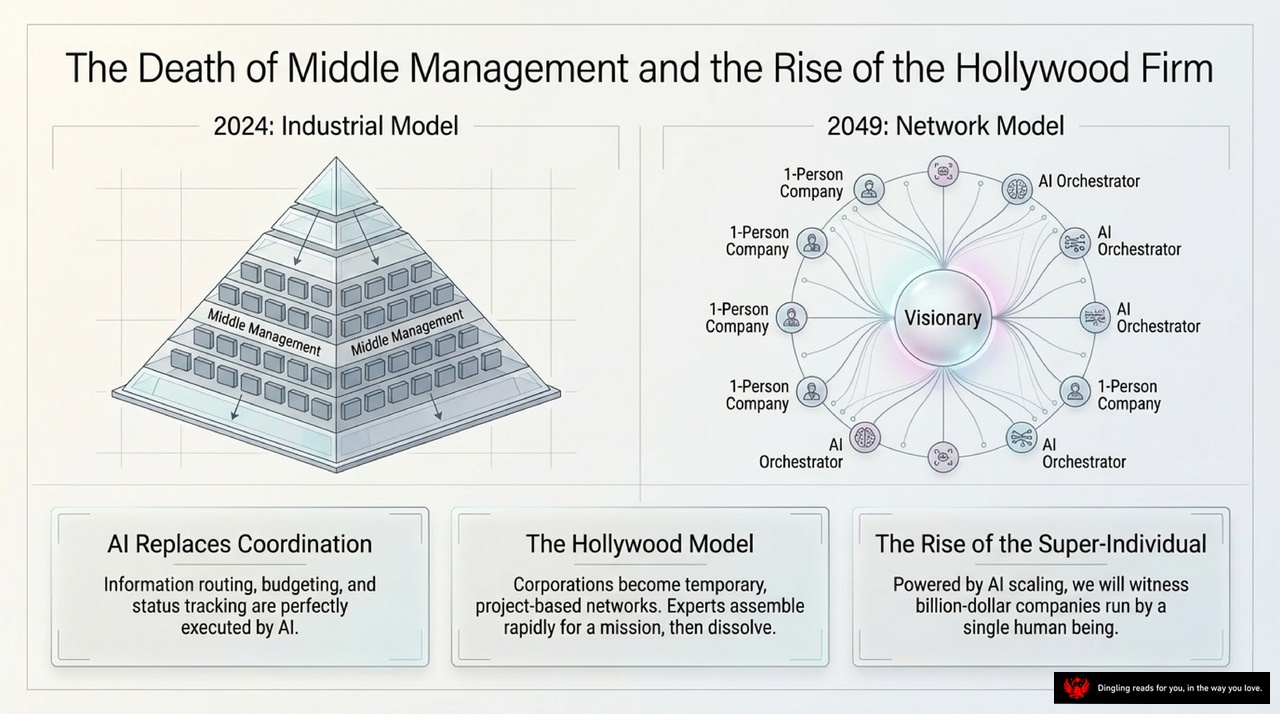
Imagine the corporate pyramid we know today is dissolving right before our eyes. By 2024, we're still stuck in the old Industrial Model, a rigid hierarchy where "Middle Management" acts as the essential bottleneck, shuffling information up and down the chain. But fast forward to 2049, and the Network Model takes over. The pyramid flattens into a dynamic web centered around a single "Visionary."
In this new Hollywood Firm, the Visionary doesn't micromanage; they orchestrate. They connect a circle of agile "1-Person Companies" and specialized "AI Orchestrators" to execute massive projects. Think of it like a blockbuster movie production: experts assemble rapidly for a specific mission, build the world, and then dissolve once the credits roll. AI replaces the tedious coordination of the past—handling everything from budgeting to status tracking—allowing humans to focus purely on creativity and strategy.
This shift births the "Super-Individual." Powered by AI scaling, we will witness the rise of billion-dollar companies run by a single human being. The era of the bloated bureaucracy is over. Instead, we move toward temporary, project-based networks where talent is fluid, and execution is lightning-fast. The future belongs not to the largest organization, but to the most visionary individual who can effectively command a swarm of AI and independent experts.

Imagine a world where your privacy isn't a secret, but a trade-off for a perfectly tailored life. This slide introduces the concept of "Coveillance"—a blend of surveillance and benevolence. Picture a balance scale: on one side sits Total Data Transparency, representing the continuous tracking of every move and glance you make. On the other, you find Hyper-Personalized Utility, the friction-free living experience where technology anticipates your needs before you even speak.
The image highlights that this isn't a choice between freedom and control, but an inevitable trade-off. True personalization, as the text suggests, requires total data access. In this "Mirrorworld," traditional anonymity simply cannot exist. But here's the crucial shift: unlike the one-way mirror of old surveillance, Coveillance acts like a clear window. You retain the fundamental right to see exactly who is watching you and why. This Symmetrical Accountability ensures that power isn't hidden.
Furthermore, trust in this transparent society isn't blind; it's maintained through immutable smart contracts and rapid, transparent avenues for citizen appeal. If the system ever misjudges you, you have a clear path to correct it. So, the question isn't whether you want to be watched, but whether you value the convenience of a life that fits you perfectly, provided you have the power to oversee the watchers themselves.

Imagine a world where governance isn't just about laws and politics, but about real-time, evidence-based decisions powered by an invisible engine. Today's slide, titled "Governance Migrates to the Ultimate Information State," visualizes this shift perfectly.
At the heart of this system is the "AI Policy Engine." Think of it as the brain of a hyper-efficient city. It doesn't rely on guesswork or outdated reports; instead, it draws its data directly from the pulse of daily life. On the left, you see "Citizen Behavior" and "IoT Sensors." This is the fuel: from the way people move and interact to the real-time data from millions of connected devices. Every step, every transaction, and every sensor reading feeds into this central AI hub.
The results of this data processing are transformative. First, look at "Real-Time Urban Adjustments." Instead of waiting for a traffic jam to clear up, the AI instantly reroutes flows, adjusting city operations on the fly. This leads to "Eradicating Inefficiency." The slide notes that AI instantly optimizes urban infrastructure and energy grids, removing the lag that usually plagues bureaucratic systems. No more wasted energy or clogged roads; everything runs at peak efficiency because the system is always learning and adapting.
But the benefits go beyond just smooth traffic. The third pillar is "Algorithmic Integrity." Here, the system uses complete transparency and AI auditing to make systemic corruption mathematically impossible. When every action is tracked and verified by an unbiased algorithm, the space for human error or malice shrinks to zero.
Finally, consider the outcome: "The AI Technocrat." This isn't about replacing humans with robots, but about shifting governance from ideological guesswork to a state of constant, factual optimization. In this future, the city itself becomes a self-correcting organism, guided by data rather than debate, creating a society that is not only smarter but fundamentally more fair and efficient.

Robotics and Autonomous Spaces are about to completely redefine the physical world we live in. Look at these two distinct futures unfolding right before us. On the left, we see "The Dark Factory"—a vision where function absolutely triumphs over form. Imagine a manufacturing floor where human presence is almost invisible, replaced by highly flexible, AI-driven robotic limbs. These machines don't just repeat tasks; they adapt in real-time, optimizing assembly lines and thermal efficiency with a precision humans simply can't match. This isn't sci-fi; it's the inevitable dominance of industrial automation over traditional human labor.
Now, shift your gaze to the right panel: "The Mobile 3rd Space." Here, the car transforms from a mere vehicle into a living room, an office, and an entertainment hub all rolled into one. Autonomous vehicles solve the chaos of transit, freeing you from the need to drive. Inside, the traditional dashboard disappears, replaced by immersive AR interfaces that turn the windshield into a window or a screen for work and play. This is the future of the "third space"—a mobile sanctuary where your commute becomes productive leisure time. While humanoid robots for our homes are still a distant dream, these autonomous mobile spaces are the immediate reality reshaping how we work, relax, and connect.

The cosmos isn't just a distant dream; it's the ultimate proving ground for the next generation of AI and robotics. As we look toward the Mars Goal, we realize that true interstellar travel belongs to AI and radiation-hardened robots, not fragile human biology. The race to Mars acts as the ultimate stress-test for autonomous robotics and closed-loop AI systems, driving innovation that no Earth-based environment could match.
Before we even attempt the red planet, the Moon serves as our Lunar Proving Grounds. Permanent moon bases will pioneer zero-g manufacturing and extreme remote healthcare, teaching us how to survive and thrive in the most hostile environments imaginable. This lunar infrastructure will also become a Deep Space AI Proving Grounds, where we refine our technology before sending it further out.
This entire journey is fueled by a massive economic engine: The Trillion-Dollar Catalyst. The sheer scale of this space race acts as the ultimate stress-test, accelerating the development of autonomous systems. We aren't just building bases; we are building Lunar Energy & Medical Base capabilities that will eventually trickle down to Earth. From solving energy crises to revolutionizing healthcare, the skills honed in the vacuum of space will reshape our daily lives here on the planet. The stars are calling, and this time, our machines are ready to answer.

The future isn't about choosing between the US's chaotic innovation or China's ordered scale; it's about fusing them into something entirely new. This slide captures that vision perfectly: "The New Chimerica." Think of it as a Venn diagram where the left circle represents the US model—driven by disorder and breakthrough innovation—while the right circle embodies the China model, focused on order and scaled application. The sweet spot in the middle? Open-source global standards. This synthesis is the only path forward.
Decoupling has already failed. As the slide notes, total technological isolation is simply inefficient. We need a deeply intertwined global supply chain of ideas. Instead of competing as rivals, superpowers will engage in "co-opetition." We'll compete fiercely in markets but rely heavily on a shared, open-source technological foundation. This creates a dynamic of "complementary asymmetry": the US excels at zero-to-one breakthroughs, sparking the initial ideas, while China excels at scaling them flawlessly into orderly, mass-market applications. Together, they form a powerful engine for progress that neither could build alone.

Imagine a world where the only thing left scarce is your own time. By 2049, AI abundance, robotic automation, and total transparency will finally eliminate material scarcity. The hourglass in our vision represents this shift: as physical goods become infinite, time becomes our most finite and untrackable resource.
But what does true wealth look like in this era? The slide defines it clearly: wealth will no longer be measured by goods, but by the ultimate luxury—disconnected, unmediated human interaction. When artificial intelligence manages our productivity and the Mirrorworld captures our physical reality, we are left with one critical choice. How will you spend your human time? Will you let algorithms dictate your days, or will you choose to step away from the screen and connect deeply with the people right in front of you? In a world of infinite digital possibilities, the real premium is simply being present with one another.