
21 Lessons for the 21st Century: Complete Chapter-by-Chapter Summary

Welcome everyone. Today we're opening up Yuval Noah Harari's "21 Lessons for the 21st Century." As you see on the cover, this book positions itself as "a conceptual framework for surviving the technological and political disruptions of our modern age." That sounds pretty heavy, but it's exactly where we are right now. We're living through massive shifts—tech is changing how we work, politics is getting volatile, and the stories that used to guide us are fading. Harari doesn't just predict the future; he gives us the tools to understand it. We'll explore how to navigate this uncertainty together. So, let's dive into these lessons and see what they have to say about our world.
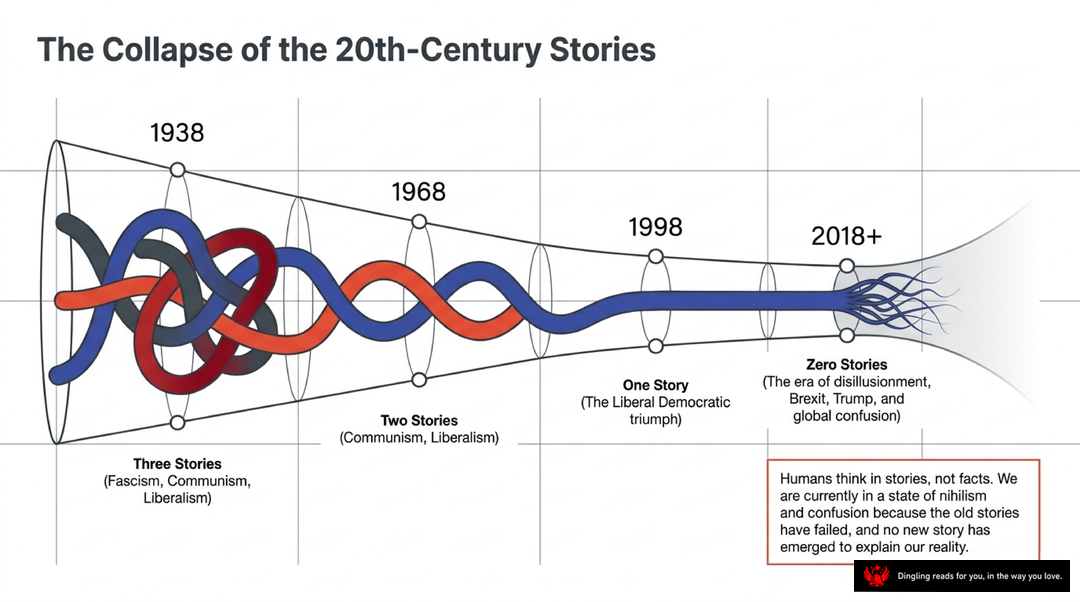
Take a look at this funnel. It visualizes the narrowing of our global narratives over time. In 1938, the world was a chaotic mix of three competing stories: Fascism, Communism, and Liberalism. They were all tangled together, fighting for who would define the future. It was a time of intense ideological warfare.
Fast forward to 1968. The lines start to separate. Communism began to lose its grip, leaving us with just two main narratives left on the table.
By 1998, the funnel gets even narrower. Liberalism seemed to have won. It became 'The One Story.' Democracy, free markets, globalization—it looked like the final answer. The world believed that this path was inevitable and that anyone who resisted would be left behind. There was a sense of triumph, a belief that history had a clear direction. But as the text notes, this was the era of the Liberal Democratic triumph, a myth that eventually collapsed.
But look at the end of the funnel, right here at 2018. The single blue line fractures into a messy tangle of thin strands. This is what the author calls 'Zero Stories.' We are in an era of disillusionment. Think about Brexit, Trump, and the current global confusion. The old story of liberal democracy has failed to explain our reality. The certainty of the past is gone. This shift from One Story to Zero Stories is what defines our current crisis. We are essentially in a vacuum of meaning.
The text at the bottom reminds us of a crucial truth: Humans think in stories, not facts. We need a narrative to make sense of the world. Right now, we are stuck in a state of nihilism and confusion because the old stories have collapsed, and no new story has emerged to replace them. We are left without a map, drifting in uncertainty.
So, what does this mean for us? It means we are standing at a crossroads. The certainty we had in the 90s is gone. We have to figure out how to live without a grand, unifying story. It's a challenging time, but acknowledging that we are lost is the first step to finding our way again. We need to build new meaning from the ground up.
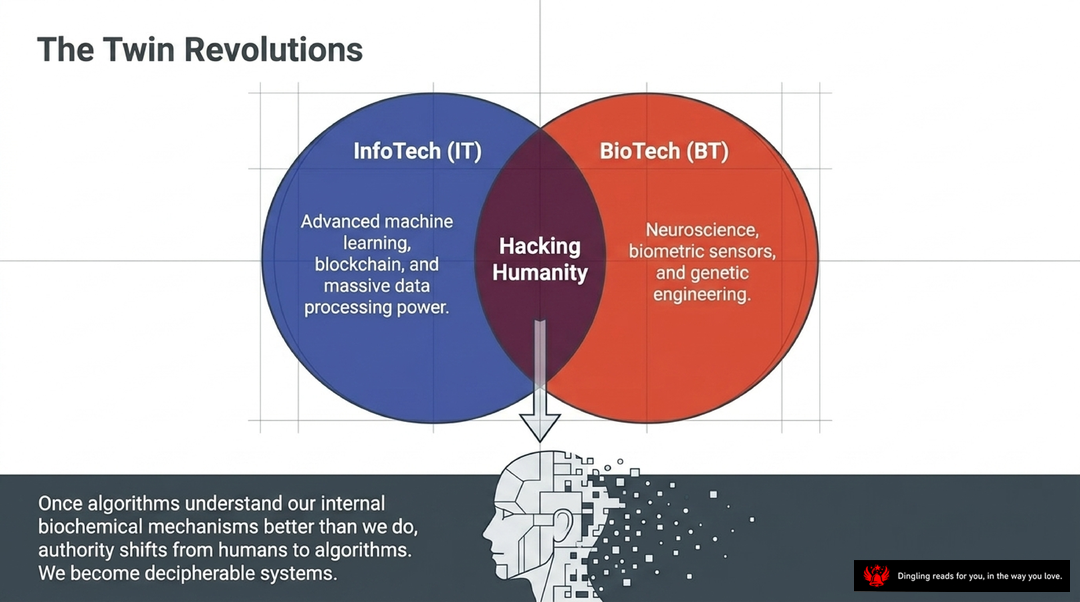
So, what are we looking at here? The Twin Revolutions. This diagram captures the two biggest forces reshaping our world right now. On the left, you have InfoTech. We're talking about advanced machine learning, blockchain, and massive data processing power. On the right, you have BioTech. That's neuroscience, biometric sensors, and genetic engineering.
When these two circles overlap, you get the intersection labeled Hacking Humanity. This is the critical point. It's not just about technology getting smarter; it's about technology getting to know us better. The text at the bottom of the slide puts it bluntly. It says, Once algorithms understand our internal biochemical mechanisms better than we do, authority shifts from humans to algorithms. We become decipherable systems.
Think about what that actually means. For centuries, we believed that our thoughts, our feelings, and our biology were our own private property. But now, the book warns us that this privacy is eroding. As the dual revolution accelerates, the gap between what we know about ourselves and what an algorithm knows about us is closing. Imagine a future where your mood, your stress levels, and even your genetic predispositions are all data points fed into a system that predicts your behavior more accurately than you can predict yourself.
When that happens, who holds the power? The authority shifts. We stop being the architects of our own lives and start becoming decipherable systems, optimized by code. This isn't just a sci-fi concept. The book points out that this shift is already happening. As information technology and biotechnology merge, they are fundamentally reconstructing the boundaries of work and life. We are moving from a world where humans made the decisions to one where algorithms do. We need to ask ourselves, are we still in control, or are we just data waiting to be processed?
The core question here is about value. If the machine knows us better than we know ourselves, what is the human value left? The book asks us to consider where our value lies when AI surpasses us in most tasks. It challenges us to find a balance between technological progress and human well-being. We cannot just accept this shift blindly. We need to understand that when we become decipherable systems, we lose the ability to hide our flaws or make private choices.
So, as we look at this Venn diagram, remember that the intersection isn't just a technical overlap. It's a fundamental change in human identity. We are standing on the edge of a new era where the definition of being human is written by code. The challenge for us is to ensure that in this new world, we remain the authors of our own story, not just the subjects of it.
Welcome back. Let's dive into the "Automation of Intuition."
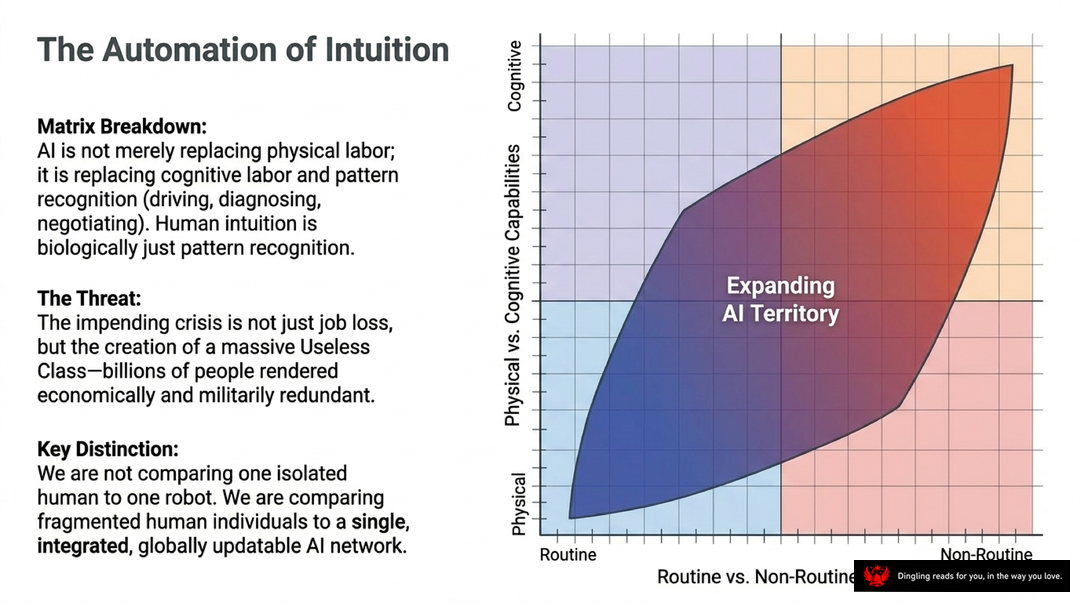
Look at that chart on the right. For decades, we've been worried about machines taking over our physical labor. We thought the factory floor was the last frontier. But that's a massive misunderstanding. As the text points out, AI isn't just replacing our brawn; it's replacing our brain. It's taking over cognitive labor and pattern recognition. Think about it: autonomous driving, diagnosing diseases, even negotiating deals. All of these rely on intuition, which biologically is just pattern recognition. And that's exactly what AI is getting better at. It's not just copying our actions; it's copying our thinking.
Now, here's the scary part. The threat isn't just losing a job. It's the creation of a "Useless Class." We're talking about billions of people who could become economically and militarily redundant. Imagine a world where your skills are no longer valuable because the machine can do them faster, cheaper, and more accurately. This isn't just about unemployment; it's about obsolescence.
This brings us to a crucial distinction that we often miss. We aren't comparing one isolated human to one robot. That's not the game anymore. We are comparing fragmented human individuals to a single, integrated, globally updatable AI network. The machine is learning from everyone, everywhere, instantly. You, as an individual, are just one data point in a fragmented system. The AI network is smarter because it is connected.
The text asks a hard question: "When AI is better at most tasks than humans, where is human value?" We can't just hope for new jobs to appear, because the new jobs often require high-level skills that the displaced workers don't have. It's a reality where the cognitive defense line is being broken.
Think about the specific examples listed: driving, diagnosing, negotiating. These aren't just tasks; they are the core of how we make decisions. When AI masters these, it masters the "intuition" part of being human. The text emphasizes that human intuition is biologically just pattern recognition. If AI does that better, the human advantage vanishes.
So, what do we do? We have to stop assuming the past will predict the future. We need to figure out where human value actually lies when intuition itself is automatable. It's a challenge that requires us to rethink our very definition of work and purpose. The question is no longer "can we do it?" but "why are we doing it?" when the machine can do it better. This is the reality we are facing.
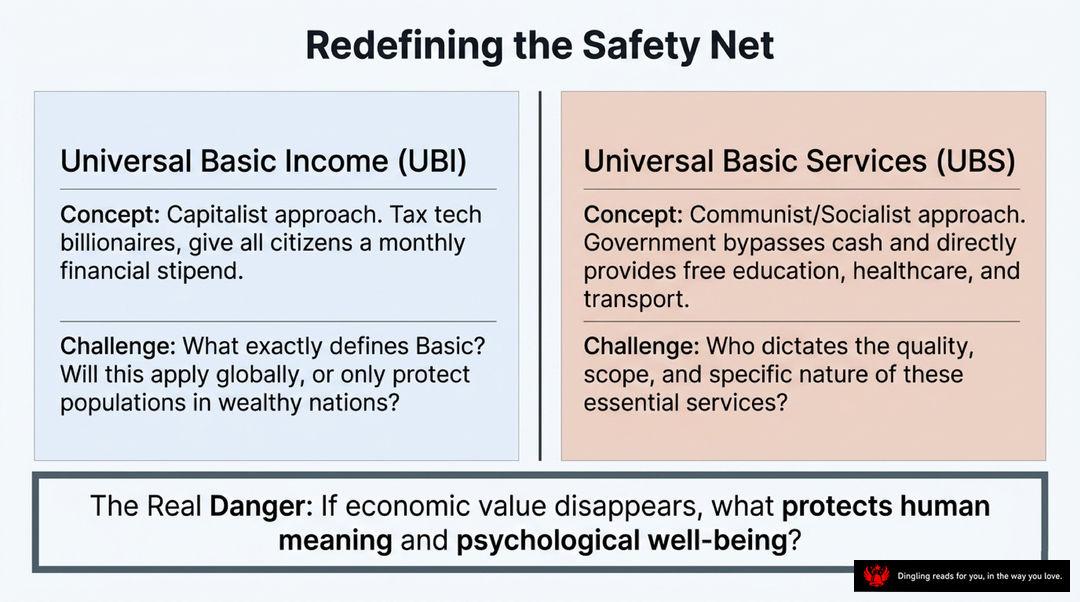
We are redefining the safety net. As automation and AI take over, the old ways of supporting ourselves are crumbling. We have two main paths to consider.
On the left, Universal Basic Income. The concept is straightforward: tax the tech billionaires who control the algorithms, and give every citizen a monthly financial stipend. But it faces a serious challenge. What exactly defines basic? Is it just food and shelter? And will this apply globally, or will it only protect populations in wealthy nations?
On the right, Universal Basic Services. Here, the government bypasses cash entirely. Instead, it directly provides free education, healthcare, and transport. But the challenge here is about control. Who dictates the quality, scope, and specific nature of these essential services? If the state runs everything, who ensures we actually get what we need?
The slide points us to a deeper issue. It asks: The Real Danger. If economic value disappears, what protects human meaning and psychological well-being? This is the scary part. For centuries, our worth was tied to our economic output. We felt valuable because we worked. But now, AI is surpassing us. If machines can do the work, and we survive on a stipend or free services, what happens to our identity? How do we find meaning?
We can fix the economy with UBI or UBS, but we can't easily fix the human condition. We need to figure out what gives life value when the traditional economic engine breaks down. It’s not just about money or services; it’s about finding a new way to feel like we belong and matter in a changing world. That’s the question we all have to answer.
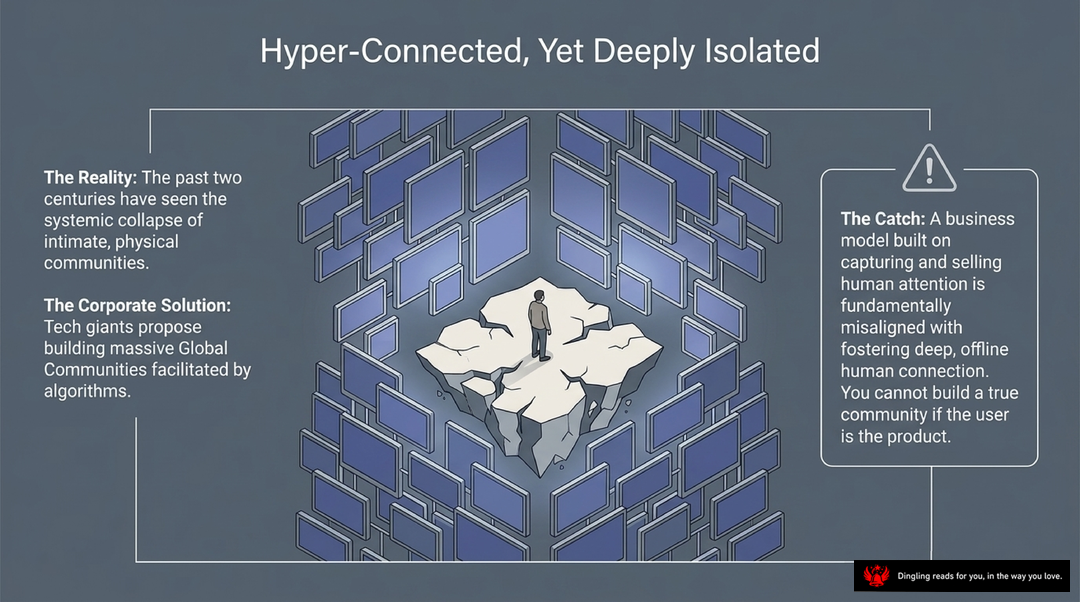
Look at this image. We see a single person standing on a broken rock, completely surrounded by a wall of screens. The title above it says, Hyper-Connected, Yet Deeply Isolated. It is a striking description of where we stand today. The book explains that the reality is clear: the past two centuries have witnessed the systemic collapse of intimate, physical communities. We used to gather in person, share meals, and build bonds face-to-face. Now, we are digitally connected but physically distant. We traded the living room for the living room of the internet, trading face-to-face conversations for likes and comments. Globalization and new technologies, instead of bringing us closer, have actually widened the class gap and created a sense of alienation. We are technically everywhere, yet spiritually nowhere.
Tech giants proposed a solution to this isolation. They suggested building massive global communities facilitated by algorithms. They promise us connection, a sense of belonging, and endless content. But here is the critical catch. As the slide warns, a business model built on capturing and selling human attention is fundamentally misaligned with fostering deep, offline human connection. These platforms are not designed to help us connect with each other; they are designed to keep us engaged with the screen.
Think about it. We trade our attention and personal data for free services. The book notes that data giants harvest our attention and information, often for free, because this data is far more valuable than the ad revenue they generate. The algorithms know us better than we know ourselves, feeding us content that keeps us scrolling. But this comes at a cost. You cannot build a true community if the user is the product. When your attention is the commodity, trust becomes a liability. Real connection requires vulnerability, presence, and the ability to sit with someone without a distraction. Algorithms cannot replicate that.
We are surrounded by screens, yet standing on a broken rock, isolated in the center. The digital world offers us a thousand voices, but it often leaves us with nothing to say to the person sitting next to us. This disconnect challenges us to ask: how do we reclaim our humanity from the digital noise? How do we find the offline connection that the screen cannot provide? We need to remember that while technology connects us to information, it does not necessarily connect us to each other. True community requires us to step off the rock and look each other in the eye. We must choose to prioritize the human connection over the digital engagement, even if it feels uncomfortable. Only then can we move from being isolated users to being connected humans.

So, let's take a closer look at this slide titled The Limits of the Nation-State. We see a balance scale, and it tells a story about where our current political system stands. On the left, we have a flag representing the local reality. The text here makes a crucial point: nationalism isn't necessarily bad. It provides a necessary psychological comfort and a sense of belonging in a confusing world. We crave identity, and nations give us that. It helps us navigate a rapidly changing landscape. It gives us a reason to care about our neighbors. But look at the right side of the scale. It is heavily weighted down with three blocks: Nuclear War, Ecological Collapse, and Technological Disruption. This is what the author calls The Global Triad. Here is the problem: these threats simply do not respect borders. Nuclear radiation doesn't stop at a national line. Climate change cannot be halted by a single country's policy. And AI and bioengineering are borderless scientific arms races. You cannot hide behind a wall when the technology is spreading globally. Consider these three blocks. Nuclear war means extinction. Ecological collapse means no future. Technological disruption means we don't know what's coming. These are the heavy weights. The text emphasizes that nuclear radiation respects no borders, and ecological collapse affects everyone regardless of where they live. Nationalism cannot solve planetary equations. The takeaway at the bottom is the key to moving forward. It acknowledges that local identity is acceptable, but it must be paired with global political cooperation. We need to realize that while we can love our home, we cannot fix the world alone. We are all on the same spaceship, and one crisis can bring us all down. So, the challenge isn't to reject our national identity, but to recognize that solving the big problems of the future requires us to look beyond the flag and work together across the globe. We need to pair our local love with global responsibility. If we don't, the weight on the right side will crush us all. This is the reality of our time.
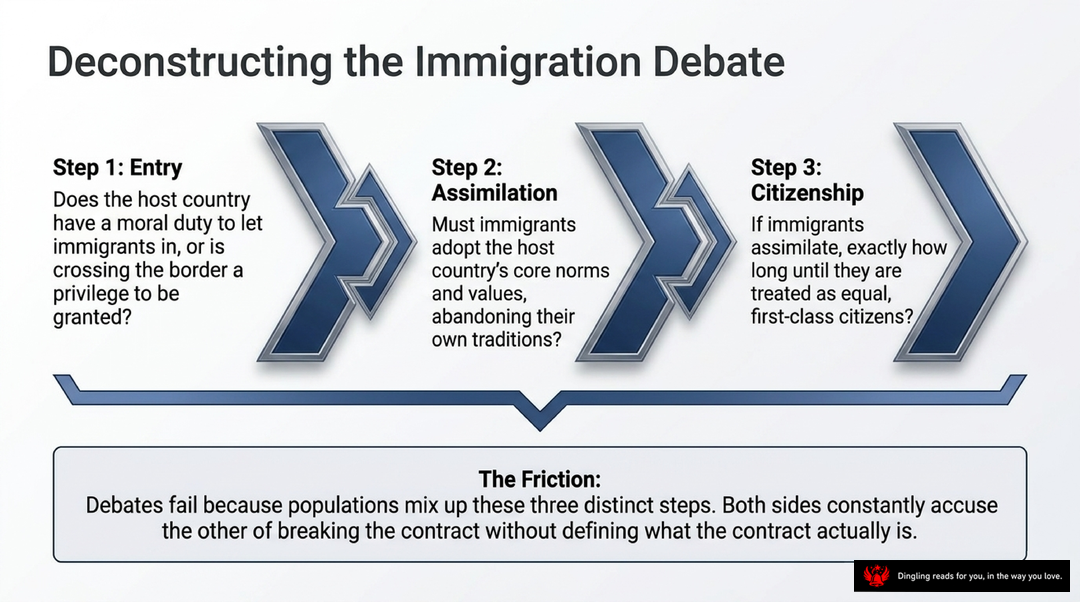
Let's take a step back and deconstruct the immigration debate. It feels like a shouting match, but underneath, it's actually a negotiation over a three-part contract. And the problem is, nobody agrees on the terms.
First, we have Entry. The core question is: Does the host country have a moral duty to let immigrants in, or is crossing the border simply a privilege to be granted? Supporters argue it's a moral responsibility, especially for those fleeing crisis. Opponents argue it's a matter of national sovereignty and resource allocation. Some countries even use illegal labor while denying legal status, creating a class divide.
Second is Assimilation. Once they are here, must immigrants adopt the host country's core norms and values, abandoning their own traditions? Pro-immigration advocates emphasize diversity and tolerance. Anti-immigration voices fear that without adopting local culture, the social identity gets diluted. It's a clash over what the country actually is.
Third is Citizenship. If immigrants assimilate, exactly how long until they are treated as equal, first-class citizens? Is it a generation, or a lifetime? This is where the timeline gets messy. For an individual, 40 years feels like forever. For a society, it's just a blink.
Here is the friction that makes the debate fail. Debates fail because populations mix up these three distinct steps. It's like a buyer and seller arguing over the same contract but reading different pages. Both sides constantly accuse the other of breaking the contract without defining what the contract actually is.
One side complains, "You're not assimilating fast enough." The other replies, "You're not granting citizenship fast enough." It's a cycle of mutual distrust. We need to be honest about the specific definitions. If we don't clarify the rules, we'll keep fighting over the same ground. The solution isn't more shouting; it's defining the actual deal. Assessing the agreement requires us to define the terms clearly. We also need to be careful not to focus only on breaches, ignoring the fact that most people are actually following the rules.

Let's dive into this slide titled Post-Truth Species. It's a provocative title, but the book reveals something counterintuitive. We aren't actually new to this.
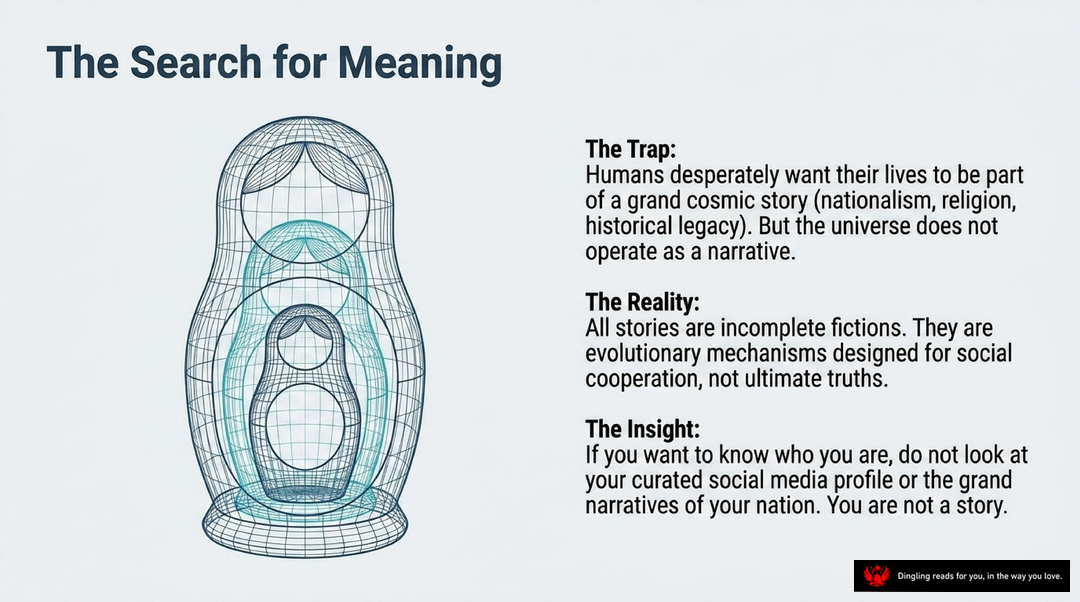
On the left, you see that ancient stone tablet. That symbolizes the reality. Homo Sapiens have always been a post-truth species. Our global dominance doesn't come from hard facts, but from our unique ability to believe in shared fictions. Money, corporations, nations, even gods—none of these exist in physical reality, yet they hold us together. We built civilization on these stories. Without these shared myths, we couldn't cooperate on a massive scale.
Now, look at the smartphone on the right. That represents the modern myth. We tell ourselves that we are entering an unprecedented new post-truth era. We feel like something has broken. But that's just a myth. We aren't inventing this now; we've been doing it for thousands of years. The tools have changed from stone tablets to screens, but the game remains the same. We are still relying on stories to unite us. The difference is just the speed at which these stories spread now.
And at the bottom, we have the dilemma. This is the core conflict. Truth and power are often mutually exclusive. Why? Because power requires uniting millions of people around a simple, shared myth. Truth, on the other hand, is often complex, painful, and highly divisive. It doesn't unite; it fractures. So, if you want power, you need the myth. If you want truth, you might lose power.
Understanding this tension is crucial. It explains why we see so much polarization today. It's not just about lies; it's about the cost of unity versus the cost of honesty. We need to recognize that we are always living in a story, and the challenge is deciding which stories serve us best. We have to ask ourselves: are we willing to sacrifice truth for the sake of unity, or do we risk division for the sake of honesty? That is the real question of our time.
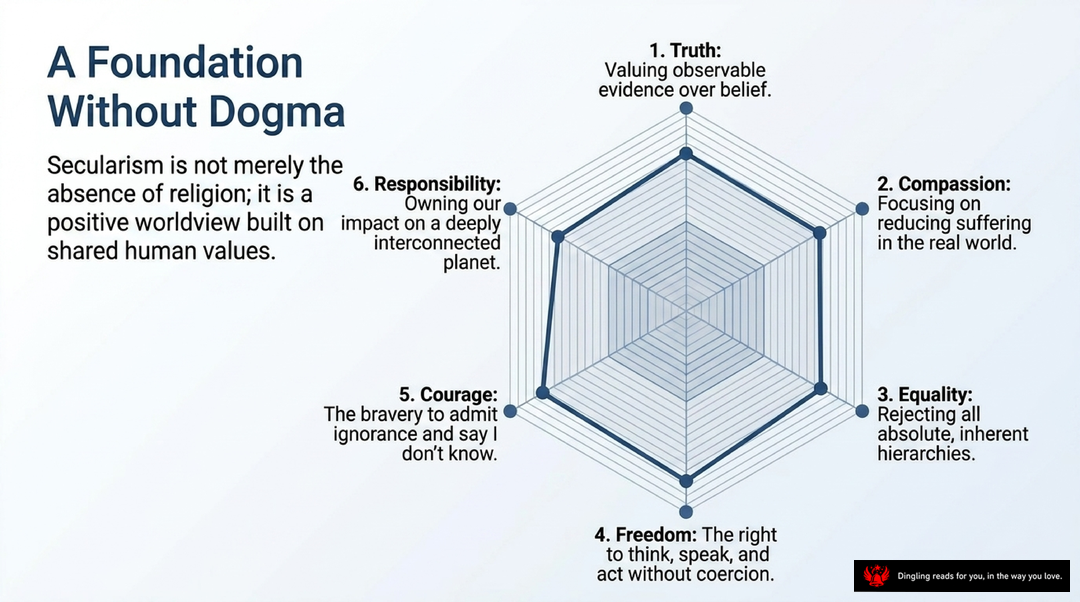
So, what is the foundation we need to build the future on? It's not about rejecting faith entirely, but about building a positive worldview based on shared human values. Secularism isn't just the absence of religion; it's a practical framework for how we live together. This concept, often called a foundation without dogma, is exactly what we need.
Take a look at this six-point model. It starts with Truth. This means valuing observable evidence over belief. We prioritize what we can verify, not just what we are told to believe.
Next is Compassion. This focuses on reducing suffering in the real world. It's not about following a divine commandment; it's about understanding that pain matters. We act ethically because it helps people, not because a book says so.
Then we have Equality. This involves rejecting all absolute, inherent hierarchies. It challenges the idea that some people are naturally superior to others based on race, gender, or status. Everyone deserves the same dignity.
Freedom is the fourth point. It's the right to think, speak, and act without coercion. But freedom isn't just doing whatever you want; it requires Courage. That's the bravery to admit ignorance and say, honestly, I don't know. In a world full of fake experts, humility is the most radical act of all.
Finally, Responsibility. This is about owning our impact on a deeply interconnected planet. We can't isolate ourselves anymore; our actions affect everyone.
Why does this matter? Because dogmatic systems often break when the world changes. This secular foundation is more resilient because it admits imperfection. It allows us to change when we are wrong. The book suggests that when choosing leaders, we shouldn't pick someone who claims to know everything. We should pick someone willing to admit they don't know. This flexibility is what allows us to navigate the complex challenges of the future, from AI to climate change. It's a foundation that doesn't break when the world changes around it.
Ultimately, this isn't just about politics or religion. It's about how we treat each other. When we stop relying on dogma and start relying on these six values, we create a system that can actually evolve. We stop fighting over who is right and start focusing on what works.
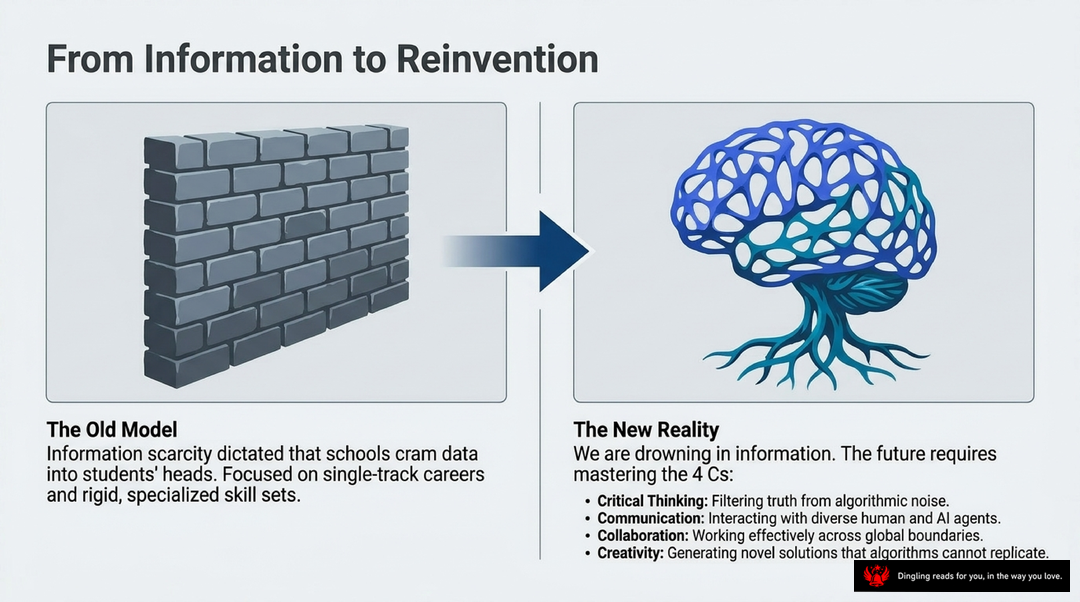
Welcome to this page. Look at the title: From Information to Reinvention. This slide illustrates the fundamental transformation of how we learn and work. On the left, we have "The Old Model." For a long time, information scarcity dictated the rules. Schools treated students like hard drives, cramming data into their heads. The focus was entirely on single-track careers and rigid, specialized skill sets. It was about memorizing what was known, because there wasn't enough to know otherwise. Students were expected to be passive recipients of knowledge, believing that the more facts they stored, the smarter they were.
But look at the arrow. It points to the right: "The New Reality." We are no longer information-poor; we are drowning in information. The challenge is no longer access; it's processing. The future requires mastering the 4Cs.
First, Critical Thinking. This means filtering truth from the noise of algorithmic feeds. We need to be skeptical and analytical. Second, Communication. It's not just talking; it's interacting with diverse human and AI agents. We have to learn to collaborate with machines, not just compete with them. Third, Collaboration. We must work effectively across global boundaries, breaking down the silos of the past. We need to understand different cultures and perspectives. And finally, Creativity. This is the one thing algorithms can't replicate. It's about generating novel solutions that machines can't dream up. It's about being the innovator, not just the executor.
This shift means education itself needs reinvention. We can't just fill buckets anymore. We need to light fires. As the text notes, lifelong learning is now a necessity, not a bonus. We must be ready to constantly reshape ourselves. If we stick to the old model, we are preparing students for a world that has already changed. We need to cultivate these four cognitive muscles now. In an age of information overload, your ability to think, connect, and create is the only currency that truly matters. This is how we move from being passive consumers of information to active architects of the future. We are no longer just learning for a job; we are learning to survive and thrive in a rapidly evolving world.
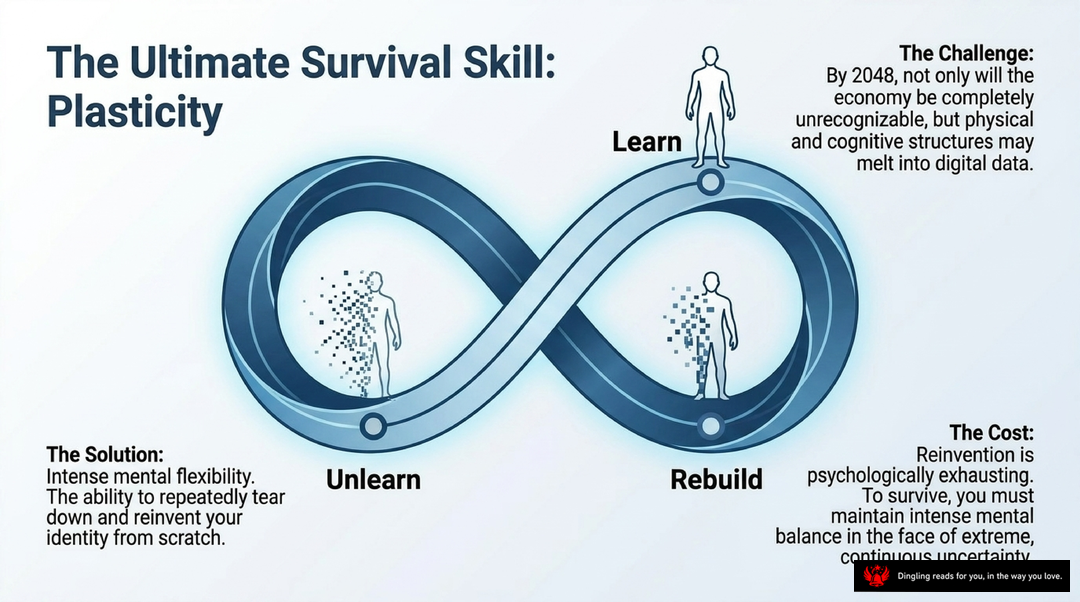
So, what is the ultimate survival skill for the next century? It's Plasticity. Imagine a timeline where, by 2048, not only will the economy be completely unrecognizable, but physical and cognitive structures may melt into digital data. That is the challenge we face.
The solution lies in intense mental flexibility. You need the ability to repeatedly tear down and reinvent your identity from scratch. Look at this cycle: it starts with Unlearn, then moves to Rebuild, and finally Learn. It's a continuous loop of transformation. You can't just hold onto the past; you have to actively dismantle your old self to make room for the new.
Why is this so critical? Because the technology revolution is fundamentally reconstructing the boundaries of work. AI and machines are no longer just competing with our physical labor; they are catching up with our cognitive skills. If you rely on outdated knowledge, you're left behind. New jobs will require high-level expertise, but for many, the path to retraining is almost impossible. We often suffer from a knowledge illusion, thinking we understand things we don't, which makes this shift even harder.
However, there is a heavy cost to this process. Reinvention is psychologically exhausting. To survive, you must maintain intense mental balance in the face of extreme, continuous uncertainty. It's not just about learning new tools; it's about managing the stress of constantly changing who you are. In the past, we could learn once and work for a lifetime. Today, that linear model is broken. Stability is a luxury. Everyone needs to be ready to constantly reshape themselves.
The ultimate goal of education shouldn't just be filling your head with information, but teaching you how to coexist with change. You need to cultivate a flexible mindset to find your inner anchor amidst the chaos. Education experts agree that lifelong learning is now a survival necessity. So, plasticity isn't just a buzzword. It's the ability to adapt when the ground beneath you shifts. It's about accepting that your identity is a story you can rewrite. Without this mental flexibility, the future will pass you by, leaving us unable to navigate the unknown.
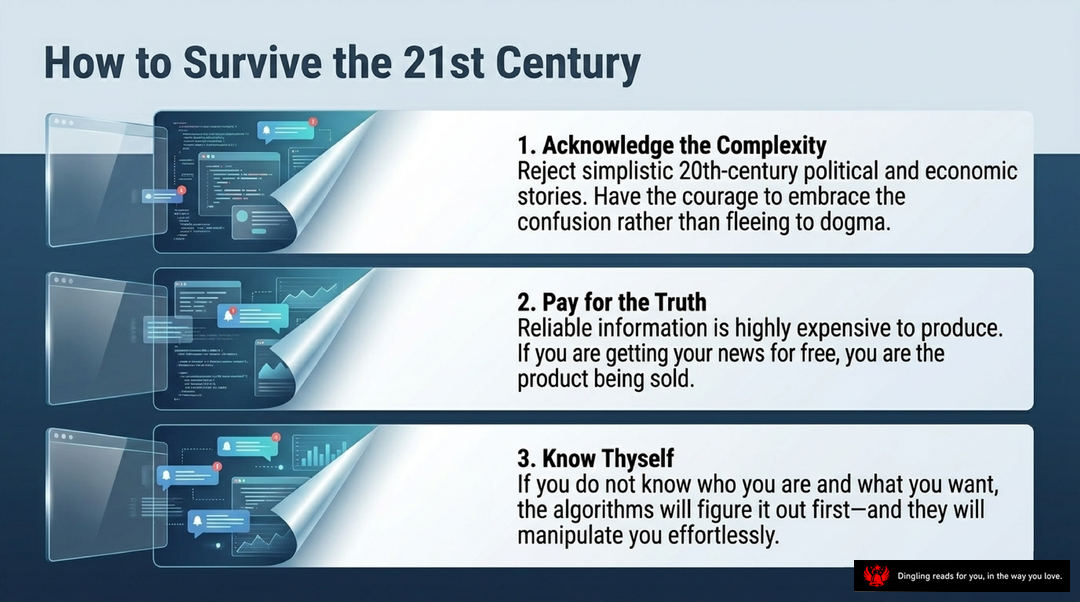
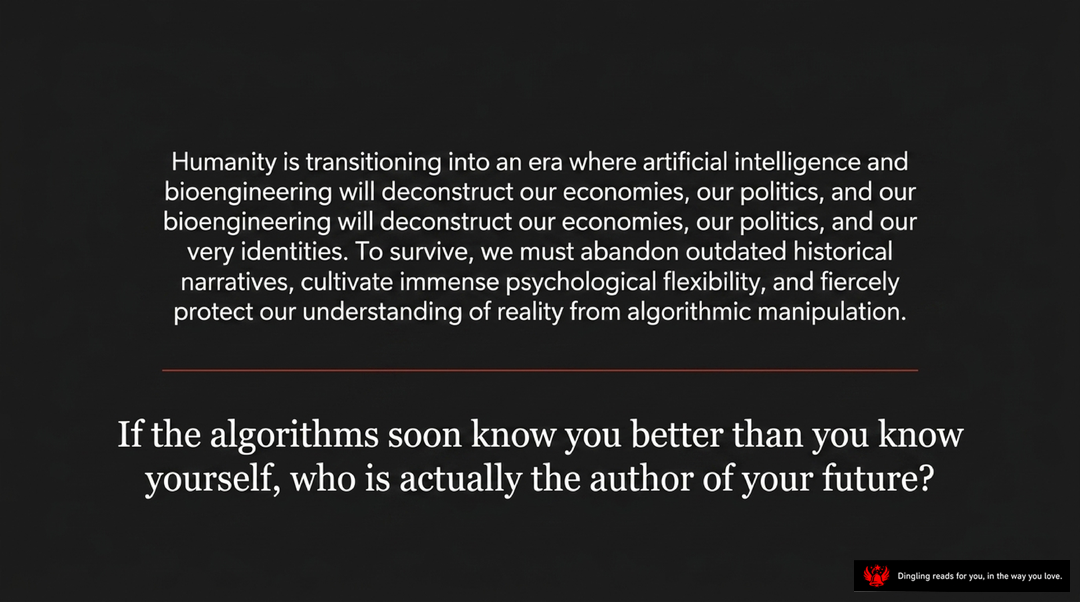
Today, we're facing a massive shift. As this slide states, humanity is transitioning into an era where artificial intelligence and bioengineering will deconstruct our economies, our politics, and our very identities. This isn't just a technological upgrade; it's a fundamental rewrite of what it means to be human.
We've discussed how the old stories are fading. We're entering a 'zero-story' era where no single narrative holds the truth. The slide tells us we must abandon outdated historical narratives. Why? Because clinging to the past blinds us to the present. To survive, we must cultivate immense psychological flexibility. We can't be rigid; we need to adapt to a world that changes faster than we can.
But here is the real danger. The slide asks a chilling question: 'If the algorithms soon know you better than you know yourself, who is actually the author of your future?' Think about that. Algorithms are already shaping our choices, our news feeds, and even our deepest desires. We are trapped in echo chambers where we only see what we want to see. If they understand us better than we do, aren't we just data points in their system? We risk losing our agency.
To fight this, we need to fiercely protect our understanding of reality from algorithmic manipulation. We can't let the 'post-truth' era rewrite what is real for us. We have to stop blindly trusting the narratives sold to us by big tech. But if algorithms decide what is 'better' for us, we lose the right to choose.
How do we do that? By looking inward. The book suggests that understanding our own minds is the key. We need to practice self-awareness, perhaps through mindfulness, to see how our own thoughts are formed, rather than just reacting to external noise. If we can't control our own minds, algorithms will control them for us.
So, who is the author of your future? It's not the code, and it's not the algorithm. It's you, but only if you stay awake. We must cultivate the wisdom to navigate this new world without losing our humanity. We need to stop being passive consumers of information and become active creators of our own lives. Let's keep that question in mind as we move forward.