
A Complaint Free World: Complete Chapter-by-Chapter Summary

Welcome to "A Complaint-Free World" by Will Bowen. This isn't just about being nice; it's about reclaiming your life from the invisible weight of negativity.
Look at this purple ring. It's the symbol of a powerful movement: stopping the habit of complaining and starting to enjoy the life you've always wanted.
Here's the truth: most of us are like fish in water. We don't realize we're complaining until someone points it out. We complain about the weather, our jobs, our bodies, even the news. But there's a difference between stating a fact and complaining. Saying "It's hot" is a fact. Sighing and saying "This heat is unbearable" is a complaint. The energy behind the words changes everything.
When we complain, we're essentially telling our brain, "I'm a victim. This is unfair." And our brain listens. It starts producing more negative thoughts, which can actually harm our health and relationships. But when we choose gratitude instead, we shift our focus to what's good. And here's the magic: reality often shifts to match our focus.
So, how do we break this cycle? By using a simple tool: this purple ring. Every time you catch yourself complaining, move the ring to your other hand. Start over. It's not about perfection; it's about awareness. By repeating this action, you're training your brain to notice the negative thoughts before they take root, replacing old habits with new ones.
Imagine your life as a baseball being painted. Every complaint adds a layer of dark paint, making the ball heavier and smaller. Every moment of gratitude adds a layer of bright paint, expanding your life. You have the power to choose which paint to use. Let's stop complaining and start painting a brighter future.
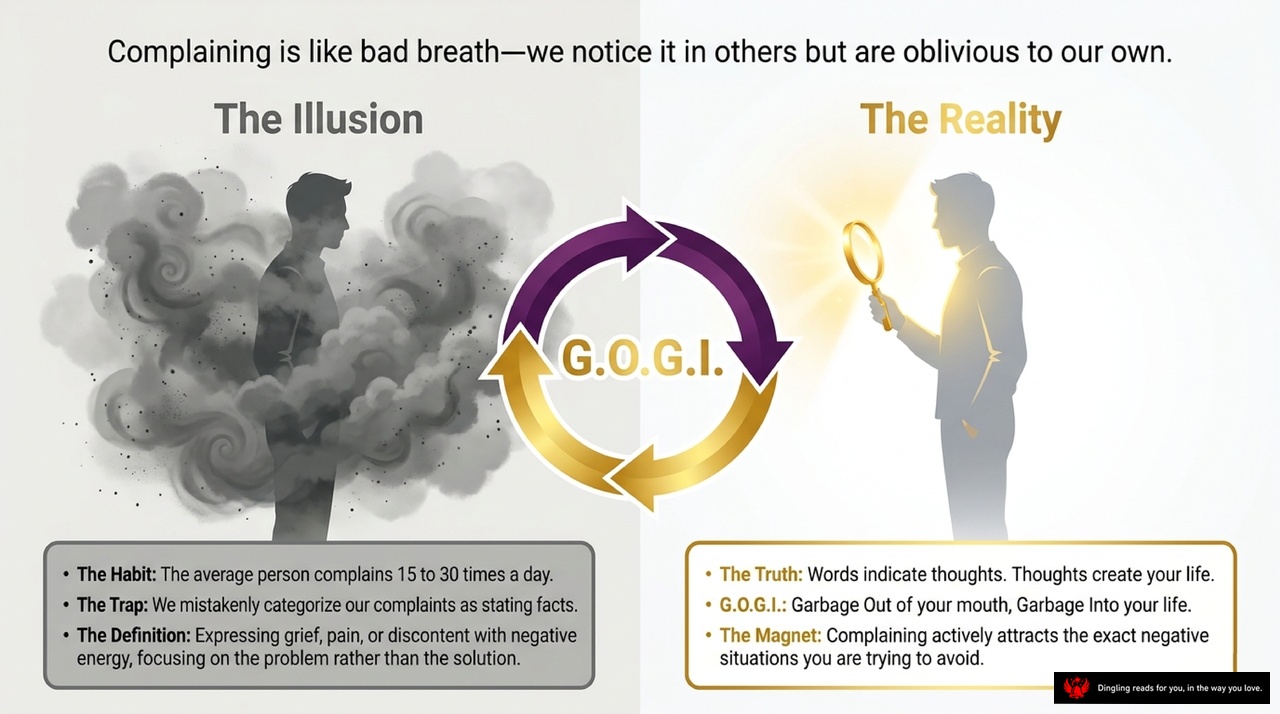
Complaining is like bad breath—we notice it in others but are oblivious to our own. Have you ever wondered why we seem so quick to spot negativity in others, yet blind to our own? This slide breaks down the difference between The Illusion and The Reality.
On the left, under The Illusion, we see the trap. The average person complains 15 to 30 times a day, yet we mistakenly categorize these complaints as stating facts. We think we are just expressing grief or pain, but the definition of complaining is actually expressing discontent with negative energy, focusing on the problem rather than the solution. It's a habit that keeps us stuck.
But look at the right side, The Reality. Here, the truth is revealed: words indicate thoughts, and thoughts create your life. This is where the G.O.G.I. principle comes in—Garbage Out of your mouth, Garbage Into your life. You might be surprised to learn that complaining actively attracts the exact negative situations you are trying to avoid. It acts like a magnet for bad energy.
The image shows a person surrounded by dark smoke, representing how complaining clouds our vision, while another person holds a magnifying glass, symbolizing the clarity we gain when we stop. By shifting from the illusion of "just stating facts" to the reality of "creating our life," we can break this cycle. Remember, if you want a positive life, you must first stop feeding your mind with garbage thoughts.

Imagine a purple bracelet on your wrist. It's not just an accessory; it's a trap designed to catch your negative emotions. Here is how it works: You start by placing the bracelet on either wrist on Day One. But the moment you complain, criticize, gossip, or use sarcasm, you have to move it to the opposite wrist. That simple action resets your progress, sending you immediately back to Day One. It sounds frustrating, right? But that's the point. Most people take four to eight months to achieve the goal: wearing the bracelet on the same wrist for twenty-one consecutive days without moving it.
This mechanism teaches us a hard truth about our habits. We are often like fish in water, completely unaware of the air around us until we try to hold our breath. Similarly, we rarely notice how often we complain about the weather, our jobs, or even our spouses. We think we are making fact-based statements, but often, we are just pouring out negative energy. The bracelet forces you to become aware of every single time you slip into that negative pattern. It stops you from justifying your complaints as harmless observations. Instead, it challenges you to pause, breathe, and choose a different way of speaking. By repeatedly resetting your progress, you aren't just counting days; you are actively replacing an old, destructive habit with a new, conscious one. You are training yourself to stop being a consumer of negative thoughts and start building a life where gratitude and positive expression are the default.

So, let's look at this slide. We're diving deep into the hidden psychology behind why we complain. It's not just about venting; it's about five specific, often unconscious drivers.
First up, we have "Get Attention." Think about that classic line: "You won't believe the terrible day I had." We complain not because the day was actually that bad, but because we want to be seen. We want validation. The disarming tactic here is simple but powerful: instead of defending yourself, just ask, "What is going well for you today?" You shift the focus from their drama to their wins.
Next, we see "Remove Responsibility." This is the "victim mindset" in action. When someone says, "That's impossible. It won't work," they aren't looking for a solution; they're building a wall to protect themselves from failure. The trick here is to challenge the impossibility gently. Ask them, "If it were possible, how would you do it?" This forces their brain to shift from "why can't I" to "how can I."
Then there's "Inspire Envy." Have you ever heard someone say, "My boss is such an idiot"? It's rarely about the boss; it's about making themselves look smarter. The counter-move is to compliment the opposite trait. Instead of arguing, say, "I admire how patient you are." You disarm their need to feel superior by validating the very quality they are criticizing.
We also have "Power." This is about creating a tribe. When someone says, "Can you believe what Sarah did?" they are trying to rally you against an enemy. Don't join the team. Instead, encourage direct communication. Tell them, "It sounds like you and Sarah need to talk directly." You refuse to be the weapon in their war.
Finally, we have "Excuse Poor Performance." This is the most common one. "I failed because I didn't get the email." It's a rationalization for laziness or poor planning. The fix is to look forward, not backward. Ask, "How will you plan to avoid this next time?" You turn a complaint about the past into a strategy for the future.
Basically, every time we complain, we're playing a game to get something—attention, an excuse, envy, power, or a safety net. But the moment we recognize these hidden motives, we can disarm them with a simple question or a shift in perspective. It's about stopping the automatic pilot and taking control of the narrative.
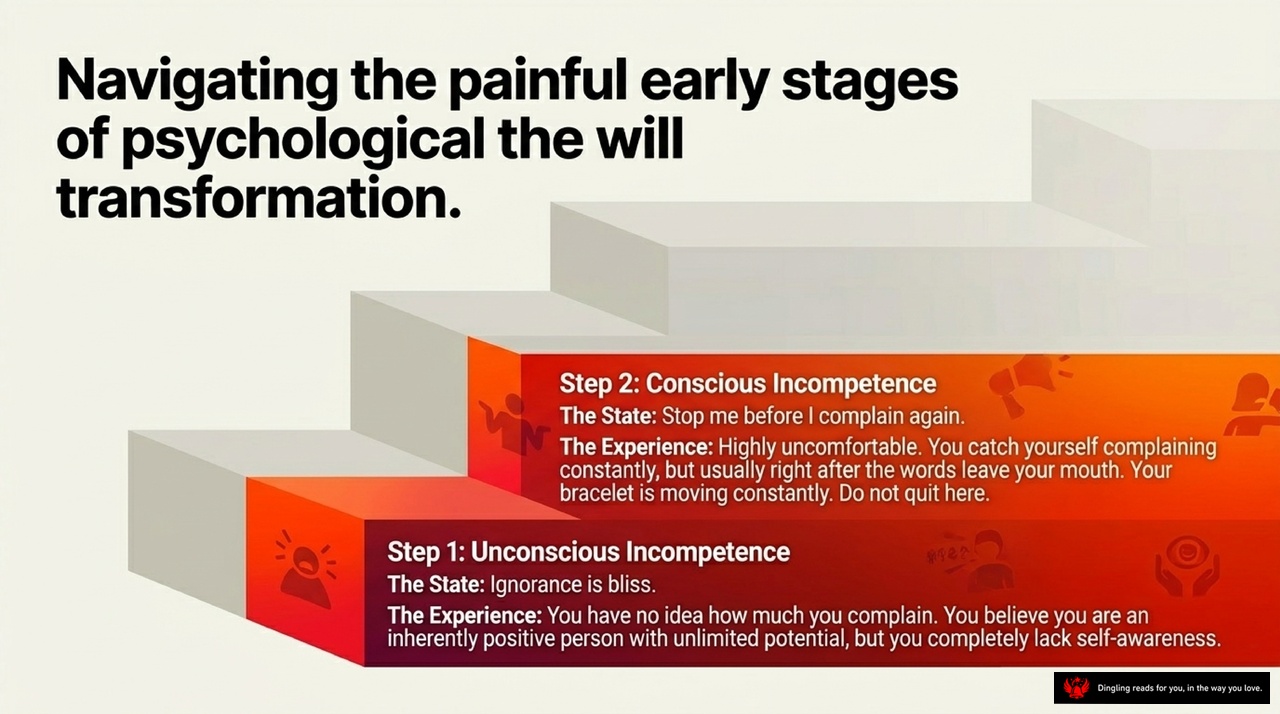
Navigating the painful early stages of psychological transformation often feels like climbing a steep, unfamiliar staircase. Today, we focus specifically on the second step: Conscious Incompetence. This is the stage where you realize you were wrong all along. As the slide illustrates, the state here is simply saying, "Stop me before I complain again." The experience is highly uncomfortable. You catch yourself complaining constantly, usually right after the words leave your mouth, and you feel a constant urge to quit. But do not quit here.
This discomfort is actually the most critical signal that real change is beginning. In the book, we learn that complaining is often an unconscious habit, like a fish unaware of the water it swims in. Many people, like the character Matty Point, only realize how much they complain after a specific challenge. They discover they are venting anger at work, complaining about their bodies, or even sighing at the weather, all without noticing it happening. This lack of self-awareness is the hallmark of the first step, Unconscious Incompetence, where ignorance is bliss.
However, once you become aware of this behavior, you enter Conscious Incompetence. You know you are doing it, but you cannot stop. It feels like a struggle. The book uses the metaphor of a purple bracelet to help manage this. Every time you complain, you move the bracelet to the other hand and start over. It is a painful process. You might fail after ten days of success, or even break several bracelets in frustration. But this repetition is exactly what breaks the old habit. Just as a baseball painted with thousands of layers of paint becomes a heavy, distorted object, our daily complaints slowly reshape our lives into negativity. By consciously moving that bracelet, you are actively replacing that layer of negative paint with a layer of awareness and positive intention. This painful awareness is the bridge from not knowing you are stuck, to knowing you have the power to change.

Rewiring your brain's default settings to achieve unconscious mastery is the ultimate goal of this journey, and we are currently standing right at the top of that transformation. As shown on this slide, we've reached Step 4: Unconscious Competence. Think of it as becoming a "blind cave fish." Just as these fish lose their eyes over generations because they are useless in the dark, your brain eventually shuts down its "complaint factory" when you consistently choose positivity. It stops manufacturing negativity because you no longer feed it.
But to get here, you had to pass through Step 3: Conscious Competence, known as "The Power of Silence." In this stage, you catch a complaint right before you speak. You utilize Spiritus—your breath—to pause and filter your words. You might find conversations feature awkward silences as you search for positive phrasing instead of falling into old habits.
It all started back at Step 1: Unconscious Incompetence. That's where "ignorance is bliss." You have no idea how much you complain. You believe you are an inherently positive person with unlimited potential, but you completely lack self-awareness. You are like a fish unaware of the water surrounding it, completely oblivious to the negativity bubbling up from your own mouth.
The magic happens when you move from knowing you need to change, to doing it automatically. When you master this, positivity and gratitude become your effortless, automatic reflex. You stop buying negative thoughts from your brain's production line. You realize that no matter what happens, your perspective is the only reality that truly matters. By rewiring these default settings, you don't just stop complaining; you unlock a state of effortless mastery where your life simply flows with grace and joy.
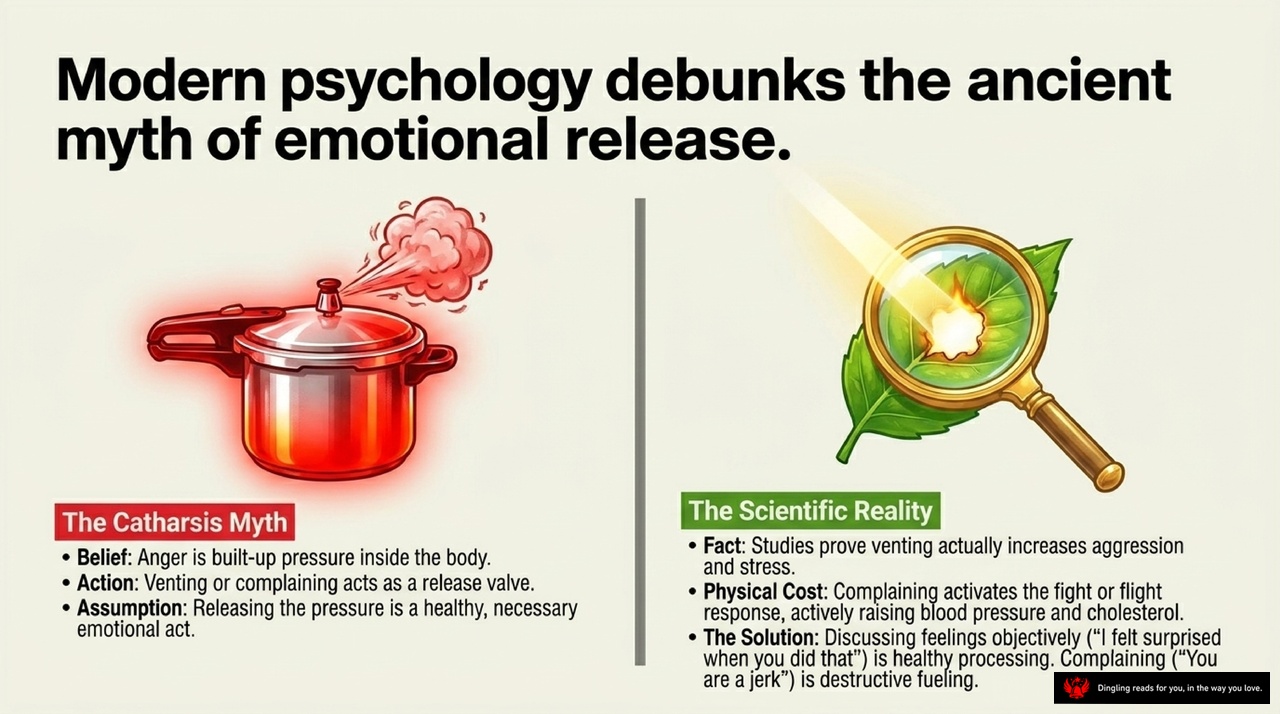
Have you ever noticed how a simple comment can instantly shift the entire mood of a room? It happens constantly, almost like an invisible force pulling everyone in the same direction. Psychologists call this "chiasmus" or the "chicken effect"—a concept where one person's emotion acts like a gravitational pull, dragging the behavior of everyone around them.
Think about it: when someone starts complaining about their bad day, what happens? Pretty quickly, the whole group joins in. They start sharing their own worst stories, turning a casual chat into a competition of misery. Who has it worse? Who suffered the most? It becomes an invisible game where the goal is just to be the most pitiful. This is exactly what happens in the "Four Yorkshiremen" sketch from Monty Python, where four gentlemen escalate their complaints until one guy claims he was killed by his parents and is now dancing on their graves. It's absurd, yet it reveals a painful truth: we often trade our genuine connection for a contest of who is the biggest victim.
But here's the good news: this effect works both ways. If you start talking about the small wins in your life, the little joys, and the things you're grateful for, the energy in the room shifts. People will naturally mirror that positivity. They'll start looking for the good stuff too, just like they did when the negativity took over.
So, how do you become that positive "lead bird" in the flock? The answer is simple: start with yourself. You don't need to convince anyone else to change. You just need to change your own direction. When you choose gratitude over grievance, when you speak with hope instead of fear, you become the new gravitational force. Your friends, family, and colleagues will naturally follow your lead. As Gandhi wisely said, "Be the change you wish to see in the world." By simply refusing to complain, you have the power to lift the entire group out of the negativity trap and into a brighter, more connected future.
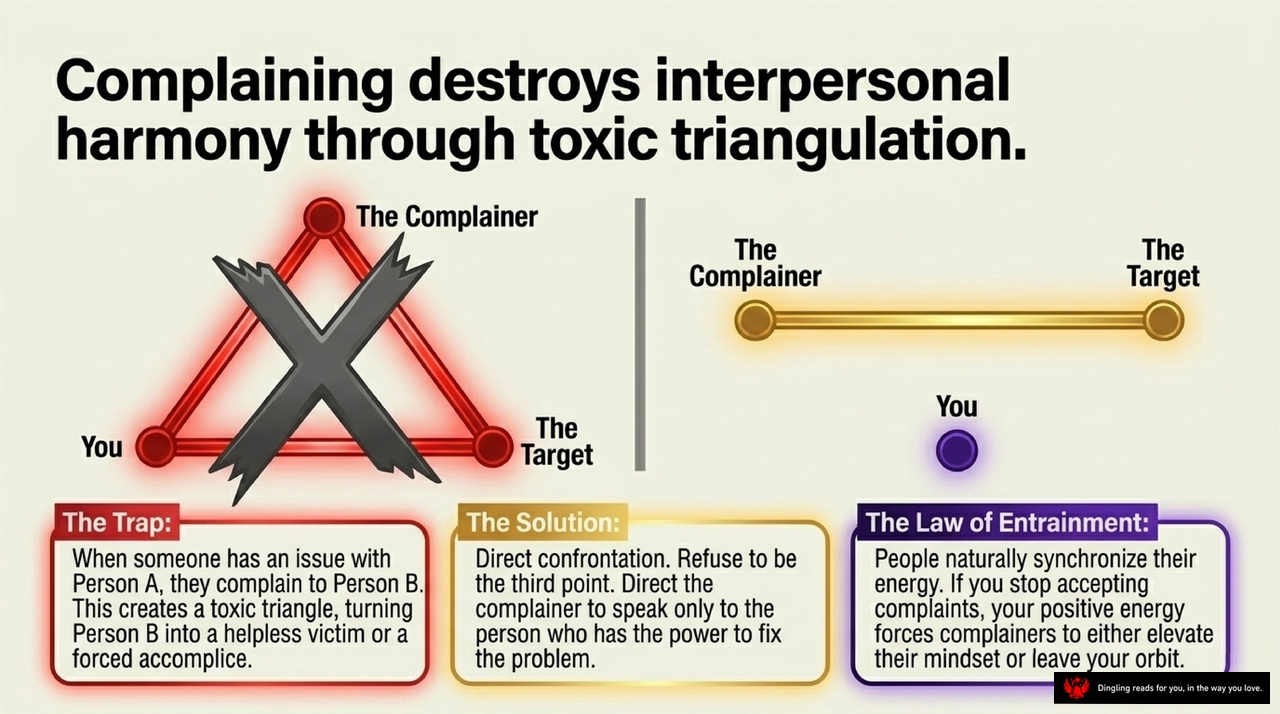
Complaining doesn't just vent frustration; it actively dismantles the harmony between people through a psychological trap known as "toxic triangulation." Look at this diagram on the left. It shows a red triangle connecting "You," "The Target," and "The Complainer." This is the trap. When someone has an issue with Person A, instead of talking directly to them, they complain to Person B. This creates a toxic triangle, turning Person B into a helpless victim or a forced accomplice. It pulls you into a three-way conflict where the real problem never gets solved, and relationships fracture under the weight of indirect communication.
But there is a solution, as shown on the right side of the slide. Instead of forming that destructive triangle, we shift to a direct line connecting "The Complainer" and "The Target." You, the third party, step out of the equation entirely. The rule is simple: direct confrontation. Refuse to be the third point. Direct the complainer to speak only to the person who actually has the power to fix the problem. This breaks the cycle of gossip and forces accountability.
Furthermore, remember "The Law of Entrainment." People naturally synchronize their energy like birds in a flock. If you stop accepting complaints and refuse to join the negative frequency, your positive energy forces complainers to either elevate their mindset or leave your orbit. You become the leader of that flock. By choosing direct, positive communication, you don't just solve one problem; you change the entire emotional climate of your relationships.

Have you ever noticed how a single shift in perspective can completely rewrite your reality? The slide you're seeing right now captures the heart of that transformation. It's not about ignoring problems; it's about changing the very vocabulary we use to describe them. Look at these powerful swaps: "Problem" becomes "Opportunity," "Setback" turns into a "Challenge," and even an "Enemy" transforms into a "Teacher." Finally, the phrase "I have to" shifts to the liberating "I get to." This isn't just semantics; it is a fundamental reconstruction of your worldview.
As we discussed, our language shapes our world. When we stop complaining and start reframing our experiences, we stop buying into negative thoughts. We realize that happiness isn't the absence of difficulties, but a conscious, deliberate choice to focus on the blessings already present in our lives. Just like the story of the blind fish that evolved to thrive in darkness, or the woman who found joy by honking her horn, your ability to change your words gives you the power to change your life. By choosing these new perspectives, you stop being a victim of circumstance and start becoming the architect of your own happiness.
Complaining is the ultimate illusion of control. It drains our energy, alienates our allies, and binds us to the very problems we wish to escape. By committing to 21 days without complaining, criticizing, or gossiping, we do not just change our vocabulary—we fundamentally rewire our brains to seek out abundance, gratitude, and solutions. When we stop verbalizing the garbage, the garbage stops entering our lives.
Think about this: if your words shape your world, what kind of world will you speak into existence today? The choice is yours.