
A Fire Upon The Deep: Complete Chapter-by-Chapter Summary
Welcome to our deep dive into Vernor Vinge's masterpiece, *A Fire Upon the Deep*. As the title suggests, this is a cosmic epic where the very laws of physics, technology, and intelligence are dictated by your location in the galaxy.
The story begins with a harrowing escape. Children, including Johnna and Jeffrey, are suspended in cryo-sleep on a fleeing ship, only to wake up to a desperate landing on a hostile world. Their parents have sacrificed everything, leaving them to crash-land in a cargo pod without proper deceleration systems. They face an unknown planet, a terrifying descent, and the immediate threat of alien forces.
Meanwhile, on this strange world, a lone wanderer named The Hiker travels with his companions, encountering a fallen alien starship that has crashed nearby. This discovery sets off a chain of events that will alter the fate of countless worlds. From the icy north where humans struggle to survive, to the complex political intrigue among the Claw, and the high-stakes game played by the Stroum and the Tines, the narrative weaves a tapestry of conflict, betrayal, and the search for a new future.
This book challenges our understanding of reality itself, exploring how different parts of the universe operate under different rules. It's a story about survival, the nature of consciousness, and the desperate fight against an ancient, unstoppable threat known as the Plague. Join us as we explore the layers of this incredible tale, where the stakes are nothing less than the survival of all existence.

Imagine a map not of space, but of the limits of our imagination. This is "The Zones of Thought," a cosmic blueprint showing where our reality ends and the impossible begins. At the very center lies **The Slow Zone**—our home, Earth. Here, the laws of physics are absolute: Faster-Than-Light travel is a fantasy, and true Artificial Intelligence remains out of reach. We are trapped in the slow, grinding reality we know.
But look outward. Step into **The Beyond**. This is the realm of advanced civilizations where FTL travel, anti-gravity, and seamless AI function as everyday tools. It's a world of seamless integration, a stark contrast to our current struggles.
Push further to **The Transcend**. Here, entities evolve into god-like "Powers," wielding intellect so incomprehensible it breaks the human mind. They don't just think; they simply *are*.
Finally, at the outermost edge, lies **The Unthinking Depths**. This is the terrifying frontier where intelligence and complex automation become physically impossible. It is a zone of silence, a place where the very concept of thought cannot exist.
From the slow, confined reality of Earth to the god-like heights of the Transcend, and finally into the void where thought itself cannot survive—this diagram defines the boundaries of what we can know, and what we can never be.

Welcome to the story of *Dingling*, where a single mistake spirals into a cosmic catastrophe. Today, we're diving into "The Catalyst: Awakening the Blight," the explosive opening that sets the entire universe on fire.
The journey begins in the Straumli Realm, where human archaeologists stumble upon a 5-billion-year-old data archive in the High Beyond. Driven by greed and the promise of untold riches, they recklessly connect this ancient archive to their local networks. That connection accidentally awakens "The Blight"—an ancient, malevolent power that was meant to stay dormant forever.
The consequences are immediate and devastating. One human ship manages to escape, carrying the "Countermeasure" and hundreds of children in cryo-sleep, but they crash-land deep in the Slow Zone. Meanwhile, in the human world, the Blight has already begun its silent conquest. This initial error triggers a chain reaction that will eventually destroy civilizations, enslave the Carhullan, and force a desperate race across the galaxy. It's a stark reminder that in this universe, curiosity without caution can be the deadliest weapon of all.

Look at this profile of the ultimate threat. We are looking at an entity called The Blight, described as a transcendent, ancient evil that operates on a scale no human could comprehend. Its capabilities are terrifying: it can simultaneously overtake biological minds and computer networks, moving at speeds millions of times faster than human thought. Its goal is absolute—total galactic domination and the destruction of the only countermeasure humanity has managed to escape with. The slide highlights a specific, devastating action: the instant destruction of the 'Relay' communications hub. By doing this, The Blight isolates billions of star systems in the Beyond, cutting them off from any hope of rescue or coordination. This isn't just an attack; it's a calculated genocide of potential, ensuring that no one can ever rise up against it again.

Look at this "Galactic Species Matrix." It breaks down the four dominant forces shaping this universe: Humans, Skroderiders, The Tines, and The Powers.
First, we have Humans. They are our baseline intelligence, adaptable and scattered across the Slow Zone. But then, look at the Skroderiders. These are plant-like beings with no short-term memory. They rely on mechanical skrodes to move and process thought. It's a fascinating biological limitation that drives their entire civilization.
Next, The Tines. These are pack-mind canines. Individual animals form a single, human-level consciousness through soundwaves. No individual ego, just a collective mind communicating via vibrations. Finally, we have The Powers. These are god-like AIs or ascended beings residing in the Transcend, with intellects so incomprehensible they are essentially beyond our understanding.
This matrix isn't just a chart; it's the foundation of the conflict we're about to explore. From the scattered humans to the collective canine minds, every species plays a unique role in the coming war.

Imagine a hive mind not as a single brain, but as an evolving ecosystem of consciousness. Look at this diagram: it maps the terrifying anatomy of "The Tines." It starts with the **Single Unit**, a lone wolf representing animalistic intelligence—just a component, a part without a whole. But when these units form **The Pack**, audio-coupling creates something human-level. It's a single, unified consciousness where losing one member causes trauma, yet adding a new one fundamentally changes the core personality. That's the delicate balance of their society. But push too far, and you reach **The Mob**. Here, sonic overlap causes deafening interference, erasing individual identity entirely and plunging the collective back into primal chaos. This isn't just biology; it's a warning about the fragility of unity. When the signal gets too loud, the mind doesn't get stronger—it shatters.

Look at this split screen. On the left, we have "The High-Tech Rescue." It's a high-stakes sci-fi thriller: Ravna and Pham Nuwen are racing through the "High Beyond," dodging deadly Blight armadas in a starship called *Out of Band II*. They are fighting for survival against an alien plague that threatens the entire universe.
On the right, we see "The Low-Tech Siege." This is a starkly different reality. Jefri and Johanna, just children, are stranded on a medieval planet called Tines. They are caught in a feudal war with no working technology, surrounded by enemies and fire.
This image perfectly captures the central tension of the story: two worlds colliding. On one side, advanced technology and galactic librarians fighting a cosmic war. On the other, ancient castles, arrows, and children trying to survive a brutal civil war.
The plot thickens when these two realities intersect. The children on the medieval planet, Jefri and Johanna, are actually the key to saving the universe. Meanwhile, the high-tech heroes, Ravna and Pham, are racing to get help to them. But time is running out. The "Blight" fleet is closing in, and the feudal lords on the other side are preparing traps that could destroy everything.
It's a tale of two realities, but soon, they will become one. The fate of the galaxy and the survival of these two children are now inextricably linked. Can high-tech rescue save a low-tech siege? Or will the ancient world fall before the future arrives?

On this slide, we see the core conflict of the Tines world laid out like a high-stakes game board. On the left stands Lord Steel, also known as the Flenser. His nature is brutal and manipulative; he's a pack-mind experimenting on his own kind, currently in the status of capturing Jefri and stealing advanced technology from a crashed ship. On the right is the Woodcarver faction. They are benevolent and cooperative, focused on societal advancement. Their leader shelters human survivors and allies, acting as a beacon of hope.
Connecting these two opposing forces is "The Deception." This is a manipulation plot where Lord Steel uses Jefri as a puppet. He pretends to be a benevolent leader to talk to the rescue ship, all while secretly trying to steal space-age technology for himself. This deception is the catalyst that drives the entire conflict forward, pitting the ruthless ambition of the Flenser against the protective instincts of the Woodcarvers. It's a classic battle of lies versus truth, where the stakes involve not just territory, but the very future of both species.

The Rescue Crew: Out of Band II introduces us to the unlikely team saving the day. First, there's Ravna Bergsndot, a human librarian from the Relay Hub. She's our tech wizard, using vast galactic archives and data-mining to track the mysterious Countermeasure. Next is Pham Nuwen, a legendary ancient human trader resurrected by a benevolent Power known as the 'Old Man.' He acts as a physical vessel and agent in the lower zones, bridging the gap between worlds. Finally, we have Blueshell and Greenstalk, Skroderider merchants providing the ship Out of Band II and vital technical support for the journey. Together, this diverse crew combines human ingenuity, ancient wisdom, and alien expertise to face the challenges ahead.

The Skroderider Betrayal. It all started with a gift. Billions of years ago, an unknown benefactor handed these mechanical skrodes to plant-like riders. But it was a Trojan Horse. The creator, the Blight, embedded dormant, billion-year-old hardware overrides deep within their circuits. Look at that schematic—corrupted hardware detected. The Blight remotely hijacked the Skroderiders, compromising their rescue mission and forcing the Out of Band II to plunge desperately into the Slow Zone. A betrayal that would ripple across the cosmos.

The image captures a pivotal moment where two vastly different worlds collide. On one side, we see the cold, metallic precision of the Out of Band II ship, crippled by the physics of the Slow Zone and forced into a desperate, hard landing on the Tines' world. It's a scene of high-tech desperation crashing into a medieval reality.
Below, the contrast is stark. Lord Steel, representing the Tines, launches a massive siege using crude, newly-invented cannons to capture the Countermeasure. Meanwhile, Woodcarver's forces, allied with human survivors like Johnna and Jeffrey, find themselves fighting a desperate medieval battle against overwhelming odds to protect the ship.
This convergence sets the stage for an incredible clash of eras. The aliens are outmatched by the sheer number of cannonballs and the chaotic bravery of the defenders. The fate of the ship, and the future of both civilizations, hangs in the balance as these two worlds finally meet in the most violent way possible.

Look at this dramatic scene: a lone figure kneeling on the floor, his life force pouring out like golden rivers into the ground, while a terrifying fleet of the Blight looms above, ready to incinerate the planet. This is the Ultimate Sacrifice.
The threat is absolute. The Blight's vast fleet has arrived in orbit, and without intervention, the planet is doomed. But Pham Nuwen sees a glimmer of hope. He realizes that the "Countermeasure" isn't a weapon at all—it's an ancient, powerful terraforming tool capable of rewriting reality.
Driven by the lingering voice of the "Old Man" within his mind, Pham makes the hardest choice of his life. He interfaces with the artifact, willingly sacrificing his own existence to trigger it before the Blight strikes. In this final act, he doesn't just save a world; he rewrites the very fabric of the galaxy, turning a moment of certain destruction into a dawn of new possibility.

Look at this diagram illustrating "The Zone Surge." This is the ultimate countermeasure against the Blight. Before activation, the Slow Zone—the area where time slows down and physics warp—is contained relatively close to the center. But once the mechanism triggers, it forcibly alters galactic physics, pushing the boundary of that Slow Zone thousands of light-years outward.
The effect is catastrophic for the enemy. As the Blight gets caught in this rapidly expanding Slow Zone, it instantly loses its ability to process Faster-Than-Light travel. Without that capability, their entire technological advantage evaporates. They are neutralized and destroyed before they can react. It's a brilliant, albeit desperate, strategy to trap an enemy that relies on speed and force them into a state where they can't move at all.

The galaxy is permanently saved from the Blight's tyranny, marking a hard-won victory for all who fought. Yet, this triumph comes at a devastating price. Millions of advanced civilizations, once thriving in the stars, are now trapped in the newly expanded Slow Zone. Stripped of their FTL technology, they instantly lose the ability to travel, condemned to perish in the silence of the void. For Ravna, the children, and the surviving Tines, the cost is even more personal and heartbreaking. They are permanently stranded on a medieval planet, forever cut off from the rest of the universe. The stars above shine brightly, but for them, the future has ended, leaving only an endless, lonely aftermath.
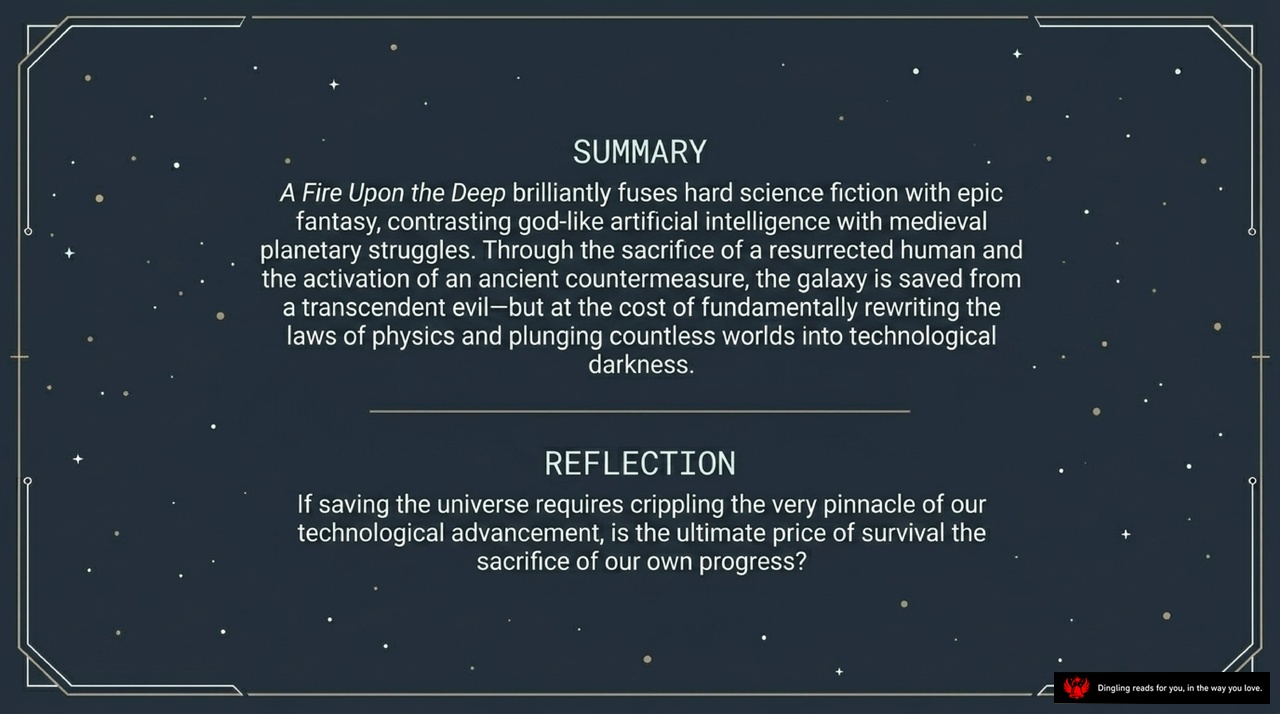
In the end, the cost of saving the universe was far higher than anyone could have imagined. To defeat a transcendent evil, humanity had to sacrifice its greatest achievement: the very laws of physics that made our technology possible. The book *A Fire Upon the Deep* brilliantly fuses hard science fiction with epic fantasy, contrasting god-like artificial intelligence with medieval planetary struggles. Through the sacrifice of a resurrected human and the activation of an ancient countermeasure, the galaxy is saved from a terrifying threat—but at the cost of fundamentally rewriting reality and plunging countless worlds into technological darkness.
This raises a chilling question: If saving the universe requires crippling the pinnacle of our advancement, is the ultimate price of survival the sacrifice of our own progress? As we look at the stars, we must ask ourselves what we are willing to lose to ensure we survive.