
A Man for All Markets: Complete Chapter-by-Chapter Summary
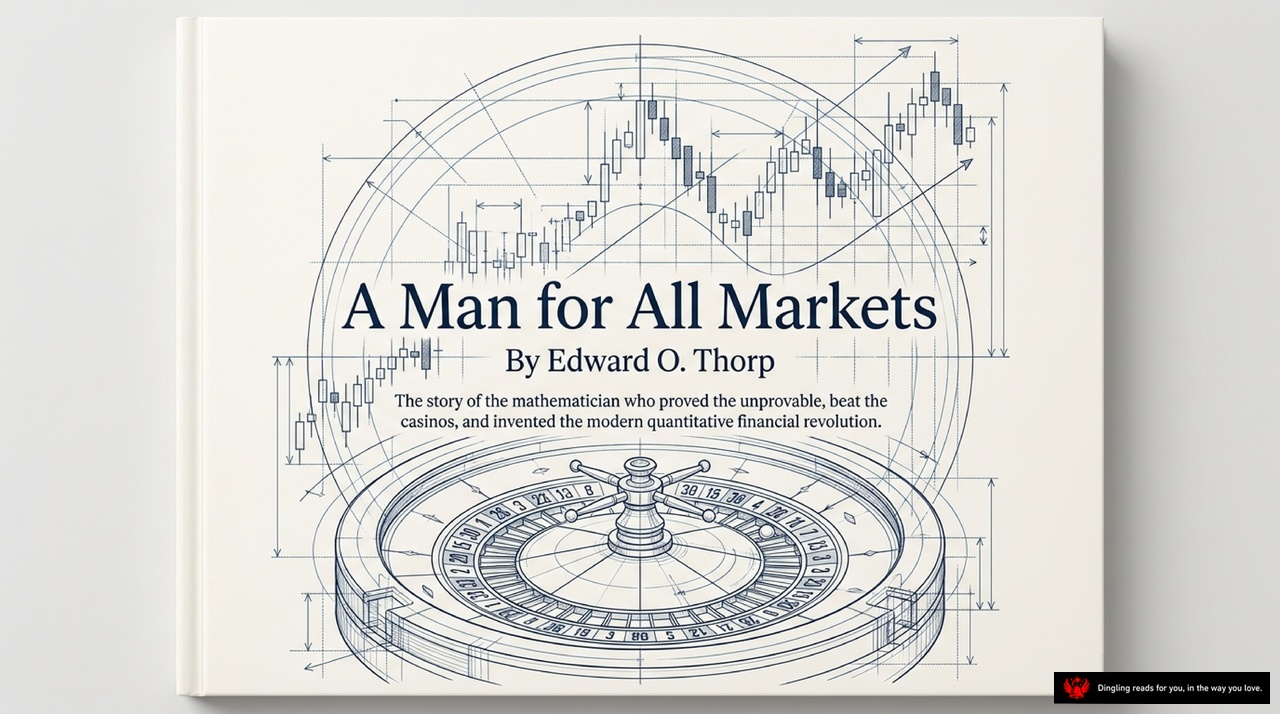
Welcome to the story of a man who proved the impossible. This is *A Man for All Markets* by Edward O. Thorp, the mathematician who beat the casinos and invented the modern quantitative financial revolution.
Look at the cover: it blends the chaos of stock market charts with the cold precision of a roulette wheel. That visual perfectly captures Thorp's life—he was the bridge between two worlds. He took the mathematical logic used to crack slot machines and applied it to the stock market, proving that even in a world designed to be unpredictable, there are patterns waiting to be exploited.
This isn't just a biography; it's a blueprint for thinking. It shows us how a curious kid who loved counting and experiments grew up to become a pioneer in finance. From his early days mastering math and radio to his groundbreaking work on card counting and option pricing, Thorp's journey teaches us one vital lesson: success isn't about luck. It's about understanding the rules, calculating the odds, and having the courage to act on the truth, no matter what the crowd believes.
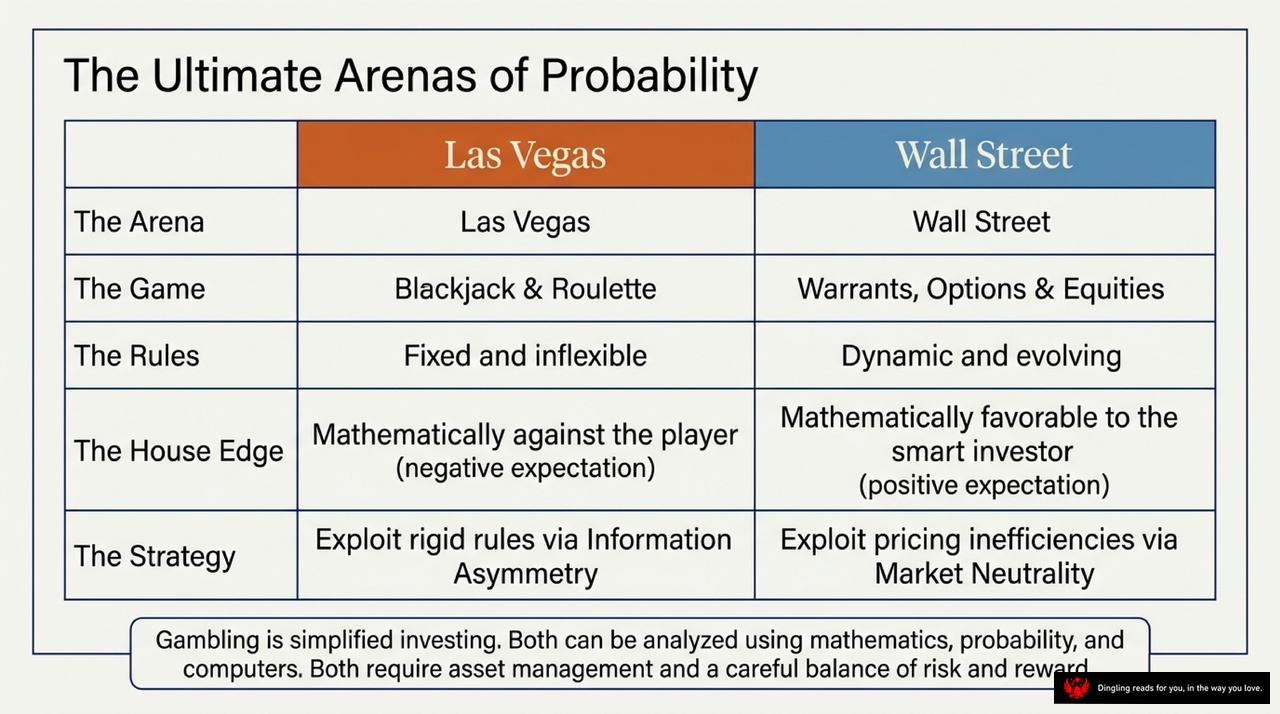
The slide we see right now is a masterclass in understanding how probability shapes our world, comparing two of the most famous arenas in history: Las Vegas and Wall Street. While they look different on the surface, the underlying math is surprisingly similar.
Let's break down the table. On the left, we have Las Vegas. The game here is classic—Blackjack and Roulette. The rules are fixed and inflexible, which sounds fair, but the reality is the "House Edge." Mathematically, the house always has the advantage, creating a negative expectation for the player. Your strategy here is to try and exploit those rigid rules using information asymmetry, like card counting, to get a tiny edge.
Now, look at the right side: Wall Street. This is the ultimate arena for the modern investor. The game involves warrants, options, and equities. Unlike the casino, the rules here are dynamic and constantly evolving. Crucially, the "House Edge" flips. For a smart investor, the market can be mathematically favorable, offering a positive expectation. Your strategy shifts from exploiting rigid rules to exploiting pricing inefficiencies through market neutrality.
The bottom line, as stated on the slide, is that gambling is essentially simplified investing. Both require asset management, a careful balance of risk and reward, and a deep understanding of mathematics and probability. Whether you're sitting at a blackjack table or analyzing a stock portfolio, the goal remains the same: find the edge where the odds are in your favor.

Imagine the casino floor not as a place of chaos, but as a laboratory where invisible rules govern every outcome. The true innovator doesn't just play the game; they question the very consensus that says, "You can't beat the house." As we saw in our earlier chapters, by translating abstract math into a concrete model—like tracking the count of remaining cards—we can actually see the hidden leverage available to the player.
But a model is useless without proof. That's why the innovator must test empirically. It's not about blind faith; it's about designing real-world experiments, whether that's squeezing eggs to test durability or betting thousands of dollars at a table to verify a strategy. Only when the math is proven, and the data speaks for itself, do we move to the final step: executing irrationally coldly. This means stripping away fear and emotion, scaling the edge until success is inevitable. It's a disciplined journey from skepticism to certainty, turning the odds in your favor through rigorous verification and fearless action.
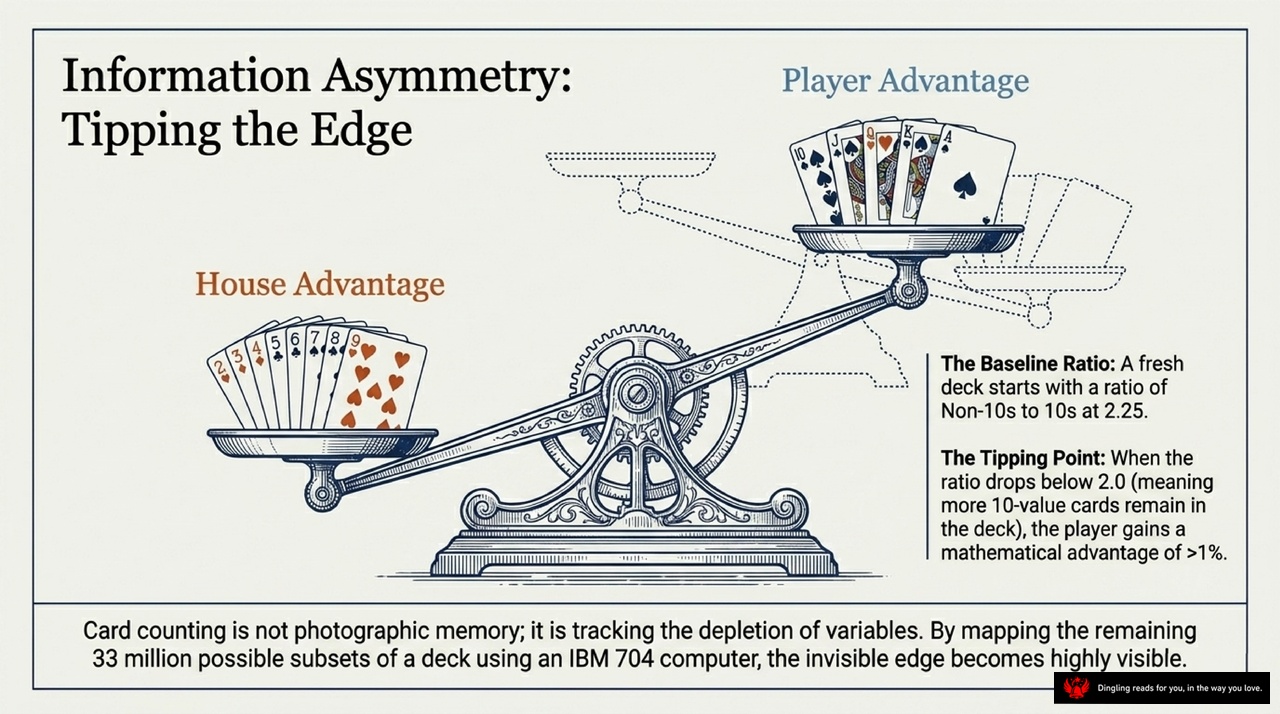
Information Asymmetry: Tipping the Edge. Imagine a classic blackjack table, but instead of just luck, you're holding a scale. On one side sits the "House Advantage," weighed down by a fresh deck where the ratio of non-10s to 10s is a comfortable 2.25. This is the baseline where the casino always wins. But on the other side, we have the "Player Advantage." The game tilts only when you track the depletion of variables. As high-value cards like 10s and Aces are removed, that ratio drops. The tipping point arrives when the ratio falls below 2.0, meaning more 10-value cards remain in the deck. Suddenly, the player gains a mathematical edge of over 1%. Card counting isn't about photographic memory; it's about mapping the remaining 33 million possible subsets of a deck. By using logic to track these invisible shifts, you transform a losing game into one where the odds finally tip in your favor.
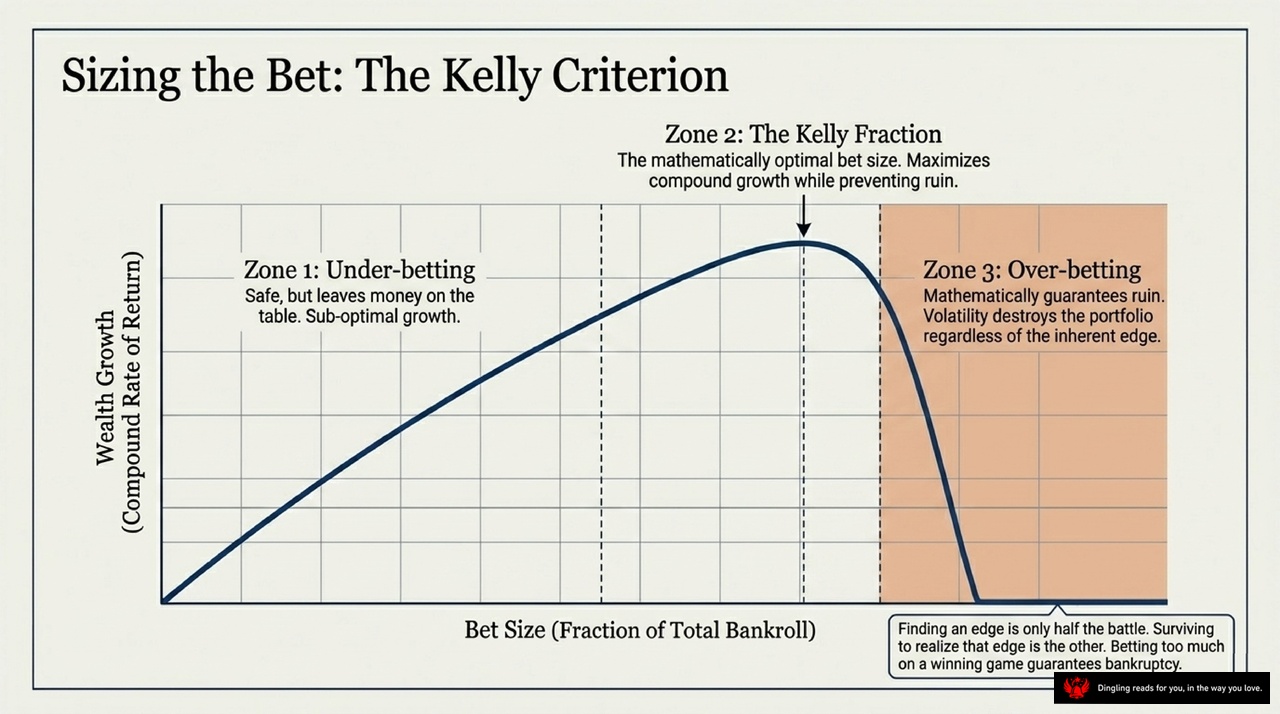
Sizing the Bet: The Kelly Criterion. This chart illustrates the most critical lesson I learned from the casino tables: finding an edge is only half the battle; surviving to realize that edge is the other.
Look at Zone 1, the under-betting zone. It's safe, but you are leaving money on the table. You have a winning strategy, yet you are sub-optimally growing your wealth because you aren't risking enough.
Then look at Zone 3, the over-betting zone. This is where most people fail. Mathematically, betting too much on a winning game guarantees bankruptcy. Even if you have a massive advantage, the volatility destroys your portfolio regardless of the inherent edge. You simply bet yourself out of the game.
The sweet spot is Zone 2: The Kelly Fraction. This is the mathematically optimal bet size. It maximizes compound growth while preventing ruin. It strikes the perfect balance between aggression and survival. As I moved from the blackjack tables to the stock market, this principle became the foundation of my entire investment philosophy. It taught me that the difference between a millionaire and a bankrupt investor often isn't the quality of their edge, but the size of their bet.

Imagine a roulette wheel spinning in slow motion. To the casual observer, it's pure chaos—a game of pure statistics where every spin is independent. But what if I told you that roulette isn't a game of chance, but a problem of classical mechanics? By measuring the velocity of the rotor and the ball with a hidden micro-computer, we can calculate the physical decay of the ball's orbit. This allows us to predict exactly where the ball will land, giving us a massive 44% edge.
This same logic applies to the stock market. Markets and games can be beaten if you change the framework. Instead of blindly following trends or relying on luck, you look for the physics behind the numbers. Whether it's tracking the speed of a spinning wheel or analyzing the momentum of a stock, the goal is always the same: move from being a passive participant to an active predictor. When you stop treating the world as random and start understanding the underlying mechanics, you stop gambling and start winning.

Welcome back. Today, we are stepping away from the high-stakes tables of Las Vegas and the frantic trading floors of Wall Street to look at something far more enduring: your own life and the legacy you leave behind.
The final slide asks a profound question: What does it truly mean to be wealthy? Is it the number in your bank account, or is it the ability to fund generations of impact? We see that different people define wealth differently—some say two million dollars is enough to retire, while others look at the top 0.01% of families who hold hundreds of millions. But true wealth isn't just about accumulation; it's about the math of growth. We've seen how the "72 Rule" and the power of compounding can turn a small sum into a fortune over decades, proving that patience and consistent reinvestment are far more powerful than any quick gamble.
However, history warns us that this wealth can vanish instantly if we ignore risk. The 2008 crisis wasn't caused by a lack of intelligence, but by unchecked leverage and the belief that "this time is different." When we borrow too much, a small drop in value can trigger a catastrophic collapse, wiping out decades of hard work. This is the ultimate lesson from our journey: while we can beat the odds in a casino or the market through superior analysis, we cannot control the entire system.
So, what is the real takeaway? It's not just about managing money, but managing our minds and our society. We must recognize that probability and statistics are missing from many of our daily decisions, from health to investing. And we must demand a system where no single entity is "too big to fail," ensuring that the risks we take don't become the burden of everyone else.
Ultimately, the most valuable investment we can make is in education and rational thinking. By equipping ourselves and the next generation with the tools to analyze data, understand risk, and value fairness, we build a foundation that no market crash can destroy. As we close this chapter, remember that true success isn't defined by how much you earn, but by how wisely you live and what you leave for those who come after you.
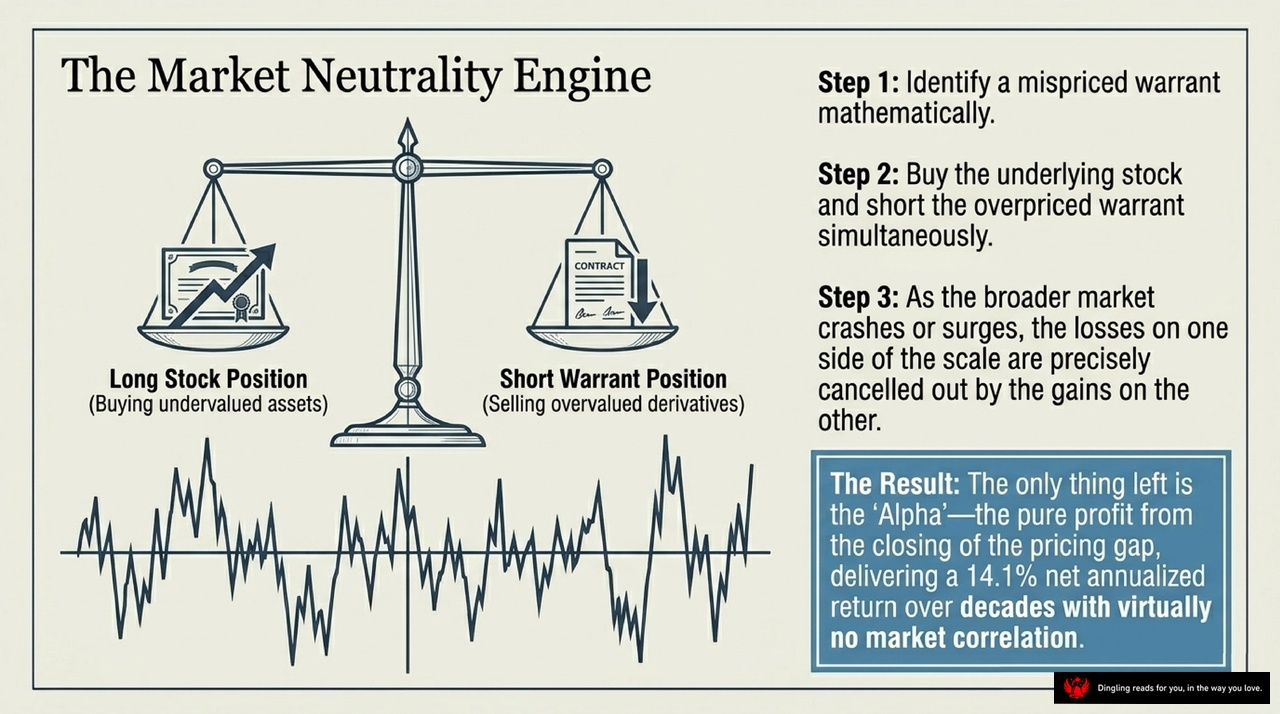
Imagine a world where the chaotic noise of the market doesn't dictate your fate, but rather, you use it to your advantage. This slide illustrates "The Market Neutrality Engine," a sophisticated strategy that effectively decouples your portfolio from the terrifying ups and downs of the broader economy.
At the heart of this engine is a perfect balance, visualized by that central scale. On one side, you take a "Long Stock Position," buying assets that are undervalued. On the other, you take a "Short Warrant Position," selling derivatives that are overpriced. The magic happens when the market moves. Whether the broader market crashes or surges, the losses on one side of the scale are precisely cancelled out by the gains on the other. It's like having a hedge that automatically neutralizes market risk.
The process is a disciplined three-step algorithm. First, you must identify a mispriced warrant mathematically. Second, you simultaneously buy the underlying stock and short that overpriced warrant. And finally, as volatility spikes, your opposing positions protect each other, leaving you with only the "Alpha"—the pure profit from closing that pricing gap.
The result is nothing short of revolutionary. By stripping away market correlation, this strategy delivers a net annualized return of 14.1% over decades, regardless of whether the economy is booming or busting. It's the ultimate tool for generating consistent wealth without being a slave to the market's mood swings.

The Anatomy of Returns: Edge vs. Illusion. Look at this slide. We are dissecting the DNA of financial success to separate real edge from pure illusion. On the left, we have Princeton-Newport Partners. This is the gold standard of true edge. Notice their volatility profile: low and mathematically constrained. Their strategy is transparent, built on clear, verifiable hedging formulas. And crucially, their market footprint is real—traceable options and warrants trades. It's honest, auditable math.
Now, look at the middle column: LTCM. This is a flawed model that looks impressive on paper but collapses under pressure. Their volatility was massive, hidden by extreme leverage. Their strategy was highly complex, relying on flawed assumptions about normal distributions while completely ignoring the risk of "Ruin." And while they had real trades, they were systemically over-leveraged, a ticking time bomb waiting to explode.
Finally, on the right, we have Bernie Madoff. This is the ultimate fraud. His volatility profile is an impossible, perfectly straight upward line with zero volatility, which defies the laws of probability. His strategy is a total "black box"—a secret that could never be replicated. And here is the smoking gun: there was no actual market footprint. No trades were ever executed. It was all paper illusions.
The key takeaway at the bottom drives this home: if reported returns defy the laws of probability and lack a verifiable market footprint, it is not a financial miracle. It is fraud. In investing, you don't just want high returns; you need proof that the numbers are backed by reality.
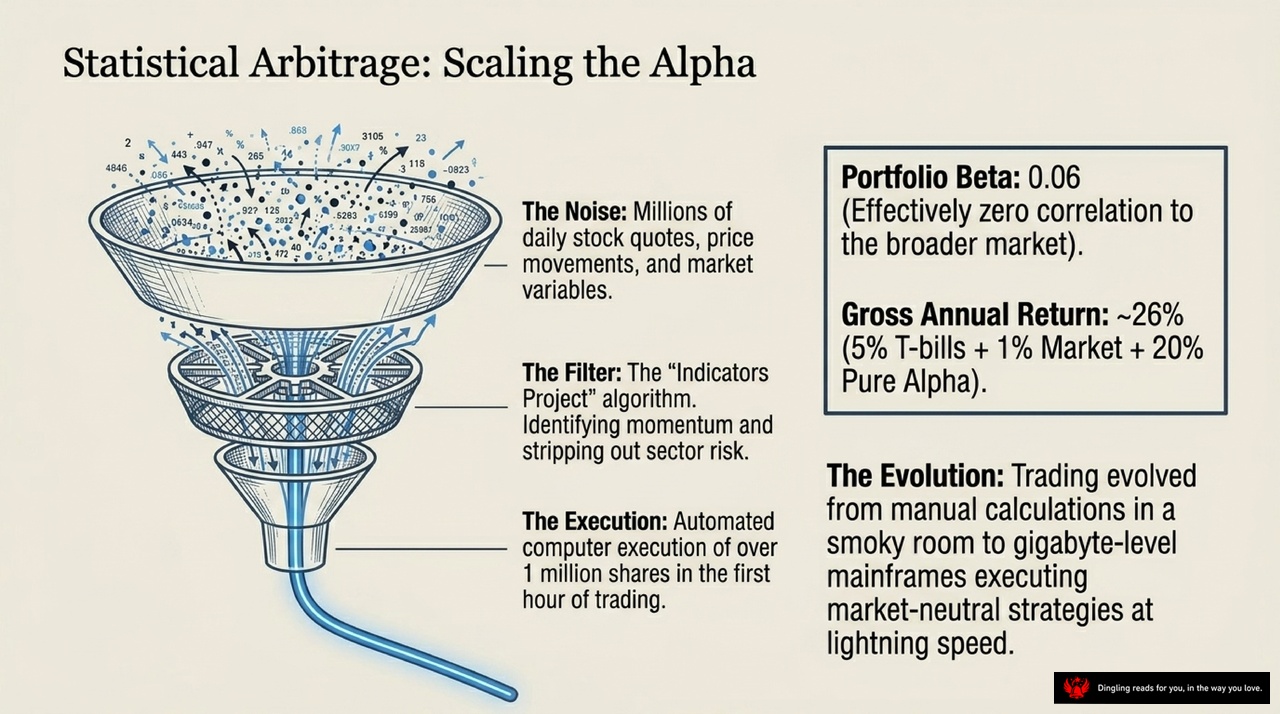
Imagine a high-tech funnel filtering chaos into pure profit. On the screen, we see "The Noise"—millions of daily stock quotes and price movements pouring in. But the magic happens in the filter: an algorithm that identifies momentum while stripping out sector risk. This is the core of statistical arbitrage, scaling alpha by finding mispriced assets in a noisy market.
Look at the results. By automating the execution of over one million shares in the first hour, this strategy achieves a Portfolio Beta of just 0.06. That means it has effectively zero correlation to the broader market; it doesn't care if the economy crashes or booms. The gross annual return sits at a staggering ~26%, composed of safe T-bills, a small market beta, and 20% pure alpha.
This represents the evolution of trading itself. We've moved from manual calculations in smoky rooms to gigabyte-level mainframes executing market-neutral strategies at lightning speed. It's no longer about beating the market; it's about using mathematics and speed to capture value that others simply miss.
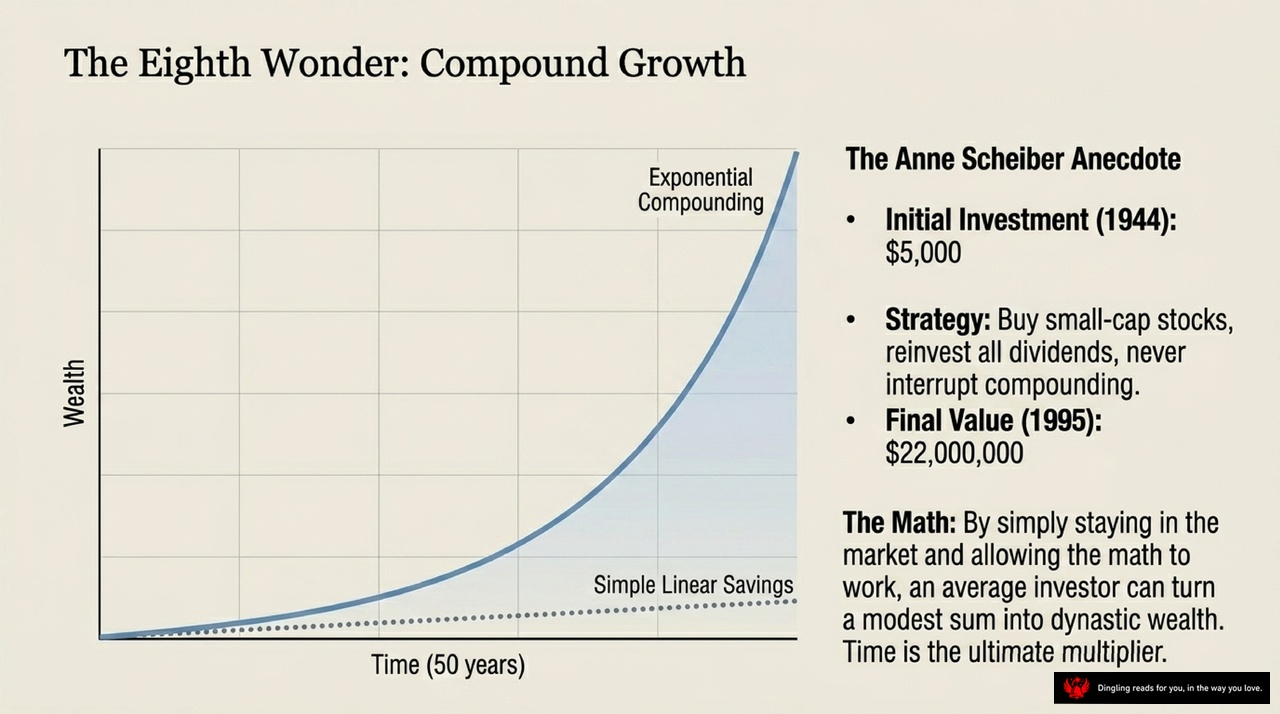
Welcome to the ultimate lesson on wealth: the eighth wonder of the world, compound growth. Look at this graph; it perfectly illustrates why time is the most powerful asset you can own. On the left, you see a modest starting point of just $5,000 in 1944. On the right, that same sum has transformed into $22 million by 1995. How? By sticking to one simple strategy: buying small-cap stocks, reinvesting every single dividend, and never interrupting the process.
The math here is undeniable. While simple linear savings barely move the needle over 50 years, exponential compounding creates a vertical cliff of wealth. This isn't magic; it's mathematics working in your favor. As the slide notes, an average investor can turn a modest sum into dynastic wealth simply by staying in the market and letting time act as the ultimate multiplier. Don't try to time the market or chase quick wins; instead, trust the process, reinvest your gains, and let the power of compound growth do the heavy lifting for you.
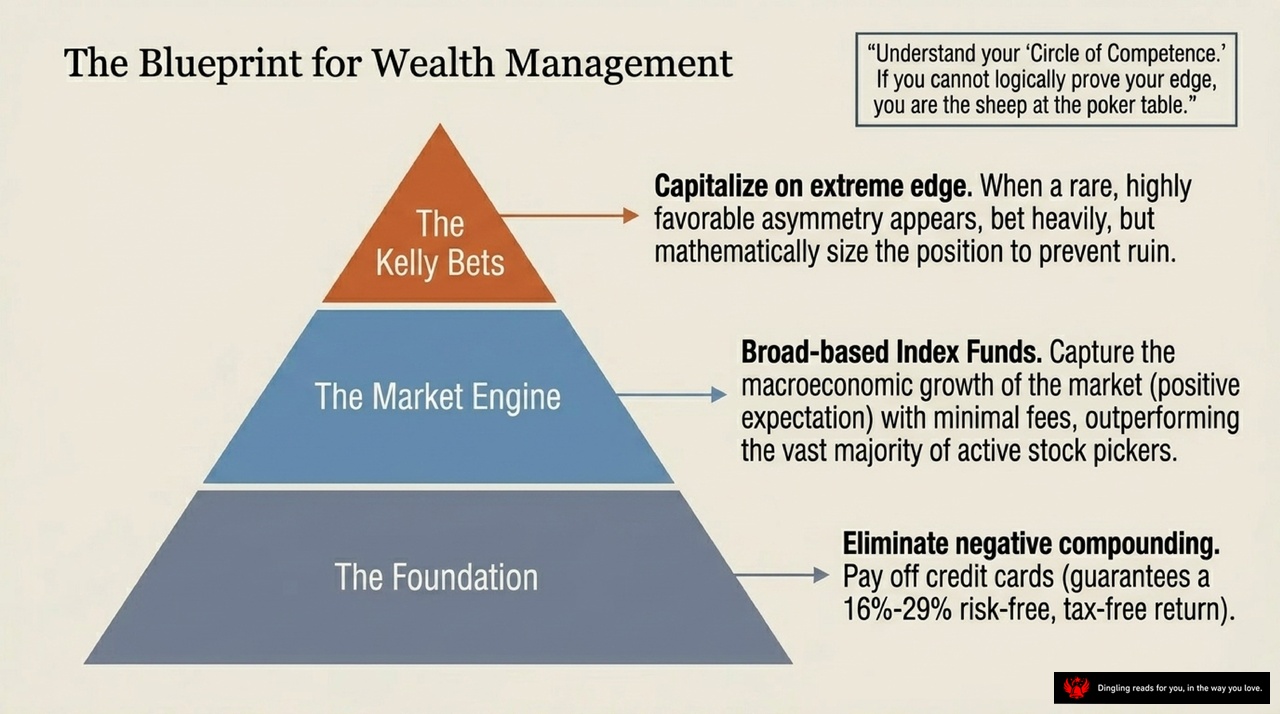
Imagine a wealth management blueprint built like a pyramid, where every layer protects your financial future. At the very base, we have "The Foundation." This isn't about complex strategies; it's about eliminating negative compounding. Think of it as paying off your credit cards. By doing so, you instantly guarantee a risk-free, tax-free return of 16% to 29%. It's the simplest way to secure your ground.
Moving up to the middle layer, we find "The Market Engine." Here, the focus shifts to broad-based index funds. Instead of trying to outsmart the market with high fees and risky stock-picking, you capture the macroeconomic growth of the entire market. With minimal costs, these funds consistently outperform the vast majority of active investors, acting as the reliable engine of your portfolio's growth.
At the peak sits "The Kelly Bets," representing the ultimate edge. This is where you capitalize on rare, highly favorable asymmetries. When a unique opportunity appears, you bet heavily, but you must mathematically size your position to prevent ruin. As the slide reminds us, if you cannot logically prove your edge, you are nothing but sheep at the poker table. This top layer is reserved for those who have mastered the foundation and the market engine, allowing them to bet big with confidence and precision.
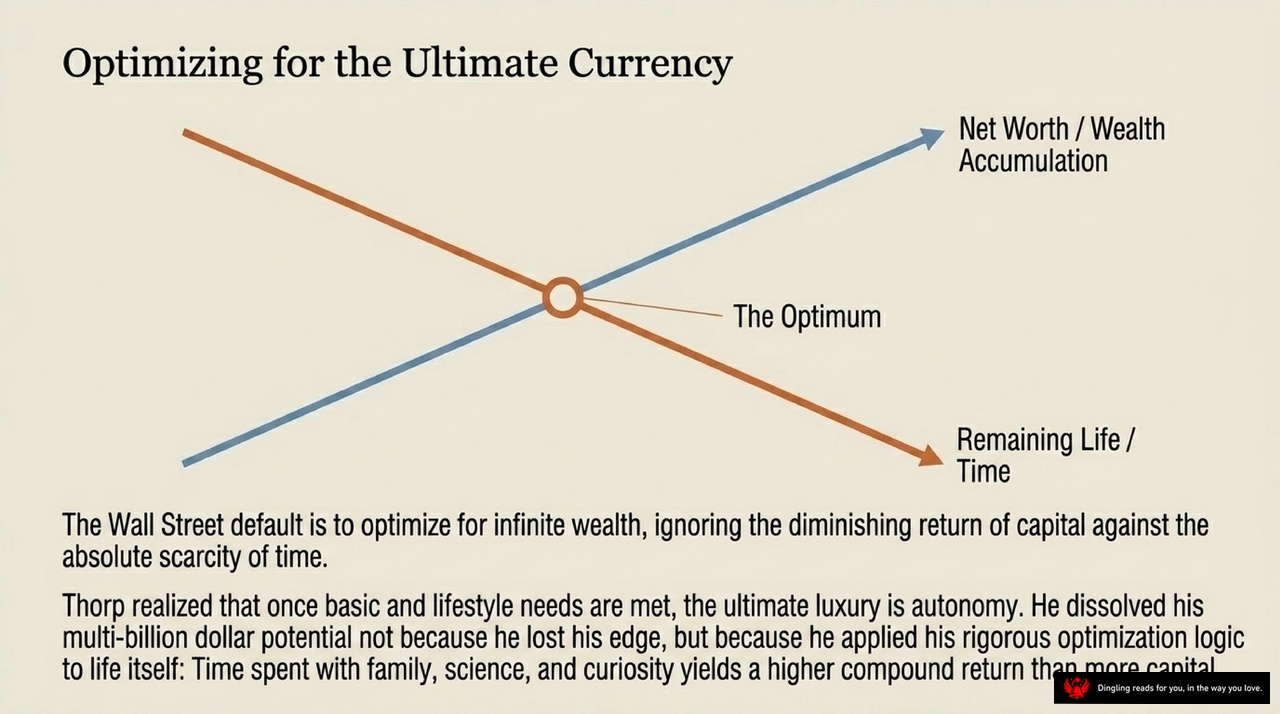
Optimizing for the Ultimate Currency. Look at this chart. We're weighing two things: Net Worth and Remaining Life. The Wall Street default is to chase infinite wealth, ignoring the absolute scarcity of time. But as we saw with Thorp, once basic needs are met, the ultimate luxury isn't more capital—it's autonomy. He realized that time spent with family, science, and curiosity yields a higher compound return than just hoarding money. It's about finding the optimum where wealth and time intersect, not maximizing one at the expense of the other.

From the felt tables of Las Vegas to the trading floors of Wall Street, the world is governed by the same immutable laws of probability. Edward O. Thorp proved that by questioning consensus, identifying information asymmetry, strictly managing risk, and letting time compound, any system can be understood—and beaten.
You now know how to calculate the edge, but when you look at how you spend your time and capital today—are you the house, or are you just gambling?