Economics & Finance Book Summaries & Key Insights

Economics & Finance Total 39 books

The Logic of Economy Operation summary and key insights by Gao Shanwen
Loading…

The Logic of Economy Operation

Gao Shanwen

3.2676 learners

Drawing on rigorous scientific research frameworks, *The Logic of Economy Operation* demystifies the inner workings of China’s economy for investors, analysts, and economic enthusiasts. Starting with a deep dive into the core principles of empirical research—contrasting Western logical rigor with traditional Chinese thinking gaps—the book unpacks critical economic pillars: the drivers behind China’s inflation dynamics (including the Lewis Turning Point’s impact on food prices), the cyclical patterns of capacity expansion and contraction, and the theory of asset revaluation linking real economy trends to financial market movements. Using concrete case studies from the 2000s to the post-2008 crisis era, it offers actionable insights into distinguishing supply vs. demand shocks, interpreting monetary policy effects, and navigating asset allocation across cycles. The final sections address the evolving role of financial analysts and the unique valuation dynamics of China’s A-share market, making this a go-to guide for anyone seeking to understand and leverage China’s economic logic.


Way of the Wolf summary and key insights by Jordan Belfort
Loading…

Way of the Wolf

Jordan Belfort

3.51016 learners

From the high-octane chaos of Stratton Oakmont to global sales mastery, Jordan Belfort lays bare his transformative Straight Line System—the framework that turned rookie brokers into million-dollar earners. In this unfiltered playbook, Belfort breaks down the non-negotiable core of high-stakes sales: the "Three 10s," which demand clients be fully certain of your product, trust you as a seller, and believe in your company. He reveals the critical 4-second rule for locking in instant first impressions, shares actionable state-management hacks like scent anchoring to maintain peak performance, and teaches how to craft ethical, natural-feeling sales scripts that cut through objections. More than just a sales guide, it emphasizes the moral line between persuasion and manipulation, urging readers to prioritize integrity alongside results. Whether you’re a new rep or a seasoned pro, Belfort’s proven strategies will help you qualify leads efficiently, navigate client pushback, and close deals consistently.

Reminiscences of a Stock Operator summary and key insights by Edwin Lefevre
Loading…

Reminiscences of a Stock Operator

Edwin Lefevre

4.31192 learners

More than just a memoir, *Reminiscences of a Stock Operator* chronicles the legendary career of Jesse Livermore—writing under the alias Larry Livingston—one of Wall Street’s most iconic speculators. Starting as a 15-year-old chalkboard boy in a bucket shop, Livermore turned his knack for reading price patterns into his first $1,000, only to face repeated bankruptcies and dramatic comebacks over decades. Through his triumphs and devastating losses, he distills timeless lessons: trade with the market trend, master entry timing over direction, follow the path of least resistance, and never let greed, fear, or insider tips cloud your judgment. This classic isn’t just about stock trading—it’s a masterclass in human psychology, teaching readers how to navigate the emotional pitfalls that sink even the most seasoned traders. For anyone looking to understand the real rules of Wall Street, it’s an indispensable guide.

Capitalism in America summary and key insights by Alan Greenspan;Adrian Wooldridge
Loading…

Capitalism in America

Alan Greenspan;Adrian Wooldridge

4.4987 learners

From the colonial era’s resource-rich, free-spirited foundations to today’s tech-driven, globally dominant economy, *Capitalism in America* by Alan Greenspan and Adrian Wooldridge traces the wild, transformative journey of U.S. capitalism. This sweeping history unpacks how key turning points—from Hamilton’s financial system and the Civil War’s resolution of slavery to the Gilded Age’s robber barons, the Great Depression’s New Deal, and the post-WWII golden age—shaped the nation’s economic identity. It highlights the central role of 'creative destruction': how entrepreneurs like Ford, Rockefeller, and Silicon Valley innovators disrupted old systems to drive prosperity, even as crises (2008’s financial crash, 1970s stagflation) and challenges (ballooning welfare costs, stagnant productivity) tested its resilience. The book argues that America’s unique blend of entrepreneurial grit, institutional flexibility, and a willingness to adapt remains its greatest asset, even as it faces modern threats to its economic vitality.

You Are What You Risk summary and key insights by Michele Wucker
Loading…

You Are What You Risk

Michele Wucker

2.9708 learners

Most of us see risk as something to avoid—a threat to our safety, success, or stability. But in *You Are What You Risk*, risk expert Michele Wucker turns that idea on its head. She argues that risk isn’t just a challenge to navigate; it’s a core part of who we are. Each of us has a unique “risk fingerprint,” shaped by our life experiences, cultural background, values, and even our biology. Wucker uses real-world stories—from entrepreneurs betting on startups to parents making family decisions—to break down how our risk preferences drive every choice we make. She shows readers how to identify their own risk fingerprint, understand why they make certain risky calls, and leverage this self-awareness to make smarter decisions in career, finance, and daily life. Instead of fearing risk, you’ll learn to see it as a tool for growth, self-discovery, and thriving in an uncertain world.

Capital in the Twenty-First Century summary and key insights by Thomas Piketty
Loading…

Capital in the Twenty-First Century

Thomas Piketty

4.1669 learners

Thomas Piketty’s *Capital in the Twenty-First Century* upends mainstream views on inequality by analyzing 300 years of global economic data, from 19th-century European aristocracies to 21st-century U.S. super-executives. At its core is the pivotal formula: when the rate of return on capital (r) outpaces overall economic growth (g), inherited wealth accumulates faster than earned income, widening the gap between the haves and have-nots. Piketty contrasts Europe’s legacy of inherited wealth concentration with America’s surge in sky-high executive pay, showing both systems fuel systemic inequality. He debunks myths about "natural" market balance, arguing unregulated capitalism will revert to a "patrimonial" system where birth determines fortune. The book’s bold prescription? A global progressive capital tax to rein in extreme wealth, boost financial transparency, and reframe capitalism to serve the many, not just the few—offering a roadmap for a more equitable future.

The Theory of Economic Development summary and key insights by Joseph A. Schumpeter
Loading…

The Theory of Economic Development

Joseph A. Schumpeter

4.21044 learners

Joseph A. Schumpeter’s *The Theory of Economic Development* redefines how we understand growth by rejecting static “circular flow” economic models. Schumpeter argues that true economic progress doesn’t come from incremental adjustments to existing systems, but from entrepreneurial innovation that disrupts equilibrium. He introduces the core concept of “new combinations”: five transformative acts—launching untested products, adopting novel production methods, opening untapped markets, securing new raw material sources, and restructuring industries—that drive economic change. The book explains how credit creation enables entrepreneurs to redirect existing resources toward these innovations, frames entrepreneurial profit as a temporary reward for breaking economic inertia, and positions interest as a derivative of these profits. Finally, Schumpeter ties economic cycles to clustered waves of innovation, showing how bursts of entrepreneurial activity spark booms, followed by recessions as the economy adapts to new structures. This foundational work elevates the entrepreneur as the critical engine of economic transformation.

You Can Be a Stock Market Genius summary and key insights by Joel Greenblatt
Loading…

You Can Be a Stock Market Genius

Joel Greenblatt

4.21295 learners

In *You Can Be a Stock Market Genius*, legendary investor Joel Greenblatt reveals how individual investors can outperform Wall Street pros by leveraging their greatest advantage: flexibility. Unlike large fund managers constrained by size limits, short-term performance pressures, and forced diversification, retail investors can target overlooked special-event opportunities—from corporate spinoffs and merger arbitrage to bankruptcy restructurings and capital reorganizations. Greenblatt breaks down how to identify mispriced assets in these niche areas, using tools like SEC filings, margin of safety principles, and long-term options (LEAPS) to minimize risk while maximizing returns. He emphasizes that success doesn’t come from chasing hot stocks, but digging into details others ignore, following top investors’ frameworks, and focusing on cash flow over superficial metrics. Packed with real-world case studies, this guide turns the tables on institutional players, showing small investors how to turn market inefficiencies into consistent, profitable gains.

The General Theory of Employment, Interest and Money summary and key insights by John Maynard Keynes
Loading…

The General Theory of Employment, Interest and Money

John Maynard Keynes

4.11163 learners

John Maynard Keynes’ *The General Theory of Employment, Interest and Money* blows up the classical economic playbook that dominated 19th and early 20th-century thought. Rejecting the idea that markets automatically hit full employment, Keynes introduces involuntary unemployment—workers ready to take jobs at current wages who can’t find work. He argues aggregate demand, not supply, drives economic activity, with employment levels set by the sweet spot between total supply and demand prices. The book breaks down three core pillars shaping demand: consumption propensity (how much people spend vs. save), marginal efficiency of capital (expected returns on investments), and liquidity preference (the urge to hold cash over assets). Using the 1930s U.S. Great Depression as a stark example, Keynes shows how weak demand leads to prolonged recessions, pushing for government interventions like deficit spending and interest rate tweaks to stimulate demand and get people back to work. This revolutionary framework redefined modern macroeconomics, giving policymakers a practical playbook for tackling economic crises.

Principles of Economics summary and key insights by N. Gregory Mankiw
Loading…

Principles of Economics

N. Gregory Mankiw

4.3803 learners

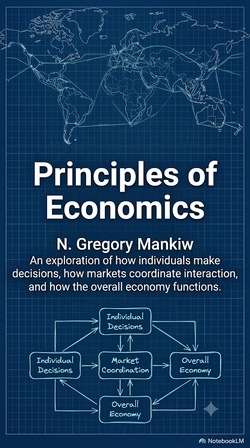
Gregory Mankiw’s *Principles of Economics* is the definitive introductory guide for anyone seeking to understand how economies function at every level—from individual choices to global markets. Anchored by 10 core principles grouped into three pillars—individual decision-making, interpersonal trade, and macroeconomic performance—the book demystifies complex concepts with relatable, real-world examples: from why airlines sell last-minute tickets cheap to how Reagan-era tax policies reflected the Laffer Curve. It covers foundational models like the circular-flow diagram and production possibility frontier, dives into microeconomics (supply and demand, market structures, consumer choice) and macroeconomics (inflation, unemployment, economic growth), and explores critical topics such as trade policy, market failures, taxation, and income inequality. Designed to be accessible yet rigorous, it equips readers to decode daily economic decisions, evaluate policy impacts, and think critically about how resources are allocated in society.

The Economic Way of Thinking summary and key insights by Paul Heyne;Peter J. Boettke;David L. Prychitko
Loading…

The Economic Way of Thinking

Paul Heyne;Peter J. Boettke;David L. Prychitko

3.9716 learners

Tired of viewing economics as a jargon-heavy, inaccessible field? *The Economic Way of Thinking* demystifies core economic principles by grounding them in everyday, relatable scenarios—from rush-hour traffic coordination to your morning grocery run. This book teaches you that economics isn’t just about graphs and numbers; it’s a practical framework for analyzing how individuals make choices based on trade-offs, opportunity costs, and self-interest. You’ll discover why voluntary trade creates wealth for both parties, how price controls and government interventions often backfire with unintended consequences, and why clear property rights are essential for a thriving market. It also delves into macroeconomics, breaking down GDP, inflation, and the roots of economic cycles, plus explores why some nations achieve long-term prosperity while others remain trapped in poverty. Whether you’re a student, professional, or curious reader, this guide equips you to spot hidden economic logic in daily decisions and avoid common misconceptions about markets and governance.

The Simple Path to Wealth summary and key insights by J. L. Collins
Loading…

The Simple Path to Wealth

J. L. Collins

4.61127 learners

Drawing from decades of personal experience and hard-earned lessons, J.L. Collins lays out a no-nonsense, actionable roadmap to financial independence in *The Simple Path to Wealth*. He starts by dismantling the myth of "good debt," teaching readers to eliminate high-interest obligations first using a straightforward, data-driven method, and emphasizes building an emergency "F*** You Fund" to gain control over career and life choices. Collins then demystifies investing, advocating for low-cost, broad-market index funds—especially those from Vanguard, thanks to its unique owner-first structure—over expensive active funds or flashy stock-picking. He breaks down tax-advantaged account strategies, retirement withdrawal rules like the 4% rule, and how to navigate Social Security benefits. Along the way, he exposes industry scams and the pitfalls of consumerism, proving that lasting wealth doesn’t require fancy degrees or complex tricks—just discipline, patience, and a commitment to living below your means while letting compound interest work its magic.

The Membership Economy summary and key insights by Robbie Kellman Baxter
Loading…

The Membership Economy

Robbie Kellman Baxter

3.8884 learners

Robbie Kellman Baxter’s *The Membership Economy* demystifies the critical distinction between subscriptions and true membership models: while subscriptions center on recurring payments for access, memberships prioritize long-term emotional connections, belonging, and mutual value. Baxter breaks down how digital technology and innate human social needs have fueled this transformative business framework, outlining six core membership categories—from digital subscriptions like Netflix to loyalty programs such as Starbucks Rewards. She provides actionable strategies for building efficient member acquisition funnels, nurturing high-value super users, and retaining new members during their critical first 30 days. The book also explores flexible pricing models, essential tech tools for scaling memberships, and real-world case studies, from LinkedIn’s free-value growth to Airbnb’s community-driven disruption. Baxter guides organizations of all sizes—startups, nonprofits, and legacy businesses—through transitions to membership models, while warning against complacency and highlighting future trends: continuous innovation, member-centricity, and tech-driven efficiency.

Economic Development and Value Choice summary and key insights by Chen Chunhua
Loading…

Economic Development and Value Choice

Chen Chunhua

3.6969 learners

Against the backdrop of China’s seismic shift from a planned economy to a socialist market economy, *Economic Development and Value Choice* by Chen Chunhua explores the intense clash between rapid economic growth and evolving personal values. Rooted in a 1992 research project tracking value transformations across decades, this book draws on extensive surveys of students, workers, and urban/rural residents to unpack the dynamic two-way relationship between economic progress and value systems. It delves into Marxist theories of human nature, the dialectical bond between individuals and society, and critiques prevalent value distortions like egoism, money worship, and hedonism during the transition. The book argues for the enduring relevance of social value principles, emphasizing that personal fulfillment must align with societal progress. It also outlines pathways to self-realization and transcendence, guiding readers to navigate the chaos of economic change, clarify their value coordinates, and achieve meaningful growth for both themselves and their communities.

China 2049: Economic Challenges of a Rising Global Power summary and key insights by David Dollar;Yiping Huang;Yang Yao
Loading…

China 2049: Economic Challenges of a Rising Global Power

David Dollar;Yiping Huang;Yang Yao

3.61256 learners

China 2049: Economic Power takes readers on a comprehensive journey through China’s remarkable economic transformation—from its imperial-era economic peaks to the post-1978 reform boom that turned it into the world’s second-largest economy. Authors Yang Yao and David Dollar break down the core drivers of this historic rise: early planned economy foundations, demographic dividends, and aggressive opening-up policies. They then unpack the critical shifts underway: moving from export-led growth to a consumption-driven model, navigating de-industrialization, and addressing pressing challenges like slowing total factor productivity (TFP), rapid population aging, and evolving global trade tensions. Using cross-country productivity convergence theory and demographic data, the book projects China’s economic trajectory to 2049, when it could reclaim its 1820 share of global GDP. It also outlines actionable reforms across sectors—from state-owned enterprise restructuring and innovation policy to green transition and financial liberalization—while examining China’s evolving role in global trade, technology competition, and RMB internationalization. Essential reading for anyone seeking to understand China’s economic future and its global impact.

Principles for Navigating Big Debt Crises summary and key insights by Ray Dalio
Loading…

Principles for Navigating Big Debt Crises

Ray Dalio

4.4721 learners

Drawing on decades of research and real-world market experience, Ray Dalio’s *Big Debt Crisis* demystifies the complex mechanics of debt cycles and financial crises. Through deep dives into iconic historical cases—from Weimar Germany’s hyperinflation and the U.S. Great Depression to the 2008 subprime meltdown and Eurozone debt crises—Dalio breaks down how bubbles form, why they burst, and the critical differences between deflationary and inflationary depressions. He outlines the four core tools policymakers use to manage deleveraging: fiscal austerity, debt restructuring, money printing, and wealth transfers, emphasizing the delicate balance needed to achieve 'beautiful deleveraging' that minimizes economic pain. This book equips readers, from investors to policymakers, with a framework to identify crisis warning signs, understand policy tradeoffs, and navigate turbulent financial landscapes with confidence.

The Little Book That Builds Wealth summary and key insights by Pat Dorsey
Loading…

The Little Book That Builds Wealth

Pat Dorsey

4.51017 learners

In Pat Dorsey’s The Little Book That Builds Wealth, you’ll uncover the cornerstone of successful value investing: identifying companies with "economic moats"—structural competitive advantages that shield them from rivals and sustain above-average profits for decades. Dorsey clarifies the critical difference between real, durable moats and misleading short-term wins like trendy products or high market share, then breaks down the four core sources of lasting moats: intangible assets (brands, patents, regulatory licenses), high customer switching costs, network effects, and cost/scale advantages. He also teaches readers to spot warning signs of moat erosion, from technological disruption to poor capital allocation, and maps which industries are most likely to harbor wide moats (media, finance, software) versus those that rarely do (consumer services, industrial materials). With practical metrics like return on invested capital to validate moats, actionable valuation techniques, and clear sell strategies, this book equips investors to avoid value traps and build a resilient portfolio of wealth-generating stocks that outperform over the long haul.

Xue Zhaofeng's Economics Lectures summary and key insights by Xue Zhaofeng
Loading…

Xue Zhaofeng's Economics Lectures

Xue Zhaofeng

4.4749 learners

Forget dry textbooks stuffed with jargon—Xue Zhaofeng’s Economics Lectures turns everyday moments into accessible masterclasses in economic thinking. Tailored for regular people, not just finance experts, this book uses relatable scenarios: why train tickets sell out during peak travel seasons, why rent climbs in desirable neighborhoods, and even why we pick one coffee order over another. Xue breaks down core concepts like scarcity, opportunity cost, property rights, and transaction costs into simple, actionable lessons, showing how these ideas shape every choice we make—from career moves to grocery runs. Ditching complex equations, it teaches you to view the world through an economist’s lens, helping you spot hidden incentives, make smarter decisions, and cut through noise in debates about policy, business, and daily life. Whether you’re a student, professional, or curious learner, this book turns economics from an intimidating subject into a practical tool for navigating modern life.

New Structural Economics summary and key insights by Justin Yifu Lin
Loading…

New Structural Economics

Justin Yifu Lin

4.41300 learners

Developed by Justin Yifu Lin, *New Structural Economics* redefines how developing nations achieve sustainable, inclusive growth by moving past failed ideologies of either heavy government intervention or unfettered market liberalization. At its core, the theory argues that a country’s optimal industrial structure is determined by its unique factor endowment structure—land, labor, capital, and infrastructure. By aligning industries with these inherent strengths, firms gain competitive viability, generate economic surpluses, and accelerate capital accumulation to drive gradual industrial upgrading. The book introduces the Growth Identification and Facilitation Framework (GIFF), a step-by-step tool for governments to identify promising industries, address bottlenecks like poor infrastructure or limited financing, and support pioneer firms without distorting markets. Real-world case studies, including Nigeria’s economic transition and East Asia’s rapid growth, illustrate how balancing market efficiency with targeted government guidance can unlock catch-up advantages, reduce poverty, and create stable employment.

How An Economy Grows and Why It Crashes summary and key insights by Peter D. Schiff;Andrew J. Schiff
Loading…

How An Economy Grows and Why It Crashes

Peter D. Schiff;Andrew J. Schiff

4.5556 learners

Using a playful, easy-to-follow story of a tropical island community starting from hand-to-mouth fishing, How An Economy Grows and Why It Crashes demystifies complex economic principles. Authors Peter and Andrew Schiff contrast the Austrian School’s focus on savings, productivity, and free markets with the flawed Keynesian policies that dominate modern economics. The book exposes how government intervention—from excessive money printing and deficit spending to trade barriers and artificial credit expansion—creates false prosperity, bubbles, and eventual crashes. Through relatable analogies, it connects the island’s journey to real-world crises like the 2008 housing bubble and quantitative easing, arguing that sustainable growth only comes from prioritizing production, responsible saving, and unshackling markets from harmful political meddling. Perfect for readers tired of confusing jargon, it cuts through economic myths to reveal the straightforward truths behind growth and collapse.