
A Random Walk Down Wall Street: Complete Chapter-by-Chapter Summary

Welcome to today's session on *A Random Walk Down Wall Street* by Burton G. Malkiel. As the title suggests, this book presents a time-tested strategy for successful investing. It challenges the idea that you need to be a genius to beat the market, proving instead that even a blindfolded monkey throwing darts at a wall of stock names can select a portfolio that rivals the experts.
The core message is simple yet revolutionary: in the short term, stock prices move like a random walk—unpredictable and without a clear pattern. This means that complex charts, expert tips, and intricate analysis often fail to add value. Instead of trying to time the market or pick individual winners, the smartest move is to buy a broad, diversified mix of stocks and hold them for the long term. By doing so, you let the market's natural growth work for you, turning the chaos of daily fluctuations into steady, life-changing wealth over time.

On the left, you see a chaotic chalkboard filled with frantic arrows, formulas, and desperate cries like "BUY!" and "SELL NOW!" alongside predictions that swing wildly between "Forecast: Up!" and "Prediction: Down!" This visual perfectly captures the reality of short-term market noise. It suggests that trying to time the market or predict the next move is nothing more than guessing in the dark.
But look at the right side. That calm, orange target with the dart hitting the bullseye represents a different truth. The definition here is clear: future steps cannot be predicted based on past history. Short-term fluctuations are entirely random. This leads to a powerful implication: expert stock-picking, complex financial forecasts, and all those intricate charts you see on the left simply cannot consistently outperform a randomly selected, broadly diversified portfolio.
Think about it this way: in the world of investing, a "random walk" isn't a flaw; it's a feature. It means that the most reliable strategy isn't trying to be an expert predictor, but rather being a disciplined owner. Whether you pick stocks like a professional or toss them like a monkey throwing darts, over the long run, a simple, diversified approach beats the frantic, high-cost chase for timing the market every single time. The dart hits the center not because of skill, but because it avoids the chaos of trying to predict the unpredictable.

Welcome back. Today, we're diving into the two opposing philosophies that have shaped the entire history of investing: The Firm-Foundation Theory and The Castle-in-the-Air Theory.
On the left, you see the "Firm-Foundation Theory." Think of this as building a skyscraper on solid bedrock. This approach, championed by legends like Benjamin Graham and Warren Buffett, believes that every asset has an intrinsic value based on reality—things like future cash flows, earnings, and long-term growth. The goal here is simple and rational: find when the market price is lower than that true value, buy it, and wait for the price to eventually return to where it belongs. It's about math, fundamentals, and patience.
Now, look at the right side. This is "The Castle-in-the-Air Theory," illustrated by a castle floating on clouds. This is the perspective of John Maynard Keynes and modern behavioral economists. Here, the focus isn't on the asset's actual worth, but on crowd psychology. Keynes famously compared the stock market to a newspaper beauty contest: you don't pick the most beautiful face yourself; you pick the face that you think *everyone else* will pick. In investing, this means predicting where the masses will build their next "castle" and buying in early, riding the wave of their enthusiasm before it crashes.
So, which one is right? The truth is, both exist. The Firm-Foundation approach gives us the discipline of value investing, while the Castle-in-the-Air theory explains why bubbles form and burst when emotions take over. Understanding the tension between these two views is the key to navigating the market.

Look at this chart. It tells a simple but powerful story about history: gravity always wins.
From the Tulip Mania in the 17th century to the Dot-Com Bubble in the 2000s, every single spike you see here—whether it was the South Sea Bubble, the Wall Street Crash, or the Housing Crisis—eventually collapsed back down to the "Intrinsic Value" line.
This visual proves a crucial insight: while the market can remain wildly irrational for long periods, it will ultimately correct itself to its firm foundation. Bubbles are just temporary distortions. No matter how high the hype gets, the truth always pulls the price back to reality.

Today's slide cuts through the noise of modern finance to reveal a hard truth: most of what we think we know about predicting the market is actually fiction. Look at this chart. It's labeled "generated entirely by random coin tosses," yet it looks suspiciously like a complex trading strategy with clear "Heads" and "Tails" patterns. This visual perfectly illustrates the "Lag Effect." Chartists and technical analysts often buy only after a trend is already established, consistently missing those sudden, lucrative market reversals that happen right at the start.
The chart also highlights the "Self-Destruct Sequence." Any predictable pattern that guarantees profit tends to self-destruct the moment the broader market discovers it. If everyone could simply follow the lines on this graph, the opportunity would vanish instantly. We are seeing the same phenomenon with "Correlation vs. Causation." Indicators like the Super Bowl winner or even the lengths of Hemline are pure financial astrology. They might look correlated to price movements on a chart, but they have absolutely no causal link to reality.
The lesson here is fundamental. The market is often driven by random walks and human psychology, not by rigid, predictable laws that we can easily exploit. Relying on these superficial patterns is a recipe for failure. True investing isn't about finding the perfect line on a chart; it's about understanding that the most reliable strategy is often the one that looks the least like a strategy at all.

Imagine your portfolio as a complex machine designed to weather any storm. While chasing high returns often tempts us to take bigger risks, history teaches us a crucial lesson: the most reliable path to wealth isn't about picking the next big winner, but about how you manage risk and time.
First, understand that risk and return are inextricably linked. You cannot expect higher gains without accepting higher volatility. But here is the game-changer: time is your greatest ally. While stock prices might swing wildly in the short term, holding them for a longer period—say, 25 years—smooths out those bumps, making your average returns much more predictable and stable.
To build a resilient portfolio, you need a solid framework. Think of asset allocation as the foundation. Research shows that over 90% of your investment success comes from how you mix different asset classes, not which specific stocks you pick. You should balance risk and reward, and remember that your ability to take risk depends on your life stage. Younger investors with stable incomes can afford to be more aggressive, while those nearing retirement should shift toward bonds and income-generating assets to protect their nest egg.
A powerful tool for all investors is dollar-cost averaging. By investing a fixed amount regularly, you automatically buy more shares when prices are low and fewer when they are high. This strategy lowers your average cost per share over time and removes the stress of trying to time the market.
Finally, don't ignore the tax implications of your decisions. Choosing the right accounts and asset locations can significantly boost your after-tax returns. By combining a diversified mix of assets, sticking to a long-term horizon, and letting time work in your favor, you transform investing from a gamble into a predictable journey toward financial freedom.

Imagine you're building a portfolio, but instead of betting on just one stock, you're hedging your bets against nature itself. Look at this chart: on the left, we have a "Resort Stock." It's a classic high-volatility play. When the sun shines, it soars 50%. But when it rains? It crashes 25%. Now, flip to the right side. This is an "Umbrella Stock." It's the exact opposite. When the sun is out, it loses 25%. But when the rain starts? It jumps up 50%.
Both assets are wildly volatile on their own. One thrives in sunshine, the other in storms. But here's the magic of modern portfolio theory: when you combine them in a 50/50 split, the chaos disappears. Notice what happens in the center box. Whether it's a sunny day or a rainy one, your portfolio delivers a steady, predictable return of 12.5%.
This visual perfectly illustrates how combining volatile assets that move inversely allows investors to completely eliminate unsystematic risk. You don't need to predict the weather to make money; you just need to own assets that react to the weather in opposite ways. This is the power of diversification—turning individual volatility into portfolio stability.

Let's talk about risk. In finance, not all risk is created equal. Imagine a scale balancing two very different things: Unsystematic Risk and Systematic Risk. On the left, we have Unsystematic Risk, which is company-specific. Think of it as the unique problems facing a single business—maybe a CEO quits, a factory burns down, or a new competitor enters the market. The key takeaway here is that this risk can be diversified away entirely. If you hold enough different stocks, these individual bad events cancel each other out. Because you can eliminate this risk simply by holding a diversified portfolio, the market pays you zero premium for taking it.
On the right side of the scale sits Systematic Risk, often called Beta. This is market-wide risk. It comes from forces that affect every single asset in the market, like interest rates, inflation, wars, or recessions. You cannot diversify this away. No matter how many stocks you buy, if the market crashes, they all fall together. Since this risk is unavoidable, the market rewards you for bearing it. This is the risk premium you earn for staying invested during turbulent times.
Now, here is where many investors fall into a trap. The slide highlights "The Smart Beta Trap." Many people believe that tilting their portfolios toward small-cap or value stocks—chasing so-called "smart beta" factors like the Fama-French factors—is a form of smarter investing. But the reality is often the opposite. This strategy isn't about being clever; it's simply taking on different, and often higher, systematic risks in hopes of getting potentially higher returns. And frequently, you are paying much higher management fees for a strategy that might not actually outperform a simple, low-cost index fund over the long run. True smart investing isn't about chasing complex factors; it's about understanding the fundamental difference between risks you can diversify away and the unavoidable market risks that drive your returns.

So, we've uncovered the four psychological traps that silently sabotage our financial success. First, there's **Overconfidence**. Did you know that 80% of investors fundamentally believe they possess above-average skills? It's a dangerous delusion that blinds us to our own limitations.
Next, consider the **Illusion of Control**. Our human brain has a desperate need to see predictable patterns in random sequences, like trying to find a formula in coin tosses. We convince ourselves we can steer the market, when in reality, we are just guessing.
Then, we have **Herd Behavior**, or groupthink. This is the overwhelming social pressure to follow the crowd. Just like in the dot-com or housing boom, we buy simply because our neighbors are getting rich, ignoring whether the asset actually has value.
Finally, there's **Loss Aversion**, which is the core of Prospect Theory. This explains why the pain of a financial loss feels exponentially more intense than the joy of an equivalent gain. We hold onto losing stocks too long hoping they'll bounce back, only to watch them vanish, while selling winners too early to lock in a win.
These aren't just abstract concepts; they are the hidden forces driving every bubble and crash in history. Recognizing them is the first step to regaining control of your own wallet.

Look at this funnel. It starts in 1970 with a massive cohort of 358 equity funds, but by 2013, only a tiny fraction survived and outperformed. This visual perfectly illustrates the harsh reality of survivorship bias. The funds that disappeared are hidden from view, making the market look more efficient than it actually is. The truth is, beating the market over a 10 to 20-year period is mostly statistical luck, not repeatable skill. In fact, more than two-thirds of active managers fail to beat the S&P 500. As the chart reminds us, today's star is often tomorrow's laggard. This data proves that chasing outperformance is a fool's game; the smartest move is simply to buy the whole market and let time do the work.
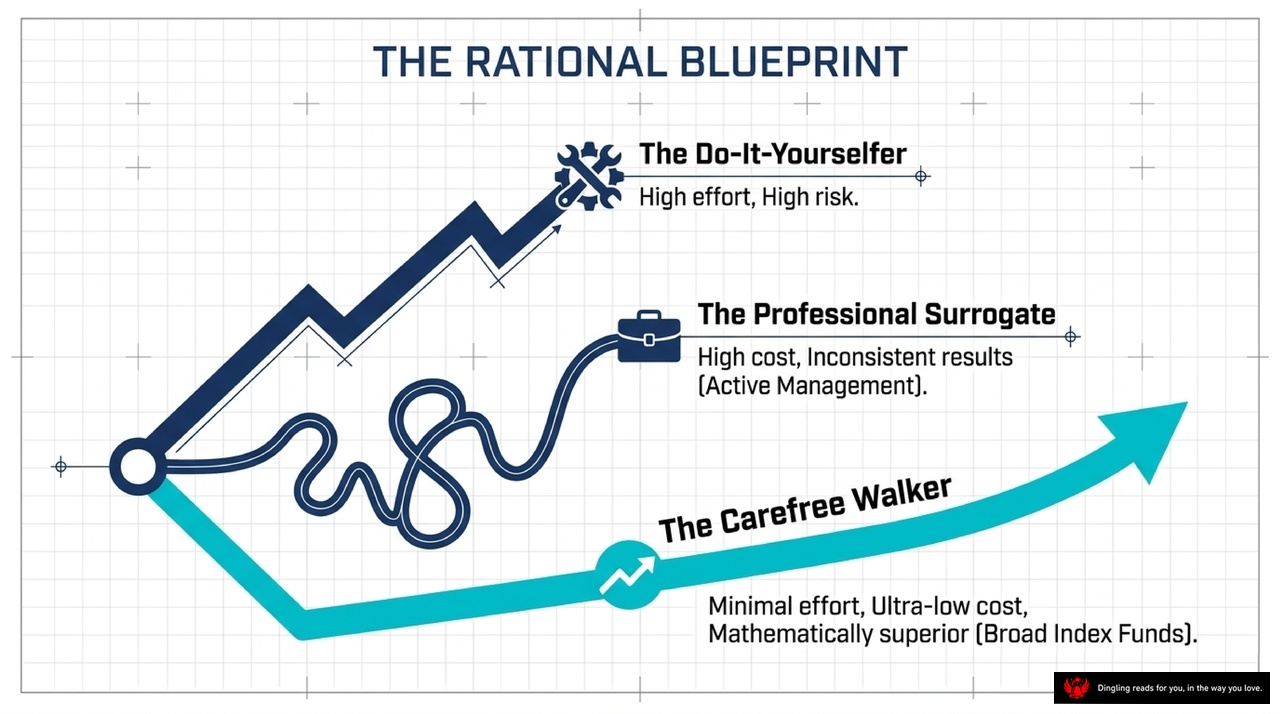
The Rational Blueprint isn't just a catchy title; it's the ultimate guide to how we actually invest, and frankly, it tells a story that most of us are living out right now. Look at this chart: it breaks down three distinct paths. The first one, labeled "The Do-It-Yourselfer," is the classic high-effort, high-risk route. It's like trying to outsmart the market yourself, picking every stock, timing every move. It requires massive work and carries the heaviest burden of risk. Then there's "The Professional Surrogate." This is where we hand our money to experts, hoping for the best. But as the graphic warns, this path comes with high costs and inconsistent results. Think of it as hiring a pilot who sometimes flies blind; you're paying a premium for a ride that isn't guaranteed to land safely.
But then, there's the third line, the smooth, steady teal arrow labeled "The Carefree Walker." This represents the "Broad Index Funds" approach. It's the mathematical superior choice. Why? because it offers minimal effort and ultra-low cost. Instead of fighting the market or paying hefty fees to someone else, you simply ride the wave of the entire market. You get exposure to thousands of companies without the stress of picking winners or losers. The data is clear: over the long run, this passive strategy consistently outperforms the frantic attempts of active management and the exhausting grind of DIY investing. It's not about being smarter than the market; it's about being smarter about how you play the game. By choosing the Carefree Walker path, you stop chasing returns and start capturing them, letting time and compounding do the heavy lifting for you.

So, how do we actually build wealth without getting crushed by market chaos? The answer lies in a simple, four-step blueprint that separates the successful investors from the rest.
First, you need **Sustained Growth**. This means buying companies that are mathematically expected to grow their earnings above the average for at least five years. It's not about picking the hottest stock of the day; it's about backing businesses with a proven track record of expansion.
Second, stick to **Rational Pricing**. Never pay a premium higher than the intrinsic value of the firm. If a stock is trading for more than its actual worth, you're not investing; you're speculating. Keep your prices grounded in reality.
Third, and this is crucial, look for **The Psychological Hook**. You want a compelling story that captures the crowd's imagination. Think of it as leveraging that "Castle-in-the-Air" feeling where everyone believes the sky is the limit. But remember, you're using that energy to your advantage, not falling for it blindly.
Finally, ensure **Frictionless Execution**. You must radically minimize your trading. Every time you buy and sell, you're paying massive taxes and commission fees that drag down your compounding returns. The goal is to let your money work for you without unnecessary interruptions.
By following these four rules, you create a rational system that works against the noise of the market.

Welcome back to the Rational Blueprint. Today, we are focusing on the investor at Age 34. As you can see on the screen, this is the prime phase of your financial life. Your Risk Capacity is High, and that isn't just a label—it's a strategic advantage.
At this stage, your "Driver" is Human Capital. Think of your future earning power as a massive, liquid bond. You have a long career ahead of you, meaning you can weather short-term storms. Because you have this safety net, you can afford to be aggressive. Your Allocation should be heavily weighted in equities to maximize compounding. You are buying time, and time is your greatest asset right now.
Fast forward to Age 64. The dynamic flips completely. Your Risk Capacity drops to Low because your Human Capital is depleted; you are no longer earning a paycheck to offset market dips. Your reliance shifts entirely to your portfolio yield. Now, the goal changes from aggressive growth to stability. You need income stability and inflation protection. This means your Allocation requires a heavier weighting in bonds and annuities to ensure your nest egg lasts through retirement.
The core lesson here is simple but powerful: your investment strategy shouldn't be static. It must evolve as your life does. When you are young, lean into the risk to build wealth. When you are older, protect what you've built. This blueprint ensures you don't outlive your money.
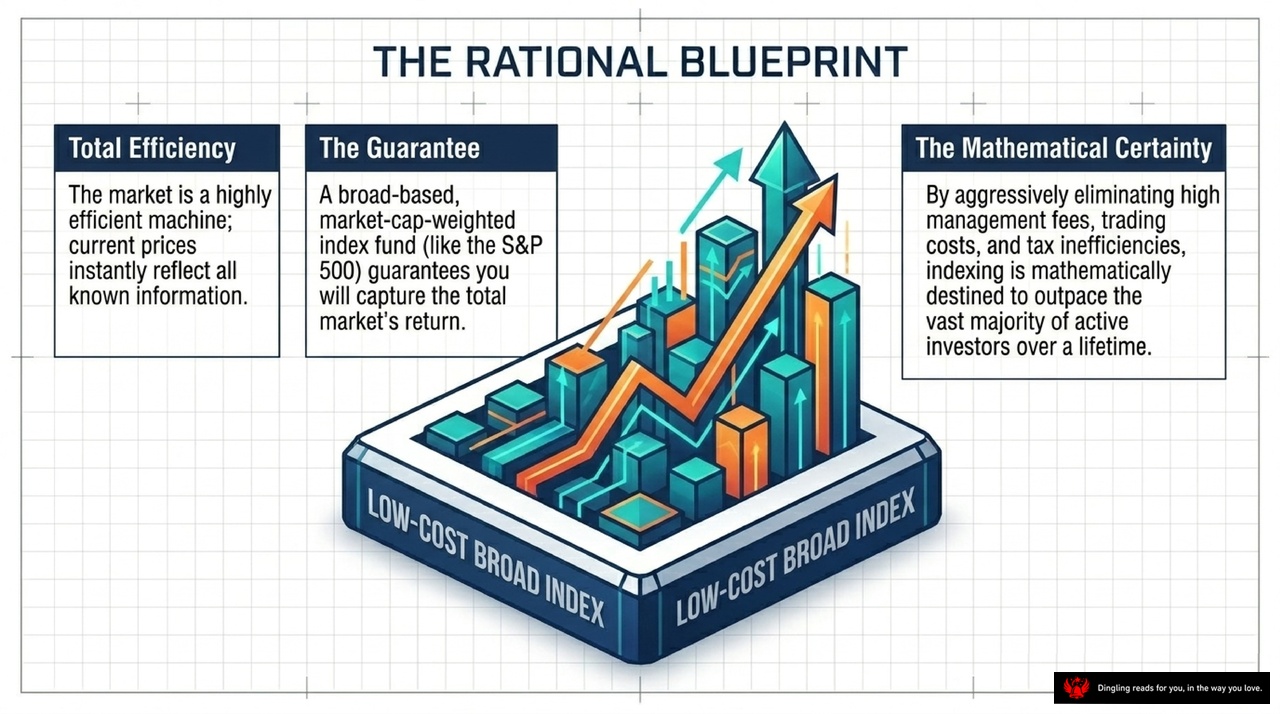
Let's talk about the "Rational Blueprint"—the simple, mathematical case for why most investors should just buy the whole market.
The image breaks this down into three powerful pillars. First, **Total Efficiency**. Think of the market as a highly efficient machine. Every piece of known information instantly gets baked into current prices. This is the heart of the Efficient Market Hypothesis: if you can't predict the future, you can't consistently beat the market. Trying to outsmart it with complex charts or tips is often just a game of chance.
Next, look at **The Guarantee**. This is the power of a broad-based, market-cap-weighted index fund, like the S&P 500. Instead of picking individual winners and losers, you capture the total market's return. You own the winners when they rise and the losers when they fall, smoothing out the volatility. It's not about being right; it's about being in the game.
Finally, there's **The Mathematical Certainty**. Here is the real kicker: by aggressively eliminating high management fees, trading costs, and tax inefficiencies, indexing is mathematically destined to outpace the vast majority of active investors over a lifetime. Active funds charge you to try to beat the market, but history shows they usually fail to do so while eating up your returns in fees and taxes.
The graphic illustrates this with a rising arrow on a block labeled "Low-Cost Broad Index." This isn't just a hope; it's a strategy built on efficiency, broad exposure, and the simple math of keeping more of what you earn.

Wall Street history teaches us a hard truth: no amount of charting, fundamental analysis, or star-manager intuition can consistently beat the collective efficiency of the market. True wealth isn't built by outguessing the crowd, but through the disciplined, long-term compounding of low-cost, broadly diversified index funds tailored to your life stage.
So, if the collective wisdom of the market consistently outsmarts the brightest minds and the most expensive algorithms on Wall Street, why continue paying a premium for the illusion of control?