
A Study of History: Complete Chapter-by-Chapter Summary

Welcome to today's session on Arnold J. Toynbee's monumental work, *A Study of History*. As the title suggests, this isn't just a record of past events; it's a sweeping framework for understanding how human civilizations rise through the friction of challenge and fall when they lose their own creative power.
Toynbee argues that history isn't about isolated nations, but about vast civilizations. He posits a profound truth: civilizations are born when a society faces a challenge it cannot easily solve, forcing it to innovate and grow. But they die when they stop facing new challenges, becoming stagnant and relying on past successes instead of creating new ones.
The book also tackles a critical misconception: that all civilizations are the same or that one culture is superior. Toynbee shows us that from the Western world to the Islamic and Indian spheres, every civilization follows a unique path of responding to its specific environment. Whether it's the harsh terrain of Athens driving the Greeks toward trade, or the fertile plains of India fostering a different kind of society, the environment acts as a catalyst, not a destiny.
Ultimately, Toynbee leaves us with a powerful warning and a call to action. He suggests that the future of humanity depends on our ability to maintain that creative tension—to keep challenging ourselves rather than settling into comfort. If we lose our capacity for self-transcendence, we risk repeating the tragic cycle of rise and fall that has defined our history for millennia.

Today's slide challenges a fundamental assumption we often hold: that history is best understood by studying isolated nation-states. The image on the left, showing a single disconnected puzzle piece, represents this "Illusion of the Nation-State." It suggests that countries like Great Britain or France have self-contained histories. But as the text explains, this is a myth. These nations are merely fragments, swept up by broader forces that ignore artificial borders. You cannot truly understand the British Industrial Revolution or the French Revolution by looking at them in isolation; they are parts of a much larger, interconnected whole.
This leads us to the second part of the image: "The True Unit," depicted as a fully assembled globe. This represents the concept of Civilization. To grasp the true rhythms of human progress and decay, we must shift our lens from the microscopic view of individual countries to the macroscopic view of civilizations. Currently, there are five living civilizations, alongside the fossilized remnants of others. Only by studying these larger species can we understand our own origins. The lesson is clear: history is not a collection of separate national stories, but a single, complex narrative of competing and evolving civilizations.

For centuries, historians have tried to explain the birth of civilization by pointing to just two things: the biology of the people or the geography of the land. But today, we are here to debunk those false causes. Look at the slide. We are crossing out the idea that race or environment alone drives history.
First, let's look at the biological fallacy. The image shows a DNA strand crossed out. Why? Because there is no inherent, superior biological trait that triggers civilization. History proves that the same "races" have produced vastly different societal outcomes across different eras. Biology is static, but human societies are dynamic.
Next, consider the geographical fallacy. The image on the right shows a serene landscape, also crossed out. Many believe easy, comfortable environments breed greatness. But the truth is the opposite. Static, accommodating environments actually trap humans in a rigid loop of primitive survival. It is not the comfort of the land that builds a civilization; it is the struggle against it.
So, if not race and not environment, what is the true origin? The insight at the bottom of our slide gives us the answer: The birth of a civilization is not caused by a single, static entity, but by a dynamic relationship. It is an encounter. Civilization is born from the collision of forces, a challenge met by a response, creating something entirely new.

Civilizations don't just appear out of nowhere; they are born from disruption. Think about it: a society often starts in a state of perfect, static equilibrium—a "Yin" state where everything is calm, but nothing is moving. Primitive groups might exist in this comfortable silence, relying on custom and rest, but without friction, there is no progress. It's like a car idling in neutral; it's stable, but it's not going anywhere.
Then comes the spark. The slide calls this "The Encounter." A severe challenge strikes—a harsh climate, a sudden migration, or a physical blow. This acts as a catalyst, shattering that perfect stillness. Suddenly, the society is forced to respond. If they can successfully adapt, they transform. They move from the state of Yin into the state of Yang, which represents action. This struggle generates momentum, pushing the society toward a higher level of complexity.
It's a mythological truth as well as a historical one. Just as God's perfect creation in mythology only advances when challenged by a disruptor, friction is actually the father of progress. Without that shock to the system, we stay stuck. So, the engine of history isn't peace; it's the dynamic tension between challenge and response. It's the moment the engine turns over, and the journey begins.

The Optimum Challenge isn't just a curve on a graph; it's the fundamental rhythm of human history. Look at that bell shape: it tells us that civilization doesn't grow by simply making things harder or easier. It thrives only in the sweet spot—the "Optimum Point."
On the left, you see "Challenge Deficient." When an environment is too accommodating, like a protected valley with endless resources, there is no stimulus. Society remains primitive because there is no reason to innovate. On the opposite side, we have "Challenge Excessive." If the pressure becomes too severe—think of a society crushed by relentless disaster or tyranny—it either breaks completely or retreats into a specialized, arrested state of mere survival.
The magic happens at the peak. This is where the curve hits its highest point. Here, the environment is harsh and demanding, requiring unprecedented effort, but it is still theoretically conquerable. It's the exact pressure needed to force a society out of its comfort zone, sparking the creativity and resilience required to build something great. Too little pressure breeds stagnation; too much breeds destruction. Only that precise, balanced tension allows civilization to rise.

How do we truly measure growth? The answer isn't found in conquering new lands or dominating technology. As a civilization matures, the battlefield shifts from the outside world to the depths of our own soul.
Look at the left side of this slide: The Macrocosm. In the early stages, challenges are strictly external—floods, hostile neighbors, untamed wilderness. It's a time of conquering the environment, much like the Polynesians who mastered the ocean or the Spartans who perfected warfare. But here lies the trap. When a civilization becomes too specialized in one skill, that "绝技" turns into a cage. The Spartans and the Ottomans didn't fail because they lacked talent; they failed because they stopped looking inward, becoming rigid and unable to adapt when the world changed.
Now, look to the right: The Microcosm. This represents mature growth. Here, challenges become internal. The civilization stops trying to dominate nature and starts mastering itself. Think of Shakespeare's evolution from Henry V's external wars to Hamlet's internal struggles. True growth is defined as a continuous, compounding process toward Internal Self-Determination.
The slide captures a profound truth: when we stop measuring our success by how much territory we control, and start measuring it by how deeply we understand ourselves, we finally break free from the cycle of stagnation and begin a journey of true, sustainable evolution.

Progress isn't driven by the masses; it's fueled by a small, dynamic fraction of creative individuals who pull the uncreative majority forward. This is the mechanism of growth through "Creative Minorities."
The process follows a clear cycle. First comes **Withdrawal**: the creative genius detaches from the paralyzing customs of society to find solitude. This leads to **Incubation**, where, in isolation, the individual realizes their dormant energies and undergoes a spiritual transformation. Next is **Transfiguration**: their internal state shifts to a higher level of conscious complexity, often visualized as a light igniting within. Finally, comes the **Return**: the creator comes back to society, armed with inspiration and leadership, to uplift the masses.
Once the creator returns, the uncreative masses follow through **Mimesis**, or imitation. While this provides an effective shortcut for social progress, it is a mechanical and potentially dangerous one. Without the initial spark of the creative minority, society risks stagnation. True growth happens only when these visionary individuals break away, transform, and then re-enter the world to reignite the collective spirit.

A civilization doesn't collapse from the outside; it breaks down from within. Think of it not as a murder by cosmic forces, but as a tragic suicide. As we see in this slide, the very creativity that solved yesterday's challenges often becomes the rigid institution that kills tomorrow's potential.
First, we face the Nemesis of Creativity. The creators stop innovating and start worshipping their own past successes, turning dynamic art into static dogma. This leads to a total loss of self-determination. Society loses its flexibility; the leader becomes a tyrant, and the creator shrinks into a mere bureaucrat. Finally, we witness the failure of mimesis. The uncreative majority, who once followed leaders out of admiration, now must be controlled by force.
This isn't about invincibility or military might. Militarism and the illusion of being unbeatable are actually symptoms of a fatal, self-inflicted breakdown. When a civilization stops evolving from the inside out, it doesn't just decline—it commits suicide.

When a civilization breaks down, it doesn't just crumble; it shatters into three distinct, warring factions. Think of it as a social body splitting into three pieces.
First, you have the Dominant Minority. These are the former leaders who have lost their charm. Instead of inspiring people, they cling to power through force, building an oppressive state just to stay in control.
Then, look inside the society itself. You have the Internal Proletariat. These are the subjugated masses who feel alienated and oppressed. They secede spiritually, often creating a Universal Church to find salvation elsewhere, escaping the chaos of the physical world.
Finally, outside the borders, you have the External Proletariat. These are the barbarian forces no longer attracted to the decaying civilization. They form hostile military bands, resulting in a violent Heroic Age as they clash with the crumbling state.
This tripartite split—ruling elites, internal spiritual refugees, and external warriors—is the anatomy of disintegration.
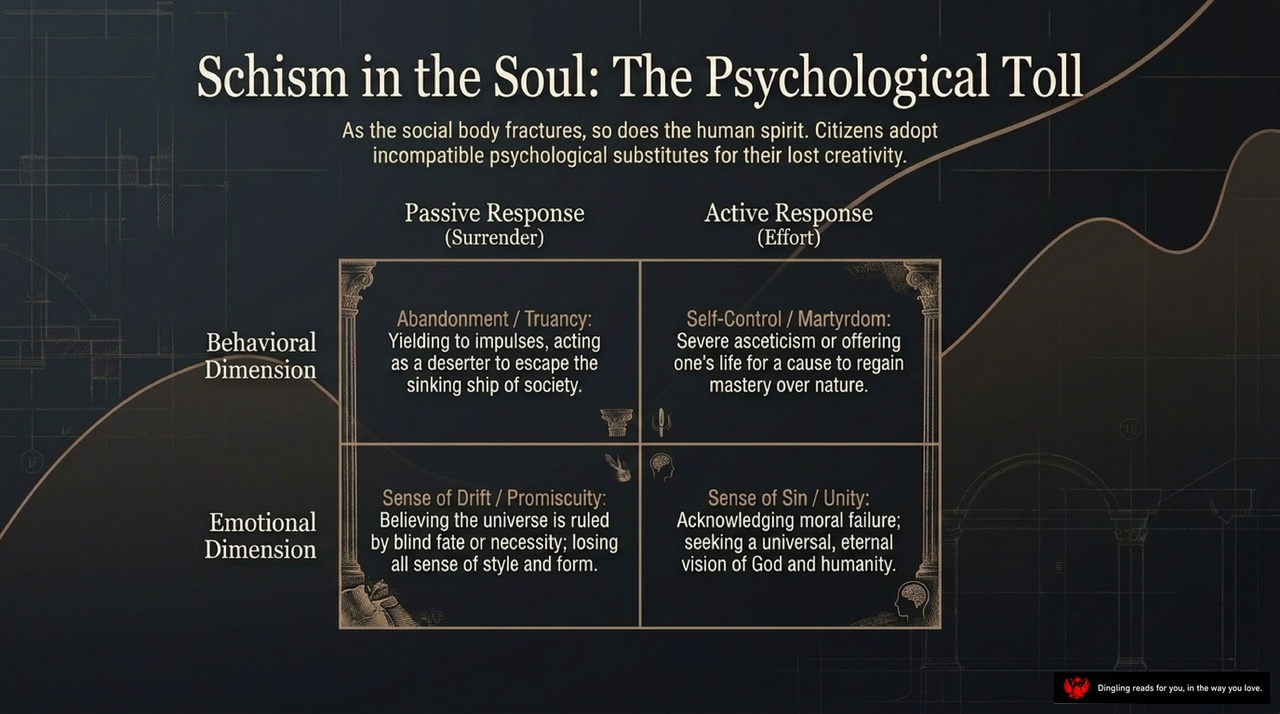
When we talk about the soul fracturing, we're not just talking about abstract philosophy; we're describing a very real psychological crisis that happens when society breaks apart. As the social body cracks, our spirit follows suit, and people end up adopting incompatible psychological substitutes to fill the void where their creativity used to be.
The slide breaks this down into two distinct paths: the Passive Response, which is essentially surrender, and the Active Response, which requires effort. On the behavioral side, the passive path leads to abandonment or truancy—people yielding to impulses and acting like deserters to escape a sinking society. In contrast, the active path demands self-control and martyrdom, where individuals practice severe asceticism or offer their lives for a cause to regain mastery over nature.
But it goes deeper into our emotions. The passive side breeds a sense of drift and promiscuity, a belief that the universe is just ruled by blind fate, causing us to lose all sense of style and form. The active side, however, cultivates a sense of sin and unity. This means acknowledging our moral failures and seeking a universal, eternal vision of God and humanity.
Ultimately, this schism in the soul shows us that when we stop trying to create and instead choose to either drift aimlessly or rigidly control everything, we lose the very thing that makes us human. True growth requires that active effort to find unity and purpose, rather than succumbing to the chaos of drift or the tyranny of control.

Look at this graph: "The Rhythm of Disintegration." It paints a stark, repeating cycle that history seems to refuse to break. We see a sharp red line plunging down, labeled "Rout," or the "Time of Troubles." Then, the line stabilizes into a flat plateau, marked as a "Rally"—the era of the "Universal State." This pattern repeats endlessly: collapse, then a temporary respite, followed by collapse again.
The slide tells us that citizens of massive empires often believe their state is immortal, but history shows this is just a recurring illusion. The establishment of a Universal State isn't a permanent victory; it's simply a temporary rally following a devastating rout. These giant, stagnant holding pens enforce a peace that merely delays the final collapse.
But here's the twist: the infrastructure of the empire serves as an unwitting host. Ironically, while the state fights to survive, its very systems become the transmission mechanism for the "Internal Proletariat" to spread their new, higher religion. The state doesn't save us; it prepares the ground for the next spiritual shift. So, don't look for an eternal empire. Look for the rhythm of the rout and the rally, because the next rally will eventually turn into the next rout.
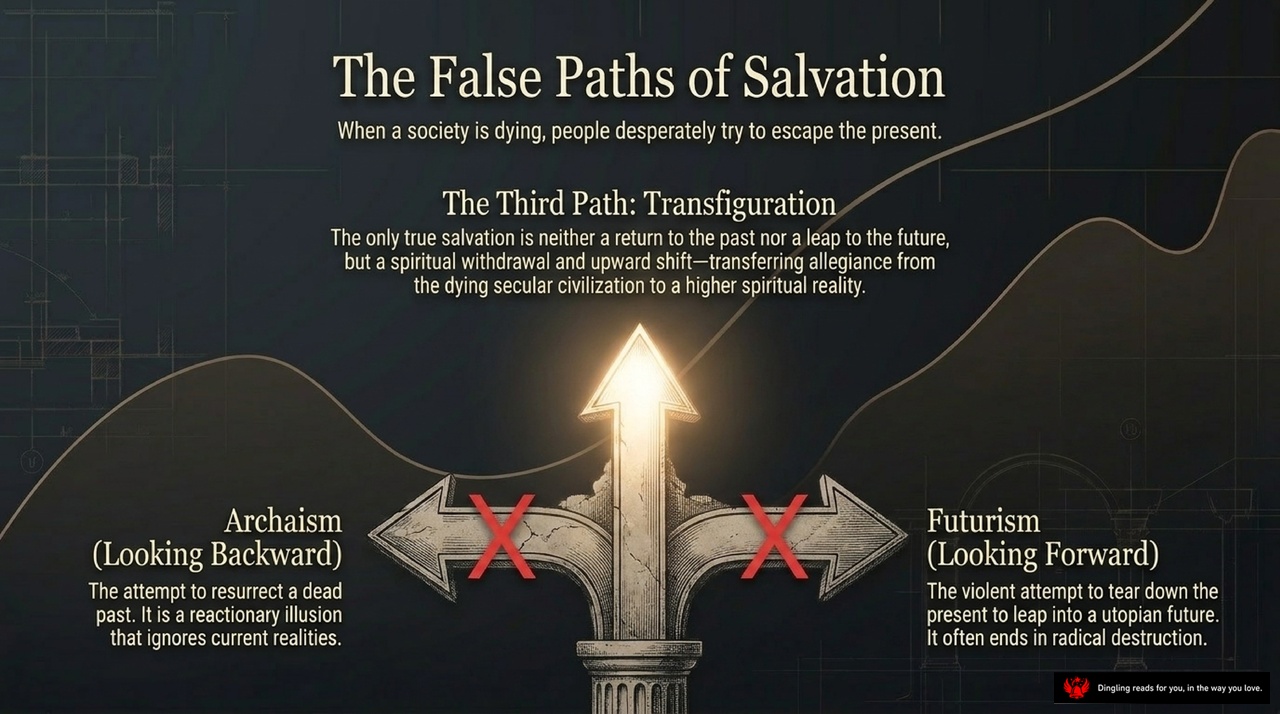
When a society is dying, the instinct to escape the present often leads us down false paths of salvation. As this slide illustrates, we face a critical choice: look backward or leap forward? Looking backward, we fall into the trap of archaism—a reactionary illusion that tries to resurrect a dead past while ignoring current realities. This is a fantasy that cannot survive the harsh light of the present. Conversely, looking forward, we risk futurism, a violent attempt to tear down the present in a desperate leap toward a utopian future. This path often ends in radical destruction, as we try to engineer a paradise that doesn't exist.
But there is a third path: Transfiguration. This is the only true salvation. It is neither a retreat to the past nor a reckless sprint into an uncertain future. Instead, it is a spiritual withdrawal and an upward shift. It means transferring our allegiance from a dying secular civilization to a higher spiritual reality. While the other two paths try to escape the crisis by running in time, transfiguration asks us to rise above it. It is about finding meaning not in what we can reconstruct or create, but in the spiritual transformation that comes from facing the truth of our current moment. This is how we move from mere survival to true renewal.

Civilization as a Chrysalis isn't just a poetic metaphor; it's the core mechanism of human history. Think of the crumbling column on the left as "The Dying Civilization"—a secular empire that has exhausted itself, destroying its own foundation. But look at what emerges from that decay: a glowing butterfly labeled "The Universal Church." This visual captures the central question we face: Does religion serve civilization, or does civilization exist to give birth to religion?
The answer lies in the three stages outlined here. First, we have "The Crucible." As secular civilization collapses, the profound suffering of the internal proletariat acts as a pressure cooker, forcing a spiritual awakening. Second, there is "The Higher Purpose." A disintegrating civilization isn't a failure; it's a tragic but necessary stepping stone—a prelude to the birth of something greater. Third, we achieve "Spiritual Continuity." While empires inevitably rise and fall, the spiritual insights they generate survive, carrying human progress forward into the next era.
In short, the death of an old world is the birth certificate of a new one. The chrysalis breaks, and the Universal Church takes flight.
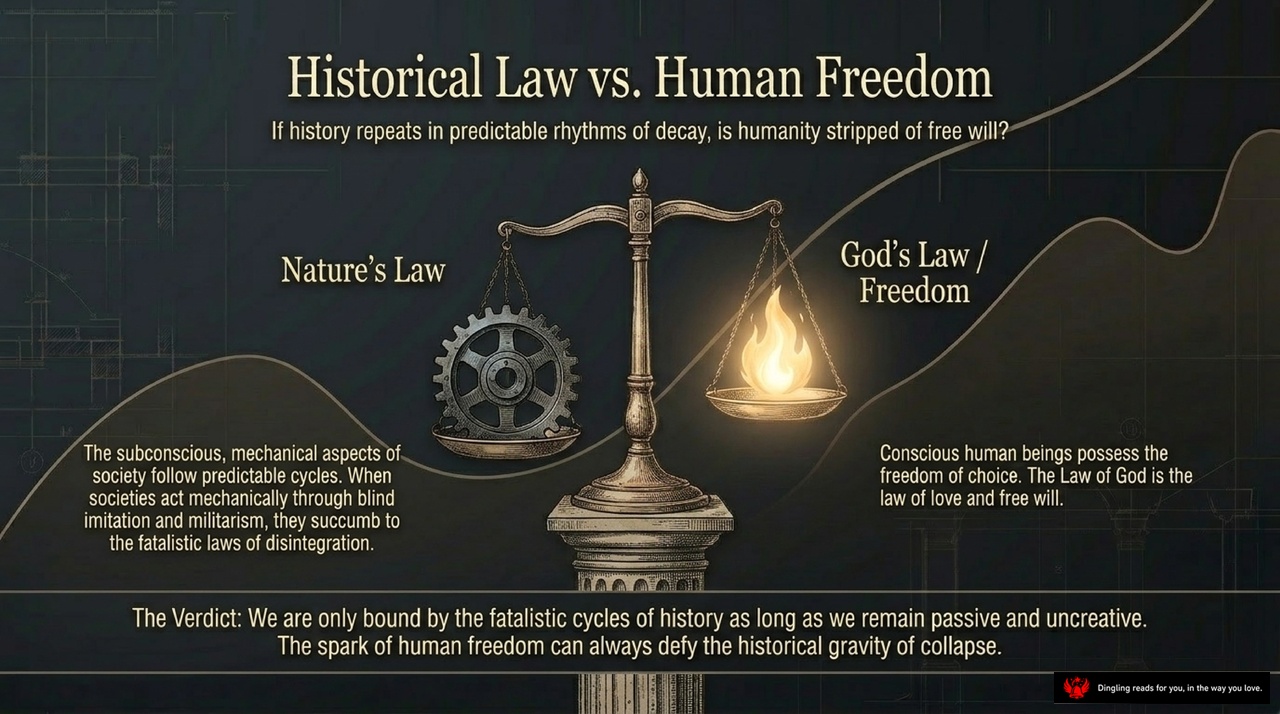
Have you ever wondered if history is just a predictable cycle of decay, stripping us of our free will? This slide asks us to weigh two opposing forces: the mechanical grind of "Nature's Law" against the fiery light of "God's Law" or true Freedom.
On the left, we see the gear of Nature's Law. This represents the subconscious, mechanical side of society where blind imitation and militarism trap us in fatalistic cycles of disintegration. If we act like machines, we are doomed to collapse.
But on the right, we see the flame of God's Law. This is where conscious human beings shine. It's the realm of choice, love, and free will. Here, we aren't just victims of history; we are active participants.
The verdict is clear: We are only bound by these destructive historical cycles as long as we remain passive and uncreative. But that spark of human freedom? That can always defy the gravity of collapse. It's up to us to choose the fire over the gear.

Civilizations don't die from murder, but from suicide. They break down when they lose their creative vitality, worship their own past successes, and replace inspiration with mechanical force. Yet, the cycle of decay is not absolute—humanity retains the ultimate freedom to respond to new challenges with spiritual and creative renewal. As the Western world faces its own unprecedented challenges and the immense pressures of modern technology, will we summon the creative response required to transcend our crises, or will we succumb to the nemesis of our own success?