
A Terrible Beauty: Complete Chapter-by-Chapter Summary

Welcome to the journey of *A Terrible Beauty*, a sweeping intellectual adventure by Peter Watson that maps the explosive transformation of the human mind in the 20th century. As the title suggests, this era was defined by a paradoxical duality: the shattering of ancient certainties and the forging of a new, scientific narrative of our existence.
Imagine a universe where the very fabric of reality is being rewritten. The image before you captures this tension perfectly—the intricate, branching structure of neurons against the vast, star-filled cosmos. This isn't just a backdrop; it's the central metaphor of the book. On one side, we have the biological, the messy, and the human; on the other, the infinite, the cold, and the cosmic. The 20th century was the moment these two worlds collided, creating a "terrible beauty."
This was the century where Darwin's ideas about evolution didn't just explain animals anymore—they dismantled our understanding of humanity itself. Suddenly, we were no longer special creations, but products of natural selection, subject to the same laws as every other species. This shift rippled outward, fueling social Darwinism, eugenics, and even the darkest ideologies of the 20th century, proving that science could be both a liberator and a weapon.
But it wasn't just about biology. It was about the mind itself. We saw the rise of Freud, who opened the door to the unconscious, revealing that our deepest fears and desires drive our actions. We witnessed the birth of quantum physics, where the universe stopped being a predictable machine and became a realm of probability and uncertainty. We entered an age where nothing was fixed, where truth was fluid, and where the old comforts of religion and tradition were challenged by a relentless, often terrifying, new logic.
From the chaotic cafés of Vienna to the industrial pragmatism of America, from the abstract art of Picasso to the existential angst of Sartre, this century forced us to ask the hardest questions: Who are we? What is real? And in a world stripped of its old certainties, how do we find meaning? This book traces that long, difficult, and ultimately transformative path, showing how we moved from a world of divine order to one of scientific possibility—a journey that is indeed terrible, yet undeniably beautiful.

Welcome back. Today, we're peeling back the layers of what we often call "history."
Look at the top line of our slide. We're used to thinking of history as a straight arrow defined by military conflict and political trauma—the "Traditional Narrative." We see swords clashing and leaders speaking from podiums, believing that wars and treaties are the only drivers of human change.
But look closer at the web below that timeline. That represents the "Intellectual Reality"—the hidden engine that actually rewired how we understand the world.
Notice how these dots connect: Quantum Mechanics, Genetics, Psychoanalysis, and Modernism. These aren't just isolated scientific discoveries; they are a tangled, living network. When Quantum Mechanics changed our view of the atom, it didn't just update physics; it shattered our certainty about reality. When Genetics revealed that we are just our ancestors' code, it fundamentally altered our concept of identity.
The text reminds us that science didn't just expand our knowledge of the universe; it revolutionized the very rules by which the intellect functions.
Think about it this way: In the 20th century, a breakthrough in the lab didn't stay in the lab. It leaked into our art, our politics, and our psychology. The abstract shapes of Modernism in art? That was a direct reflection of the uncertainty in Quantum Physics. The focus on the subconscious in therapy? That was the echo of Freud grappling with the new understanding of the human mind.
We stopped seeing history as a story of battles and started seeing it as a story of shifting perspectives. The "Hidden Engine" isn't a person or a weapon; it's the moment our collective understanding of reality gets updated. That is how the 20th century truly moved forward.

Welcome to the next chapter of our journey through the 20th century. Today, we're shifting our focus from the turbulent wars and political upheavals of the mid-century to the quiet, yet revolutionary, explosion that occurred in the laboratories and studios of the late 1900s. This was the era where the very fabric of reality began to unravel and rebuild itself.
Look at the center of this slide: **1900**. It wasn't just a date on a calendar; it was the moment certainty shattered across every field of human endeavor. Let's explore how.
First, on the left, we see **Psychology** and **Physics**. In 1900, Sigmund Freud published *The Interpretation of Dreams*, shattering the illusion that we are fully rational, conscious actors. He birthed the concept of the 'Unconscious'—those repressed, primitive instincts that drive us, long before we admit it. Simultaneously, Max Planck was outlining Black Body Radiation. This event destroyed the Newtonian dream of a continuous, predictable universe. Instead, he birthed the 'Quantum,' revealing that energy moves in invisible, erratic leaps. The clockwork universe was dead; a probabilistic one was born.
Now, turn your eyes to the right side of the screen. Here, **Biology** and **Art** underwent their own revolutions. In biology, Hugo de Vries and Gregor Mendel rediscovered the rules of pea plant hybridization. This shattered the old belief in slow, smooth Darwinian adaptation. Instead, they birthed the idea of genetic mutations—hidden, discrete biological codes that could change everything instantly. In the world of art, Pablo Picasso arrived in Paris in October 1900. His presence shattered the classical, objective representation of reality. He birthed Modernism, introducing subjective, fragmented perspectives that challenged everything we thought we knew about beauty and form.
So, what does this mean for us? It means that the 20th century didn't start with a bang, but with a series of profound realizations: that our minds are not masters of our own house, that the universe is not a predictable machine, that life changes in sudden jumps, and that art is not a mirror of nature, but a reflection of our inner chaos. These four pillars—Psychology, Physics, Biology, and Art—laid the foundation for the modern world. They taught us that uncertainty is not a flaw in our understanding, but the very nature of reality. As we move forward, remember that the greatest discoveries often come from the moment we admit we don't know everything.
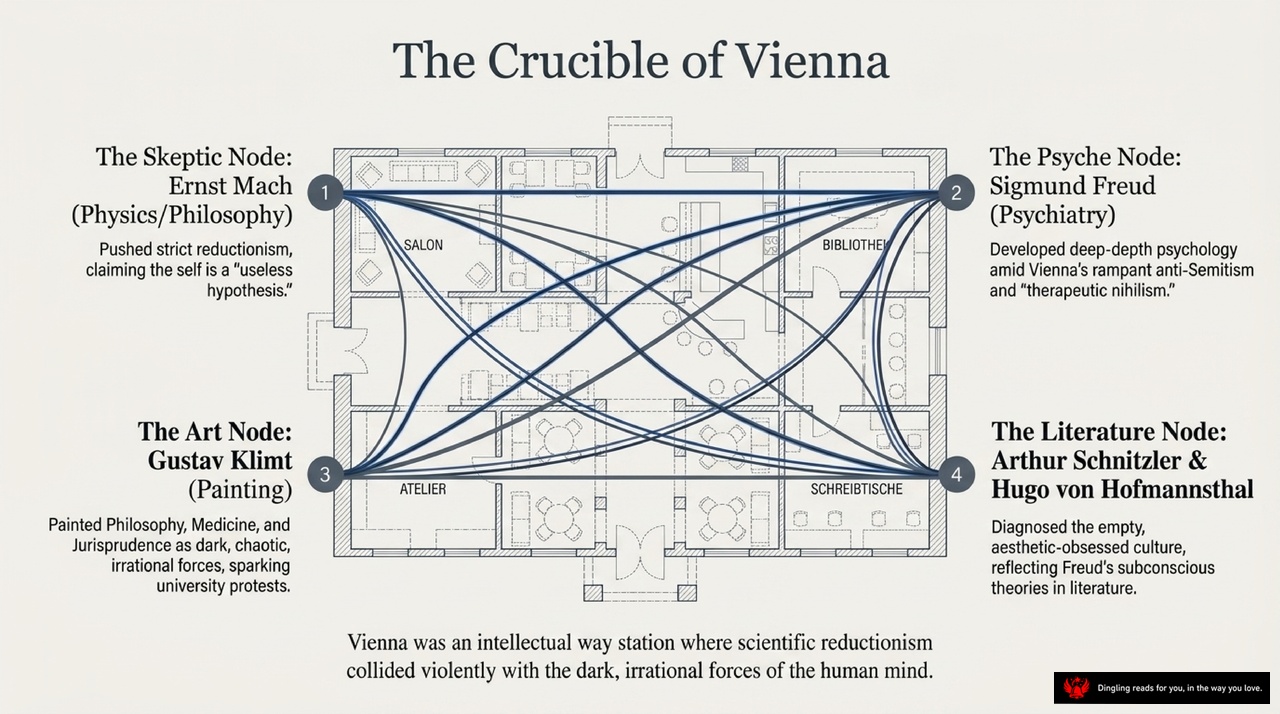
Welcome to the third chapter of our journey through the 20th century. Today, we step into the golden age of physics, a time when humanity finally cracked the code of the universe.
Look at this slide. We are in the era of the "Big Bang" of science. On the left, we see the building blocks of reality: Rutherford discovering the atomic nucleus, Bohr introducing quantum mechanics, and Heisenberg shattering our certainty with the uncertainty principle. This isn't just math; it's a revolution. It proved that at the deepest level, the universe is probabilistic, not predictable.
On the right, the scale expands to the cosmos. Hubble's observations of redshift revealed that the universe is expanding, planting the seed for the Big Bang theory. Meanwhile, chemistry and biology are undergoing their own transformations. Pauling applies quantum mechanics to chemical bonds, while Whittler and O'Hearn invent the jet engine, literally shrinking the world.
But the most profound shift happens in our understanding of life itself. In 1944, Erwin Schrödinger asks, "What is Life?" He proposes that life is a system that creates order from disorder, and that genes are essentially "aperiodic crystal"—a code, like Morse code, storing biological instructions. This insight didn't just explain biology; it ignited the birth of molecular biology, leading directly to the discovery of DNA's double helix by Watson and Crick.
This scientific explosion wasn't happening in a vacuum. It occurred against the dark backdrop of the Nazi era. As we see in the text, the rise of the Third Reich brought a brutal cultural purge. Modern art was labeled "degenerate," and brilliant minds like Einstein and Freud were forced into exile. Yet, even in this darkness, the fire of truth could not be extinguished. While pseudoscience like Lysenkoism choked Soviet biology, and the Nazis tried to weaponize science for racial hatred, the true spirit of inquiry survived. It fled to America and beyond, carrying the torch of reason.
So, what do we take away from this crucible? We learned that the universe is vast and mysterious, that life is a coded miracle, and that the pursuit of truth, no matter how persecuted, remains the most powerful force of our species. This scientific revolution didn't just change how we see the stars; it changed how we see ourselves.
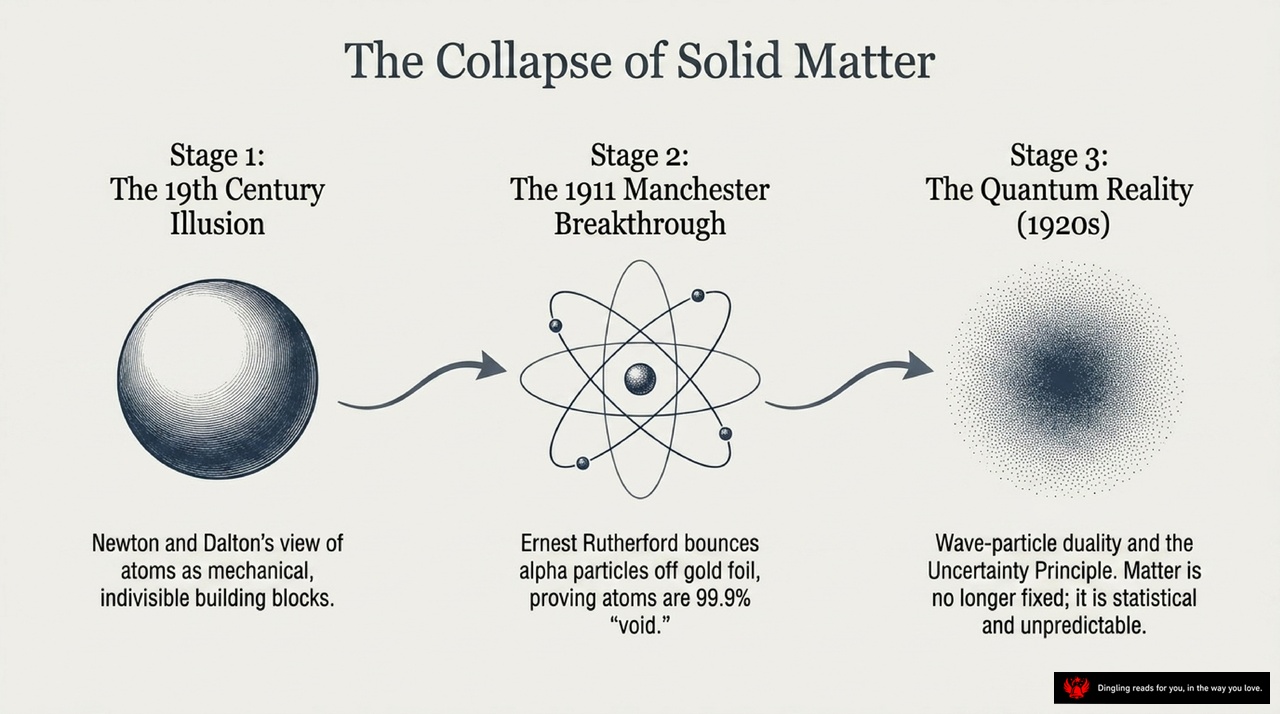
The Collapse of Solid Matter isn't just a physics lesson; it's a story about how our entire reality shifted from something solid and predictable to something fluid and probabilistic.
Let's look at this journey in three stages.
First, we have the 19th Century Illusion. For centuries, thanks to thinkers like Newton and Dalton, we believed the world was built like a machine. Atoms were seen as mechanical, indivisible building blocks—tiny, unbreakable spheres that made up everything. It felt safe, logical, and absolutely certain.
Then came the 1911 Manchester Breakthrough. Ernest Rutherford changed everything. By bouncing alpha particles off gold foil, he proved that atoms aren't solid balls at all. In fact, they are 99.9% empty space. This shattered our first illusion, revealing that the "solid" matter we touch is mostly void.
Finally, we arrive at the Quantum Reality of the 1920s. This is where things get truly mind-bending. We discovered wave-particle duality and the Uncertainty Principle. Matter is no longer fixed or predictable; it's statistical. We can't know everything about a particle at once. The solid world we trusted has collapsed, replaced by a universe that is fundamentally uncertain and probabilistic.
So, what we thought was solid was always an illusion. The real world is far stranger, and far more fascinating, than we ever imagined.

Welcome back to our exploration of the 20th century. Today, we're looking at the final chapter of our journey: the fusion of science and the humanities.
As we reach the end of this century, we see a powerful convergence. Think of it as a triad of forces reshaping our world: the awe-inspiring power of science, the dynamism of a free market, and the reach of mass media. These three pillars didn't just coexist; they wove together to create a new intellectual landscape where disciplines began to blend. Physics talks to astronomy, biology converses with linguistics, and the concept of evolution stretches from the Big Bang all the way to the origin of life.
But while the empirical side of our world was exploding, the human side faced a crisis. We witnessed the rise of the "scientific spirit," yet we also saw the quiet fading of the humanities. Sociology and psychology were often hijacked by ideology, losing their analytical edge. The grand narratives of the left and the right struggled to make sense of a complex reality. Even the foundational theories of psychoanalysis were exposed as myths lacking real-world evidence.
In this shift, the role of the public intellectual changed. Scientists began to take the stage, often overshadowing the traditional humanists. While non-Western cultures finally found their voice and began to flourish, they still hadn't produced a single idea that could fundamentally reshape the global narrative.
So, what's the takeaway? We need a balance. We can't choose between the precision of science and the empathy of the humanities. We need both. As we look toward the future, we stand on the threshold of a new era. We are moving beyond the fragmentation of post-modernism, seeking a harmony between the old whole and the new parts. The goal is clear: to use the narrative of evolution not just to explain where we came from, but to light the path for where we are going together.
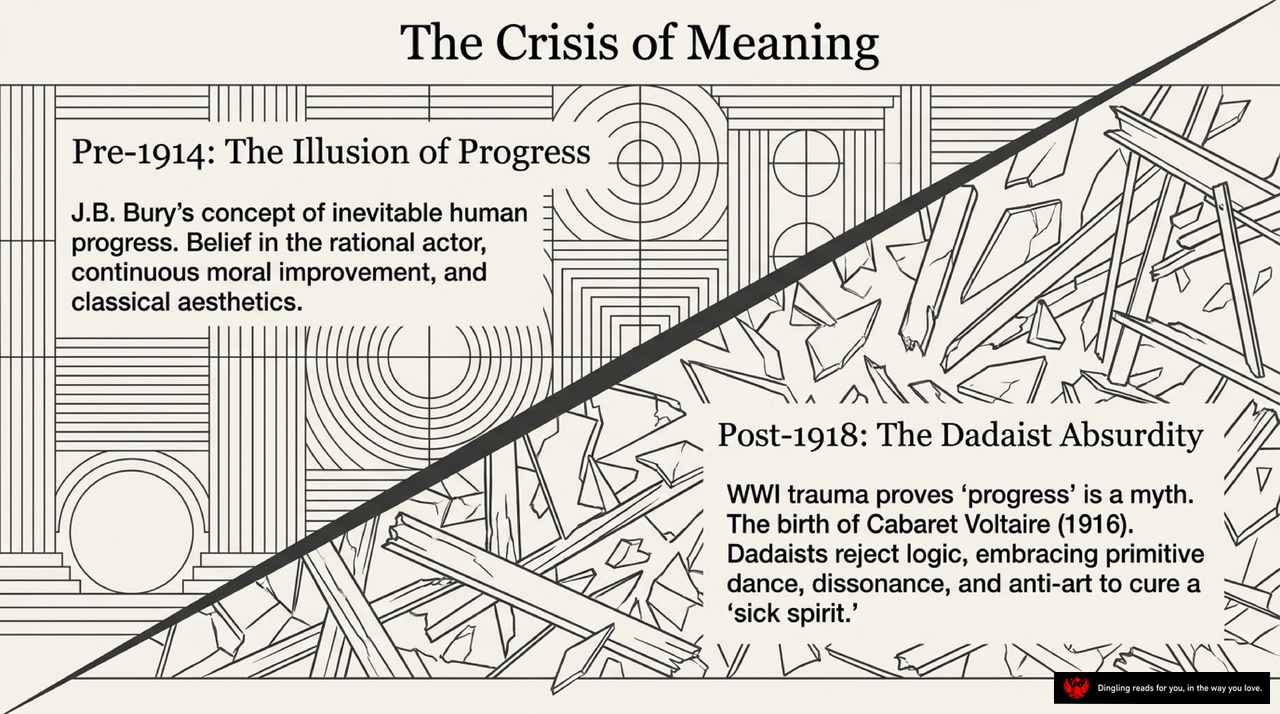
Before 1914, the world was convinced that human history was a straight line upward. We believed in J.B. Bury's idea of inevitable progress—a rational future where morality would constantly improve and classical beauty would reign supreme. It was a time of illusions, where we thought logic and order could solve everything. But then came the Great War, and that illusion shattered instantly.
Post-1918, everything changed. The trauma of World War I proved that "progress" was just a dangerous myth. In the ruins of faith and reason, the Dadaists emerged to embrace absurdity. They rejected the very logic we used to trust. Instead of seeking order, they celebrated chaos, primitive dance, and dissonance. Think of the birth of Cabaret Voltaire in 1916; it was a place where artists deliberately broke rules to cure a "sick spirit." From the Dadaists' anti-art to the fragmented landscapes of modern literature, this era wasn't about building a better future anymore. It was about staring into the void and accepting that life might have no inherent meaning. The crisis of meaning wasn't just a philosophical debate; it was the defining scar of the 20th century, forcing us to ask: if progress is a lie, what are we supposed to do?
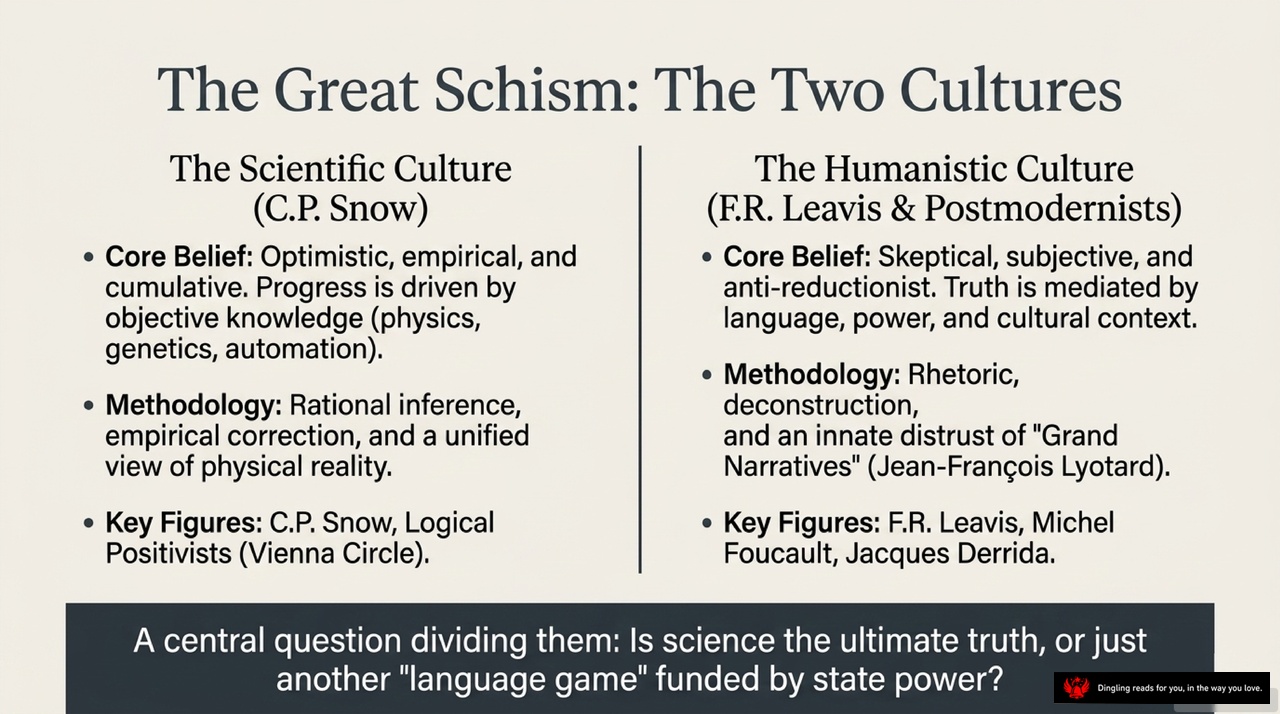
Welcome back to our exploration of the 20th century's intellectual landscape. Today, we're diving deep into a pivotal moment in cultural history: The Great Schism, or as C.P. Snow famously called it, "The Two Cultures."
Imagine the world split down the middle. On the left, you have the Scientific Culture. This is the realm of C.P. Snow, the Logical Positivists, and the Vienna Circle. Their core belief is rooted in optimism. They see the world as empirical, objective, and cumulative. Progress, for them, isn't a mystery; it's driven by hard facts—physics, genetics, automation. Their methodology is all about rational inference and empirical correction. They trust a unified view of physical reality. If you ask them, "Is there truth?" they'll point to the lab and say, "Yes, and we can measure it."
On the right side of this divide stands the Humanistic Culture. Here, you find thinkers like F.R. Leavis and the postmodernists who followed. Their worldview is fundamentally different. They are skeptical and subjective, deeply anti-reductionist. They argue that truth isn't a standalone object; it's mediated by language, power, and cultural context. Their methodology relies on rhetoric and deconstruction, carrying an innate distrust of what they call "Grand Narratives"—those big, sweeping stories about human progress. Key figures here include Michel Foucault and Jacques Derrida. They ask, "Who is telling the story, and why?"
So, what is the central question dividing them? Is science the ultimate truth, the key to unlocking the universe? Or, as the skeptics argue, is science just another "language game," a sophisticated tool funded by state power to impose a specific order on reality? This tension between the drive for objective knowledge and the suspicion of cultural construction defined the intellectual struggle of the 20th century.
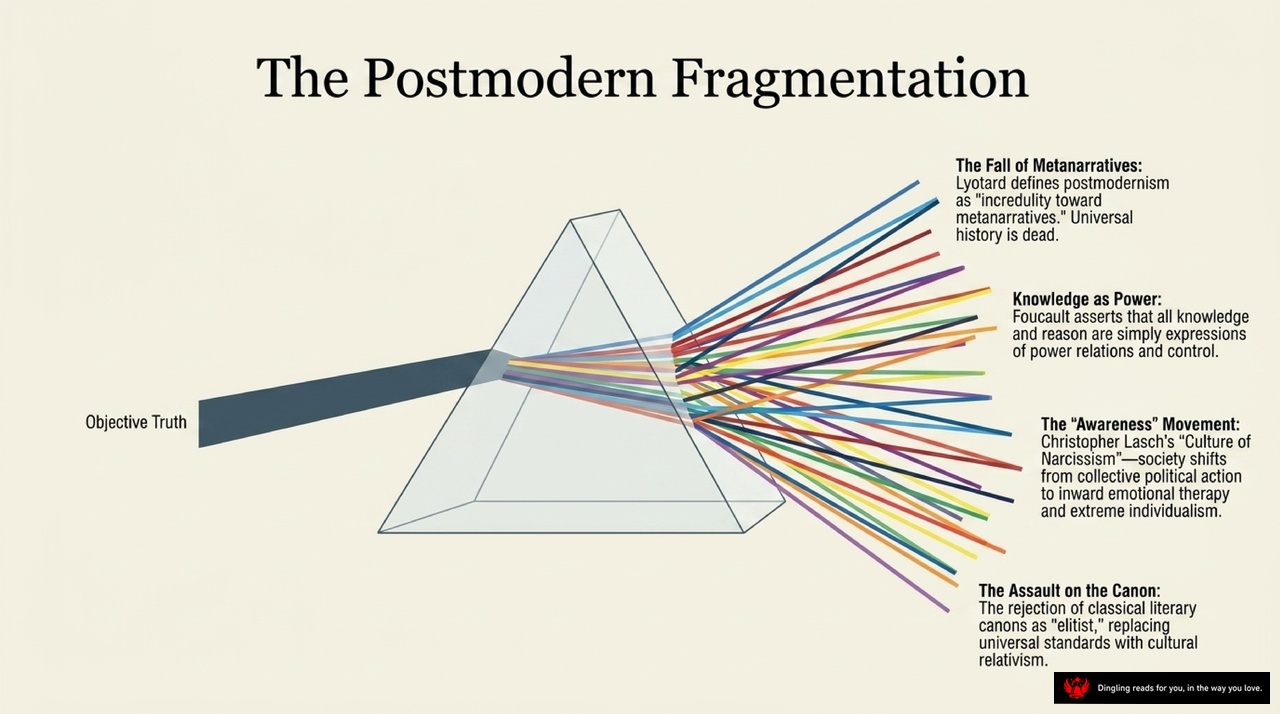
Imagine a single beam of pure, objective truth hitting a prism. In the pre-modern world, that beam traveled straight, unchanging. But look at what happens when it hits the modern era. Suddenly, that single beam shatters into a chaotic spectrum of colors. This is the essence of postmodern fragmentation.
As the slide illustrates, the first thing that breaks is the idea of "Objective Truth" itself. Jean-François Lyotard famously defined postmodernism as an "incredulity toward metanarratives." In simple terms, the grand stories we used to tell about universal history or a single path to progress are dead. There is no longer one master story that explains everything for everyone.
Next, notice how that light splits into different directions. For Michel Foucault, knowledge isn't neutral; it's power. Every fact, every theory, is just an expression of who holds the control in a specific relationship. Truth becomes a tool of domination rather than a discovery of reality.
Then, look at the shift inward. Christopher Lasch warns us about the rise of a "Culture of Narcissism." Society stops looking outward for collective political action and turns inward, obsessed with emotional therapy and extreme individualism. We become focused on our own feelings rather than our shared responsibilities.
Finally, see how the lines scatter completely. The "Assault on the Canon" means we are rejecting the old, classical literary standards that once defined high culture. We replace those universal standards with cultural relativism, where every culture is seen as equally valid, but perhaps equally isolated from one another.
What we see here is a world where the clear, straight line of objective truth has been replaced by a dizzying array of perspectives, power dynamics, and individual narratives. It's a beautiful mess, but it's a mess nonetheless.
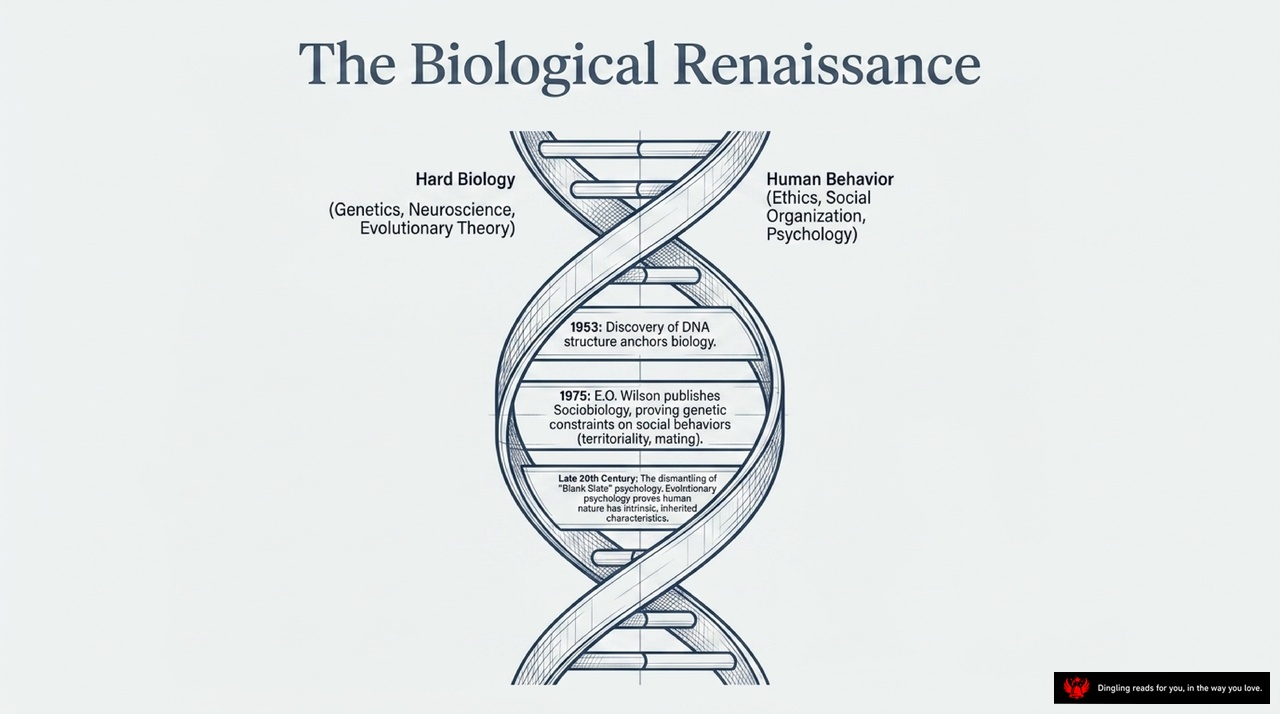
Imagine a DNA double helix not just as a biological structure, but as the timeline of a profound intellectual revolution. On the left, we have "Hard Biology"—the rigorous fields of genetics, neuroscience, and evolutionary theory. On the right, "Human Behavior," encompassing ethics, social organization, and psychology. This slide captures the essence of the Biological Renaissance: the moment these two worlds finally merged.
Look closely at the timeline etched into this helix. It all anchors in 1953 with the discovery of the DNA structure, a breakthrough that literally gave us the code of life. A decade later, in 1975, E.O. Wilson publishes *Sociobiology*, proving that even our social behaviors—like territory and mating—are constrained by our genetics. This shattered the old idea that culture alone shaped us. By the late 20th century, the dismantling of the "Blank Slate" psychology confirmed what we now know: human nature has intrinsic, inherited characteristics.
This visual perfectly illustrates the shift described in the text, where the biological revolution swept from the lab into the heart of human society. It moved us from seeing ourselves as products of environment alone to understanding the deep, biological roots of our behavior. This fusion of hard science and human behavior didn't just change biology; it fundamentally rewrote our understanding of who we are.

Welcome to the final chapter of our journey through the 20th century. Today, we are looking at a powerful concept called "The Grand Convergence"—the moment when all the scattered threads of human knowledge finally tie together into one unified story.
Imagine four distinct paths, each representing a pillar of our understanding, all flowing into a single destination. On the top left, we have Cosmology and Physics. This path takes us from the Big Bang, through the age of the universe, to the very formation of the elements that make up our world. It's the story of how the stage was set for everything that came after.
Moving to the top right, we see Geology. This narrative covers the dynamic history of our planet, from plate tectonics shifting the land beneath our feet to the unfolding age of Earth itself. It's the story of the home we live on.
On the bottom left, Evolutionary Biology joins the mix. Here, we trace the origin of species and the complex coding of DNA. It explains how life diversified and adapted, connecting the physical world to the living world.
Finally, on the bottom right, we have Anthropology and Archaeology. This path follows humanity's own journey, starting with the Out-of-Africa migration and leading us to the dawn of human civilization. It's the story of us.
Now, look at where these four paths meet. This is where we find Consilience. This is the profound realization that all these disciplines—physics, geology, biology, and anthropology—are actually telling one single story. Science has stepped up to replace religion and traditional philosophy as the primary generator of humanity's "Grand Narrative." It's a moment where the universe, the earth, life, and humanity are understood not as separate puzzles, but as one interconnected whole. This convergence is the ultimate triumph of the 20th-century mind.
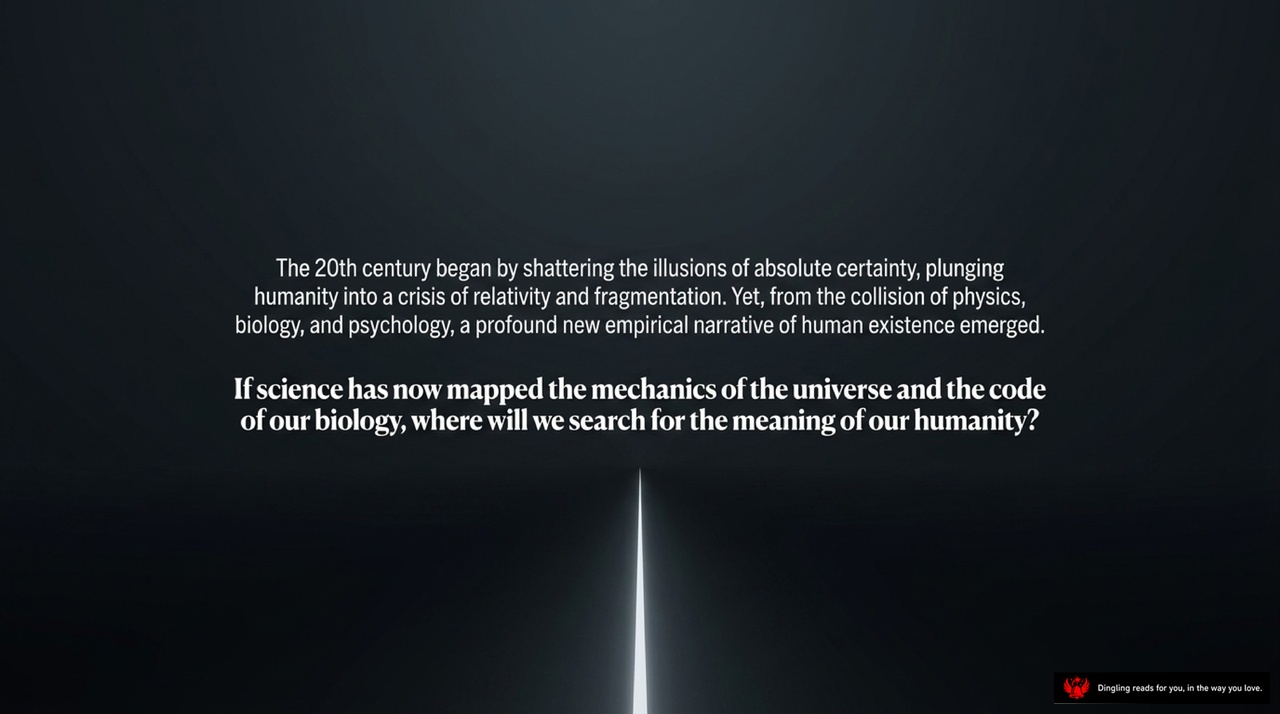
Look at this striking image. It asks a profound question: if science has mapped the mechanics of the universe and cracked the code of our biology, where exactly do we search for the meaning of our humanity? This is the central tension that defines the 20th century.
As the slide suggests, the 20th century began by shattering the illusions of absolute certainty. We plunged into a crisis of relativity and fragmentation. But from the collision of physics, biology, and psychology, something new emerged—a profound, empirical narrative of human existence.
Think about the revolution happening around you. In the 1930s, Erwin Schrödinger asked, "What is life?" He proposed that life is a system that derives order from order, and that genes are non-periodic crystals storing information like Morse code. This wasn't just biology; it was physics meeting philosophy. It led Watson and Crick to discover the DNA double helix, unlocking the very code of life.
At the same time, our view of the cosmos was exploding. Edwin Hubble proved the universe is expanding, and later, Stephen Hawking showed us that time itself might begin and end at singularities. We mapped the stars, and we mapped the atom.
But here is the crucial point the slide highlights: just because we understand the *how* of the universe and the *how* of our bodies, does that tell us the *why* of our lives?
Science gave us the tools to survive, to cure diseases, and to travel to other planets. Yet, as we saw with the rise of Social Darwinism and the horrors of the 20th century, knowing the mechanics of power doesn't make us wise. Knowing the code of our DNA doesn't automatically grant us moral clarity.
The 20th century was a unique era where we had the most powerful science ever seen, yet we faced the deepest existential questions. We built machines that could destroy the world, but we still struggled to find a reason to save it. We understood the universe better than any civilization before us, yet we felt more alone.
So, where do we look for meaning? The answer isn't found in a lab report or a physics equation. It lies in the messy, unpredictable collision of these hard sciences with our soft, human experiences. It's in the art that expresses what words cannot, the philosophy that questions our assumptions, and the empathy that connects us across our biological differences.
The 20th century taught us that mapping the universe is only the beginning. The real challenge—and the true meaning of our humanity—is figuring out how to live within it.