
Abraham Lincoln: The Gettysburg Speech and Other Papers: Complete Chapter-by-Chapter Summary

Welcome to today's session. We are diving into a profound exploration of American history, focusing on the evolution of the American ideal through the life of Abraham Lincoln. This page introduces our central theme: "The Engineer of the Republic."
As you see, the title isn't just about construction; it's about the delicate, step-by-step work of building a nation from the ground up. The image captures Lincoln not just as a political figure, but as a blueprint for democracy itself.
Ralph Waldo Emerson, a towering voice in American thought, described Lincoln with a powerful metaphor that we must all understand: "He is the true history of the American people in his time. Step by step he walked before them; slow with their slowness, quickening his march by theirs."
This quote is the heart of our story. It tells us that Lincoln wasn't a distant god descending from heaven. Instead, he was a fellow traveler who moved at the pace of the common man, only to gently accelerate the nation's progress. He didn't force the country to move forward; he walked alongside it, showing the way until the people were ready to follow.
This image, with its geometric lines and dual portraits, symbolizes that engineering of the soul and the state. It reminds us that true leadership isn't about commanding from above, but about understanding the terrain of the people's hearts and guiding them with patience and vision. Join me as we uncover how this "Engineer" reshaped the world.

The Architecture of Leadership isn't just about grand titles or fancy degrees; it's about the raw materials from which a leader is forged. Look at this blueprint. On the left, we have the Founding Fathers—think aristocratic English gentlemen in powdered wigs, educated in European institutions, masters of decorous, rule-bound diplomacy. Their style was polished, predictable, and built on centuries of tradition.
Now, look to the right. This is the blueprint for the New American, and it's a completely different story. We're talking about frontier-born, middle-class individuals—people like Abraham Lincoln, who were autodidacts shaped by the wilderness and the raw power of Blackstone's Commentaries. Their education wasn't in a classroom; it was in the dirt and the struggle. Their instinctual style? It wasn't about following rules; it was being unwieldy, instinctual, and fiercely pragmatic.
The diagnostic note here is crucial. As Henry Watterson observed, this new type of leader was a "common man expanded into giant proportions." He wasn't hindered by fear or bound by old-world etiquette. Instead, his genius came from common sense enriched by hard experience. While the old aristocracy relied on polish, the New American relied on grit. This shift from a structured, European model to a rugged, American one is what allowed a leader like Lincoln to rise from a log cabin to the White House, proving that true leadership often comes not from a perfect blueprint, but from the unpolished reality of the frontier.

Look at this timeline. It captures the raw, unfiltered life of Abraham Lincoln, the man who would one day save the Union. This isn't just a list of dates; it's a portrait of a man forged in fire.
Let's start at the bottom, in the "Physical Reality." In 1809, Lincoln is born in a cramped log cabin in Kentucky, the son of poor immigrants. His father barely knew how to read, and his mother worked herself to the bone just to keep them fed. Life was hard. By 1818, his mother dies in the Indiana backwoods, leaving him to fend for himself. But here is the turning point: despite having almost no formal schooling, Lincoln's hunger for knowledge never faded.
Notice the top line, "Intellectual Accumulation." While his peers were playing, Lincoln was reading everything he could get his hands on. He devoured Aesop's Fables, Robinson Crusoe, and even the Revised Statutes of Indiana. He didn't have books, so he borrowed them, walking miles just to check out a grammar book. When he couldn't afford paper, he used charcoal on a scraped wooden shovel or a broken wood tile to copy down what he read. He even memorized Blackstone's Commentaries under a tree.
This unique duality is what made him. The "Accumulation of Hardship" at the bottom gave him a deep, innate understanding of the "plain people." He knew what it felt to be poor, to struggle, and to lose. But the "Intellectual Accumulation" above gave him the tools to understand the world and lead it. He wasn't an elite lawyer from the East; he was a self-made man who read law by candlelight on a dirt floor.
This combination—extreme deprivation paired with a voracious intellect—created the perfect leader. It allowed him to speak directly to the common man with a sincerity that no polished politician could match. When he later faced the crisis of the Civil War, he didn't lead from a tower of ivory; he led from the same soil that had shaped him. He understood the cost of freedom because he had paid it himself. This foundation was essential for his future leadership, proving that the greatest leaders often come from the hardest places.

Picture this: the ultimate showdown between a rising star and an established legend. On one side, you have Abraham Lincoln, the "Tall Giant"—six feet four, physically unyielding, but strategically ambitious. On the other stands Stephen A. Douglas, the "Little Giant"—broad-shouldered, combative, and already a national figure. But it wasn't just about who looked the part; it was about their core philosophies and their strategic goals.
Lincoln believed slavery was morally wrong, while Douglas championed "popular sovereignty," claiming indifference to whether slavery was voted up or down. In 1858, their strategic goals clashed head-on. Lincoln wanted to force Douglas to reconcile the controversial Dred Scott decision with popular sovereignty, whereas Douglas simply needed to maintain Northern Democratic support to secure his own future presidential run.
Here is where the "Freeport Trap" comes into play. Against the advice of his allies, Lincoln pressed an "unfriendly legislation" interrogatory, daring Douglas to define his stance. Douglas, keeping his Senate seat but fracturing the National Democratic party, ultimately lost the 1860 Presidency. As Lincoln famously noted, "I am after a larger game." This wasn't just a local election; it was a masterclass in political maneuvering that reshaped the nation's destiny.

Look at this image. It captures the very heart of the crisis that Abraham Lincoln faced: a nation literally tearing itself in half. On the left, we see the forces pushing the country toward chaos—the Kansas-Nebraska Act and the Dred Scott Decision acting as wedges, threatening to destroy the Union. On the right, the house is split into "Slave" and "Free," representing the deep divide that threatened to collapse the entire structure.
But here is the crucial point, and the one that defined Lincoln's genius. While everyone else saw a house about to fall, Lincoln saw something different. As the graphic states, his thesis was: "I do not expect the house to fall, but I expect it will cease to be divided." He believed the nation would not remain a split entity; it would have to become "all one thing or all the other."
This wasn't just a political slogan; it was a moral stance. Lincoln refused to dilute the truth that slavery was the root cause of the conflict. He understood that you cannot have a half-slave, half-free nation. The pressure was immense, and practical politicians warned him that standing firm would cost him the election. Yet, he refused to compromise on the fundamental truth. This image perfectly illustrates why Lincoln's leadership was so transformative—he didn't just try to patch the cracks; he demanded that the nation choose a single, unified path, ultimately choosing the path of freedom.

Look at this diagram titled "The Anatomy of a Crisis: March 1861." It perfectly captures the pressure cooker Abraham Lincoln stepped into on his first day in office. At the very center, we see the White House, but it's surrounded by concentric rings of chaos.
Directly to the south, the threat was immediate and violent: armed rebellion, seven states that had already seceded, and the terrifying fact that they had seized federal forts. Inside the center circle, the text points out a "disloyal bureaucracy and an empty treasury." The federal government was bleeding out from the inside before the shooting even really started.
To the north, the situation was just as dangerous, though quieter. We see "anti-coercion meetings and calls for peace at any price." This represents the deep fracture within the Union itself. Peaceful compromise was being demanded at the expense of the Constitution, threatening to tear the country apart without a single shot fired.
So, how did Lincoln respond? The slide highlights "The First Inaugural Response." It describes his rhetoric as "calculated." He knew he couldn't win an argument with logic alone, so he adopted the tone of a "sorrowing father." He famously declared, "We are not enemies, but friends." He acknowledged that the South had no oath to destroy the government, while he held the most solemn oath to preserve and defend it.
This wasn't weakness; it was a masterclass in political survival. He yielded nothing in principle—he firmly stated that secession was illegal—but he refused to start a war over it. He tried to buy time, hoping to heal the nation through patience rather than force. It was a desperate gamble in the face of total collapse, setting the stage for the long, bloody road ahead.
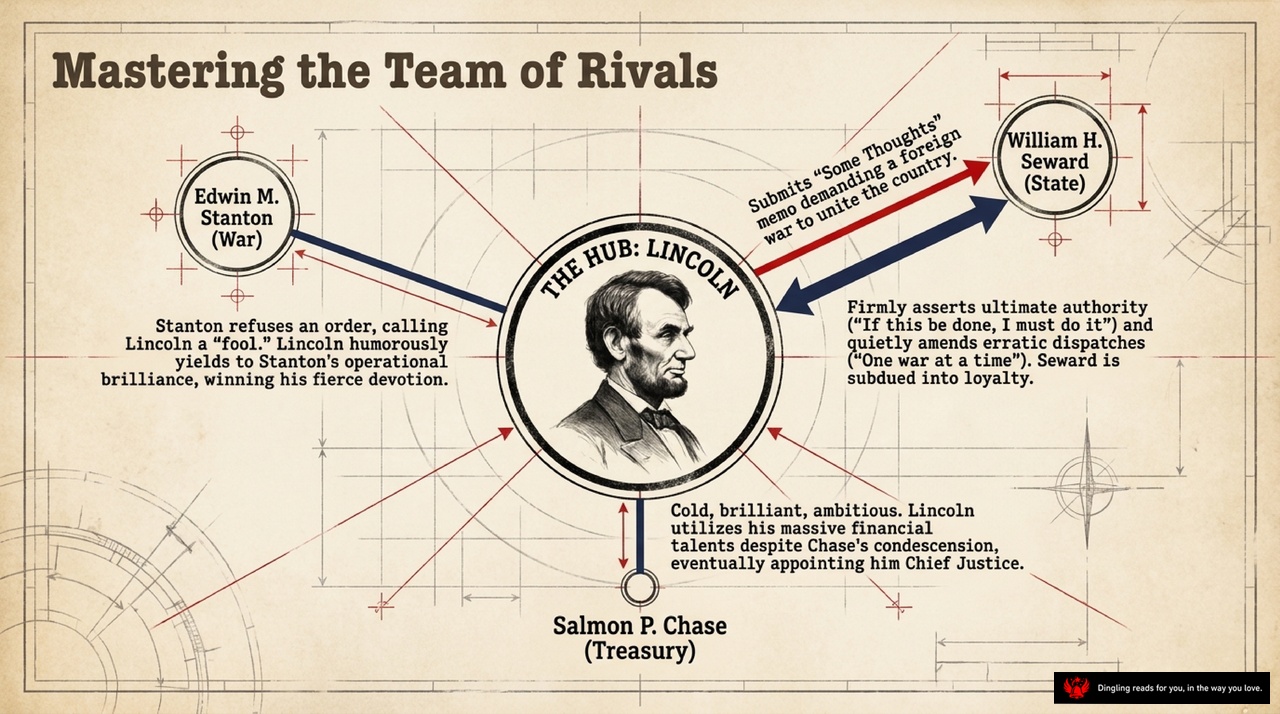
Today's slide, "Mastering the Team of Rivals," visualizes the complex web of Lincoln's presidency. At the center sits Lincoln himself, the hub holding everything together, while his cabinet members—Stanton, Seward, and Chase—radiate outward as formidable rivals who needed taming.
Look at Edwin Stanton on the left. He was a brilliant but difficult general who openly called Lincoln a "fool" and refused orders. Yet, Lincoln didn't fight him; instead, he humored Stanton's brilliance, winning his fierce devotion. This is the first lesson in managing talent: sometimes, you must yield to get the best out of someone.
On the right, we see William H. Seward. He was ambitious and once submitted a memo demanding a foreign war to unite the country, even suggesting Lincoln step aside. Lincoln firmly asserted his ultimate authority, famously saying, "If this be done, I must do it," and quietly amended Seward's erratic ideas to "One war at a time." Through this, Seward was subdued into loyalty.
Finally, at the bottom, is Salmon P. Chase. He was cold, brilliant, and ambitious, often viewing Lincoln with condescension. Yet, Lincoln utilized Chase's massive financial talents, eventually appointing him Chief Justice despite their friction.
The image perfectly captures the core strategy of the book: Lincoln didn't just hire these men; he mastered them. By respecting their strengths, setting clear boundaries, and absorbing their ego, he turned a team of rivals into a team that achieved the impossible.
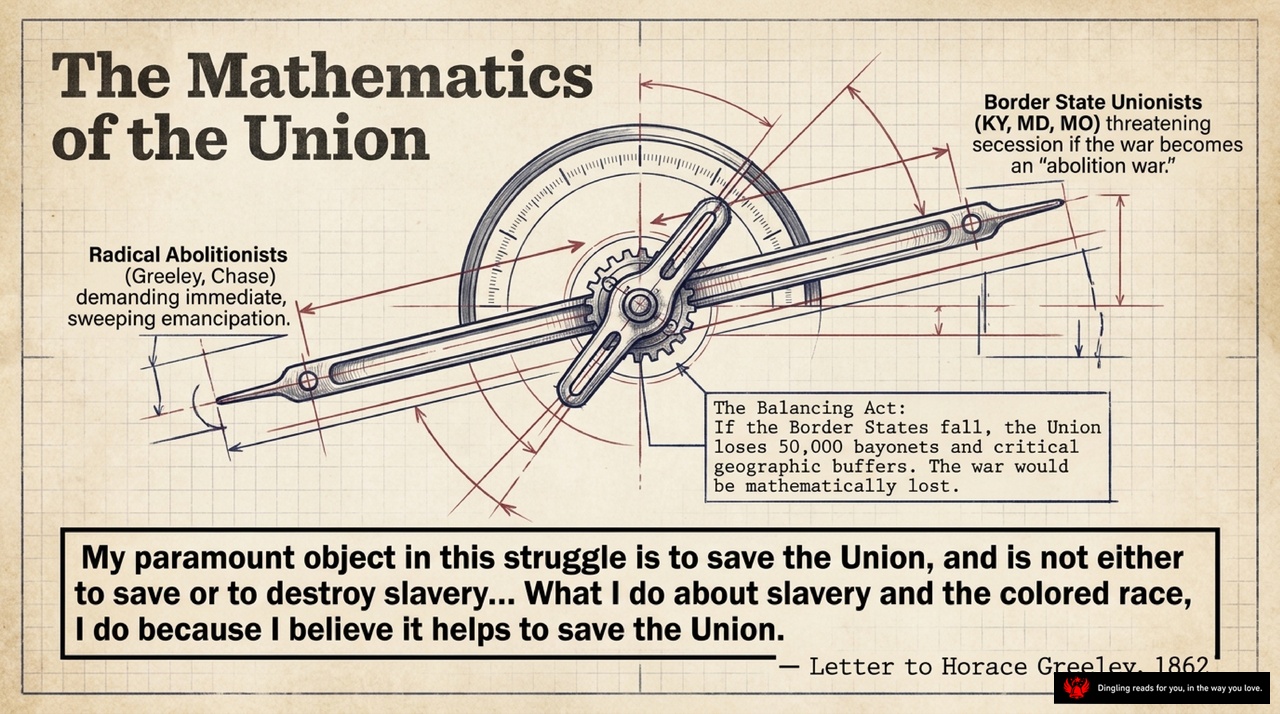
Imagine the Civil War not just as a battle of armies, but as a delicate, high-stakes balancing act. As this image illustrates, the Union was a compass, trying to find its true north between two opposing forces. On one side, you had the Radical Abolitionists like Greeley and Chase, pushing for immediate and sweeping emancipation. On the other, the Border State Unionists from Kentucky, Maryland, and Missouri, who were threatening to secede if the war turned into an "abolition war."
At the center of this tension was Abraham Lincoln, and his guiding principle was captured perfectly in his 1862 letter to Horace Greeley. He wrote, "My paramount object in this struggle is to save the Union, and is not either to save or to destroy slavery... What I do about slavery and the colored race, I do because I believe it helps to save the Union."
This wasn't just a political slogan; it was a mathematical necessity. As the graphic explains, the "Balancing Act" dictated that if the Border States fell, the Union would lose 50,000 bayonets and critical geographic buffers. Without them, the war would be mathematically lost. Lincoln understood that to win the war, he had to keep the Border States in the fold, even if it meant delaying the full abolition of slavery. It was a difficult, calculated compromise where the survival of the nation took precedence over the immediate end of slavery, proving that sometimes, saving the Union was the only way to eventually save the people within it.

Look at this graph titled "The Strategic Window." It maps the volatile journey of Union morale from 1861 to 1863. You can see the line plummeting after the Second Battle of Bull Run, hitting a rock bottom in 1862. That was the moment of despair. But then, notice the sharp spike at point number three. This is the Battle of Antietam. It wasn't just a military victory; it was the necessary leverage Lincoln needed.
This victory gave him the political capital to finally act. As the chart shows, right after that spike, we move to point four: The Preliminary Emancipation Proclamation is issued. This is the "Strategic Shift" described in the bottom right corner. Before this, slavery was actually a source of strength for the Confederacy. By emancipating the slaves, Lincoln turned that weakness into a weapon. He drew Southern labor away, added 130,000 black soldiers to the Union, and most importantly, permanently blocked European powers from recognizing the Confederacy.
Remember, back in 1862, Secretary Seward had warned Lincoln that issuing the proclamation too early would look like "the last shriek on the retreat." Lincoln shelved it then, waiting for this exact moment of victory. By timing it with the Antietam win, he transformed the war from a simple struggle to save the Union into a moral crusade for freedom. This strategic window didn't just win battles; it won the war.

Imagine a massive funnel, the "Policy Funnel," narrowing down the path to freedom. At the very top sits "Personal Morality"—the abstract belief that slavery is simply wrong. But as we move down, that pure moral impulse hits a wall: "The Presidential Oath." Lincoln couldn't just act on his personal feelings; he was bound by the Constitution, which protected slavery in the states where it already existed. So, how did he get to the bottom? The answer lies in the third layer: "Military Necessity." This is where the logic shifts. The slide explains that measures otherwise unconstitutional could become lawful if they were indispensable to preserving the Constitution itself. By framing the Emancipation Proclamation not as a moral crusade, but as a strict "fit and necessary war measure" to suppress rebellion, Lincoln navigated this funnel. He transformed an impossible moral demand into a legal military strategy, ultimately producing the output that changed history: the Emancipation Proclamation.
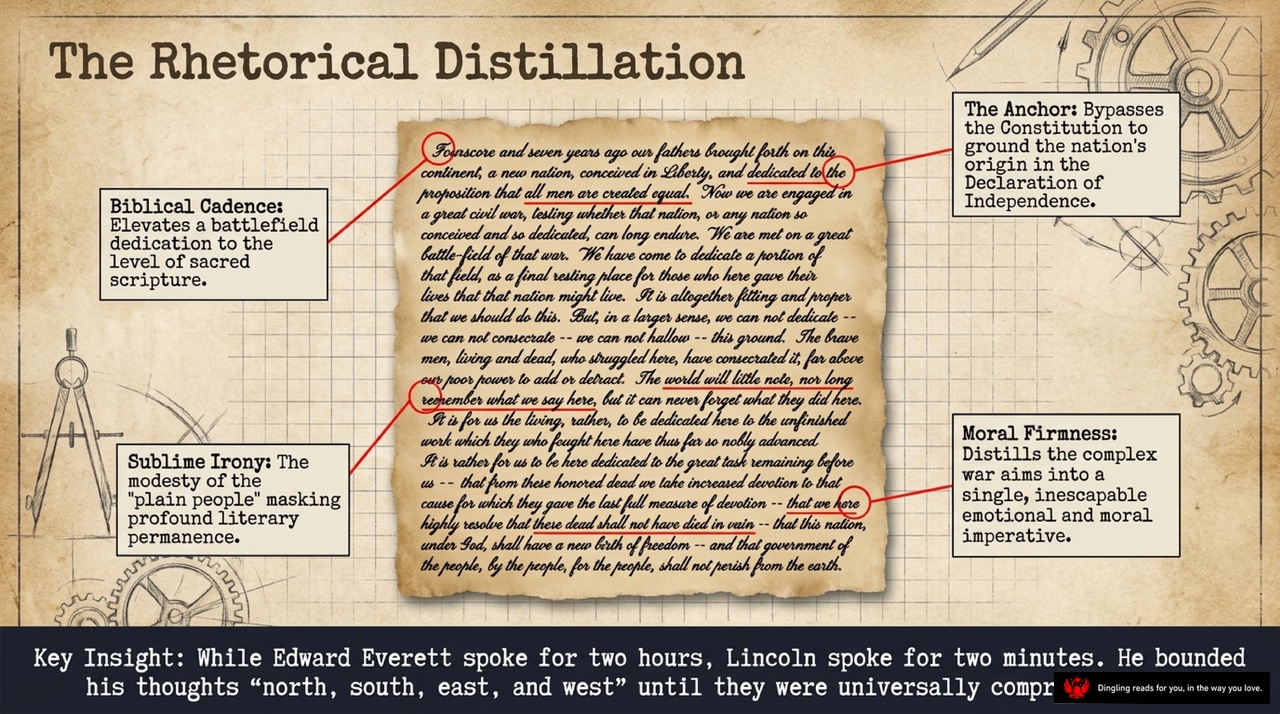
Picture: The Rhetorical Distillation
Text on Image:
- Title: The Rhetorical Distillation
- Central Text: Excerpt from the Gettysburg Address ("Four score and seven years ago...")
- Annotations:
- Biblical Cadence: Elevates a battlefield dedication to the level of sacred scripture.
- Sublime Irony: The modesty of the "plain people" masking profound literary permanence.
- The Anchor: Bypasses the Constitution to ground the nation's origin in the Declaration of Independence.
- Moral Firmness: Distills the complex war aims into a single, inescapable emotional and moral imperative.
- Key Insight: While Edward Everett spoke for two hours, Lincoln spoke for two minutes. He bounded his thoughts "north, south, east, and west" until they were universally comprehended.
Speech Draft:
While the crowd listened to Edward Everett for two hours, Abraham Lincoln held the entire nation in his grip for just two minutes. But in that brief window, he didn't just speak; he distilled history into something timeless. Look at the text on the screen. It starts with "Four score and seven years ago." That opening line isn't just a date; it's a "Biblical Cadence." By using that rhythm, Lincoln instantly elevated this battlefield dedication to the level of sacred scripture. He made the Civil War feel less like a political dispute and more like a holy test of the nation's soul.
Notice the "Sublime Irony" highlighted here. Lincoln speaks with the modesty of a "plain person," yet he masks profound literary permanence. He didn't try to sound like a scholar; he sounded like a neighbor, which is exactly why his words stuck in our minds forever. He grounded the nation's origin not in the rigid Constitution, but in the "Declaration of Independence," as our "The Anchor" note points out. This was a bold move. He bypassed the legal document to remind us of the nation's true promise: that all men are created equal.
Finally, look at the "Moral Firmness." Lincoln took the complex, messy goals of the war and distilled them into a single, inescapable imperative. It wasn't just about saving the Union anymore; it was about ensuring that "government of the people, by the people, for the people, shall not perish from the earth." He bounded his thoughts north, south, east, and west until they were universally comprehended. In a world full of noise, Lincoln's quiet two minutes became the loudest truth America has ever heard.

On this slide, we see the two sides of Lincoln's leadership: the crushing weight he carried and the gentle release he offered. On the left, under "The Weight," is the portrait of Lincoln himself, representing the agonizing burden of casualty lists and the fits of melancholy and despair that plagued him. It was a heavy load to bear. Yet, on the right, under "The Release," we see the tools he used to lift that burden: humor and mercy. Lincoln famously used humor as medicine, reading jokes by Artemus Ward to his cabinet before issuing the Emancipation Proclamation to diffuse tension. He also wove folktales into his speeches to explain complex policies, making them accessible to the "plain people." This side of the slide, labeled "The Release," highlights his boundless mercy. He resisted generals who wanted to issue pardons to deserters, famously saying, "If your son lives until I order him to be shot, he'll grow to be as old as Methuselah." This compassion wasn't just personal; it was a strategic asset. As the synthesis at the bottom explains, by maintaining proximity to the common folk and acting as "Father Abraham" rather than a distant autocrat, he retained the trust of the Northern masses. His ability to balance the heavy burden of war with the release of humor and mercy was what ultimately shielded the nation and secured his legacy.

The blueprint of a true statesman isn't found in fancy degrees or radical rhetoric; it's forged in the quiet fusion of three essential traits. Look at this diagram: it shows how Lincoln mastered the delicate art of balancing empathy, pragmatism, and moral conviction.
First, there's Deep Empathy. This wasn't just about being nice; it was an intuitive understanding of the common man. Lincoln could feel the sorrow of the "plain people" without ever sounding like he was looking down on them. He spoke their language and understood their struggles, which built a trust that no politician could buy.
But empathy alone isn't enough for a leader in a crisis. You also need Political Pragmatism. Lincoln was a brilliant tactician who knew when to compromise, when to delay, and how to manage massive egos within his own cabinet. He wasn't afraid to ignore personal insults or navigate complex alliances, as long as the ultimate goal remained clear. He understood that winning the war required flexibility in the trenches.
Yet, in the center of all that flexibility lies Moral Inflexibility. This is the bedrock. While he could compromise on tactics, he never bent on the ultimate extinction of slavery or the perpetuity of the Union. He had an absolute refusal to let these core principles be negotiated away.
Lincoln's genius wasn't being the most educated or the most radical. It was possessing this precise, unprecedented fusion of these three traits. He could be soft with the people while being hard on the cause, flexible in his methods while immovable in his soul. It was this unique combination that allowed him to navigate a democracy through the darkest days of civil war.
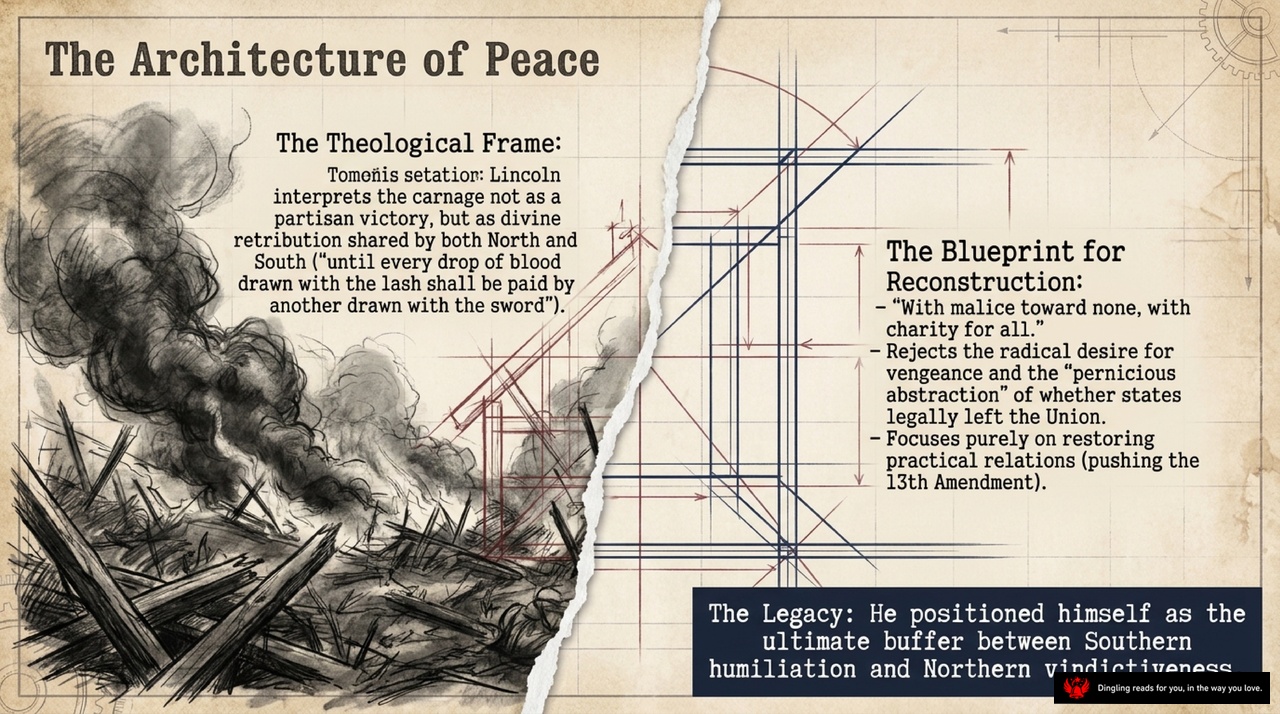
Look at this split image. On the left, we see the chaos of war—the smoke, the ruins, the sheer carnage. On the right, we see something completely different: a blueprint, a structured plan for peace. This visual contrast perfectly captures Lincoln's genius. He didn't just win the war; he decided how the country would heal after it ended.
Let's look at that "Theological Frame" on the left. It references a powerful idea: that the blood spilled on both sides wasn't just a partisan victory, but a divine retribution. Lincoln believed that every drop of blood drawn with the lash had to be paid for with blood drawn with the sword. He accepted the full weight of the war's suffering, refusing to play the role of a victor who could simply ignore the pain inflicted on the defeated.
But then, look at the "Blueprint for Reconstruction" on the right. This is where Lincoln's true legacy shines. While the North might have been screaming for vengeance, Lincoln proposed a radical alternative: "With malice toward none, with charity for all." He explicitly rejected the desire for revenge and the obsession with whether the South had legally left the Union. Instead, he focused purely on restoring practical relations. His strategy was clear: push through the 13th Amendment to end slavery, but do it with a focus on reconciliation, not retribution.
Finally, notice the bottom text calling him the "ultimate buffer." Lincoln positioned himself between the humiliation of the defeated South and the vindictiveness of the victorious North. He absorbed the anger on both sides so that the nation could survive. While others saw a defeated enemy, Lincoln saw a wounded brother who needed a hand up, not a boot on the neck. That vision of peace, born from the ashes of war, is what made him the greatest American of all time.

Look at this sketch of a lone oak standing on a sandy beach. It's a powerful image of Henry Watterson's view of Abraham Lincoln. He describes Lincoln as the "completed benefactor"—a man who rose from a squalid Kentucky hovel with no formal training, yet wielded near-dictatorial power with unprecedented restraint.
Watterson argues that Lincoln's true test came at the very end. He was struck down at the exact moment of triumph, a "lone oak" who had guided the republic through its greatest crisis, leaving its institutions intact. This wasn't just about winning a war; it was about saving the soul of the nation.
Watterson believed that no drama, no tragedy, and no epic poem in the next thousand years would ever fill us with greater wonder than the story of Lincoln's life and death. He saw Lincoln not as a distant god, but as a human being whose struggle and sacrifice created a legacy so profound that it would outlast every other event in history. It's a testament to the idea that true leadership isn't about power, but about the courage to stand firm when the world is falling apart.