
Acquiring Customers: Complete Chapter-by-Chapter Summary

Welcome to today's session on "Customer Acquisition."
This isn't just about throwing money at ads or hoping for the best. It's about building a systematic blueprint that transforms unpredictable B2B traffic into a scalable, automated revenue ecosystem.
In the modern performance-driven marketing era, the CMO is under immense pressure. With traditional channels becoming expensive and ineffective, companies need a smarter way to grow. That's exactly what this book by He Run and Zhang Yanlin delivers.
We are moving away from the old "cast a wide net" approach. Instead, we adopt a "pond and fish" philosophy. Think of it this way: you don't just hope fish swim into your net; you actively build a pond, create irresistible bait through content, and set up the right hooks to attract high-quality leads.
This book provides a step-by-step guide to mastering this. It covers everything from creating rich content to attract attention, to building an all-channel traffic pool using SCRM technology. It shows you how to use marketing automation to filter and score leads, ensuring your sales team only chases the hottest opportunities.
Whether you are in B2B or high-ticket B2C, this systematic approach will help you lower acquisition costs, improve lead quality, and turn your marketing department from a cost center into a true profit driver.
Let's dive in and learn how to build your own revenue ecosystem.

The B2B marketing dilemma is real, and it's built on a dangerous myth: the idea that high-ticket buyers will convert from a single touchpoint. As the slide shows, expecting immediate conversion ignores the messy reality of enterprise procurement. On the left, you see that simplified "Traffic to Sales" pipeline, but that's not how the modern buyer operates.
Look at the data on the right. It reveals the true complexity of the buyer's journey. A staggering 96% of website visitors are completely unready to buy on their very first visit. They aren't ready to pull the trigger yet; they are just exploring. But here is the critical insight: 57% of the buyer's journey is completed completely independently before they ever contact a sales representative.
This means your sales team is often chasing ghosts if they try to close deals too early. Traffic without a system is just wasted budget. You cannot rely on a single interaction; you need an ecosystem. You must nurture these 96% of unready visitors through content and engagement until they are ready to buy, ensuring that when they do reach out, they are actually qualified.

Welcome to the next stage of our journey: building your omnichannel traffic pool. Think of your marketing strategy not as a series of isolated channels, but as a single, unified ecosystem. The goal here is to stop chasing users and instead create a "pond" where they naturally gather.
This slide breaks down that concept into two critical components. First, we have **Stage 2: Acquisition**, which is essentially building your pond. You need to integrate your social media, website, and offline touchpoints into one cohesive SCRM ecosystem. Why? Because users are scattered everywhere. If your data is siloed, you're losing them. By pooling traffic from all these sources, you create a centralized reservoir of potential leads that you can manage effectively.
Once you've built that pond, you move to **Stage 3: Lead Nurturing**, which we call "The Breeding." This is where the real magic happens. You aren't just collecting names; you are using behavioral data, lead scoring, and automated tagging to warm up those cold leads. Imagine a fish tank with an oxygenator and food; you are providing the right content and interactions at the right time to help these leads mature. You're transforming anonymous visitors into qualified prospects ready to buy, ensuring that when your sales team finally reaches out, the conversation is already meaningful.
By connecting acquisition with nurturing, you create a seamless flow where every interaction counts, setting the perfect stage for the final harvest.
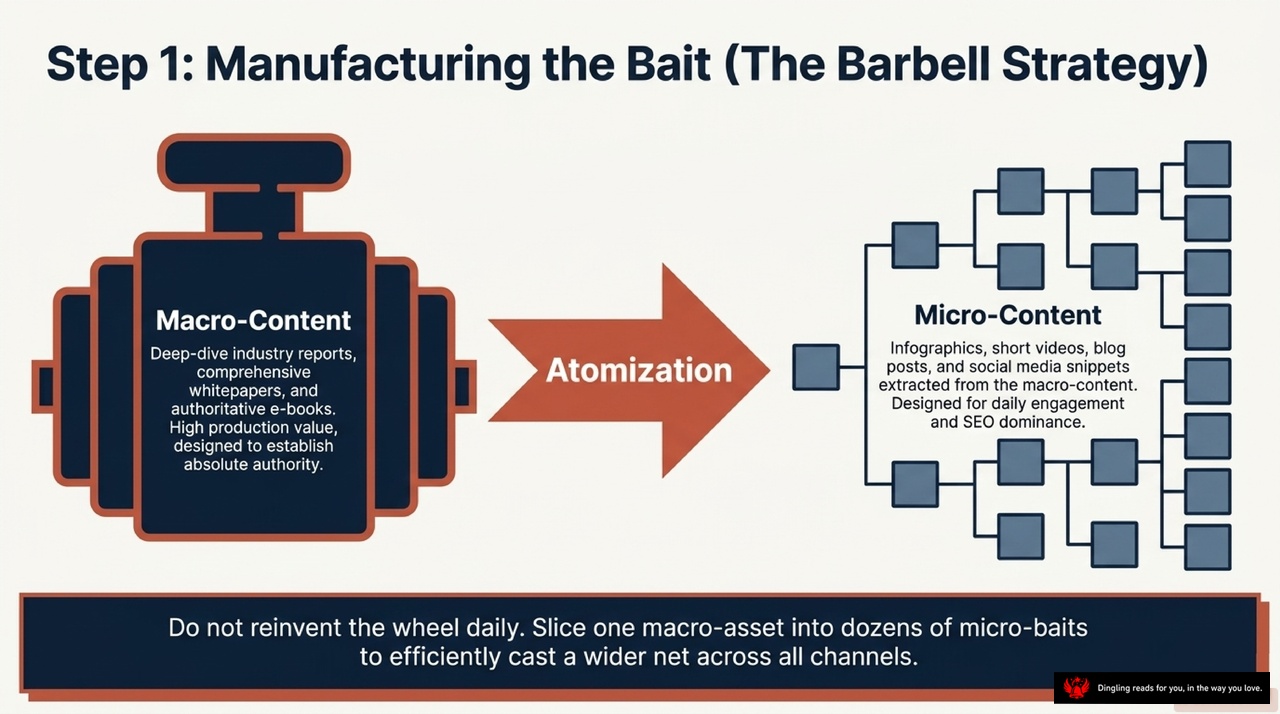
Step 1: Manufacturing the Bait with the Barbell Strategy is all about efficiency. Instead of reinventing the wheel every single day, you build one high-value "Macro-Content" asset—like a deep-dive industry report or an authoritative e-book—to establish your absolute authority. Then, you apply "Atomization" to slice that single asset into dozens of "Micro-Content" pieces. Think infographics, short videos, and social media snippets designed for daily engagement. By doing this, you efficiently cast a wider net across all channels without the burnout of constant creation. It's the smart way to dominate SEO and keep your audience hooked without overworking your team.

So, let's talk about how to stop guessing and start connecting the dots between what your audience is thinking and the content you're sending them.
This slide introduces the "Content vs. Buyer Journey Matrix," a simple but powerful grid that helps you match the right content to the right stage of a buyer's decision.
On the horizontal axis, we have the buyer's journey: Awareness, Consideration, and Preference. On the vertical axis, we look at "friction"—or how much effort a user needs to take to consume your content. Low friction means fast consumption, like scrolling through a social post. Medium friction requires a bit of time, like reading a blog or watching a webinar. High friction demands direct engagement, like a live Q&A or a one-on-one consultation.
Notice the dots on the chart. They tell us where the magic happens. In the Awareness stage, we want low-friction content like infographics or social posts. No one wants to commit to a deep dive when they are just curious. But as they move into the Consideration phase, we can increase the friction slightly with e-books or webinars because they are now evaluating options. Finally, in the Preference stage, where they are ready to buy, we introduce high-friction interactions like product demos or consultations to seal the deal.
The key takeaway at the bottom is crucial: Match the friction of the bait to the maturity of the buyer. Never ask for a high-friction interaction in the Awareness stage. If you demand a sales call when someone is just browsing, you'll scare them off. Instead, guide them gently up the funnel, increasing the effort required only when they are ready to commit. This ensures you capture interest without losing them to overwhelm.

Step 2: Building the Omnichannel Pond. Think of your customer base not as a random catch, but as a thriving ecosystem you actively cultivate. At the heart of this system lies your Unified SCRM Ecosystem, the central database that captures identity, behavior, and intent across every single touchpoint.
Surrounding this core are your diverse traffic sources. You have SEO and SEM capturing high-intent search traffic, and social platforms like WeChat serving as the ultimate mobile interactive hub. Offline events offer high-trust, face-to-face capture, while your team leverages employee advocacy to extend authentic reach through their personal networks.
But here is the critical rule: traffic is useless if it leaks. Every channel must contain a hook—whether it's a QR code, a form, or a gated link—that forces anonymous traffic into your identifiable SCRM pond. By unifying these streams, you stop chasing fleeting leads and start building a sustainable, high-value asset for your business.
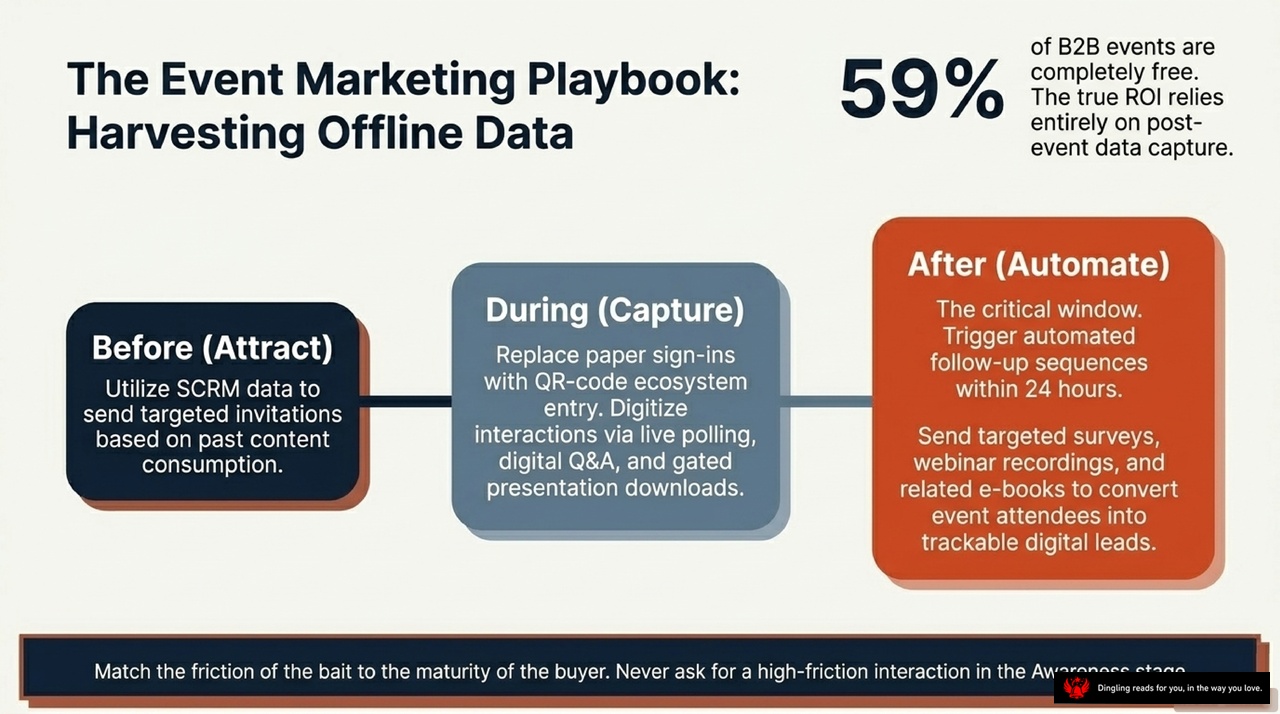
Most B2B events are completely free, and the real ROI depends entirely on what happens after the doors close. That's why capturing offline data is non-negotiable. Think of your event not as a destination, but as the start of a conversation.
Before the event, don't just send generic invites. Use your SCRM data to target people based on their past content consumption. During the event, ditch the paper sign-in sheets. Replace them with a QR code ecosystem that digitizes every interaction, from live polling to gated presentation downloads. This is your capture phase.
But the magic happens after. This is your critical window. You need to trigger automated follow-up sequences within 24 hours. Send targeted surveys, webinar recordings, and relevant e-books to convert those attendees into trackable digital leads.
Remember this golden rule: match the friction of the bait to the maturity of the buyer. Never ask for a high-friction interaction when they are just in the awareness stage. By aligning your engagement with their journey, you turn every offline visitor into a high-value lead.

Step 3: Growing the Fish. Think of your marketing strategy not as casting a wide net into the dark, but as building a specialized pond and scientifically managing who gets in. This is the Lead Scoring Diagnostic.
Here, we split your leads into four distinct zones based on two critical factors: their identity fit and their engagement behavior. On the vertical axis, we look at "Identity & Fit"—is this person the right job title, in the right industry, with the right company size? On the horizontal axis, we measure "Engagement & Behavior"—how active are they? Are they opening emails, attending webinars, or visiting pricing pages?
Look at the top right corner, highlighted in red. This is your "Perfect Fit, High Intent" zone. These are your ideal customers. They match your criteria perfectly and are actively hunting for a solution. Don't nurture them; route them immediately to sales. They are ready to buy right now.
Now, look at the bottom right. These are the "High Interest, Bad Fit" leads. Maybe they are students, competitors, or just too small for your product. Even if they are clicking everything, they are the wrong fish. Drop them or disqualify them immediately. You don't want your sales team wasting time on them.
On the top left, you have the "Great Fit, No Interest" segment. These are perfect prospects who just aren't interested yet. They need heavy, automated nurturing. Keep them in the pond, feed them content, and wait for them to wake up.
Finally, the bottom left represents "Cold / Unqualified" leads. They have neither the right identity nor the right behavior. These are the ones you simply drop or ignore.
By using this diagnostic grid, you stop guessing and start acting. You ensure your sales team only chases the red zone while your automation handles the rest. This is how you grow the fish efficiently.
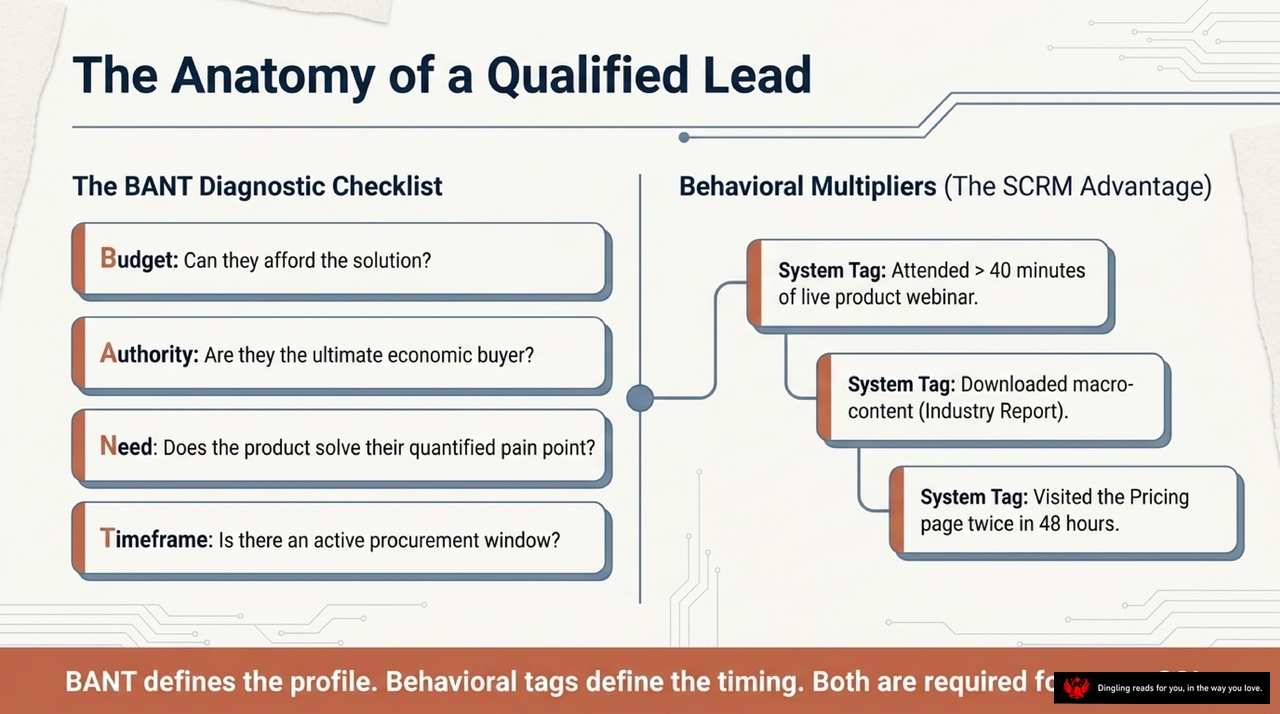
So, how do we actually stop guessing and start qualifying our leads with surgical precision? The answer lies in combining a classic framework with modern behavioral data.
On the left, you see the BANT Diagnostic Checklist. This is the foundation. It defines the *profile* of a qualified lead. We ask four critical questions: Do they have the **Budget** to afford the solution? Are they the true **Authority** with the final say? Does the product solve a quantified **Need** for them? And crucially, is there an active **Timeframe** for procurement? Without these four pillars, you're just talking to anyone, not your ideal customer.
But knowing who they *should* be isn't enough. You also need to know *when* they are ready to buy. That's where the right side comes in: Behavioral Multipliers. This is the SCRM advantage. Instead of waiting for a sales call to figure things out, we use system tags to define the *timing*.
Look at these specific triggers. If a prospect attends a live product webinar for more than 40 minutes, that's a strong signal of intent. If they download a high-value industry report, they're actively researching. And if they visit the pricing page twice within 48 hours, they are ready to buy *right now*.
Here is the key takeaway: BANT defines the profile, while these behavioral tags define the timing. You need both. A lead might have the budget and authority, but if they aren't showing these active behaviors, they aren't ready yet. Conversely, a user who visits the pricing page but lacks the budget or authority is a waste of a sales rep's time.
By layering these two systems together, you create a perfect storm. You only engage sales when the profile matches the behavior. This ensures your team spends their time on the few high-intent prospects who are actually ready to close, rather than chasing cold leads. That is the anatomy of a truly qualified lead.

Welcome to Step 4: Sales Alignment, the moment we call "The Harvest." Imagine your marketing funnel not as a chaotic spill, but as a precision-engineered pipeline. It starts with **Raw Traffic**—those anonymous web visits and social media views that are just noise until we give them a name. Once we capture their identity, they become **MQLs**, or Marketing Qualified Leads, where automated nurturing kicks in. But here's where the magic happens: we don't just wait; we filter. When a lead crosses a specific **behavioral score threshold** and passes the **BANT verification**—Budget, Authority, Need, and Timeline—they transform into **SQLs**, or Sales Qualified Leads. This is the critical handoff to your human sales team.
The result of this alignment? A staggering **192% Higher Qualification Rate**. When marketing and sales stop guessing and start working on the same algorithmic lead scoring, your sales team's efficiency nearly triples. You stop wasting time on cold calling strangers and start closing deals with buyers who are ready to buy. This isn't just about tools; it's about syncing your entire organization to turn traffic into revenue.
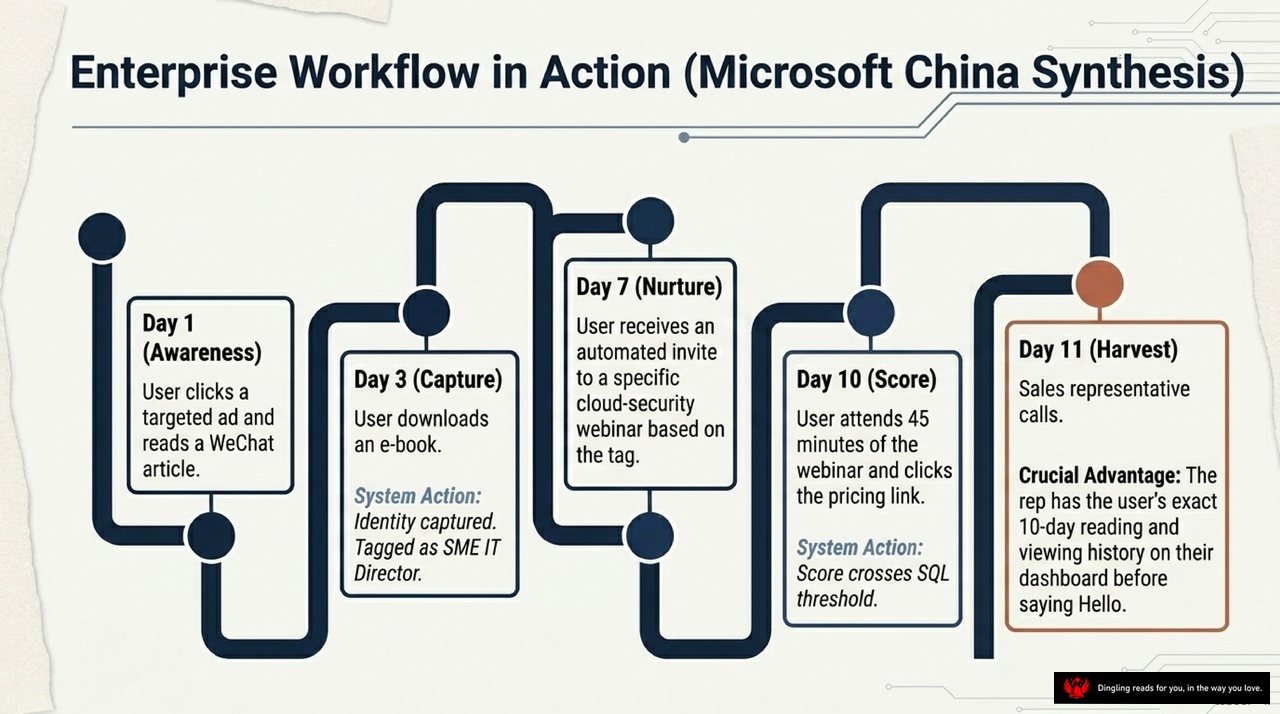
This slide maps out a complete, automated customer journey that turns a cold click into a hot sales opportunity in just 11 days. Let's walk through how this workflow actually functions.
It starts on Day 1 with Awareness. A user clicks a targeted ad and reads a WeChat article. This is just the beginning. By Day 3, during the Capture phase, the user downloads an e-book. Here is the critical moment: the system immediately captures their identity and tags them as an "SME IT Director." This is where the magic happens; the user is no longer anonymous.
Fast forward to Day 7 for Nurture. Because the system knows they are an IT Director, it automatically invites them to a specific cloud-security webinar tailored to their role. This personalization is key. By Day 10, the Score phase kicks in. The user spends 45 minutes on the webinar and clicks a pricing link. Their score crosses the SQL threshold, signaling that they are now a serious prospect.
Finally, on Day 11, we reach the Harvest phase. A sales representative makes the call. But here is the crucial advantage: the rep doesn't start with "Hello." They already have the user's exact 10-day reading and viewing history on their dashboard. The rep knows exactly what the user read, watched, and clicked before the conversation even begins. This allows for a highly relevant, personalized pitch that builds immediate trust, turning a marketing lead into a closed deal.
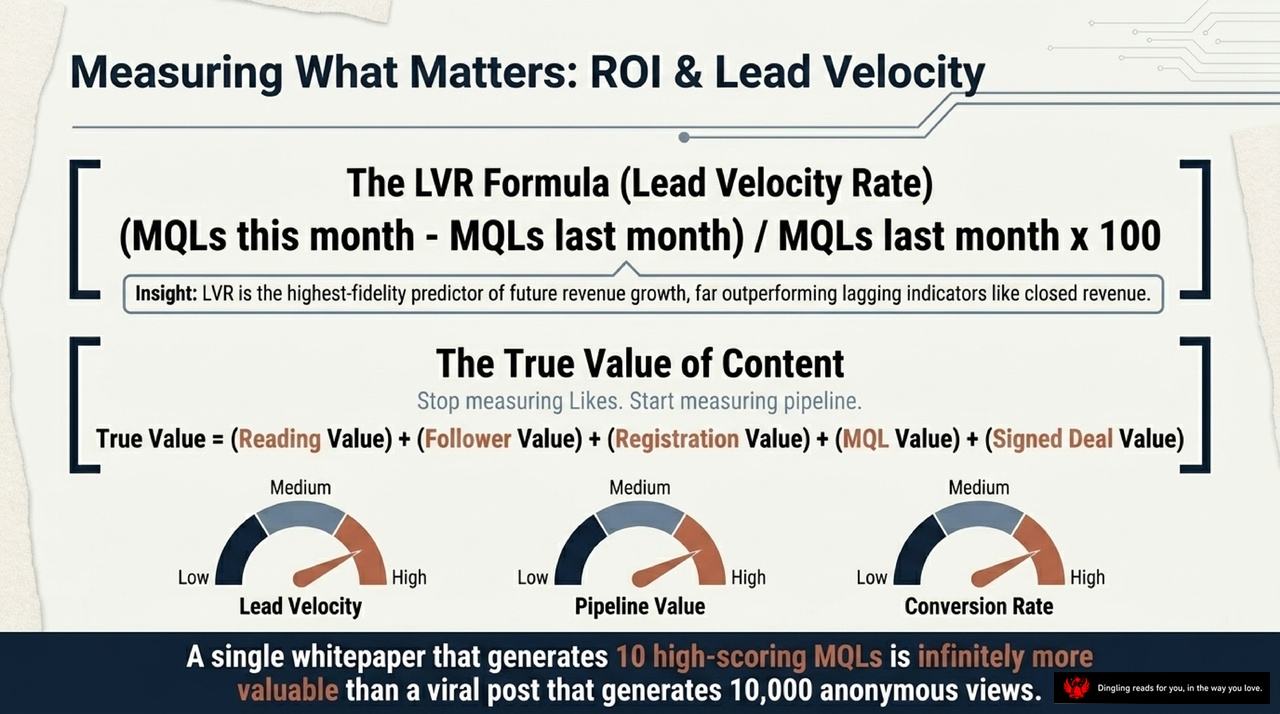
Look at this slide. It's all about shifting from vanity metrics to real business impact. The core message is simple: stop chasing likes and start measuring your pipeline.
First, let's look at the LVR Formula, or Lead Velocity Rate. It's calculated by taking the difference between your Marketing Qualified Leads this month and last month, dividing by last month's total, and multiplying by 100. Why does this matter? Because LVR is the highest-fidelity predictor of future revenue growth. It far outperforms lagging indicators like closed revenue, giving you a real-time view of where your business is heading.
Next, check out the equation for the True Value of Content. We need to stop measuring likes and start measuring pipeline. True value isn't just one thing; it's the sum of Reading Value, Follower Value, Registration Value, MQL Value, and finally, Signed Deal Value. The gauges at the bottom show that for high-value results, you need high Lead Velocity, high Pipeline Value, and a strong Conversion Rate.
Here is the bottom line: a single whitepaper that generates 10 high-scoring MQLs is infinitely more valuable than a viral post that generates 10,000 anonymous views. In B2B, quality always beats quantity.
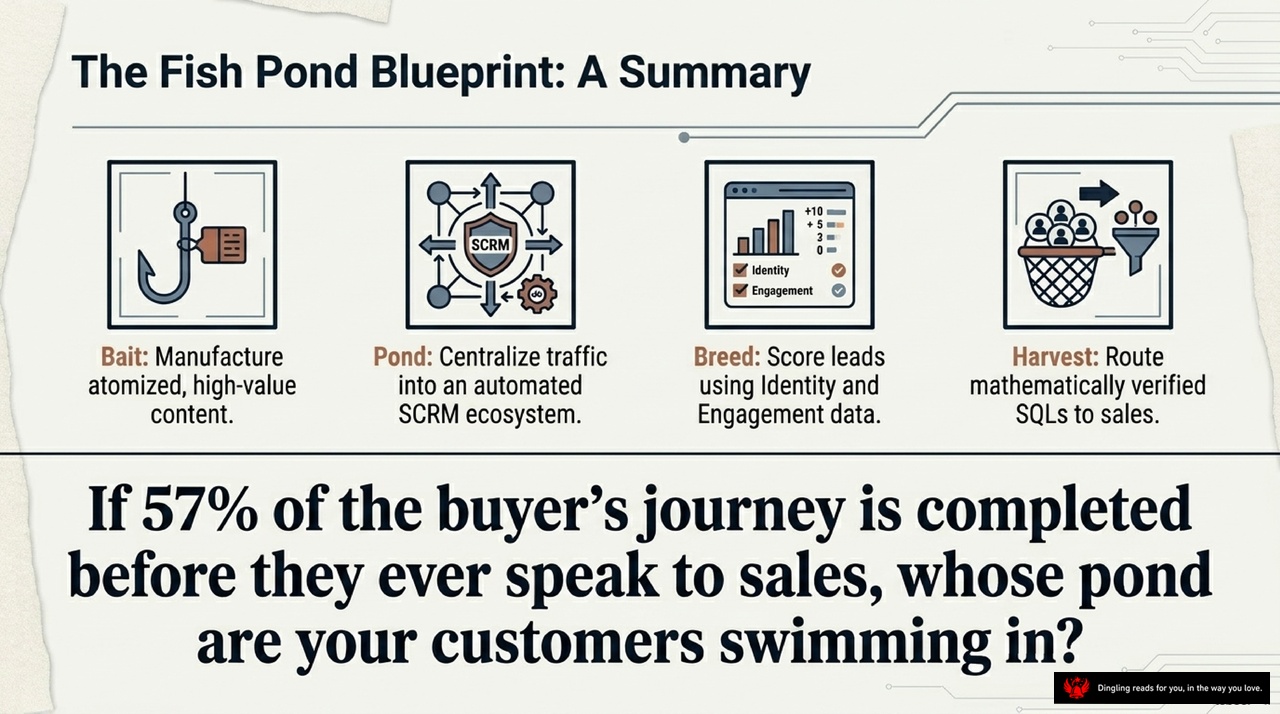
So, we've built the trap, now let's talk about the catch.
Look at this blueprint. We start with **Bait**: manufacturing that atomized, high-value content. Think of it as the perfect lure designed to stop the scroll. But catching them isn't enough. You need a **Pond**. This is where you centralize all that traffic into an automated SCRM ecosystem. You stop chasing fish in the wild and instead build a private lake where they can swim safely, ready to be caught.
Once they're in the water, it's time to **Breed**. Here, we don't guess; we score. Using identity and engagement data, we identify who is just looking and who is ready to buy. It's about separating the noise from the signal. Finally, we **Harvest**. We route those mathematically verified SQLs directly to sales, ensuring the right person talks to the right buyer at the perfect moment.
Here's the hard truth at the bottom: 57% of the buyer's journey is completed before they ever speak to sales. If you don't own the pond, your customers are swimming in your competitor's. The question isn't just "how do we get leads?" It's "whose pond are our customers swimming in?"