
Activating the Organization: Complete Chapter-by-Chapter Summary
Welcome to today's session on "Activating the Organization" by Chen Chunhua.
The image before us features an intricate, organic network of veins and cells, symbolizing a living, breathing system. This perfectly captures our central theme: transforming individual value into collective wisdom to conquer extreme uncertainty.
In today's volatile business landscape, an organization's success no longer depends solely on internal efforts; it is dictated by the external environment. To thrive, leaders must stop fearing uncertainty and start viewing it as a condition for opportunity.
The core of this transformation lies in shifting from a traditional "command-and-control" model to an "activating" mindset. Instead of relying on rigid hierarchies, the modern organization must become a platform that empowers individuals. When you activate your people, you unlock the collective wisdom needed to navigate the unknown.
Just as the complex network in our visual represents a dynamic ecosystem, your organization needs to foster strong connections and flexible value networks. This means moving from internal silos to an open system where everyone—from frontline employees to external partners—can contribute and innovate. By aligning individual aspirations with the organization's mission, you create a self-driving force that can adapt instantly to market shifts.
Ultimately, activating the organization is about recognizing that the future isn't something you predict, but something you create together. When you empower every individual to take ownership, you build a resilient entity capable of thriving in any era.

Imagine a black circle at the center labeled "The Unknown," surrounded by expanding blue rings representing the forces that drive uncertainty. Today, we aren't just reacting to change; we are navigating a system where the unknown is the only constant. Let's break down the five forces reshaping our world.
First, look at **Compounding Change**. Notice how the text describes it as "self-generating and unpredictable." Unlike the linear progress of the past, change now feeds on itself. Just like the PC industry, where a shift to smartphones didn't just disrupt sales but fundamentally altered the entire market logic, small shifts today can spiral into massive, unforeseen transformations.
Moving outward, we see **New Demographics**. The graphic notes that the "massive online population dictates entirely new rules." Think about this: the consumers of today—Gen Z and Millennials—are not just buying products; they are co-creating the rules of engagement. Companies that ignore this shift, like Nokia, fail because they try to play by old rules in a game that has already changed.
Next is **Data-Driven Channels**. The slide explains that channels have evolved from "physical supply chains to real-time, symbiotic data networks." In the era of Alibaba versus Walmart, it's not about who has more shelves; it's about who has better data. The channel itself has become a smart network that predicts demand before the customer even realizes they need it.
Then, we hit **Rule-Breaking Entrants**. The text highlights that "competitors no longer come from within the industry." Remember Uber? It didn't hire taxi drivers; it tapped into the spare time of regular people. These disruptors ignore traditional logic and use entirely new business models to overtake established giants, forcing everyone to rethink their competitive landscape.
Finally, at the outer edge, lies **The Sharing Economy**. The slide states, "the more distributed the network, the faster the concentration of immense value." This is the power of platforms like WeChat or Xiaomi. By connecting millions of users and partners, they achieve a scale and speed that traditional hierarchical companies simply cannot match.
All these forces converge on that central "Unknown." The key takeaway isn't to fear this uncertainty, but to realize that these five forces are creating the very opportunities we need. The future belongs not to those who predict the unknown, but to those who build organizations agile enough to thrive within it.
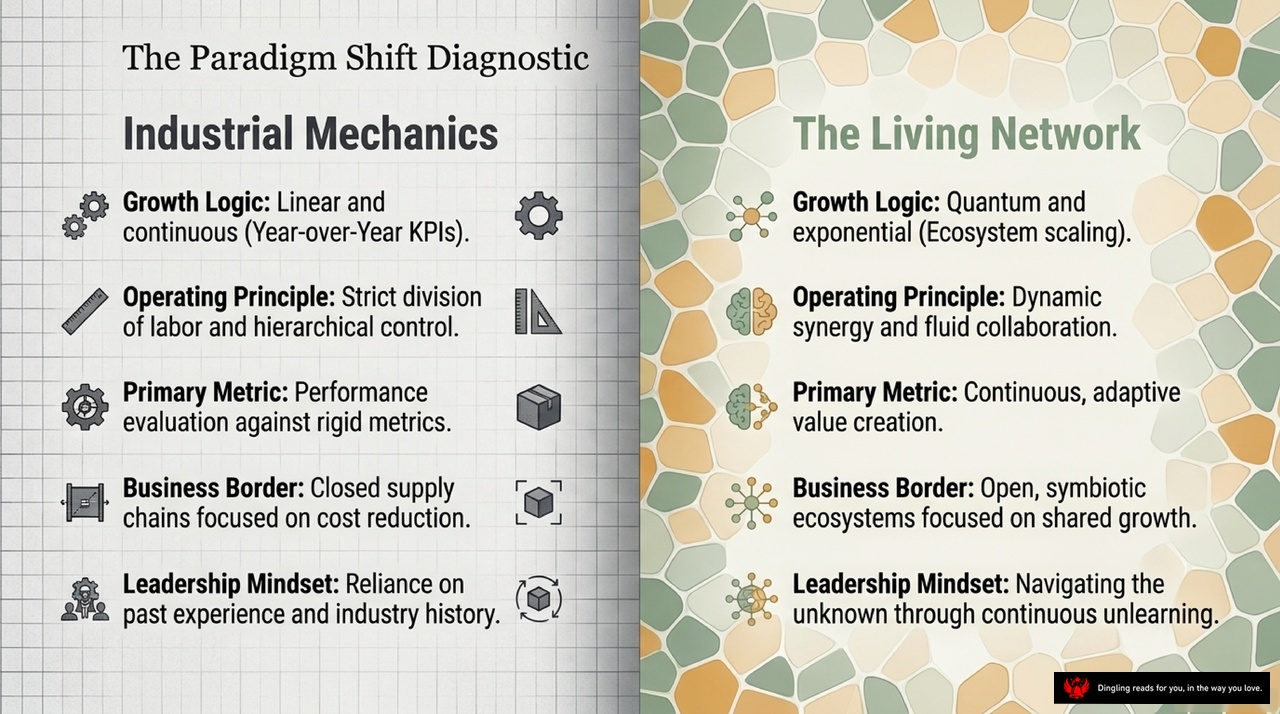
The slide you're seeing right now contrasts two entirely different worlds: the old "Industrial Mechanics" and the new "Living Network." On the left, we have the rigid, predictable machine of the industrial age. Its growth logic was linear, obsessed with year-over-year KPIs. It relied on a strict division of labor, hierarchical control, and rigid metrics. The business borders were closed, focused on cost reduction, and leadership was built on relying heavily on past experience.
But look at the right side. This is the "Living Network," the reality we are living in today. Growth here isn't linear; it's quantum and exponential, driven by ecosystem scaling. The operating principle shifts from hierarchy to dynamic synergy and fluid collaboration. Instead of rigid metrics, the primary focus becomes continuous, adaptive value creation. Business borders are no longer walls but open, symbiotic ecosystems focused on shared growth. Finally, leadership isn't about looking backward; it's about navigating the unknown through continuous unlearning.
The text on this slide perfectly captures the shift we discussed earlier. We moved from an era where the industrial mechanic ruled, to one where the living network thrives. Companies that cling to the old industrial logic—relying on closed supply chains and past experience—will find themselves out of sync. The future belongs to those who embrace the living network: who foster fluid collaboration, build open ecosystems, and lead by constantly unlearning the old ways to create value in an uncertain world.
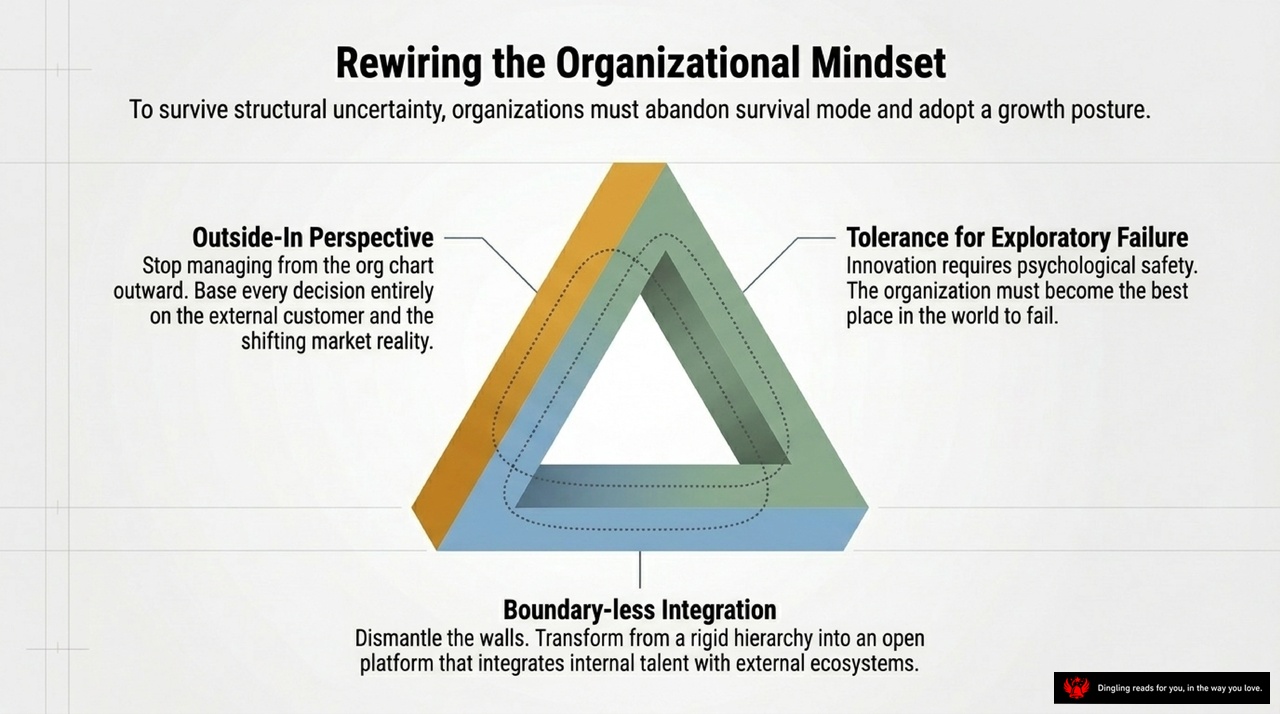
Let's talk about how to fundamentally rewire the way your organization thinks. To survive in today's volatile environment, you have to stop living in "survival mode" and fully embrace a growth posture. It's not just about doing things differently; it's about changing the very DNA of your mindset.
This transformation rests on three critical pillars. First, shift to an **Outside-In Perspective**. Stop managing strictly from the top down or relying on your internal org chart. Instead, base every single decision on the shifting market reality and your external customers. If you ignore what's happening outside, you're already losing.
Second, build a culture with **Tolerance for Exploratory Failure**. Innovation simply cannot happen without psychological safety. Your organization needs to become the best place in the world to fail. If your team is afraid to try new things because they might mess up, you will never innovate. You need to celebrate the attempt, not just the success.
Finally, you must achieve **Boundary-less Integration**. Dismantle the rigid walls of your traditional hierarchy. Transform your company from a closed fortress into an open platform. This means seamlessly integrating your internal talent with external ecosystems, partners, and even competitors. The future belongs to those who can connect and collaborate across boundaries.
By adopting this mindset—looking outward, embracing failure, and breaking down walls—you stop reacting to uncertainty and start driving your own growth.

Look at this architecture of an activated organization. It's not just a chart; it's a blueprint for survival in a world where nothing stays still.
At the very top, we have the Apex: The Leader's New Avatar. This isn't about a boss sitting in an office. It's about the leader becoming a living embodiment of the culture, constantly co-creating and spreading the vision. As the text reminds us, the leader's presence is decisive. If you can't inspire and adapt, your organization won't either.
Beneath that sits the Engine: New Incentives & Total Empowerment. This is where the magic happens. We stop relying on rigid KPIs and start driving intrinsic motivation. Think of it like this: instead of pushing employees to hit targets, we give them the tools and authority to become their own CEOs. The text mentions companies like Haier, where every employee is an "innovator," and Huawei, which lets those hearing the gunfire on the front lines make the decisions. When you empower people, self-organization kicks in, and the organization becomes agile.
This engine drives the Output layer. On one side, we have New Incentives leading to Total Empowerment, which fuels self-organization. On the other, we see Visible Performance & Symbiotic Ecosystems. This means delivering real customer value not through a closed factory, but through open networks. The text highlights how 7-Eleven in Japan and Alibaba achieve massive efficiency not by hiring millions, but by building ecosystems where partners, suppliers, and customers all pull together. You stop competing alone and start winning as a network.
Finally, everything rests on the Foundation: Breaking Equilibrium & Contractual Trust. This is the hardest but most necessary part. We have to dismantle the old hierarchies that slowed us down. We move from a relationship based on fear or blind obedience to one based on accountability and trust. The text warns that traditional "family" metaphors often fail because they raise unrealistic expectations. Instead, we build a relationship of clear, mutual responsibility.
In short, an activated organization stands on a foundation of trust, powered by an engine of empowerment, driven by an ecosystem of collaboration, and crowned by a leader who leads from the front. It's time to stop managing a machine and start activating a living system.
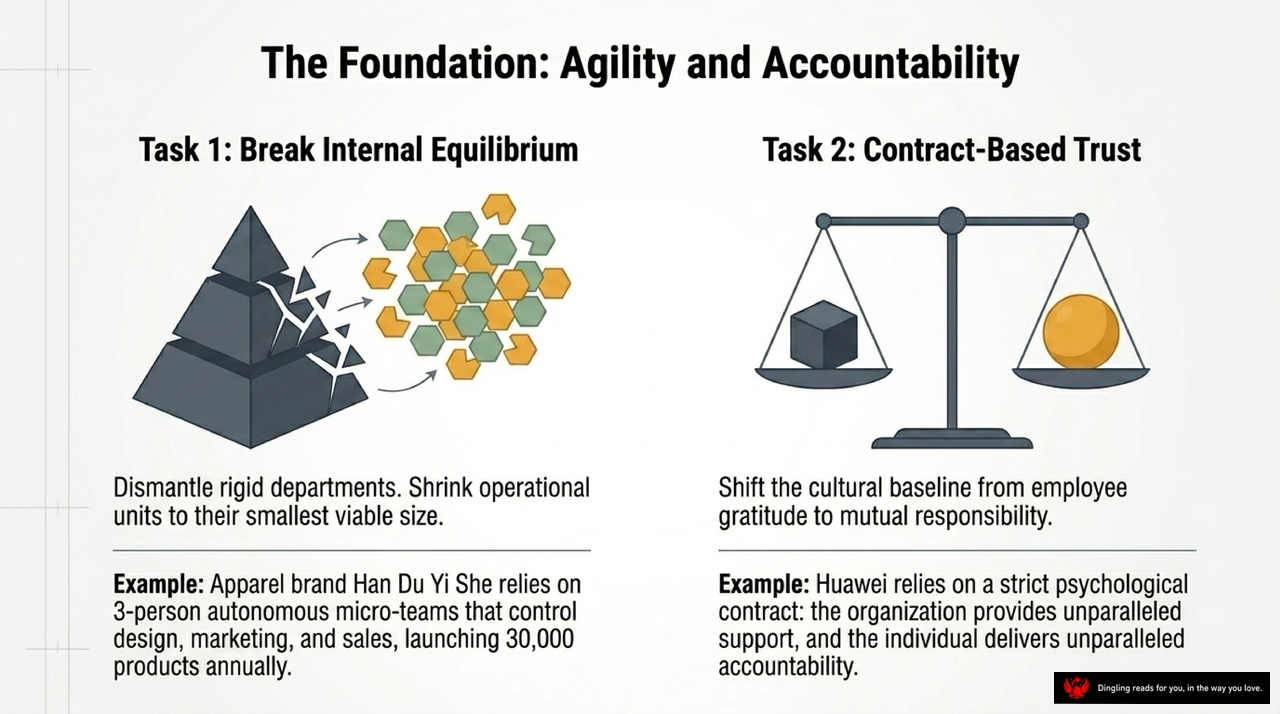
Today's slide outlines the twin pillars of our foundation: Agility and Accountability. Let's dive into how these transform the very DNA of an organization.
First, look at Task 1: Break Internal Equilibrium. The image on the left shows a rigid pyramid shattering into a swarm of hexagons. This visual perfectly captures the need to dismantle traditional, siloed departments. Instead of large, bureaucratic units, we must shrink our operational structures to their smallest viable size—think micro-teams. A prime example is the apparel brand Han Du Yi She. They didn't rely on massive hierarchies; instead, they empowered three-person autonomous teams to handle everything from design to sales. This agility allowed them to launch 30,000 products annually, a speed impossible for a traditional structure. It's about breaking the internal equilibrium that stifles innovation.
Now, turn your attention to Task 2: Contract-Based Trust. The scale on the right illustrates a shift in balance. We are moving away from the old model of "employee gratitude," where staff are expected to thank the company for employment. The new baseline is mutual responsibility. This is a shift from emotional bonds to a clear psychological contract. Consider Huawei's approach: they rely on a strict pact where the organization provides unparalleled support and resources, and in return, the individual delivers unparalleled accountability. It's a fair trade, not a hierarchy.
By combining these two tasks—breaking rigid structures and establishing contract-based trust—we create an organization that is both agile enough to adapt and accountable enough to execute. This is the foundation for true performance in an uncertain world.

The engine of any great organization isn't just about pushing harder or chasing financial targets; it's about tapping into the human spirit. As we look at this slide, we see two critical gears turning together: Task 3, establishing new incentives, and Task 4, empowering all levels.
Let's start with the first gear. Traditional financial KPIs simply aren't enough for the modern workforce anymore. If you want true activation, you have to build what the text calls a "Happiness Organization." Think about companies like Tencent and Starbucks. They don't just treat employees as cost centers; they treat them as internal customers. They invest heavily in work-life balance, respect, and long-term career ecosystems. Why? Because when you make your employees happy, they naturally drive ultimate customer satisfaction. It's a simple but powerful truth: happy people create better experiences.
Now, look at the second gear. This is about shifting from top-down mandates to biological, self-organizing teams. The goal is to move away from rigid commands and instead provide the resources, set the boundaries, and then grant autonomy. This means letting employees make decisions at the very edge of the network, right where they are closest to the customer. When you empower people to own their work, you unlock a level of agility and innovation that you simply can't get from a command-and-control structure.
When you combine these two—creating a culture of happiness and granting real autonomy—you create a self-sustaining engine. You stop managing tasks and start motivating people. You stop dictating solutions and start enabling discovery. This is how you move from a company that just survives the market to one that thrives within it.

The Output: Customer Value and Ecosystems. Today, success isn't about how well you fight competitors; it's about how well you connect with an entire network. Look at the magnifying glass in our slide—it symbolizes a shift in focus. Stop obsessing over internal problems and instead, scan relentlessly for external opportunities. The only metric that truly matters is whether your organization is delivering visible, undeniable value to the end customer. If you can't see that value clearly, you aren't growing.
But how do you scale that value? By building a symbiotic ecosystem. The old game was zero-sum: destroy the competitor to win. That era is over. Look at the network diagram below. True power comes from creating open platforms where suppliers, logistics partners, and merchants all grow together in a shared-value network. Consider 7-Eleven Japan or Alibaba. They didn't build empires through monopolistic control. They built ecosystems. They created environments where everyone—from the smallest vendor to the biggest logistics partner—could thrive. When you stop trying to be the only one and start making sure everyone around you succeeds, you create a force that is impossible to stop. That is the future of business.

The Apex: The Leader's New Avatar. To manage a decentralized, living network, the leader must abandon the role of the Commander and adopt three new identities.
First, become The Evangelist. Think of the flame icon here. Your job is propagating the cultural DNA, instilling a sense of urgent mission, and framing the chaos of the market as an unprecedented opportunity. You aren't just reporting results; you are selling the vision.
Second, step into The Designer. Represented by the compass and grid. This is about architecting the organizational systems, business models, and third places that naturally foster innovation. You are building the stage where creativity can happen, not just managing the actors on it.
Finally, embrace The Partner. Look at the handshake. This means stepping down from absolute authority to become a co-creator. You must demonstrate the vulnerability and openness required to accept the best ideas from anywhere. It's about moving from "I know best" to "Let's figure this out together."
This shift isn't just about titles; it's about the fundamental nature of leadership in a volatile world. Are you ready to stop commanding and start creating?
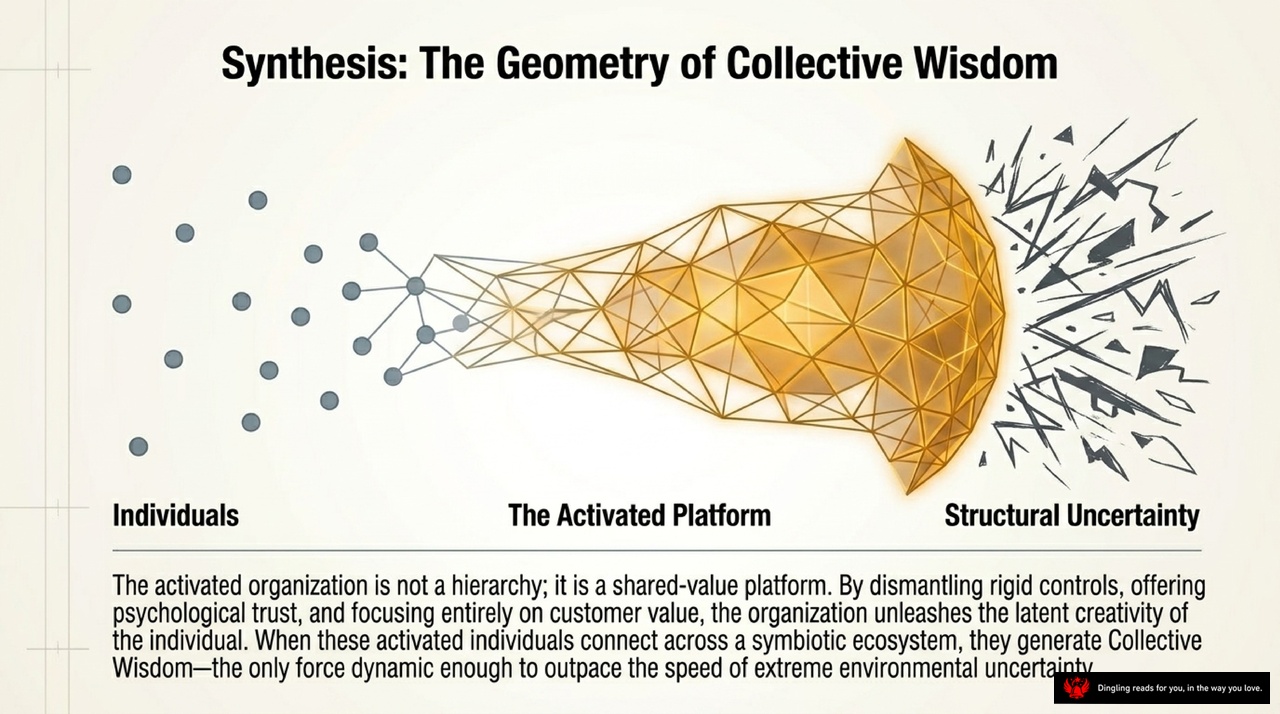
Imagine a world where individual sparks of creativity, when connected through a powerful, activated platform, don't just add up—they multiply into a force capable of shattering the very structures that once held us back. This is the geometry of collective wisdom.
Look at the flow here. It starts with scattered individuals, isolated and limited. But when they connect across a symbiotic ecosystem, something magical happens. Their latent creativity is unleashed, transforming into a dynamic, golden network that generates Collective Wisdom. This isn't just about working harder; it's about dismantling rigid controls and replacing them with psychological trust and a shared focus on customer value.
When these activated individuals collaborate freely, they create a force so powerful it can outpace the speed of extreme environmental uncertainty. This is the key to the future: moving from a hierarchy to a shared-value platform. By embracing this shift, organizations stop fighting the chaos of change and instead harness it, turning structural uncertainty into their greatest advantage. The result? A resilient, adaptive force that doesn't just survive the future—it defines it.

The slide asks a profound question: Are you ready to let go of control with dignity to unleash the future? It reminds us that the future cannot be predicted by analyzing the industrial past; instead, it must be created by an ecosystem of fully activated, empowered individuals.
Think about the giants that once ruled their industries. Kodak and Nokia didn't fail because they lacked technology; they failed because they refused to let go of their past definitions of success. They were trapped by the very structures that built their empires. But look at companies like Huawei or Alibaba. They didn't just adapt; they reinvented themselves by shifting from controlling every detail to empowering their people. When Huawei introduced the "firing squad" model, they gave frontline teams the power to decide. When Alibaba built its value ecosystem, they turned customers and suppliers into co-creators.
This shift is about more than just strategy; it's a mindset change. It requires leaders to move from being the "captains" who steer the ship to being the "architects" who build the platform where everyone can sail. It means embracing uncertainty not as a threat, but as the raw material for innovation. As the slide suggests, the future is already here. It's hidden in the potential of every individual who is finally given the freedom to contribute. The question isn't whether the future is coming; it's whether you have the courage to stop holding the reins and start letting the ecosystem run. Who will be the one to make that leap today?