
Adapt: Complete Chapter-by-Chapter Summary
Welcome to our book club session on Tim Harford's "Adapt." Today, we're diving into a masterclass that dismantles the myth of expert planning and helps us master the art of evolutionary trial and error.
We often think success comes from a perfect, top-down blueprint, but the reality is far more dynamic. True progress isn't the result of careful design; it's a miracle born from countless attempts, failures, and what remains. From the evolution of single-celled life to the rise of complex societies, every leap forward is fueled by this process of trying, failing, and learning.
As we explore this concept, remember that there is no single "correct" direction. Instead, there is only the ongoing process of adaptation. The failures of those who don't fit the current environment actually provide the necessary reference points for those who do, paving the way for future growth. Whether it's biological evolution, social development, or economic systems, trial and error is the fundamental engine of progress. So, don't fear failure. Every stumble is just a step closer to success, and every "mismatch" that fades away makes room for the next great fit to emerge.

Imagine a simple toaster sitting on your kitchen counter. It looks harmless, right? Just a device to toast bread. But look closer at this image. This is "The Toaster Project," and it reveals a shocking truth: building this simple appliance from scratch is a lifetime's work. Why? Because a modern economy contains over 10 billion distinct products, and every single one relies on a web of global complexity that we simply cannot replicate alone.
As the graphic illustrates, the iron in your toaster requires 15th-century smelting techniques or even microwave hacks. The plastic needs raw crude oil, offshore drilling, and chemical refinement. The copper is mined from toxic water using electrolysis, and the nickel is melted down from commemorative coins. Thomas Sweeney, a student who tried to build this toaster, discovered that he couldn't just order parts; he had to hunt for ore, build his own furnaces, and even melt down his own coins. He failed repeatedly—burning his microwave and ruining his plastic with mold—yet that struggle perfectly mirrors the core lesson of our world today.
We often think we can solve complex global problems with top-down planning, like a master architect designing a perfect city. But the toaster teaches us that this approach is an illusion. The real world doesn't work like a blueprint; it works like evolution. It works through trial and error. Just as the toaster's complex network of global suppliers emerged from countless small, independent decisions rather than a single grand plan, our society advances by allowing individuals to experiment, fail, and adapt. We don't need a perfect plan from the top; we need the freedom to try, to fail, and to learn from those failures. That is the only way to navigate a world as intricate as the one powering your morning toast.

The slide on the left captures a common fantasy: we crave the "Leader Delusion," instinctively seeking brilliant figures with perfect foresight who can simply command us to victory. But the data on the right tells a much harder, more liberating truth.
Philip Tetlock spent two decades evaluating over 27,540 predictions from more than 300 leading experts. The result? Experts failed to predict the future any better than a random guess.
This isn't about intelligence; it's about the environment. The world is too complex for anyone to see through the fog. When we rely on a single expert or a rigid top-down plan, we are essentially betting on a crystal ball that doesn't exist. True success in complex systems doesn't come from finding one perfect answer, but from embracing distributed trial and error. We need to stop looking for a savior and start building systems that allow everyone to test, fail, and adapt.

Look at this topography of trial and error. Imagine every problem as a sprawling landscape of possible solutions, a terrain where every step could lead you higher or deeper into failure.
In this map, the valleys represent our failures—bad decisions, flawed policies, and companies that vanished, like the 50% of the 1912 Top 100 that disappeared. But here's the key insight: these valleys aren't dead ends. They are the essential training ground. The evolutionary algorithm tells us that peaks, which represent profitable strategies and effective solutions like Google or Whole Foods, are constantly shifting. The only way to survive is through blind variation—trying new things—and ruthless selection—killing what doesn't work.
Think of it this way: if you only stayed at the top, you'd eventually fall off as the landscape changed. It's the failures in the valleys that teach us where the next peak is. We don't need a perfect blueprint from the start; we need the courage to explore the terrain, stumble into the valleys, learn from the terrain's feedback, and keep climbing until we find the summit that fits the current moment.

Innovation isn't about finding the perfect answer; it's about surviving the messy process of getting there. Think about the Supermarine Spitfire, the legendary fighter plane that helped save Britain during the Blitz. It wasn't designed in a sterile lab following a perfect blueprint. In fact, the official requirements for the plane were flawed from the start. But here's the key: General Keith, the man in charge, had the courage to ignore those rigid specs and bet on a prototype that looked risky and unfinished. He gave it a chance to evolve, and that "positive black swan" became a masterpiece.
But here's the hard truth about innovation today: we've made it harder than it needs to be. We've fallen into the trap of the "burden of knowledge." Decades ago, a breakthrough might come from one curious mind with a few books. Now, it takes massive teams, billions of dollars, and years of coordination. Look at the F-22 fighter jet; it cost 14 billion dollars and took 25 years to build. Compare that to the Spitfire, which cost just 10,000 pounds and flew in under seven years. We've built systems that are too big and too slow to take real risks.
The solution isn't to work harder with the same old methods. We need to recreate those old-school "safe havens" for radical ideas. Think of the "Skunk Works" or the independent research environments where scientists like Mario Capecchi could take huge, foolish risks—like editing a mouse's DNA—without fear of immediate failure. The best innovation strategies mix steady, small steps with occasional, massive leaps. We need more organizations willing to fund the unknown, to embrace failure as a necessary cost of discovery, and to let the best ideas rise from the chaos, rather than trying to engineer them into existence from the top down.

Imagine a world where the most dangerous thing you can do is simply try something new. That's the terrifying reality of our modern financial and industrial systems. We've built these structures to be incredibly efficient, but in doing so, we've made them dangerously fragile. Think of a complex machine where every gear is locked to the next. If one tiny part fails, the whole thing doesn't just stop; it shatters instantly.
This is what experts call "tight coupling." It's the hidden trap in everything from nuclear power plants to global banks. Take the Alpha platform disaster off the coast of Britain. A simple miscommunication—a worker forgot to mark a pump as removed—and suddenly, a catastrophic explosion claimed 167 lives. Why? Because the system was too tightly coupled. When the control room blew up, the safety systems couldn't react in time. There was no room to adjust, no time to fix it. The error traveled instantly from one point to the entire system.
We see this same pattern in finance. When banks get too interconnected, a failure in one place doesn't just stay there; it triggers a domino effect that crashes the whole global economy. We often think we're safe because we have layers of safety nets, like the "Swiss cheese" model. But history shows us that these layers often fail together, or worse, they create new risks. Sometimes, adding more safety measures actually makes the system more brittle.
So, how do we survive in a world of complex, tightly coupled systems? The answer isn't to try to eliminate all mistakes—that's impossible. Instead, we need to design for "loose coupling." We need to build systems where a failure in one part doesn't instantly destroy everything else. We need buffers, independent units, and clear ways to isolate risks. Whether it's redesigning how banks handle debt or ensuring that safety protocols in factories can't be accidentally triggered by a simple mistake, the goal is the same: create space for error so that when things go wrong, they don't go wrong *too* badly. We must learn to accept that mistakes will happen, and then build our world so that those mistakes don't become catastrophes.

Look at this slide. It's a stark comparison between two worlds: the predictable safety of traditional funding versus the risk-tolerant potential of breakthroughs. On the left, we have the NIH Grants model. It's all about predictability. The focus here is on avoiding failure at all costs. You need prior results to get funded, which means you're essentially buying insurance against being wrong. The result? Steady, safe, but ultimately incremental science. It's a system designed to keep the lights on, not to push the boundaries.
On the right, we see the HHMI Grants and Prizes model. This is where things get interesting. The philosophy flips completely: focus on maximizing massive breakthroughs. This approach embraces failure. It understands that to find a giant leap forward, you have to take a lot of wrong turns first. The data here is compelling—HHMI researchers produce double the highly cited papers of their NIH peers, but they also generate far more "failed" papers. That failure rate is actually their superpower.
And then, at the bottom, we have the X-Prize Model. Think of Netflix's $1 million algorithm prize. It proves a powerful point: when you open problems up to massive, varied crowds, you generate solutions faster than any top-down internal R&D team ever could. It's the power of distributed intelligence.
The lesson here is clear. If you want to solve complex, unknown problems, you can't just rely on a safe, incremental path. You need to build systems that tolerate risk, reward boldness, and harness the power of diverse, independent thinkers to find answers that a single, centralized authority would never discover.
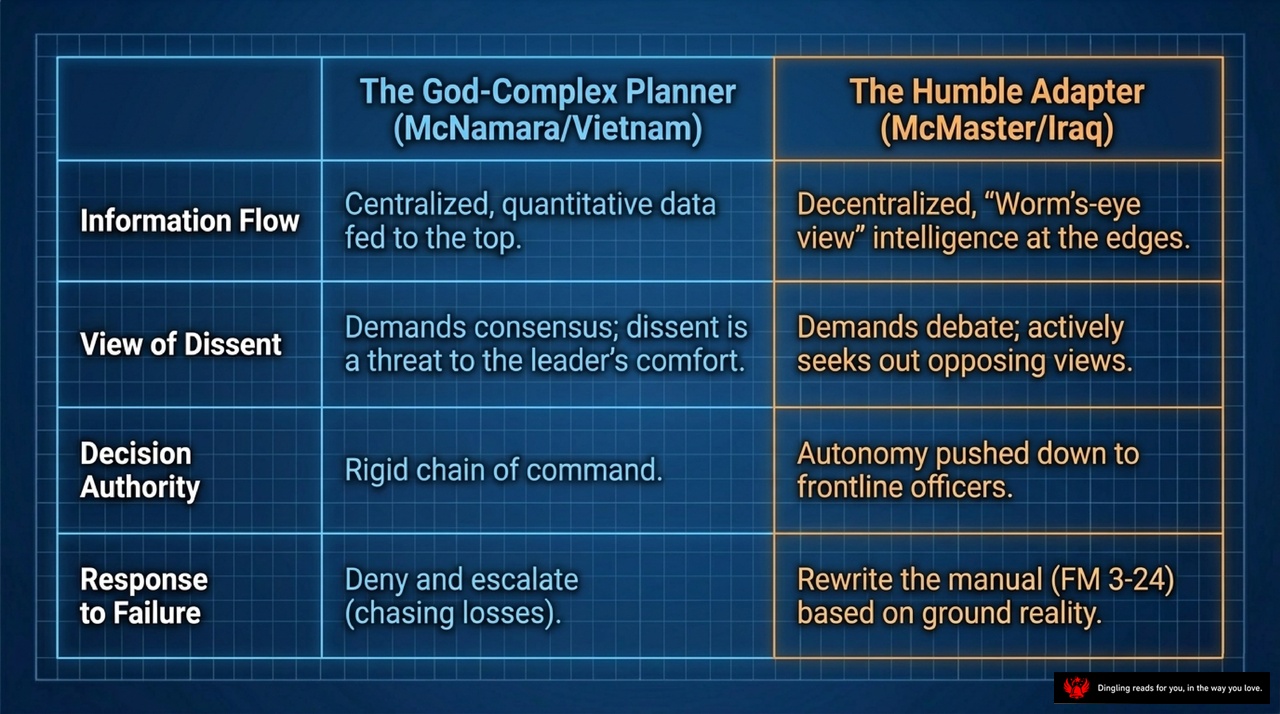
Look at this comparison between two leadership styles that defined modern military history. On the left, we have "The God-Complex Planner," represented by McNamara in Vietnam. This approach relies on centralized data flowing strictly to the top, demands total consensus, and views any dissent as a threat to the leader's comfort. Decision-making is rigid, locked in a strict chain of command. When things go wrong, the response is to deny reality and escalate forces, essentially chasing losses.
Now, look at the right side: "The Humble Adapter," exemplified by McMaster in Iraq. This model flips the script. It decentralizes information, valuing that "worm's-eye view" intelligence from the edges rather than waiting for top-down orders. Instead of silencing dissent, it actively seeks out opposing views and demands debate. Authority isn't hoarded at the top; autonomy is pushed down to frontline officers who know the ground reality. When failure strikes, the response isn't denial, but adaptation—rewriting the manual, like FM 3-24, based on what is actually happening on the ground.
The lesson here is clear: complex problems don't solve themselves with a perfect plan from the top. They require a system that embraces uncertainty, empowers the front line, and learns from failure in real-time. That is the difference between a strategy that breaks under pressure and one that evolves to win.

Imagine a stage with eleven figures: ten standing in a cool blue hue, and one glowing in a warm, distinct orange. This visual perfectly captures a critical psychological phenomenon known as the Asch Conformity Experiment. Here, social pressure becomes so intense that individuals deny their own eyes and agree with an incorrect majority. It is a trap where silence and agreement are mistaken for safety.
However, the slide reveals the cure right next to it: The Value of the Dissenter. The logic is simple yet powerful—just ONE dissenting voice, even if that voice is wrong or changing connections, breaks the spell of conformity. It shatters the illusion of consensus and allows the group to finally make accurate decisions.
This leads us to our core takeaway: An adaptive organization does not seek harmony; it engineers productive conflict. In a complex world, we must stop fearing disagreement and start valuing the single brave voice that challenges the crowd, because that is often the only thing that saves us from being led astray.

Imagine a world where everything is perfectly connected, where a single glitch instantly brings the whole system to a halt. This is the trap of "tight coupling," and the chart we see today perfectly illustrates why it's dangerous. Look at the top left: manufacturing a single component. If one gear fails, the line stops, but it's safe. Now look at the top right: a university. It has many moving parts, yet if one department fails, the school survives. It's "safe to fail."
But then, look at the bottom right quadrant. This is the "Danger Zone." Here, systems are fast, deeply interconnected, and often incomprehensible. Think of the Piper Alpha oil rig or Lehman Brothers. In these complex, tightly coupled environments, a small error doesn't just cause a hiccup; it triggers a catastrophic chain reaction. As the text reminds us, complex systems are full of blind spots. Just like experts often fail to predict market crashes, relying on a single, rigid plan in a complex world is a recipe for disaster. The lesson is clear: to survive in this high-stakes environment, we must move away from tight coupling. We need loose coupling—systems that allow for failure without total collapse, giving us the breathing room to adapt when the unexpected happens.
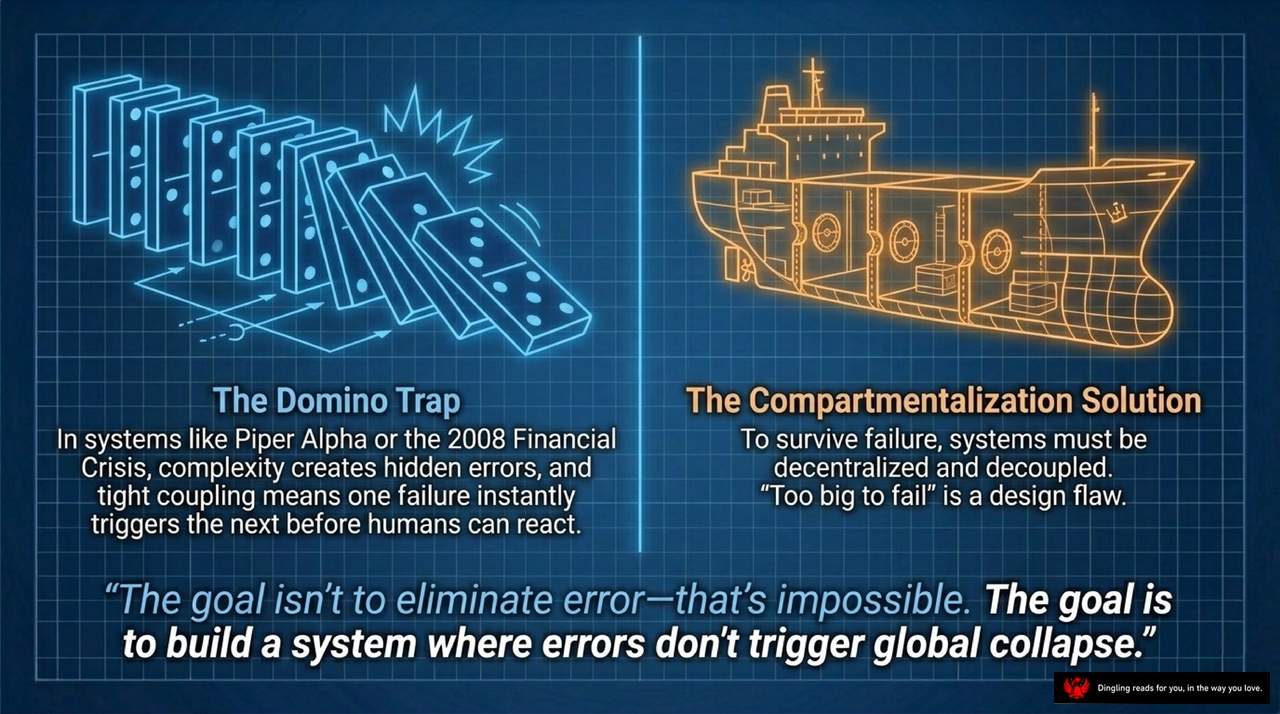
Look at this slide. On the left, we see the "Domino Trap." This visual perfectly captures the nightmare scenario of tightly coupled systems. Think of the Piper Alpha disaster or the 2008 Financial Crisis. In these complex setups, hidden errors pile up, and because everything is so tightly linked, a single failure instantly triggers the next one before humans can even react. It's a chain reaction where one broken piece knocks down the entire structure.
But on the right, we see the solution: "The Compartmentalization Solution." To survive failure, systems must be decentralized and decoupled. The slide makes a crucial point: "Too big to fail" is actually a massive design flaw. Instead of building one giant, fragile ship, we need a fleet of smaller, independent vessels. If one hits a reef, the others keep sailing.
The bottom quote drives this home: "The goal isn't to eliminate error—that's impossible. The goal is to build a system where errors don't trigger global collapse." We can't stop mistakes from happening, but we can design our world so that when they do, they stay contained. We need to move away from the domino trap and embrace a design where failures are isolated, not amplified.
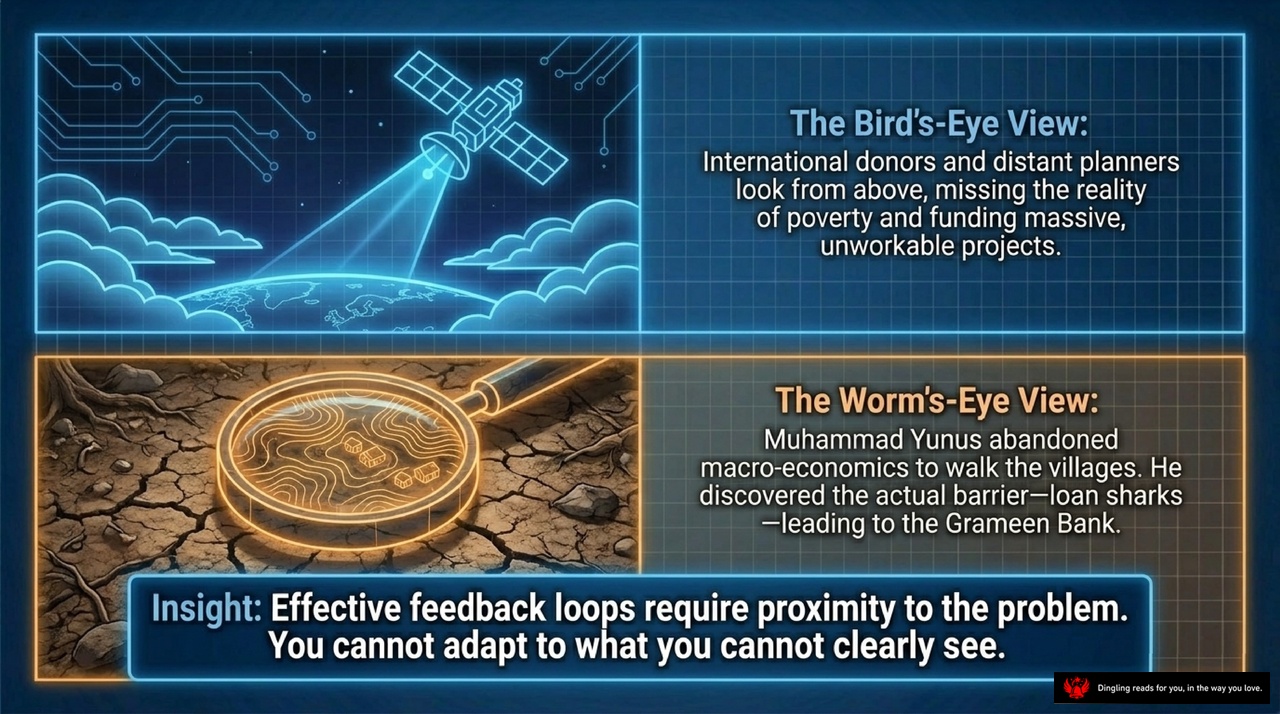
Today's slide contrasts two powerful perspectives on solving complex problems: The Bird's-Eye View versus The Worm's-Eye View.
Imagine looking down from a satellite, as international donors and distant planners often do. This is the Bird's-Eye View. From this height, it's easy to miss the gritty reality on the ground, leading to massive, unworkable projects that fail because they don't fit the actual context.
Now, look at the bottom half of our image. This is The Worm's-Eye View, named after Muhammad Yunus. Instead of looking from above, he abandoned macro-economics to walk the villages. By getting close to the problem, he discovered the real barrier wasn't a lack of capital, but loan sharks. This proximity led directly to the creation of the Grameen Bank.
The core insight here is simple but profound: Effective feedback loops require proximity to the problem. You simply cannot adapt to what you cannot clearly see. Whether you are leading a global initiative or managing a local team, the most reliable path to success isn't a perfect plan drawn from afar, but the courage to get your hands dirty and understand the terrain where the work actually happens.
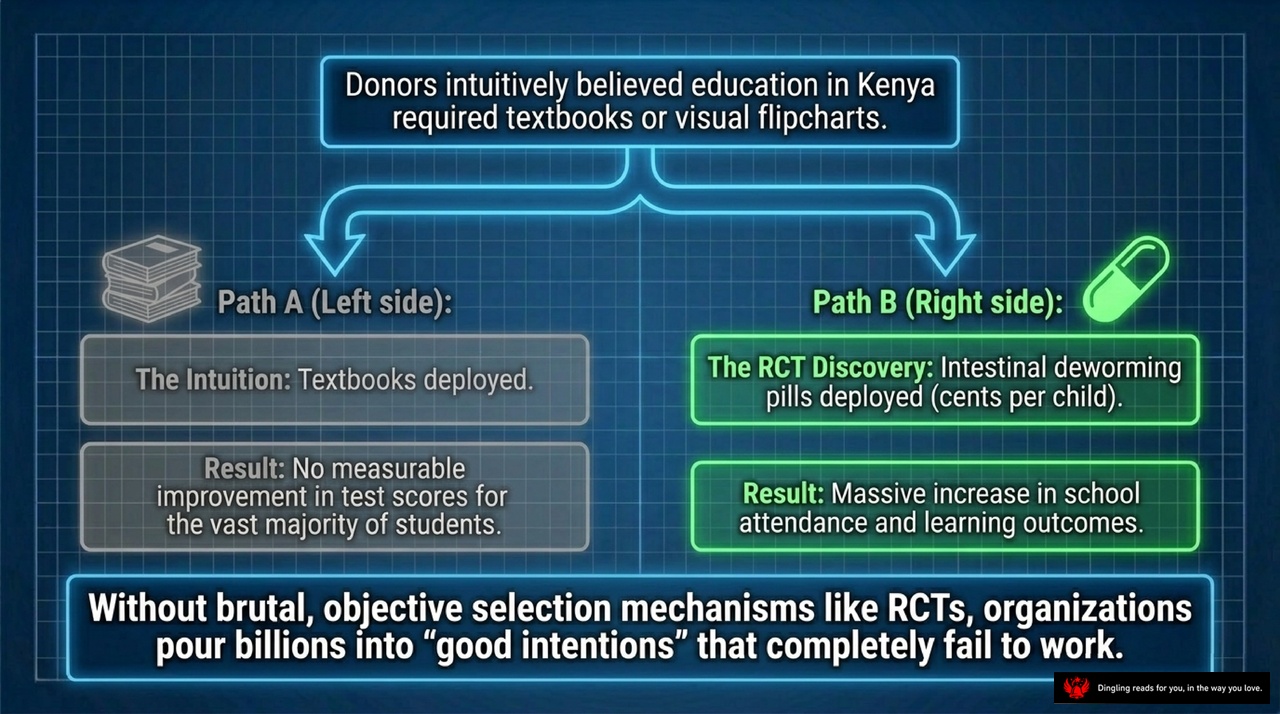
Donors often fall into a trap of intuition. When looking at education in Kenya, many assumed that the solution was obvious: simply provide textbooks or visual flipcharts. This was their natural, untested assumption. But what if they were wrong?
The image on the screen shows us exactly how this played out through a real-world experiment. On the left, we have Path A, the path of intuition. They deployed textbooks. The result? Shockingly, there was no measurable improvement in test scores for the vast majority of students. The "good intention" failed to work because it didn't address the real problem.
Then, look at the right side, Path B. This is where rigorous testing changed everything. Instead of books, they deployed a completely unexpected solution: intestinal deworming pills. The cost was incredibly low—just a few cents per child. The result was massive. School attendance skyrocketed, and learning outcomes improved dramatically.
Why the difference? Because without brutal, objective selection mechanisms like Randomized Controlled Trials, or RCTs, organizations pour billions into "good intentions" that completely fail to work. We need to stop guessing and start testing. Only by comparing these two paths can we find what actually moves the needle.

Look at this contrast between "The Dinosaur" and "The Adaptive Machine." On the left, we see the traditional hierarchy—a rigid pyramid where strategy dictates everything from the top down. This structure, exemplified by companies like Blockbuster, often destroys innovation because it ignores the shifting ground beneath it.
But on the right, we have the "Adaptive Machine." Notice the shift from a pyramid to a starburst pattern of "Adaptive Clusters." This isn't about one leader holding all the answers; it's about distributed intelligence. Take Whole Foods, where small autonomous teams decide on inventory and pricing based on what they see right in front of them, driven by total financial transparency rather than top-down orders. Or look at Google's famous "20% time," which allowed bottom-up mutations to flourish. It was peer approval, not management mandates, that decided which projects like Gmail actually survived.
The core lesson here is simple yet profound: in a complex world, the most effective strategy isn't a perfect plan drawn up in an office. It's creating an environment where everyone is an explorer. By empowering these adaptive clusters to test, fail, and learn locally, we allow the entire organization to evolve faster than any static hierarchy ever could. The future belongs not to the biggest dinosaur, but to the most adaptable swarm.

Adaptation isn't just about fixing a broken structure; it's a profound psychological battle against our own brains. As we've seen, our minds are wired to protect our egos, making it incredibly hard to admit when we're wrong. Take the legendary choreographer Twyla Tharp, for instance. When her play "Chicago" premiered and was met with a total critical disaster in Chicago, she faced a brutal choice. She could have blamed the audience, abandoned the project, or defended her work against the harsh feedback. Instead, she chose the harder path: she ruthlessly edited her show and moved it to Broadway. That decision to accept failure and adapt led to massive success and even Tony Awards.
This story highlights a critical truth: we often fall into psychological traps that stop us from learning. Psychologists call this "cognitive dissonance"—the mental discomfort we feel when our self-image as an expert clashes with the reality of our failure. We might rationalize our mistakes, chase our losses, or rewrite history to make ourselves look better. But true growth requires a "credible team" of people who will tell us the hard truths we can't face ourselves. Whether it's a failing play, a flawed economic policy, or a personal mistake, the path to success lies not in avoiding the crash, but in the courage to land, learn, and take off again.

Look at this grid: "The Psychological Traps of Stagnation." It breaks down exactly why we get stuck and how to break free.
First, we face **Denying Error**. The symptom? Telling yourself, "The critics just don't understand my vision." This is cognitive dissonance. The cure? Separate your self-worth from the specific project. Your value isn't the outcome.
Next is **Chasing Losses**. Like Frank in *Deal or No Deal*, refusing a good deal just to win back sunk costs. The fix? Accept the loss immediately and start fresh from the current reality. Don't let the past dictate your future.
Finally, **Hedonic Editing**. This is delivering a "Praise Sandwich" where you bury the actual criticism between flattery, ignoring the hard truth. The cure is simple: seek out blunt, unfiltered reality checks.
We all fall into these traps. But recognizing them is the first step to overcoming mental blocks and moving forward.

You cannot overcome your own cognitive biases alone. We all suffer from what psychologists call "hedonic editing"—the instinct to downplay our mistakes and exaggerate our successes. We edit our own reality to feel better, which blinds us to the valleys in our personal landscape.
The solution, as this slide illustrates, is to build what we call "external selection mechanisms." Think of it like having a personal board of directors who are willing to give you unfiltered, brutal opinions. The requirement is simple: a small group of peers with excellent judgment who care about you enough to tell you the hard truth.
These people act as your personal "market feedback." Just as a market corrects prices, these peers cut through your self-deception. They force you to see the real state of your fitness, your career, or your life, before it's too late. Without them, we remain trapped in our own blind spots, unable to evolve. So, who are the people you need to surround yourself with? Who is brave enough to be your mirror?

Today's slide brings it all together with what we call "The Grand Synthesis." Think of this as the ultimate playbook for navigating a complex world. It unifies three critical pillars: Mindset, Process, and People.
First, look at the left side: **Embrace the Landscape**. This is about your mindset. The text here reminds us to acknowledge that the world is simply too complex for any single expert blueprint. Stop trying to predict the future; start trying to survive within it.
In the center, we have **The Palchinsky Engine**, which is our process. This is the loop we need to run continuously. It starts with generating variation—isolating new ideas. Then, we ensure survivability by decoupling systems so failures don't collapse everything. Finally, we select ruthlessly based on ground-truth feedback.
On the right stands **The Trusted Squad**, representing our people. Success isn't just about individual brilliance; it's about institutionalizing dissent and peer feedback. We must create an environment where people feel safe to speak up, overcoming our natural human instinct to deny failure.
The bottom line, as the slide states, is clear: Success in a complex world is not about brilliant design. It is about rapid, disciplined evolution.

Look at this slide. It asks a brutally honest question: "If your organization's survival depends on learning from failure, what is the 'error' you are currently denying?"
We live in an unimaginably complex world where top-down planning consistently fails. The only viable strategy is evolutionary adaptation: making survivable mistakes, seeking out brutal feedback, and letting success emerge from trial and error.
But here's the catch. Evolution relies on failure to drive progress. If you want to survive, you must learn from those failures. So, the real challenge isn't just about trying new things; it's about identifying which mistakes you are too afraid to admit.
Think about it. Are you ignoring the data that says your current strategy isn't working? Are you silencing the team members who point out the flaws in your plan? Or are you simply refusing to accept that the market has changed and your old playbook is obsolete?
In a complex world, there is no perfect blueprint. There is only the willingness to make small, survivable mistakes, get the brutal feedback, and adapt before it's too late. The question on this slide isn't just theoretical; it's a mirror for every leader and organization today. What error are you denying right now, and what will happen if you keep ignoring it?