
Adaptive Markets: Complete Chapter-by-Chapter Summary

Welcome to the opening of our deep dive into *Adaptive Markets* by Andrew W. Lo. Look at this cover art: it blends the intricate structure of neurons, the chaotic flight of a bird flock, and the jagged lines of a stock chart. This visual perfectly captures the book's central thesis. As the text states, financial markets are not driven by the rigid laws of physics, but by the raw, evolutionary forces of biology.
For decades, the financial world operated under the assumption that markets were like physical systems—stable, predictable, and governed by fixed rules. But Lo challenges this entirely. He argues that investors aren't cold, rational machines; we are biological creatures shaped by millions of years of evolution. Our brains are wired to survive in the wild, not to navigate the complex, digital world of modern finance. This fundamental mismatch between our ancient instincts and our modern environment is where true understanding begins.
So, as we move forward, forget the idea of a perfectly efficient, unchanging market. Instead, let's embrace a dynamic view where market efficiency itself is something that evolves, adapts, and sometimes fails, just like any living ecosystem. Welcome to the adaptive market.

The elephant in the market is no longer just a metaphor for what we ignore; it's a blueprint for how we actually survive. Look at this image: on the left, you see the traditional view of finance—cold charts, stock tickers, and the Efficient Market Hypothesis treating us as rational calculators. On the right, you see behavioral economics, highlighting our cognitive biases and herd behavior. But here's the problem: neither side sees the whole animal. Traditional finance misses the panic; behavioral economics misses the order.
The real story lies in the center, where the two halves merge into a unified framework. This is the Adaptive Market Hypothesis. Just like nature, our financial strategies aren't fixed laws; they are evolutionary adaptations. When the environment is stable, like the calm waters of the 1990s, old strategies work, and the market appears efficient. But when the environment shifts—like the sudden storms of 2008 or the tech crashes of the 70s—those same strategies become fatal flaws.
Think of it like the peppered moth. In a clean forest, light moths hide perfectly. But when pollution darkens the trees, the dark moths take over. If the environment changes again, the light ones return. Markets work the same way. The "rational" strategy of today might be the "irrational" trap of tomorrow. That's why we need a dynamic view, one that understands that market efficiency isn't a constant state, but a moving target that depends entirely on how well our participants are adapted to the current moment. This is the synthesis that finally makes the whole elephant visible.

Imagine the stock market as a flawless, distributed supercomputer. In stable environments, it operates with breathtaking precision, processing information instantly and pricing assets accurately. But what happens when the environment changes?
Look at this timeline from January 28, 1986. At 11:39 AM, the Challenger space shuttle explodes. To the public, the cause is unknown. Yet, just 13 minutes later, at 11:52 AM, trading on Morton Thiokol—the manufacturer of the faulty O-rings—halts completely. The market didn't wait for an official report. It didn't need one. Within minutes, thousands of investors collectively processed the news and priced in the liability. The stock chart below shows a perfect, synchronized collapse.
This is the power of the Efficient Market Hypothesis. It suggests that when participants have time to adapt to stable rules, the market becomes incredibly efficient. It perfectly priced the disaster before the Rogers Commission even identified the engineering failure.
However, this isn't the whole story. This efficiency is a special case. It works beautifully when the environment is predictable. But when the world shifts—when we face a new crisis, a black swan event, or a completely unknown variable—our old behavioral patterns fail. The market stops acting like a supercomputer and starts behaving like a chaotic ecosystem.
This insight is the foundation of the Adaptive Market Hypothesis. It reminds us that the market isn't a static machine; it's a living system. Its efficiency depends entirely on how well our collective behavior matches the current environment. When we understand this, we stop looking for a single "correct" theory and start focusing on how markets evolve, adapt, and sometimes, crash.

Imagine the financial market not as a static machine, but as a living ecosystem where species constantly evolve to survive. Just as the peppered moth shifted from light to dark wings to match soot-covered trees during the Industrial Revolution, investors adapt their strategies to the changing economic climate. When the environment is stable, rational strategies thrive. But when the rules change—like a sudden interest rate hike or a policy shift—old strategies fail, and new, often seemingly "irrational" behaviors emerge as the new survival mechanism.
This is the core of the Adaptive Markets Hypothesis. It explains why we see phenomena like "probability matching," where investors don't always choose the statistically best option, but instead mimic the odds of success. In nature, this diversity is crucial; if every species acted exactly the same, a single environmental shock could wipe out the entire population. In finance, if everyone uses the same algorithm, a crisis hits, and everyone sells at once, causing a collapse.
Risk itself isn't fixed; it's an adaptation. In times of scarcity and chaos, being cautious keeps you alive. In times of plenty, taking risks yields the highest rewards. That's why we see investors swinging from fear to greed so quickly. Our brains are wired for survival, not for the complex, long-term logic of modern finance. We are a collection of evolutionary adaptations running in an environment that hasn't existed for long enough for us to fully adapt to it. The market isn't always efficient; it's only efficient enough for the participants currently adapted to the specific environment they are in.

The classic image of the shark tells a powerful story about how context dictates behavior. On the left, in the deep ocean, the shark is a sleek, efficient predator. This represents stable markets where strategies are perfectly adapted, risk and reward follow predictable patterns, and investors look like flawless geniuses. But look at the right side: the same shark stranded on a beach. The environment has shifted abruptly, and suddenly, that perfect predator looks clumsy, irrational, and incompetent.
This isn't just a metaphor; it's the core insight of the Adaptive Markets Hypothesis. Market failure often happens not because investors are stupid, but because they are deploying evolutionary adaptations designed for one environment into a completely different one. When the macroeconomic landscape changes—when the ocean becomes a beach—old strategies that once worked suddenly break down.
This dynamic reality challenges the old idea of the Efficient Market Hypothesis, which treated the market as a static, unchanging machine. Instead, we must view the market as a living ecosystem. Just as species evolve to survive in their specific niches, investment strategies must constantly adapt to the shifting tides of interest rates, regulations, and global events. When the environment is stable, rational strategies dominate. But when chaos strikes, the "irrational" behaviors that seemed like mistakes yesterday might actually be the only way to survive today. The power of the environment is absolute; it is the ultimate filter that decides which ideas live and which die.

The financial system isn't a static machine governed by rigid rules; it's a living, breathing ecosystem where banks, hedge funds, investors, and regulators constantly evolve together. Think of the 2008 crisis not as a sudden glitch, but as the inevitable collapse of an imbalanced ecosystem. For decades, a tightly coupled chain of mortgage brokers, investment banks, and rating agencies expanded rapidly, fueled by low interest rates and rising home prices. But when the environment shifted and rates climbed, that fragile structure snapped. The interconnectedness meant a shock in one corner—like a failing mortgage—rippled instantly through the entire system, freezing liquidity and triggering a global panic.
This chaos reveals a deeper truth: our culture and environment are locked in a constant dance. When the market booms, a culture of extreme greed takes hold, as seen in the "Gekko effect" where self-interest is glorified. This cultural shift lowers moral barriers, making fraud easier to commit and ignore. Conversely, during downturns, fear drives us toward caution and compliance. The brain's moral compass, which evolved to prevent us from harming others directly, often struggles to navigate complex financial instruments that indirectly hurt people. Without the right environmental checks, these cultural flaws can spiral into disaster.
To fix this, we must stop treating finance like a machine and start managing it like an ecosystem. We need adaptive regulation that builds in flexibility, like counter-cyclical buffers that force banks to save more during good times to survive the bad. We also need to foster a culture that values long-term stability over short-term profit, using technology to balance privacy with transparency. Ultimately, finance has a higher purpose than just generating wealth for the few. By reimagining it as a tool to solve global challenges—from curing diseases to fighting climate change—we can build a system that is not only resilient but also truly serves humanity.

The slide presents a powerful comparison between three dominant financial theories, positioning the Adaptive Markets Hypothesis (AMH) as the ultimate framework that unifies the others. Notice how the chart contrasts the "Rational Maximizer" of the Efficient Market Hypothesis with the "Irrational Human" of Behavioral Finance, ultimately resolving the debate by defining the investor as a "Biological Survivor."
This visual argument captures a critical shift in our understanding of markets. While traditional models relied on physics and math to assume markets are always in equilibrium, behavioral finance focused on psychology and acknowledged systematic errors. AMH, however, takes an evolutionary biology approach, viewing the market as a dynamic, shifting ecology where the ultimate driver is natural selection rather than profit optimization alone.
The key takeaway at the bottom drives this home: AMH doesn't reject the Efficient Market Hypothesis; it absorbs it. It reveals that market efficiency isn't a permanent law of nature, but a special case that only exists under perfectly stable ecological conditions. When the environment changes, as it inevitably does, old strategies fail, and new ones emerge through competition and adaptation. This means the market is never truly "efficient" or "inefficient" in a fixed state; it is constantly evolving, adapting to the participants and the environment around it.

Nature abhors an undiversified bet, and that's exactly why humans often make choices that look mathematically sub-optimal. Think of it as an evolutionary safeguard against extinction. In nature, if every individual in a species makes the same "perfect" bet, a single systemic shock—like a sudden climate shift or a financial crisis—could wipe out the entire population.
This slide breaks down the two types of risk we face. First, there's idiosyncratic risk, which affects individuals randomly, like micro-climates. Here, the winning strategy is perfect optimization. If you bet everything on the most likely outcome, your individual losses average out across the population, and the species survives. But then there's systemic risk, which hits everyone at once, like the 2008 Financial Crisis. In this scenario, perfect optimization is a death sentence. If everyone hedges the same way, the whole system collapses.
So, what's the winning strategy here? It's probability matching. Instead of always choosing the statistically best option, we purposely vary our behavior. We bet on the "right" outcome 75% of the time and the "wrong" one 25% of the time, just to ensure that at least a fraction of our species survives a catastrophic shock. It looks irrational, like a cognitive bias, but it's actually a brilliant evolutionary trick. By diversifying our bets, we guarantee that some of us will survive even the worst disasters, ensuring the survival of the group.
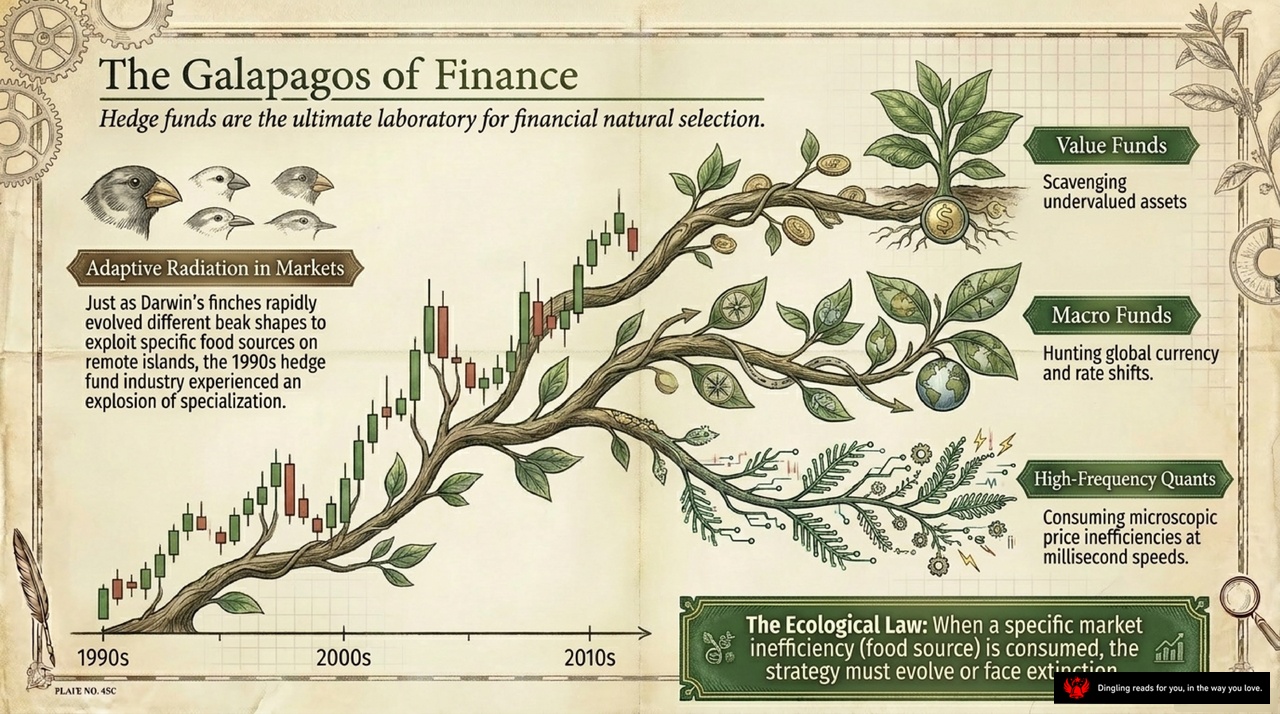
The Galapagos of Finance isn't just a catchy title; it's a powerful metaphor for how hedge funds truly evolve. Think of these funds as the ultimate laboratory for financial natural selection. Just as Darwin's finches developed different beak shapes to survive on remote islands, the hedge fund industry in the 1990s exploded into a diverse ecosystem of specialized strategies.
You see three distinct "species" thriving here. First, you have Value Funds, which act like scavengers, hunting for undervalued assets. Then there are Macro Funds, the global explorers, constantly tracking currency and interest rate shifts across the world. And finally, you have High-Frequency Quants, the lightning-fast predators that consume microscopic price inefficiencies at millisecond speeds.
But this ecosystem follows a strict ecological law: when a specific market inefficiency, or "food source," gets consumed, that strategy must evolve or face extinction. This is why we see constant innovation and why old models eventually fail.
Looking at the timeline from the 1990s to the 2010s, you can clearly see this adaptive radiation in action. As the market changed, funds didn't just hold on; they mutated. Some strategies that worked brilliantly in the past vanished, while new, more specialized ones emerged to fill the gaps. This dynamic competition ensures that the financial world remains alive, unpredictable, and constantly adapting to the next challenge.
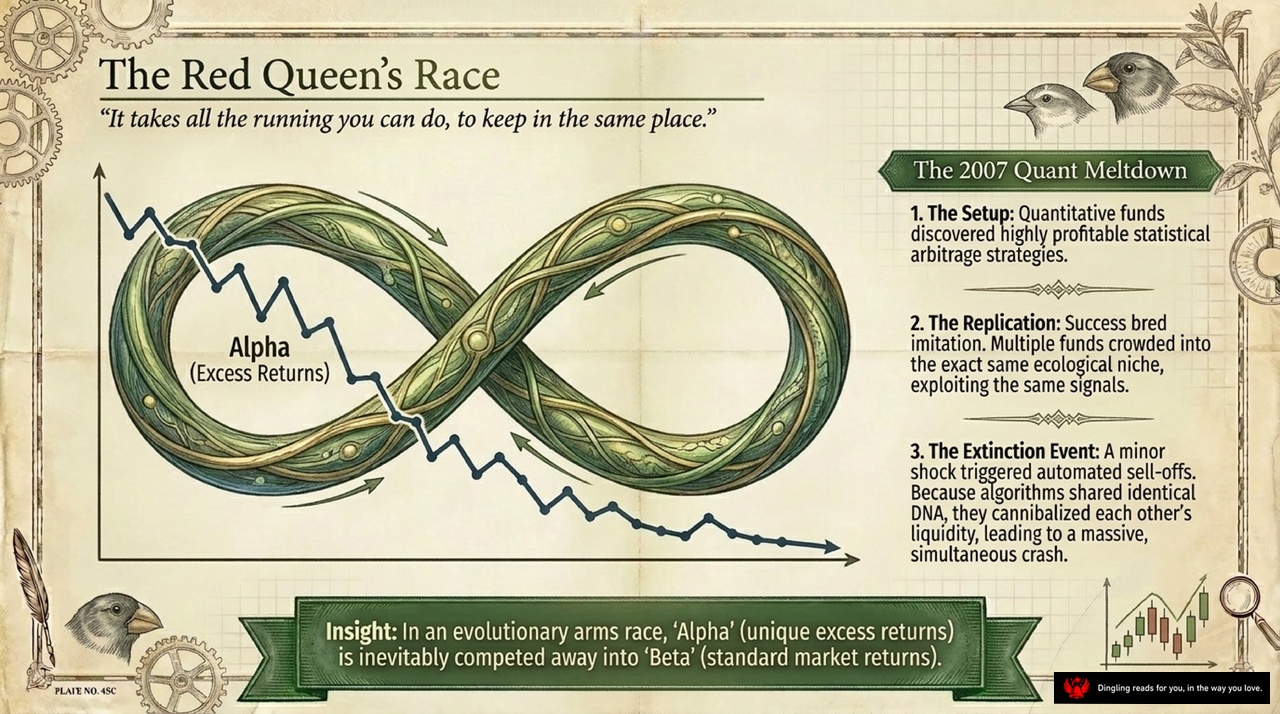
The Red Queen's Race is all about the brutal reality that you have to run just to stay in the same place. As we see on this slide, this concept perfectly explains the 2007 Quant Meltdown. It started with a setup where quantitative funds discovered highly profitable statistical arbitrage strategies. Success bred imitation, and suddenly, multiple funds crowded into the exact same ecological niche, exploiting the same signals. This is what we call "Alpha"—unique excess returns. But as the chart shows, that Alpha inevitably gets competed away into Beta, or standard market returns.
Then came the extinction event. A minor shock triggered automated sell-offs. Because these algorithms shared identical DNA, they cannibalized each other's liquidity, leading to a massive, simultaneous crash. The insight here is clear: in an evolutionary arms race, no strategy is permanent. When the environment changes, the old adaptations fail, and the entire ecosystem can collapse if everyone is running the same race. This isn't just theory; it's a warning that diversity and adaptability are the only ways to survive in a financial market that is constantly evolving.
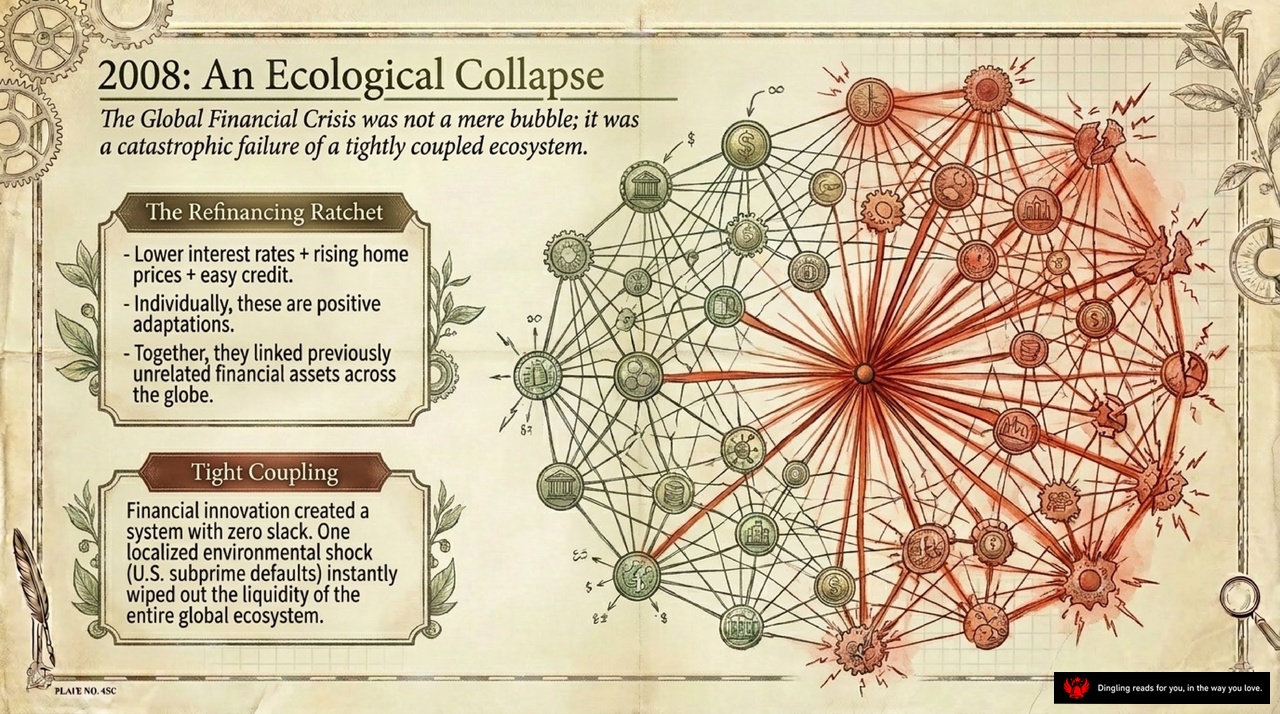
The 2008 crisis wasn't just a bubble bursting; it was a catastrophic failure of a tightly coupled ecosystem. Look at this diagram: on the left, you see the "Refinancing Ratchet." Lower interest rates, rising home prices, and easy credit individually seemed like positive adaptations for homeowners. But together, they linked previously unrelated financial assets across the globe, creating a fragile web.
On the right, the image illustrates "Tight Coupling." Financial innovation created a system with zero slack. One localized environmental shock—U.S. subprime defaults—instantly wiped out the liquidity of the entire global ecosystem. Notice how the red gears on the right are shattering while the green ones on the left remain intact. That red zone represents the collapse spreading rapidly through the network. When one part of the system fails, the tight connections meant the stress instantly transferred to everyone else, causing a domino effect that no single institution could survive. This visual perfectly captures why the 2008 crash was so devastating: it wasn't an isolated event, but a systemic collapse triggered by our inability to build financial resilience into our interconnected world.

Look at this split screen. On the left, we see the "Traditional Paradigm"—the old school belief that risk always guarantees a reward, that passive "buy-and-hold" is mathematically perfect, and that simply diversifying your assets protects you from disaster. But look at the right side: the "Adaptive Paradigm." This is where the reality check happens.
The text on the right tells us the hard truth: risk carries severe penalties during market panics, not rewards. It highlights that environmental shifts demand active risk management, reminding us of the brutal reality that "in the long run we are all dead, but ensure the short run doesn't kill you first." Furthermore, it points out a critical flaw in old theories: historical asset correlations break down completely during systemic crises.
This visual perfectly captures the shift from static assumptions to dynamic adaptation. Evolution doesn't work on a fixed script; it requires constant adjustment. When the environment changes—like a market crash—the old rules of the left side shatter, and you must rely on the adaptive principles on the right. If you cling to the idea that diversification alone saves you, or that history predicts the future, you will be caught off guard when the old correlations vanish. True survival in investing isn't about finding a perfect formula; it's about building a flexible mindset that can pivot when the ground beneath you starts to crack.

We cannot change human nature, but we can engineer the environment to manage behavioral risks and prevent positive feedback loops that lead to panic. This is the core idea behind "Fixing Finance: Behavioral Risk Management."
To do this, we need a structured approach, and that's exactly what the SIMON Framework offers. As you can see in the center of the slide, it guides us through five critical steps.
First, we must **Select**. We need to identify the specific behavioral risks most likely to damage the enterprise. It's not about fixing everything; it's about focusing on what matters most.
Next, we **Identify** the root causes. Who are the specific individuals driving these risks, and what environmental triggers are setting them off? You can't manage what you don't understand.
Once we know the triggers, we must **Measure**. We need to quantify the frequency and magnitude of these behavioral risks. How often do they happen, and how severe is the impact? Data gives us the clarity we need to act.
With that data, we **Optimize** by deploying negative feedback mechanisms. Think of these as automatic brakes. When a risky behavior starts to spiral, the system pushes back to counteract it, preventing small errors from becoming catastrophic failures.
Finally, we must **Notice**. We need to continuously monitor the entire ecosystem. Why? Because behaviors will adapt to new controls. If we don't keep watching, people will find ways to bypass our safeguards, and the risks will evolve again.
By cycling through these steps—Select, Identify, Measure, Optimize, and Notice—we create a resilient financial environment that adapts to human nature rather than fighting against it.
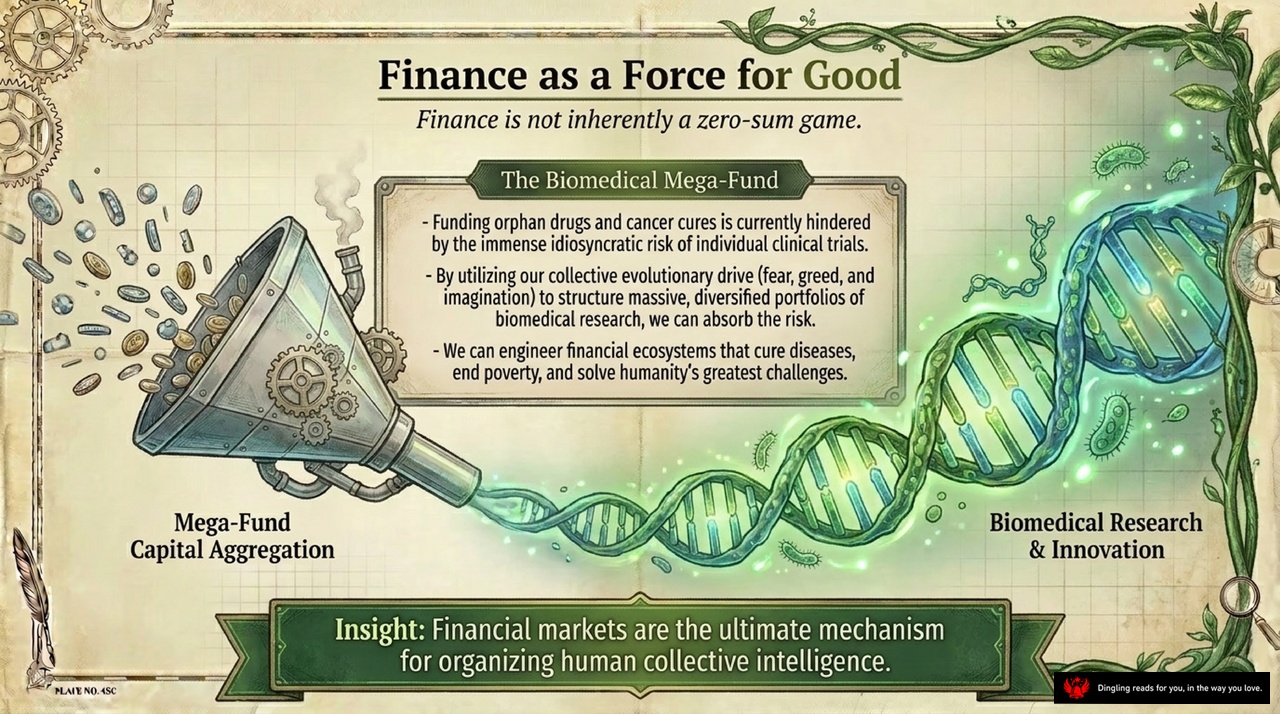
Finance isn't inherently a zero-sum game; it can be a powerful force for good. Look at this diagram: on the left, we have the Mega-Fund, a mechanism for capital aggregation, acting like a funnel that gathers vast resources. On the right lies Biomedical Research and Innovation, symbolized by that glowing DNA helix. The connection between them is the key to solving humanity's greatest challenges.
Currently, funding orphan drugs and cancer cures is severely hindered by the immense idiosyncratic risk of individual clinical trials. One failure wipes out the entire investment. But what if we could change the game? By utilizing our collective evolutionary drive—our natural mix of fear, greed, and imagination—we can structure massive, diversified portfolios of biomedical research. This approach allows us to absorb risk across hundreds of projects. Just as investing in 150 different drug candidates makes success statistically almost certain, a Mega-Fund can engineer financial ecosystems that cure diseases and end poverty.
The insight here is profound: financial markets are the ultimate mechanism for organizing human collective intelligence. Instead of viewing finance as a place where only the lucky win, we can redesign it to tackle the world's hardest problems. It's about turning our innate human instincts into a tool for progress, ensuring that capital flows toward solutions that save lives rather than just generating short-term profits.

The slide's DNA strand merging into a rising chart perfectly captures the book's final insight: financial markets aren't cold mathematical machines; they are living ecosystems driven by the biology of human survival, adaptation, and evolution. This is the core of the Adaptive Markets Hypothesis. It challenges the old idea that markets are always efficient and rational. Instead, it suggests that market efficiency is just a temporary state, shifting as the environment changes and our collective behavior evolves.
Think about it: when conditions are stable, we adapt and markets work smoothly. But when a crisis hits, like the 2008 meltdown, our old strategies fail, and the ecosystem shakes. The book asks us a powerful question for our closing thought: if our markets are ultimately a reflection of our own evolutionary biology, are you managing your wealth for the world as you wish it were, or for the environment as it actually is? The future of finance depends on our ability to adapt, just like nature itself.