
Alan Turing: The Enigma: Complete Chapter-by-Chapter Summary
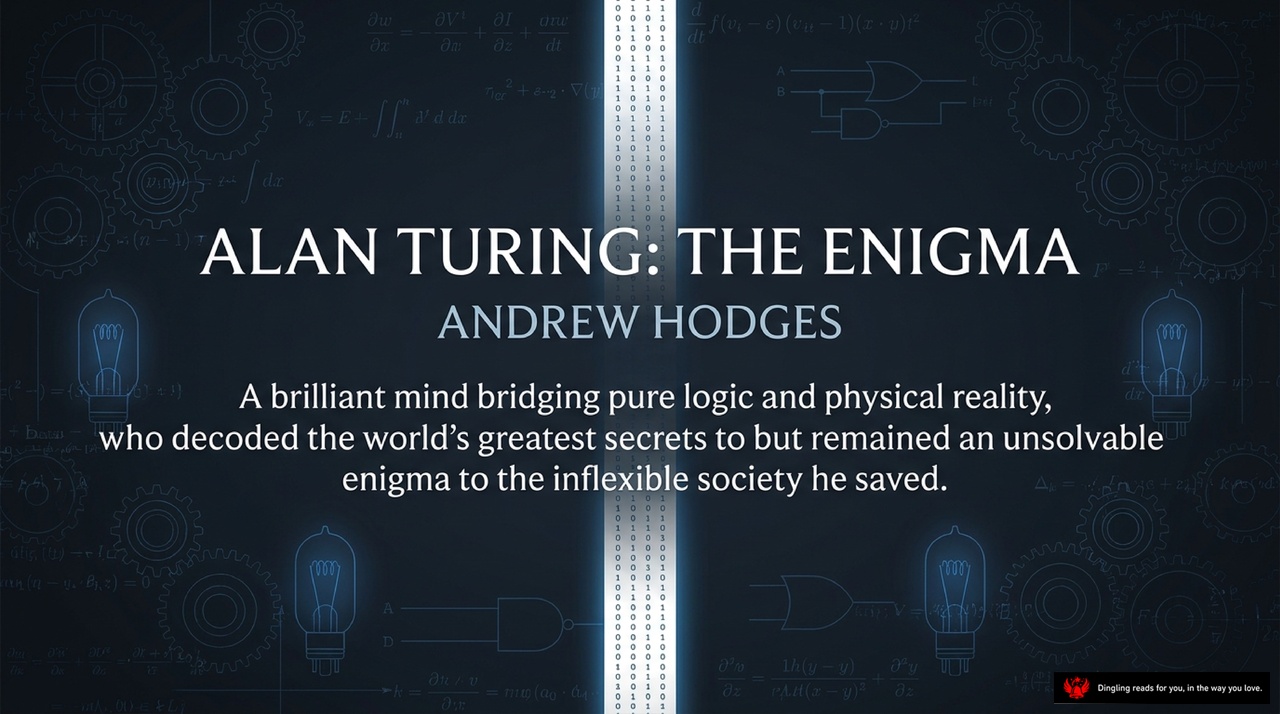
Welcome to our book club session. Today, we're diving into a story that is equal to a brilliant scientific triumph and a heartbreaking personal tragedy. The cover of our book, *Alan Turing: The Enigma* by Andrew Hodges, perfectly captures this duality. It highlights a brilliant mind bridging pure logic and physical reality, someone who decoded the world's greatest secrets but remained an unsolvable enigma to the society he saved.
Imagine a man whose life was defined by two opposing forces. On one side, he was the architect of the modern digital age, the genius who cracked the most sophisticated Nazi codes and laid the groundwork for the computer. On the other, he was a man trapped by a rigid, unforgiving society that could not accept who he truly was. The image behind the title suggests gears, logic, and mystery, reflecting how Turing's mind operated in a world that refused to understand him. This book isn't just about history; it's a profound exploration of what it means to be human when the world around you cannot accept your true self.

At the heart of Alan Turing's life lies a profound and haunting paradox: How does an abstract, ethereal spirit animate a rigid, deterministic physical machine? This question wasn't born in a vacuum; it was triggered by the sudden, devastating death of his childhood friend, Christopher Morcom, in 1930. As the slide beautifully illustrates, Turing spent the rest of his life trying to bridge this gap between the "Pure Logic & Mind" on the left and the "Deterministic Machine" on the right.
On the left, we see the human mind—complex, creative, and seemingly free. On the right, we have the mechanical world: gears, cogs, and a deterministic machine that operates on fixed rules. The connection between them is the "Infinite Paper Tape," flowing through a "Read/Write Head." This imagery captures Turing's lifelong quest: to map the ethereal mind onto the gears of reality. He wanted to understand if a machine, bound by strict logic, could ever truly think or replicate the human spirit. This fundamental question would eventually lead him to invent the concept of the universal computer, proving that a machine could indeed simulate any logical process, effectively animating the abstract with the physical.

In 1936, Alan Turing didn't just imagine a computer; he defined the very blueprint of how we think today. Look at this diagram: it's the birth of computation. Turing realized that human calculation could be broken down into simple, mechanical steps. By defining a machine that reads, writes, and changes states based on a finite table of rules, he conceptualized a single device capable of executing any computable algorithm.
Notice the "Infinite Memory" or the tape. It represents the endless potential of data. Then, there's the "State Register" with states like q1, q2, and q3. This is the machine's current condition, its memory of where it is in the process. The "Finite Instruction Set" acts as the brain, telling the machine exactly what to do next. Finally, the "Mechanical Execution" handles the read, write, and move actions, physically shifting the tape and changing the state.
The profound takeaway here is right at the bottom: One Universal Machine equals infinite possible conceptions. Turing proved that with just one simple device and a set of rules, you could theoretically solve any problem. This single idea laid the foundation for everything from modern smartphones to artificial intelligence.
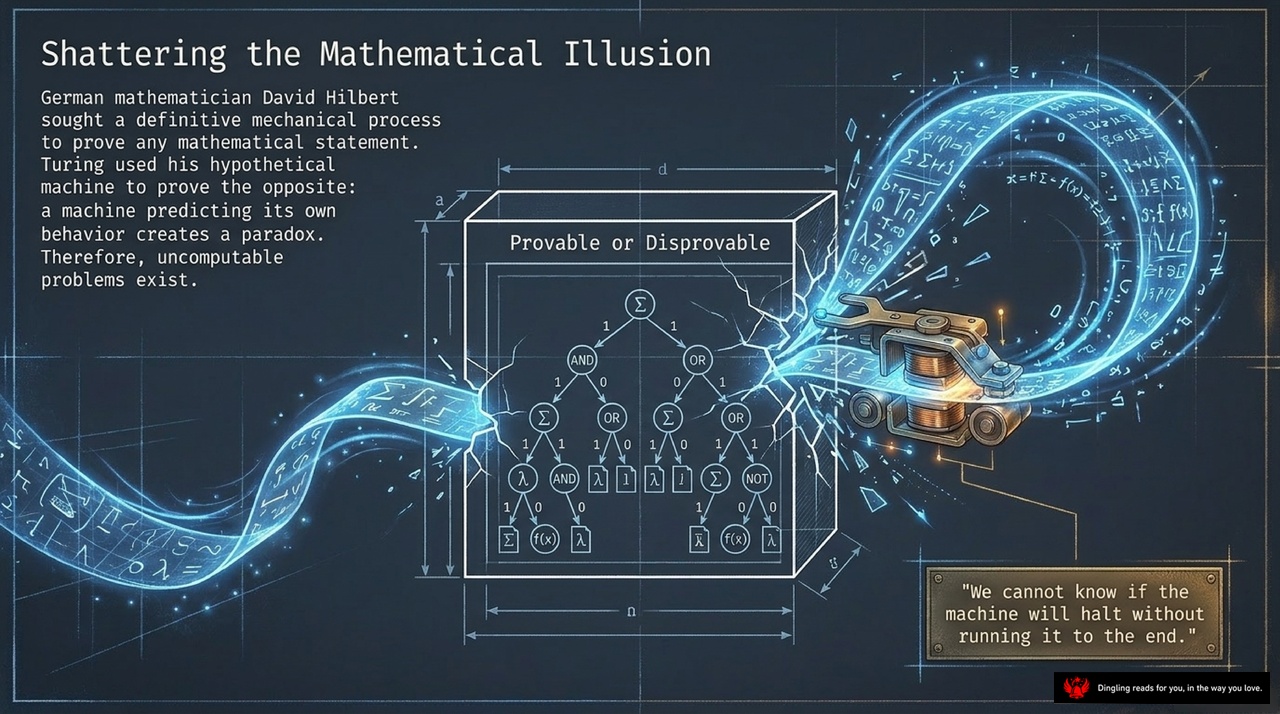
Imagine a box labeled "Provably True or Provably False," representing the dream of a perfect mathematical system where every statement can be mechanically proven or disproven. In the 1920s, German mathematician David Hilbert believed this dream was real, searching for a definitive mechanical process to solve any problem. But then, Alan Turing stepped in with a mind-shattering twist. He imagined a hypothetical machine designed to predict its own behavior. Here's the paradox: if a machine can perfectly predict its own actions, it creates an impossible situation where it must be wrong about itself. This logical contradiction proved that some problems are fundamentally uncomputable—there are questions in mathematics that no machine, no matter how advanced, can ever answer.
The image captures this collision beautifully. On the left, a stream of glowing equations represents the infinite complexity of math. On the right, a mechanical device attempts to process it, but the very act of prediction shatters the illusion of a complete system. As the quote in the corner reminds us, "We cannot know if the machine will halt without running it to the end." This realization didn't just end Hilbert's dream; it birthed the concept of uncomputable problems, laying the foundation for the limits of artificial intelligence and modern computing. It's a profound reminder that even in a world of logic, there are mysteries that remain forever beyond our reach.

The Enigma machine wasn't just a puzzle; it was a cryptographic fortress built on astronomical permutations. By 1939, when war erupted, Turing's abstract logic finally had to confront this ultimate German encryption device. As the slide illustrates, the machine was a complex assembly of three rotating scramblers, a plugboard for swapping letters, and a reflector to scramble the signal back out. The sheer scale of the challenge was mind-boggling. For every single keystroke, there were over 158 quintillion possible states. That is 158,962,555,217,826,360,000 combinations. To break this code, you couldn't just guess; you needed a strategy that could handle a universe of possibilities. This physical urgency forced Turing to move from pure theory into the high-stakes arena of wartime intelligence, where the speed of his decryption would literally determine the fate of nations.

On this slide, we see the ultimate showdown: Machine versus Machine. On the left is the Enigma, the German encryption beast. Its core principle relied on astronomical permutations, a manual operation where a letter could never encrypt to itself. It was a wall of complexity built on human effort. But on the right stands the Bombe, Britain's counterattack. Turing realized you cannot out-calculate Enigma; you must logically collapse its possibilities. The Bombe's genius lay in exploiting a specific flaw using Welchman's Diagonal Board. Instead of brute force, it used logical contradictions to instantly eliminate billions of false states. This wasn't just a faster machine; it was a smarter one. By automating the electrical sweeping, the Bombe turned an impossible puzzle into a solvable one, proving that understanding the enemy's logic was far more powerful than simply trying harder.
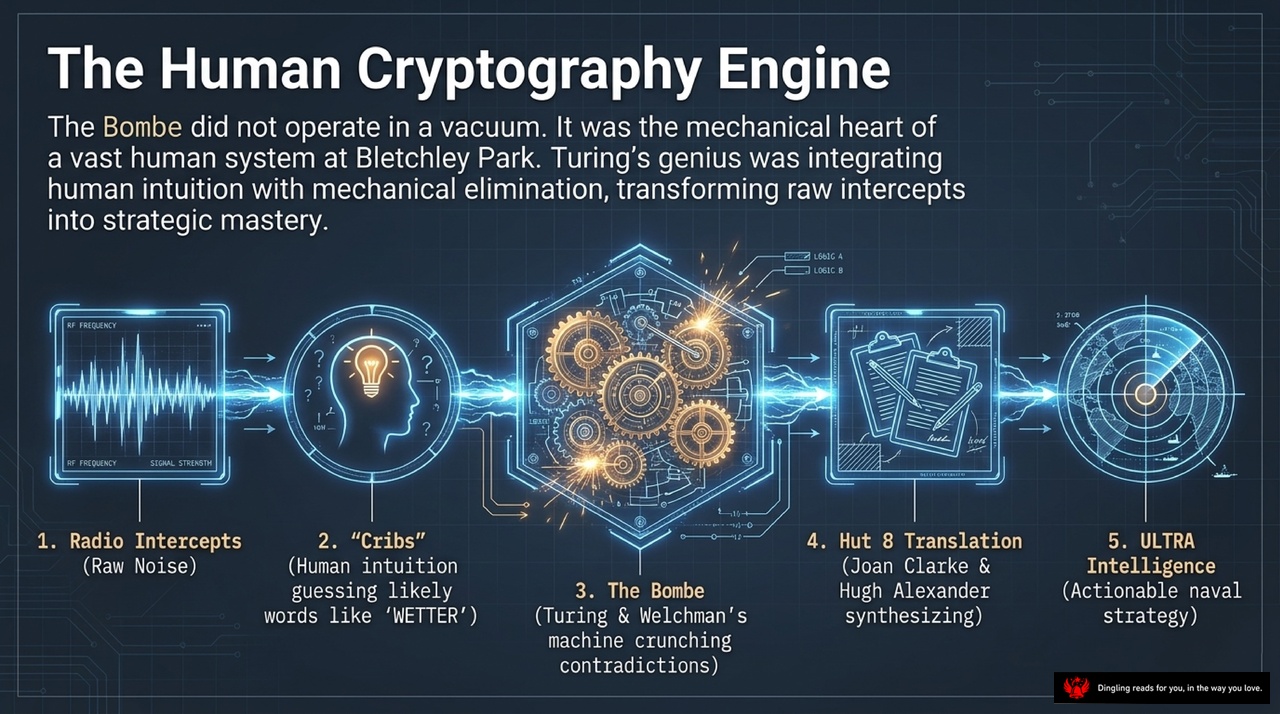
The image you see here isn't just a diagram; it's the blueprint of how humanity actually won World War II. It captures the "Human Cryptography Engine," a system where raw data met human genius to create strategic mastery.
Let's walk through this flow. It starts on the left with **Radio Intercepts**—just raw noise and static. But that noise didn't stay noise for long. Step two is where human intuition took over, using what we call "Cribs." Operators would guess likely words, like 'WETTER', to anchor their search.
Then comes the mechanical heart: **The Bombe**. This is where Turing and Welchman's genius shone. Their machine didn't just guess; it mechanically crushed contradictions, testing thousands of keys in minutes instead of months.
But the machine wasn't the whole story. On the right, you see **Hut 8 Translation**, where brilliant minds like Joan Clarke and Hugh Alexander synthesized those clues into readable German. Finally, this all fed into **ULTRA Intelligence**, transforming those codes into actionable naval strategy that changed the course of the war.
This process proves that technology alone doesn't win wars. It's the seamless integration of human intuition and mechanical elimination that turned a chaotic signal into a strategic victory.

The image captures a pivotal moment in the history of life itself: the birth of "Architecture," or what we now call morphogenesis. On the left, we see the raw, chaotic machinery of the past—gears and punch cards representing the rigid, deterministic logic that once dominated science. But on the right, the scene transforms into a fluid, glowing network of binary data and interconnected nodes, symbolizing the complex, organic patterns that define living things.
This visual shift mirrors Alan Turing's groundbreaking shift in focus after the war. He moved away from building machines to solve math problems and instead asked a profound biological question: How do cells, which start out identical, know how to grow into specific shapes like a starfish's five arms or a pinecone's spiral?
Turing realized that life isn't just about following a blueprint; it's about chemistry in motion. He proposed a radical idea: that patterns emerge from the interaction of chemicals spreading and reacting within a tissue. He simplified this complex process into a mathematical model, using just four chemicals. By simulating how these substances diffuse and interact, he could predict the formation of spots and stripes. His computer simulations didn't just show numbers; they generated visual patterns that looked remarkably like the spots on a Jersey cow or the texture of a pineapple.
This was a revolution. Turing proved that complex, beautiful biological forms could arise from simple physical laws, without needing some mysterious "life force." He bridged the gap between the hard logic of mathematics and the soft mystery of biology, showing us that the code of life is written in the very chemistry of the world around us.

Look at this slide, "Diverging Paths in Early Computing." It perfectly captures the two distinct visions that shaped the digital age. On the left, we have Alan Turing's ACE, born in the UK, built on a philosophy of minimalistic hardware and highly complex software. Turing wasn't just trying to build a calculator; he was attempting to construct a simulated "brain" capable of learning, using high-speed acoustic delay lines as memory. He saw the computer as an artificial nervous system.
On the right stands Von Neumann's EDVAC from the United States. Their approach was the opposite: a heavy hardware focus with built-in mathematical functions. They prioritized a powerful mechanical calculator, relying on slower, hardware-bound memory. While America was busy building colossal machines for brute-force calculation, Turing was quietly laying the groundwork for the software-driven, intelligent systems we use today. This fundamental split—between hardware-heavy calculation and software-driven intelligence—defined the trajectory of our entire technological future.
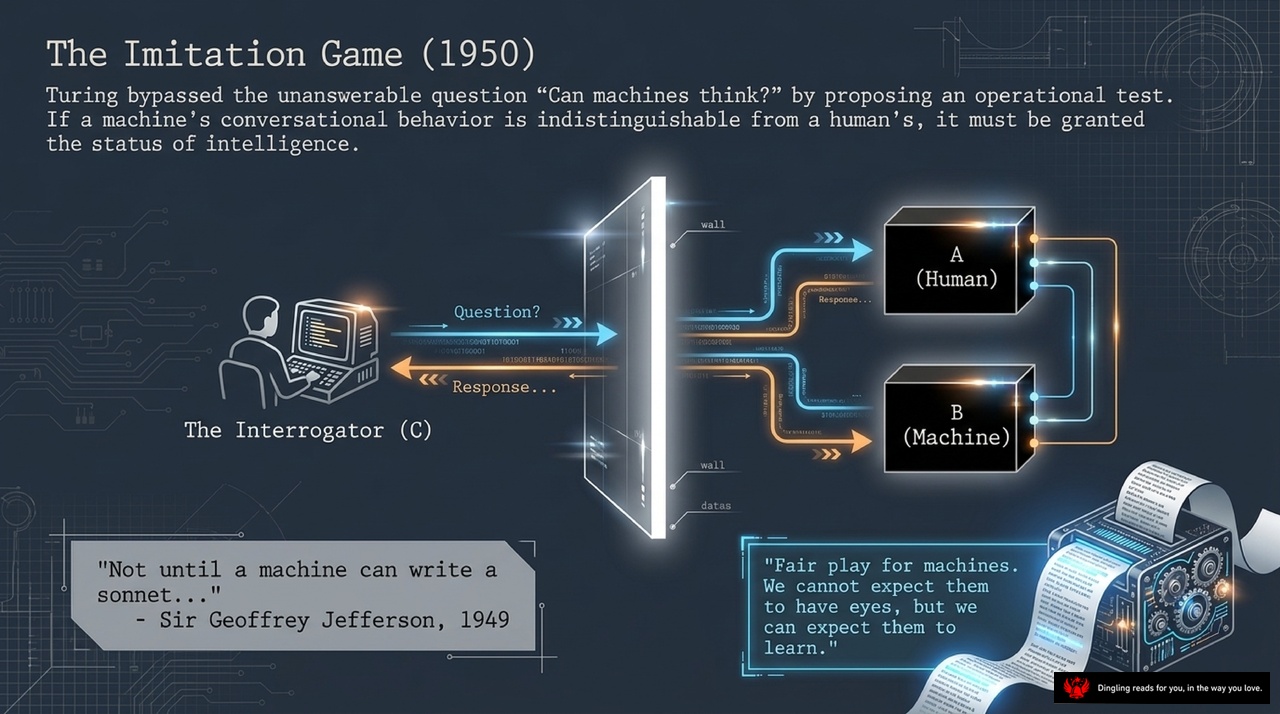
Imagine a game where a human interrogator sits behind a wall, trying to guess whether they are chatting with another person or a machine. This is the core of Alan Turing's 1950 masterpiece, *The Imitation Game*. As the slide illustrates, Turing bypassed the impossible question, "Can machines think?" by proposing a practical test: if a machine's conversational behavior is indistinguishable from a human's, it must be granted the status of intelligence.
In this setup, labeled A and B, one is a human and the other is a machine. The interrogator sends questions, receives responses, and must decide who is who. Turing's insight was revolutionary—he shifted the focus from the internal workings of the mind to its observable output. He argued that we cannot expect machines to have eyes or bodies, but we can and should expect them to learn and behave intelligently.
Even skeptics like Sir Geoffrey Jefferson admitted in 1949 that "Not until a machine can write a sonnet" could it truly be considered intelligent. Yet, Turing believed that if a machine could pass this test, convincing us it was human, the debate would be settled. This simple yet profound framework laid the foundation for the entire field of artificial intelligence, challenging us to redefine what it means to be smart.

The mathematics of nature, as Alan Turing envisioned it in 1952, reveals a stunning truth: the breathtaking complexity of life is not magic, but code. In his final frontier, Morphogenesis, Turing sought to prove that the beautiful patterns we see in nature—from the spirals of a pinecone to the stripes of a zebra—are generated by deterministic mathematical rules.
Look at the image before you. It's a pinecone, a perfect example of the Fibonacci sequence: 0, 1, 1, 2, 3, 5, 8. But Turing went deeper than just counting. He built equations to describe the chemical processes causing these biological patterns. You see those complex formulas surrounding the spiral? They represent the reaction-diffusion system. He imagined chemicals interacting and spreading, much like ink in water, but with a twist. When the rate of reaction matches the rate of diffusion, uniformity breaks down, and stable waves emerge. These waves dictate everything: the number of tentacles on a hydra, the spots on a leopard, or the very shape of a leaf.
Turing's ultimate synthesis was radical yet simple: biological life can be decoded as an algorithm. He showed that the chaotic, organic growth of a living thing could be predicted by the same logical, step-by-step rules that power a computer. It's a powerful reminder that the universe, from the smallest cell to the grandest spiral, operates on the same fundamental logic.

In 1952, society wasn't a flexible community; it acted like a rigid, unforgiving social machine. Back then, the system had a hardcoded instruction set that simply couldn't process Alan Turing's authentic identity. Unable to accommodate his truth, the state machinery convicted him of "gross indecency," forcing a fatal system crash.
This slide illustrates that tragic collision. On the left, we see the input: 1950s British Society feeding in Alan Turing himself—defined by the system as a homosexual, unconventional, and honest man. This input enters a brutal processing unit governed by the Criminal Law Amendment Act of 1885 and fueled by Cold War paranoia. The gears of this machine grind down any deviation from the norm.
The output is devastating. Instead of innovation or understanding, the machine produces a "System Error" labeled as a Fatal Crash. The result wasn't just a legal sentence; it was chemical castration—a forced destruction of the very man who had once saved the system. As the image poignantly reminds us, the man who saved the system was ultimately destroyed by its inflexible rules.

On June 7, 1954, the man who once cracked the world's most impenetrable codes took a bite of an apple laced with cyanide. It wasn't just a random act; it was a final echo of his lifelong fascination with the Snow White fairy tale, a story he loved more than almost anything else. He left no note behind, maintaining an ultimate ambiguity about why he chose to end it all.
Look at the image. That glowing apple represents the very end of a journey that began with pure logic. Alan Turing was the architect of pure logic, the man who decoded the entire world for us. Yet, in the final chapter of his life, he could not overcome the fatal complexities of the human condition. He could solve the hardest mathematical problems, but he could not solve his own pain. He decoded the world, but his own end remained an unsolvable output, a final enigma that history is still trying to understand.

Alan Turing didn't just build machines; he built the very architecture of our digital future. Look at this image of a universal mind bridging the gap between abstract math and physical reality. That's exactly what he did. He took the theoretical concepts of logic and turned them into the silicon chips that power our world today.
His vision was revolutionary. He didn't just solve the cryptographic puzzles of World War II; he dared to imagine a future where a machine could harbor human thought. As we relentlessly build machines designed to perfectly imitate human thought, we are walking a path he paved. But here is the profound question he left us with: as we create these perfect digital replicas, will our society ever evolve to tolerate the beautiful, divergent complexities of the actual human beings who created them? We are still trying to answer that, a century later.