
Algorithms to Live By: Complete Chapter-by-Chapter Summary

Welcome to Algorithms to Live By. This isn't just a book about computer science; it's a guide to the hidden logic of human decisions. Think of your brain as a machine running complex, invisible code every second of the day.
We are going to explore how the principles that power the internet, from search engines to traffic lights, can actually help you navigate your own life. Whether you are deciding when to stop looking for a job, how to manage your time, or how to predict the future, there are algorithms designed to help you make better choices.
In this course, we will move beyond intuition and tap into the scientific strategies used by the world's most advanced systems. We'll learn how to balance exploration with knowing when to settle, how to organize information efficiently, and how to handle uncertainty without getting overwhelmed.
So, let's dive into the computer science of human decisions and discover how to live by algorithms.

Today's slide lays out the core premise that reshapes how we think about intelligence itself. Look at the center: **Algorithmic Wisdom**. It sits right where **Computer Science** and **Human Life** overlap.
Let's break down why this matters. On the left, under **The Reality**, we see that computers aren't magical or all-knowing. They have **Limited Processors**, strict **Memory Constraints**, and finite **Processing Time**. They don't have infinite resources.
On the right, under **The Myth** that we often believe, we see the human side. We suffer from **Limited Attention**, we are bound by **Physical Space**, and we face the hard truth of **Mortality**.
The diagram shows that despite these differences, both fields share the same fundamental challenge. We are all trying to make the best of what we have.
So, what is **The Goal**? It's clearly stated in the bottom right: using computational logic to minimize regret and maximize efficiency in an unpredictable world.
Modern algorithms, much like human beings, manage extreme uncertainty, limited time, and incomplete information. Instead of waiting for perfect data that never arrives, we use these constraints to our advantage. We learn to stop watching and start acting, to explore new options while utilizing what we know, and to find the best path forward even when the future is unclear.
In short, whether you are a machine crunching numbers or a human making life choices, the path to wisdom isn't about having more power—it's about making smarter decisions with exactly what you have.

Have you ever wondered why your search for an apartment or a partner feels so frustratingly endless? The answer lies in a mathematical concept called "Optimal Stopping," and today's slide breaks it down into two distinct phases.
On the left, we have "The Look Phase," which takes up the first 37% of your search window. During this time, you are not supposed to commit. Instead, you must gather data and calibrate your standards. Think of it as setting a baseline without making any promises. The key here is to observe everything but choose nothing.
Once you hit that 37% activation threshold, you switch to "The Leap Phase." This is where the math gets interesting. Your rule is simple: choose the very first option that is better than everything you have seen so far. If you haven't found a winner by now, you must take the next available option immediately. Hesitation is mathematically suboptimal.
The beauty of this framework is that it applies identically whether you are renting a place or seeking a life partner. By spending the first third of your time purely on calibration, you avoid the trap of settling too early or waiting too long. It transforms a chaotic search into a structured strategy, ensuring you stop at the right moment.

Imagine a world where your computer is constantly switching tasks, like a chef frantically running between three different orders at once. Every time it switches, it has to clear its "workbench"—the memory—to make room for the new task. This constant clearing and reloading is called "thrashing." It's like trying to write a novel, but every time you write a paragraph, you have to erase the entire page and start over. You're busy, but you're getting nowhere.
This is exactly what happens when we suffer from too many interruptions. In computer science, we solve this with a strategy called "interrupt batching." Instead of reacting to every single notification immediately, we group them together. Think of it like this: instead of checking your email every time a new message arrives, you set a rule to check it only three times a day. Or, you designate specific times, like right after lunch or right before bed, to handle all your administrative tasks at once.
This simple shift changes everything. By reducing the number of times you switch contexts, you stop your brain from "thrashing." You allow your focus to settle, your memory to retain information, and your deep work to actually happen. The goal isn't to eliminate interruptions entirely, but to stop letting them dictate your rhythm. By batching them, you take control back from the algorithm, turning a chaotic stream of demands into a manageable, efficient workflow.

Sorting isn't just about making things neat; it's a strategic trade-off between the effort you put in today versus the ease of finding things tomorrow. Imagine a scale balancing two weights: on one side, the upfront cognitive and physical effort of sorting; on the other, the future retrieval effort of searching. This is the core architecture of mastering space.
The slide breaks this down into two distinct approaches. First, there's Bubble Sort, which compares every single item to every other item. In computer science terms, this is O(n²)—extremely slow and inefficient. It's the equivalent of trying to organize a library by comparing every book against every other book on the shelf. The advice is clear: never use it.
The smarter alternative is Bucket Sort, which groups items into broad categories first before refining them. This operates in O(n) time, making it highly efficient. Think of it like a library that first separates fiction from non-fiction, then organizes those sections. By sorting broadly upfront, you drastically reduce the time needed to find what you need later.
But here's the crucial rule to remember: Erratic order is perfectly fine if you never intend to search it. You should only sort to prevent future search debt. If you rarely look for something, leave it messy. Sorting is an investment in your future self, and the Tradeoff Rule tells you exactly when that investment is worth making.

Randomness isn't about chaos; it's the ultimate tool for solving problems that logic alone cannot crack. While traditional algorithms struggle with complex, uncertain environments, introducing a calculated dose of luck allows us to find near-optimal solutions where certainty fails. Think of it as trading absolute precision for speed and adaptability.
Consider the "Traveling Salesman Problem," where finding the perfect route is computationally impossible. Instead of getting stuck in a local optimum—a good but not great solution—randomness acts as a powerful escape mechanism. Techniques like "Simulated Annealing" mimic the physical cooling of metal: initially, the system is "hot," accepting bad moves to explore vast possibilities. As it cools, it becomes selective, settling into the best stable structure. This approach breaks rigid thinking, allowing us to jump over obstacles that deterministic methods would never cross.
This principle extends far beyond code. In biology, random mutations provide the raw diversity that natural selection refines, driving evolution itself. In creativity, randomness forces us out of mental ruts. Tools like random word generators or "indirection cards" can suddenly flip a stuck idea on its head, revealing connections we missed. Whether you're planning a project, designing a product, or just navigating a difficult conversation, embracing the unexpected can be the key to unlocking a better outcome than you ever could by planning every step in advance.

Stop treating every task like it's equal. The real secret to mastering your day isn't working harder; it's choosing the right algorithm for your specific goal.
Look at the three strategies on this slide. First, if your main metric is minimizing the maximum tardiness—meaning you hate missing deadlines—use the Earliest Due Date algorithm. Just sort strictly by deadline and ignore how long each task takes. It's simple, but it keeps your most critical commitments safe.
Second, if your goal is to minimize the total number of items you throw away—perhaps you're overwhelmed and just want to clear the backlog—switch to Moore's Algorithm. Sort by deadline, but if you fall behind, ruthlessly drop the single longest task to save the rest. It's a strategic sacrifice to keep the majority of your goals alive.
Finally, if your success metric is simply reducing your inbox count as fast as possible, apply the Shortest Processing Time strategy. Do the quickest, simplest tasks first to clear sheer volume and build momentum.
The bottom line is clear: Stop treating all tasks equally. Define the metric of success first, then apply the correct algorithmic lens. One size does not fit all.

Imagine you're trying to predict the future, but you only have one data point to go on. Maybe you're wondering how long a relationship will last, or when the next bus will arrive. This is where the concept of "distributions" changes everything.
On the left, you see the **Normal Distribution**, often called the Bell Curve. This applies to things like human lifespans or movie runtimes. It follows **The Average Rule**: if a 90-year-old is alive, we predict they will live just past the average, say to 94. Why? Because nature tends to revert to the mean. Things in this distribution end soon.
Now, look at the right side. This is the **Power-Law Distribution**. Think box office revenue or the length of a war. This follows **The Multiplicative Rule**. Here, the longer a phenomenon has survived, the longer it will continue to survive. This is known as the Copernican Principle.
So, how do you predict? You first have to identify which distribution you are dealing with. If it's normal, bet on the average. If it's a power law, bet that the trend continues. Mastering this distinction is the key to predicting the future in an uncertain world.

Mastering Complexity: Overfitting. Look at this chart. We see two paths to the future. The red line represents a "9-Factor Model"—it's overfitted and fragile. It dances wildly, chasing every tiny fluctuation in the past data, only to crash spectacularly when the future arrives. The blue line, labeled "Simple Model," is robust. It ignores the noise, sticking to the true trend.
The core lesson here is counterintuitive: more data and more variables do not equal better decisions. In fact, they often make us worse. A highly complex model perfectly fits the past but wildly fails the future because it mistakes noise for signal. It's like memorizing a specific set of exam questions instead of learning the subject; you pass that test, but you fail every future one.
To combat this, we need "Regularization." Think of it as a mathematical penalty for complexity. It forces us to simplify. When uncertainty is high, we must stop thinking early. We need to embrace the simple model because it generalizes better. In a world full of noise, the most sophisticated tool you can have is the wisdom to know when to stop adding complexity and trust the basics.

Imagine a situation where you are facing a problem so complex that it feels impossible to solve directly. Maybe it's a chaotic project schedule, a tangled web of personal relationships, or a life decision with too many variables. The slide in front of us introduces a powerful mental shift called "Mastering Complexity through Relaxation." Instead of staring at the jagged, impossible shape of the problem on the left, we are encouraged to solve an easier version of it first. As the text at the bottom reminds us, progress beats perfection.
On the right, we see three specific strategies to achieve this. First is Constraint Relaxation. This means removing absolute rules. Think of it as solving the "easy baseline" version of your problem. Instead of demanding a perfect solution immediately, you lower the bar to find a starting point.
Next is Continuous Relaxation. This is about turning rigid "Yes or No" choices into percentages. Instead of forcing a binary decision, you might commit to 50% of an invite or allocate resources in degrees rather than all-or-nothing blocks. This flexibility helps you find a starting point without the pressure of a final commitment.
Finally, we have Lagrangian Relaxation. This is perhaps the most liberating concept: turning an impossible rule into a measurable penalty. Instead of saying "you must do this or fail," you ask, "What if we break the rule, but we pay a steep fine?" By assigning a cost to breaking the rule, you transform a rigid constraint into a flexible trade-off.
The visual on the left beautifully illustrates this transformation. We start with a complex, jagged problem and, through these relaxation techniques, smooth it out into a simple, manageable circle. The goal isn't to ignore the complexity, but to relax it enough to make movement possible. By accepting that we can't solve the hard version immediately, we unlock the ability to make progress today, knowing we can refine our solution tomorrow.

Imagine you are trying to solve a complex puzzle, but every time you take a step that looks like progress, you find yourself stuck on a small hill, unable to see the much higher peak that lies just beyond. This is the trap of the "Local Maximum"—the danger of getting trapped in incremental logic. As the chart illustrates, always taking the next logical step can keep you confined to a small hill, preventing you from ever reaching the "Global Maximum." To get there, you actually need to take a temporary downward trajectory, a counterintuitive move that requires you to step back or even go down before you can climb higher.
The solution lies in a concept called "Simulated Annealing." Think of it like heating up metal until it's fluid, allowing atoms to move freely and escape their rigid, suboptimal positions. In our decision-making, we deliberately inject randomness. We take "worse" options early on to force ourselves off the small hill and jump into entirely new mountains. Then, we gradually "cool" the randomness over time, locking us into the highest peak. This process teaches us that mastering complexity often requires embracing randomness. By allowing ourselves to explore the unknown, even if it means making a temporary misstep, we unlock the ability to find the truly best solution rather than just settling for the easiest one right in front of us.

Imagine a world where every interaction is a high-stakes game of chess, where you are constantly trying to outthink your opponent by guessing what they think you know. This is the "Recursion Trap"—that paralyzing feeling of endless strategic calculation. But what if the solution isn't to think harder, but to change the game itself?
The slide highlights this shift through the power of Mechanism Design, specifically using Vickrey Auctions as a prime example. In a standard auction, you spend hours strategizing, hiding your true value, and bluffing to win. But in a Vickrey Auction, the highest bidder wins, yet pays only the second-highest price. This simple rule change creates a mathematical incentive for absolute honesty. If you bid your true value, you either get the item at a fair price or lose without cost. If you try to cheat by bidding higher or lower, you only hurt yourself.
The result is profound: it completely removes the cognitive burden of lying, hiding, and strategizing. As the slide suggests, if changing your strategy fails, you should change the game. By designing the right rules, we can align individual self-interest with collective success, turning complex, chaotic human interactions into predictable, efficient systems. It's not about being smarter; it's about making the right game.

SYNTHESIS: COMPUTATIONAL KINDNESS
On the left, we see a tangled knot labeled "Traditional Politeness," and on the right, a clean, simple rectangle representing "Computational Kindness." The slide contrasts how we usually handle social decisions versus how an efficient algorithm would.
Think about planning dinner. Traditional politeness often looks like saying, "I'm fine with anywhere for dinner, what do you want?" On the surface, this sounds generous and flexible. But underneath, you are secretly offloading a massive cognitive burden onto your friend. You are forcing them to search through every option, filter out the bad ones, and compute the perfect choice all by themselves. You've made the problem harder for them.
Now, look at the solution on the right. Computational Kindness suggests you say, "I'd love either Italian or Thai. Which do you prefer?" By narrowing your options down to just two, you dramatically reduce the search space for your friend. You bound the problem, making their decision-making effortless. You aren't just being polite; you are being computationally efficient.
The core principle here is simple but powerful: Good algorithms minimize the labor of thought. We should design our interactions, environments, and questions to minimize the computational burden on others. Instead of pretending to have no preferences, give your friend a manageable set of choices. This isn't about control; it's about empathy. It's about realizing that the most kind thing you can do is to make it easier for someone else to think.

Imagine a world where you could solve life's toughest puzzles simply by relaxing your grip on the rules. This is the power of "relaxation," a core concept in computer science that teaches us to stop fighting for perfection and start hunting for the best possible solution.
Think about the classic "Traveling Salesman Problem." A salesman needs to visit a dozen cities, but calculating every single possible route is computationally impossible. Instead of getting stuck trying to find the absolute perfect path, we use a strategy called "constraint relaxation." We temporarily remove the strict rule that the salesman must visit each city only once. Suddenly, the problem becomes easy: we just connect all the cities with the shortest possible lines, creating a "Minimum Spanning Tree."
This relaxed solution might not be the final answer, but it's incredibly valuable. It gives us a performance baseline. If the relaxed route is 100 miles, we know the real solution can't be shorter than that. If we find a route that's 110 miles, we instantly know we're within 10% of perfection. This approach transforms an unsolvable nightmare into a manageable challenge.
But the lesson goes far beyond math. It applies directly to how we live. When you're overwhelmed by work, try relaxing your constraints. Stop trying to do everything perfectly at once. Prioritize the core goals and temporarily ignore the minor details. You might end up with a solution that isn't flawless, but it's functional, efficient, and actually gets things done.
Even in complex social scenarios, this logic holds true. Imagine planning a wedding seating chart where every table must have exactly ten guests. The math explodes into chaos. Instead, relax that rule. Allow some tables to have nine or eleven guests, perhaps even penalizing the deviation slightly in your mental model. You'll quickly find a seating arrangement that satisfies everyone's relationships, even if it breaks the rigid "ten-person" rule.
The ultimate takeaway is simple: perfection is often the enemy of progress. By learning to relax our constraints—whether they are mathematical rules, strict schedules, or rigid social expectations—we unlock the ability to find solutions that are "good enough" to be brilliant. We stop obsessing over the impossible and start celebrating the practical.
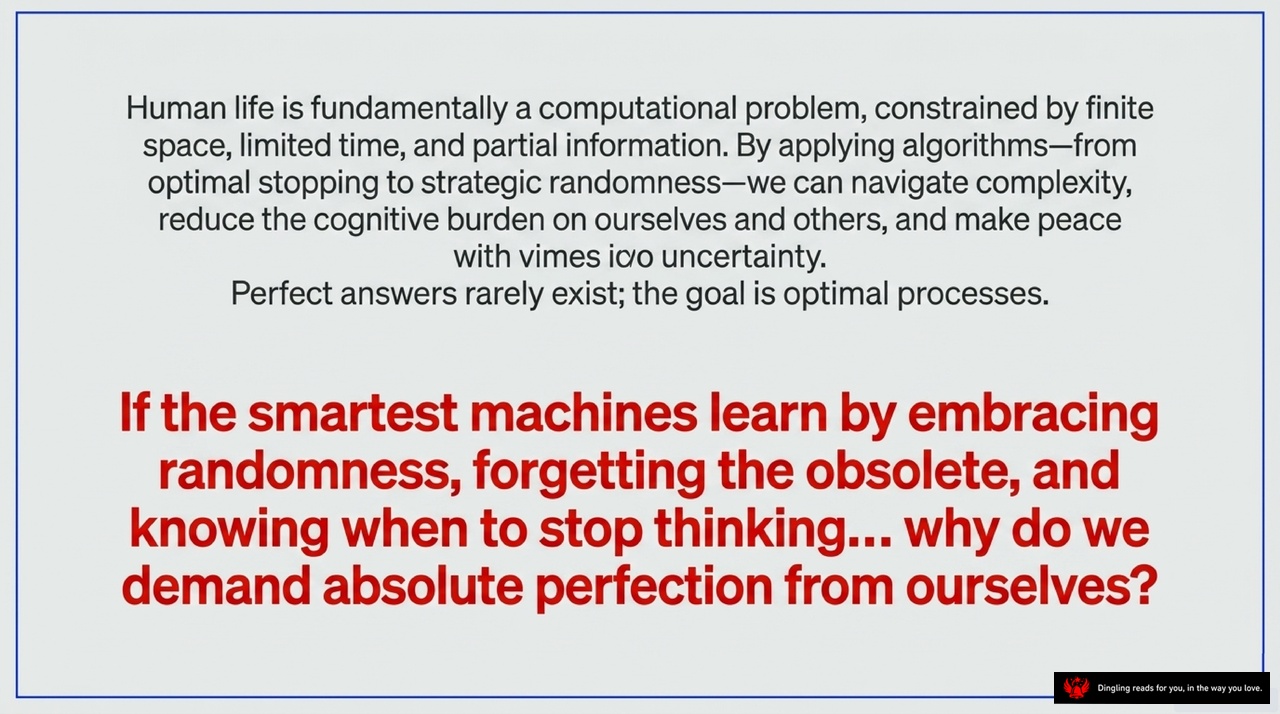
Human life is fundamentally a computational problem, constrained by finite space, limited time, and partial information. We often find ourselves paralyzed by the pressure to find perfect answers, but the smartest machines teach us a different lesson: they learn by embracing randomness, forgetting the obsolete, and knowing exactly when to stop thinking. Why do we demand absolute perfection from ourselves when the goal is simply optimal processes?
By applying algorithms like optimal stopping and strategic randomness, we can navigate complexity and reduce the cognitive burden on ourselves and others. The reality is that perfect answers rarely exist; the goal is optimal processes. Instead of trying to predict the future with certainty, we can use probabilistic thinking to make better decisions in an uncertain world. Whether it's deciding when to stop searching for a job, choosing a partner, or even navigating the chaotic flow of information, the key lies in balancing exploration with utilization. We don't need to know everything to make good choices; we just need the right framework to act wisely amidst the noise. Embracing this mindset allows us to make peace with uncertainty and find our way forward without getting stuck in the endless loop of overthinking.