
Alienation and Return: Complete Chapter-by-Chapter Summary

Welcome to today's book club session. We are diving into a profound historical exploration by Zhang Kaiyuan, titled "Alienation and Return: The Relationship Between Traditional Culture and Modernization."
The title itself sets a powerful tone for our journey: a civilization must sometimes break away from its roots to survive, only to rediscover them later to retain its soul. This image of a map overlaid with blueprints of machinery perfectly captures the central tension of the book—the collision between ancient geography and industrial progress.
In this historical narrative, we see how nations navigate the painful transition from tradition to modernity. It is a story not just of technology, but of identity. As we move forward, we will examine how figures like Gong Zizhen challenged the stagnation of the Qing Dynasty, how Wei Yuan opened China's eyes to the West with "Learn from the Barbarians," and how the shift from reform to revolution reshaped the nation's spirit.
We will also look at the complex dance of alienation and return, where breaking away from the past was necessary for survival, yet returning to cultural roots was essential for the soul. This is a story of a nation finding its way through the turbulence of the modern era, a struggle that resonates deeply with anyone who has ever had to choose between who they are and where they need to go. Let's begin this exploration together.

Look at this diagram. At its heart lies "The Mother Culture," representing our deep-rooted heritage. But notice the arrows flanking it. On the left, a hook pulls us back; on the right, an arrow pushes us forward. This visual perfectly captures the dual forces shaping our cultural evolution: "Return" and "Alienation."
On the left, we see "Return," or *Huigui*. This is the psychological recoil, the inward pull to reclaim our national identity. It's about anchoring new institutions in the soul of our native heritage, preventing total assimilation by the outside world. Think of it as the cultural immune system, ensuring we don't lose our way in a rapidly changing world.
On the right, we have "Alienation," or *Liyi*. This is the necessary, often painful detachment from decaying traditions. It's a spatial and psychological outward movement designed to absorb advanced foreign civilizations and break the stagnation of an outdated society. Without this outward push, a culture risks becoming stagnant and unable to adapt.
History shows us that true progress isn't about choosing one side over the other. It's about navigating the tension between them. We must detach from what no longer serves us to grow, while simultaneously holding onto the core of our identity to remain grounded. This dynamic balance is the key to a culture that is both modern and authentic.

Let's dive into a critical framework that explains how the West and the East took vastly different paths to modernization. Look at this four-quadrant chart. It breaks down the "Method of Escape" based on whether the driver of change was internal or external, and whether the escape happened through Time or Space.
In the top left, we see the West's path. Driven by an endogenous force, they escaped their own "Dark Ages" by moving forward through Time. They didn't look outside; they looked inward, reclaiming their ancient Greco-Roman heritage during the Renaissance to build a new future from within. It was an evolution of their own identity.
Now, look at the bottom right. This represents the East, specifically China. Here, the driver was exogenous—caused by an external shock. The ancient civilization was forcibly ruptured by events like the Opium Wars. Because they couldn't escape backward through Time, they had to escape sideways through Space. Modernization required looking laterally across the globe to imitate foreign, "alien" powers just to survive.
This contrast highlights a fundamental difference: the West rebuilt itself from the inside out, while the East had to look outward to find its way forward. Understanding this distinction is key to grasping why the two regions evolved so differently.

The slide we see here contrasts how Russia, Japan, and China responded to the West. Look at the gauges at the bottom: Russia shows "High" adaptation, Japan "Very High," while China lags at "Low." This visual perfectly captures a critical historical lesson: the privilege of the latecomer.
Russia, under Peter the Great, chose top-down radical westernization, ruthlessly discarding the old to build a European empire. Japan, during the Meiji Restoration, utilized this very privilege to import entire systems while preserving the Emperor myth, allowing for a "Very High" speed of adaptation. In contrast, Late Qing China hesitated. Deeply entrenched in agricultural-patriarchal pride, they believed the Celestial Empire could not learn from "barbarians." This arrogance blocked piecemeal adaptation, resulting in a low speed of change.
As the book notes, while both China and Japan had the chance to skip intermediate stages and borrow advanced results, Japan seized the moment. China, however, was punished for its arrogance. Instead of embracing the "privilege of the latecomer" to leap ahead, it missed the window to catch up. This stark difference in mindset—between the willingness to break with tradition and the stubborn refusal to learn—explains why one nation surged forward while the other struggled to keep pace with the modern world.

Phase 1: The Awakening begins with a pivotal moment in history: the clash between internal critique and external solutions. On the left, we see Gong Zizhen, the first to diagnose the rot within. He didn't wait for foreign ships to arrive; he called for "wind and thunder" to shatter the oppressive stagnation of the late Qing dynasty, recognizing that the empire was already dying from the inside out. On the right stands Wei Yuan, offering a radical external solution. He shifted the paradigm from viewing foreigners as inferior tributary vassals to treating them as teachers. His famous phrase, "learn the superior techniques of the barbarians to control them," opened the first crack in our cultural wall. While Gong Zizhen focused on awakening the soul of the nation, Wei Yuan provided the practical blueprint for survival. Together, they laid the foundation for a new era, proving that true awakening requires both self-reflection and the courage to learn from the world.

The image before us is a striking metaphor: an iceberg cracking under pressure. What we see floating above the water is labeled "Yong"—Application, or technology. But the massive, hidden mass beneath the surface is "Ti"—Substance, representing our core culture, ethics, and political structure. The slide warns us that grafting foreign technology onto a hostile cultural root inevitably fractures the foundation below.
This visual perfectly captures the tragic dilemma of China's early modernization efforts. Think of the late Qing Dynasty. Leaders like Zeng Guofan and Li Hongzhang believed they could simply adopt Western "Yong"—ships, guns, and industrial machines—while perfectly preserving the old "Ti," the absolute monarchy and traditional Confucian ethics. They thought the two could coexist without conflict.
But history proved them wrong. The imported application exerted immense pressure on the outdated substance. Just as the iceberg in our image, the rigid, feudal structure of China could not withstand the weight of modern technology. The cracks began to show. The very tools meant to save the empire ended up accelerating its collapse. This is the "Ti-Yong Trap." We tried to modernize the body while keeping the soul stuck in the past, and the result was inevitable disintegration. It wasn't just a technical failure; it was a cultural and structural one. We learned the hard way that you cannot simply paste new tools onto an old system without transforming the system itself.

The slide we are looking at is titled "System Failure," and it offers a stark, mechanical metaphor for why China's early modernization efforts ultimately collapsed. On the left, we see "Imported Western Tech," represented by clean, glowing gears. These are the advanced machines and weapons brought in from the West. In the center, these gears are forced into a massive, rusted engine labeled "Corrupt Patriarchal Bureaucracy." This is the heart of the problem. As the diplomat Guo Songtao observed, when you put advanced Western machinery into a corrupt, patriarchal bureaucracy, the results are inevitably corrupted. The machine doesn't run smoothly; it sputters, smokes, and breaks down.
This systemic rot leads directly to the outcome on the right: "Military Defeat." The image shows the engine exploding, shattering a stone, symbolizing the devastating collapse of the Beiyang Fleet during the Sino-Japanese War of 1894. The logic is clear: without a fundamental change in the cultural soil—ethics, the rule of law, and civic duty—imported technology merely arms corrupt officials. You can give a man a Ferrari, but if he has no moral compass or sense of duty, he will use it to commit crimes or crash the car. The slide illustrates that technology alone cannot save a nation if the underlying system is rotten. The systemic failure wasn't a lack of tools; it was a lack of a healthy foundation to support them.

Phase 2: Deep Alienation. This slide captures a pivotal moment in China's modern history—the realization that the gap with the West wasn't just about weapons, but about the very concepts of freedom and the individual. Look at the image: a figure breaking through a rigid net. That net represents the invisible chains of the past—archaic scholarship, absolute monarchy, and the oppressive Three Bonds of traditional ethics. Reformers like Yan Fu and Tan Sitong saw this clearly. They demanded the destruction of these invisible nets binding the Chinese mind. They understood that true transformation required more than just new technology; it required a fundamental shift in how people viewed themselves and their place in society. It was a struggle to break free from centuries of conformity and embrace the modern spirit of individual liberty. This was the birth of "Deep Alienation," a necessary, painful, yet liberating step toward a new China.

Traditional versus Modern Values: the clash between the old world and the new. On the left, we see the Agricultural-Patriarchal Society, built on The Three Bonds of hierarchy, governed by Filial Piety and Imperial Loyalty. Its economy relied on Restricting Flow for conservation, and its worldview was rooted in Fatalism—submitting to Heaven. On the right stands the Modern Civic Society, founded on Individual Equality. Governance shifts to Civic Duty and Public Law, while the economy embraces Opening Resources for expansion. Most importantly, the worldview transforms from passive submission to Human Agency—mastering nature. This slide captures the core of our journey: the shift from a static, fate-bound past to a dynamic, human-driven future. As we've explored from Gong Zizhen's early calls for change to the revolutionary spirit of the 20th century, this transition wasn't just about technology; it was about liberating the human spirit. We moved from asking "What does Heaven want?" to asking "What can we achieve?" This bold leap from fatalism to agency is the very engine of modern progress.

The Backlash: Reactionary Return. Driven by a profound fear of total cultural assimilation and the loss of national identity, society forcefully rejects all foreign influence. This is what we call Toxic Conservatism. Look at the image on the right—a tangled, broken knot. It perfectly symbolizes the Boxer Rebellion, the ultimate example of this mindset. Here, the pendulum swings to a reactionary extreme, relying entirely on superstition and blind xenophobia. Instead of embracing modernity to strengthen the nation, this toxic rejection of progress leads directly to the tragic collapse of the country's defenses against imperialism. It is a painful reminder that when a society turns its back on the future out of fear, it hands its destiny to its enemies.

The Renaissance Model isn't just about looking backward; it's about finding the future hidden within our past. As the slide illustrates, true modernization is a "Progressive Return"—a spiral where we unearth the newest ideas from our oldest traditions. This concept of "Reinterpreting the Past" is crucial. It doesn't mean regressing to an archaic state or blindly copying the West. Instead, it means re-evaluating our traditional texts and philosophies to anchor our modern ideas in our native soil. By doing this, we build the cultural confidence necessary to move forward without losing our identity. Just as Japan and Russia used their unique historical contexts to embrace Western advancements while preserving their core, we too must learn to innovate from within. We don't need to abandon our roots to grow; we need to reinterpret them to flourish. This is the path to a confident, modern society that honors its heritage while boldly stepping into the future.

Welcome back to our journey through the complex history of China's modernization. We have reached Phase 3: The Ultimate Synthesis. This slide illustrates the three critical stages our nation went through to find its unique path forward.
First, we see "Total Alienation." In the early days, China blindly adopted Western Christianity and republican ideals, hoping they were the silver bullet for all our problems. But as we moved into the second stage, "Disillusionment," that perfect circle shattered. We realized the predatory nature of Western imperialism and the fatal flaws of pure Westernization. Simply copying the West didn't work; in fact, it left us culturally hollow and politically vulnerable.
So, how did we survive? We arrived at the third stage: "Higher-Level Return." This isn't about going back to the past, but synthesizing modern Western democratic mechanisms with our own traditional Chinese moral philosophy—specifically concepts like *The Kingly Way* and *The Great Harmony*. This synthesis forged a unique path that respects our heritage while embracing the world.
This evolution—from blind imitation to painful realization, and finally to a creative, culturally rooted synthesis—is the story of how China learned to stand tall in the modern world without losing its soul.

Imagine a map of human destiny, divided by how we feel about the past and the future. On one axis, we stand on our tradition; on the other, we face the modern world. This creates four distinct paths, and our current era is dangerously scattered across them.
Look at the top left: "Reactionary Conservatism." Here, we embrace tradition but reject modernity. It's a toxic return—a blind xenophobia that tries to turn the clock back, ignoring the reality that technology and progress are no longer optional.
Now, look at the bottom right: "Cultural Nihilism." Here, we embrace modernity but reject our roots entirely. This leads to total alienation, erasing our identity and soul until we are nothing more than hollow shells floating in a global void.
Then there is the bottom left: "Isolationism." We reject both the modern world and our own past, leading only to stagnation and decay. We shut the door on the future while letting the past rot inside.
But the top right quadrant offers the only viable path: "The Ideal Synthesis." This is about embracing modernity without losing our roots. It's the courage to return to our heritage without reverting to antiquity. It means building a future that honors who we are, rather than pretending we never existed.
The modernization diagnostic is clear: we must avoid the traps of blind regression or total erasure. We need a synthesis that allows us to walk forward with our heads held high, carrying the wisdom of our ancestors while fully engaging with the challenges of today. That is the only way to find our place in the world.
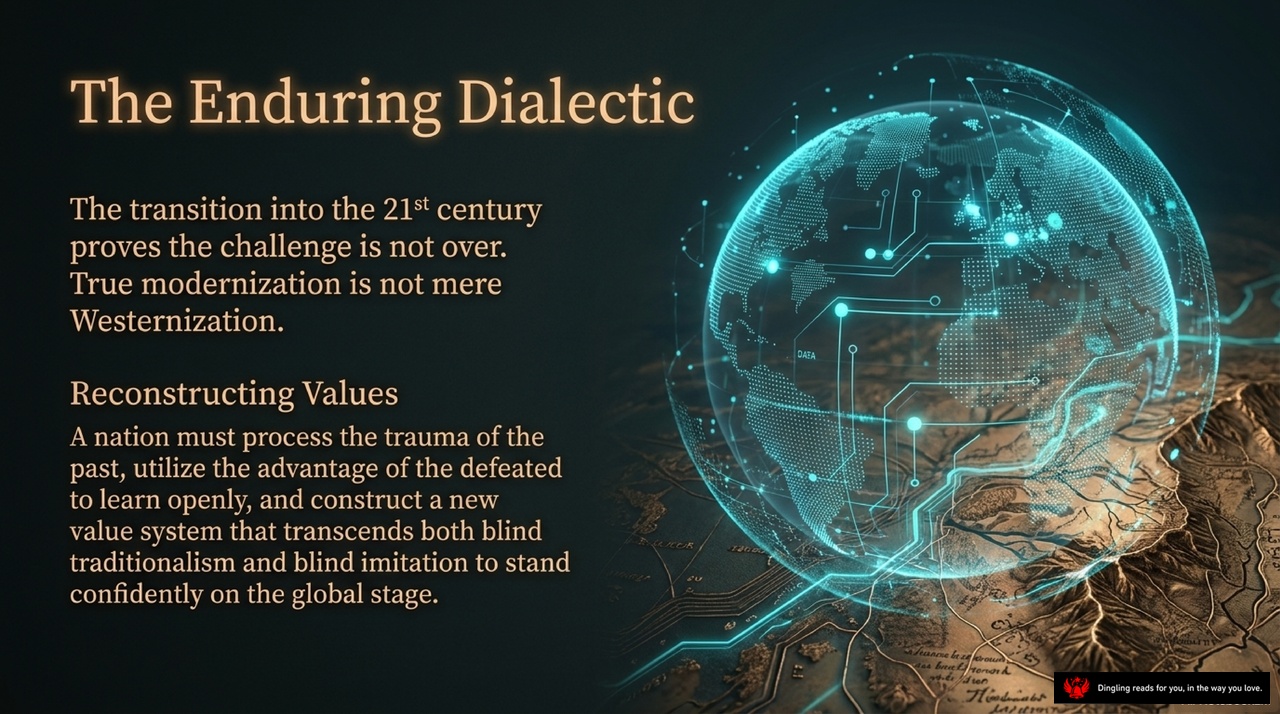
The enduring dialectic of modernization is not a linear march toward the West, but a complex, ongoing struggle to define our own identity. As we step into the 21st century, the challenge remains far from over. True modernization is never merely Westernization; it requires us to reconstruct our values with courage and clarity.
To stand confidently on the global stage, a nation must first process the trauma of its past. We cannot ignore history, nor can we blindly imitate others. Instead, we must learn openly from the experiences of those who came before us, even the defeated, turning their lessons into our strength. The goal is to build a new value system that transcends the trap of blind traditionalism on one side and mindless imitation on the other.
This image of a digital globe represents our future: a world where technology connects us, but our core values must remain uniquely ours. We must move beyond the fear of losing our culture and the stagnation of clinging to outdated norms. By integrating the best of the past with the innovations of the present, we can forge a path that is both modern and authentically our own. This is the only way to truly thrive in an interconnected world.
Civilization doesn't survive by clinging to its past or by erasing its identity to copy others. Its true survival depends on the courage to cut away what has decayed and return to its core essence to build a new future. But in today's era of accelerating globalization, we face a critical question: Are we truly synthesizing the wisdom of our heritage with the demands of modernity, or are we simply swinging between cultural amnesia and nostalgic retreat?
History shows us that the path is rarely straight. Look at Japan after the Meiji Restoration; they embraced Western science and technology, yet they also fiercely protected their own cultural soul, creating a unique blend that allowed them to rise as a global power. Contrast this with the tragic path of militarism that followed when that balance was lost, reminding us that economic strength without moral grounding is dangerous. Similarly, Russia's Peter the Great forced a complete break from tradition to modernize, only to face decades of internal struggle as the nation tried to reconcile its new Western face with its ancient soul.
For us today, the lesson is clear: we must be strong enough to critically examine our own traditions. We shouldn't blindly reject our past because it differs from the West, nor should we hide behind it when the world changes. The goal isn't to choose between "tradition" and "modernity," but to forge a new culture that keeps the best of our heritage while embracing the innovations that make us stronger. It requires the confidence to say, "This is who we are, and this is where we are going." Only by boldly navigating this transition can we avoid the traps of the past and build a future that is truly our own.