
Altitude: Complete Chapter-by-Chapter Summary
Welcome to today's session on *Altitude* by Wu Jun. This book isn't just about climbing higher; it's about mastering the structural engineering of your mindset to permanently elevate the ceiling of your success.
Imagine your mind as a building. If you don't understand the underlying principles—the load-bearing walls, the foundation—you might reach a certain height, but eventually, you'll hit a hard limit. Many people stay stuck not because they lack talent, but because they never learned how to reinforce their own mental structures.
The core idea here is simple yet powerful: true growth comes from understanding the mechanics of your thinking. When you master these internal structures, you stop reacting to the world and start shaping it. You move from being a passenger in life to the architect of your own destiny.
In a world where change is the only constant, those who understand the structural integrity of their mindset are the ones who don't just survive the storm—they build the shelter that allows everyone else to find safety. Let's dive in and explore how to engineer a mind that can reach new heights.
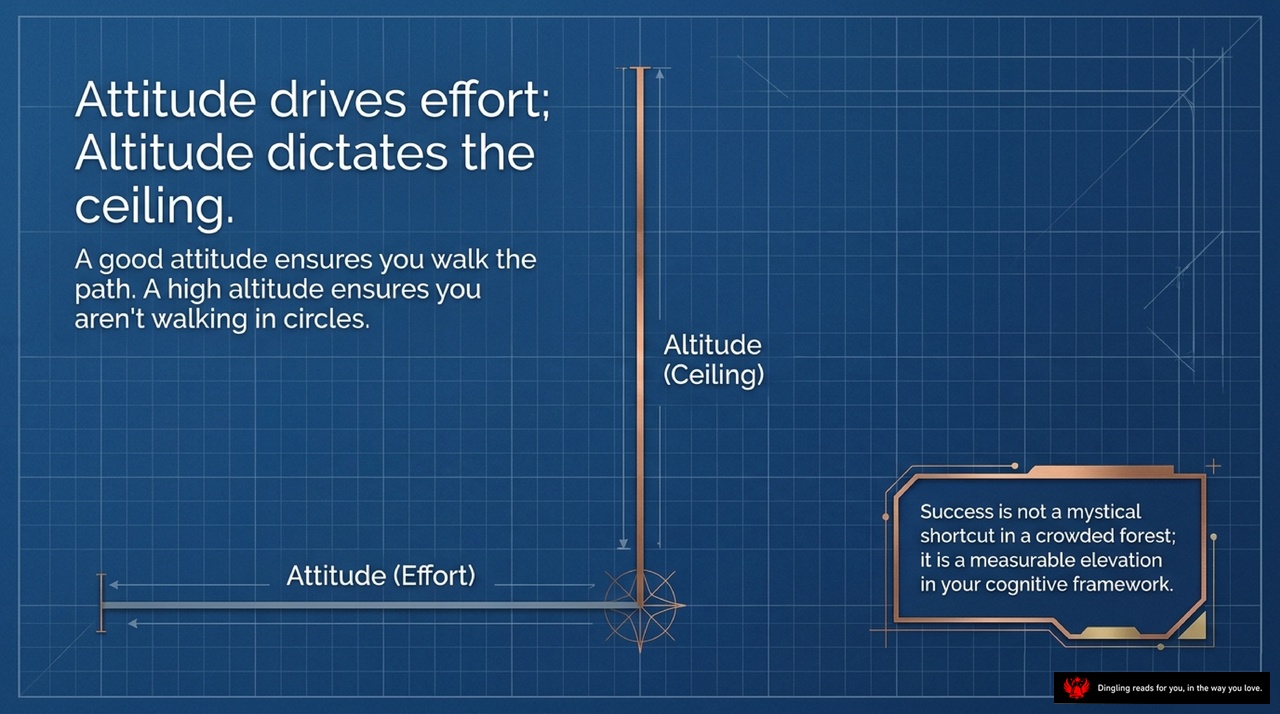
Success isn't a mystical shortcut through a crowded forest; it is a measurable elevation in your cognitive framework. This slide illustrates the critical difference between how hard you work and how high you can fly.
Look at the horizontal axis labeled "Attitude." This represents your effort. A positive attitude ensures you keep walking the path, but it doesn't guarantee you're going anywhere new. You could be working tirelessly, yet just walking in circles.
Now, look up at the vertical axis labeled "Altitude," which I've defined here as your "Ceiling." This is the true determinant of your potential. While effort drives your daily actions, your altitude dictates the ultimate limit of what you can achieve. If your altitude is low, no amount of effort will help you break through the barrier.
Think of it this way: a great attitude keeps you on the road, but high altitude ensures you aren't stuck in a valley. True success comes from elevating your thinking, expanding your perspective, and raising your standards. Don't just focus on how much you push; focus on how high you climb.

The Architecture of Altitude isn't just a fancy title; it's the blueprint for surviving in a world where change is the only constant. Imagine building a skyscraper, but instead of concrete, you're building your career and life on five critical pillars: Position, Direction, Method, Pace, and Rhythm.
First, get your bearings. Position means knowing your exact coordinates right now. Are you in an era of creation like today, or just blindly following the footsteps of a Napoleon? You need to understand your current reality before you can navigate it.
Next, lock in your Direction. Don't just look at where you are; choose a trajectory that aligns with the future. The best opportunities often hide in the blind spots that everyone else ignores. If everyone is cheering for a trend, be the one asking, "What if this crashes?" That contrarian thinking is where real value lies.
Then, refine your Method. Stop relying on luck or accidental success. Transform your actions into a highly probable, repeatable science. Whether it's investing or building a product, treat your approach like a rigorous experiment. You need a system that works, not just a lucky break.
Now, watch your Pace. The goal isn't to sprint in erratic bursts; it's about achieving continuous, stackable progress. Small, consistent wins today compound into massive results tomorrow. Avoid the trap of trying to leap over your own head.
Finally, master your Rhythm. This is about understanding the bandwidth of your human capacity. Sometimes, the smartest move is to slow down. By stepping back and managing your energy, you avoid the chain of bad luck that comes from burning out. You give yourself the mental space to see the bigger picture.
When you align these five elements—Position, Direction, Method, Pace, and Rhythm—you stop reacting to the chaos around you and start architecting your own success. You move from being a passenger in history to being the driver of your own future.

Today's slide highlights a critical concept: The Vision Gap. It contrasts two distinct approaches to investing—one with altitude, and one stuck at ground level.
On the left, we see J.P. Morgan, labeled as the High Altitude Investor. His target wasn't just a single company, but the future of energy itself—electricity. He didn't bet on one winner; he invested in the entire industry, backing visionaries like Edison, Tesla, and Marconi. His strategy was bold: invest in the whole ecosystem. His method was disciplined and ruthless; he followed strict investment norms and cut losses immediately when necessary. This "altitude" allowed him to see the big picture before the rest of the world caught on.
On the right stands Mark Twain, the Low Altitude Investor. His focus was narrow, targeting only personal hobbies like publishing. Instead of betting on an industry, he invested in isolated, struggling companies. His method was driven by emotional attachment rather than logic. Tragically, he dismissed revolutionary technology, like Bell's telephone, as mere fantasy because it didn't fit his immediate comfort zone.
The lesson here is clear. High altitude investing means betting on the future of an entire sector, ignoring the noise of the present. Low altitude investing gets trapped in the details, missing the paradigm shift entirely. To succeed, you must raise your altitude. Don't just look at what is working today; look at where the world is going tomorrow.

Imagine success not as a lottery, but as a rigorous engineering project. Today, we're looking at the blueprint for that mindset: treating your life like a scientific discipline.
Look at this diagram. It breaks down success into three distinct layers. At the very top is the ceiling—the absolute limits of physics and math. Just like Carnot's theorem limits steam engine efficiency, there are undeniable laws we cannot break. Amateurs dream of shattering this ceiling; true engineers simply respect it and work within the boundaries.
Below that is the ladder, representing your methodology. This is where the magic happens. It's not about random luck; it's about systematic processes, repeatable actions, and rigorous testing—think of the Wright Brothers using wind tunnels to validate their designs. This is the gap you bridge between where you are and where you need to be.
Finally, at the bottom, is the floor: your baseline. This is your foundational education, resources, and starting point. Professionals know they never start from the basement; they aggressively raise their baseline first. You must build a strong foundation before you can climb the ladder.
In short, success as a science means respecting the limits, mastering the methods, and constantly upgrading your foundation.

Cutting the Chain of Bad Luck. Have you ever seen a small mistake spiral into a disaster? This slide illustrates exactly that phenomenon using a story about a man named Nicholas Bourricher. It all started with a simple, harmless action: opening a hotel window to dry a sausage. But once the seagulls invaded, the situation spiraled out of control. He fought them with a towel, dropped his shoe, and then tried to wash it with a hairdryer, which accidentally blew out the hotel's power. This is what we call "The Cascade"—minor errors compound into catastrophes when panic overrides logic.
The solution is simple but powerful: The 5-Second Stop-Loss. When you hit a bad shot in golf, or face a minor setback in life, admit it immediately. Accept the initial loss, like a ruined sausage, rather than trying to amplify the disaster. Don't let one mistake destroy your form or your entire day. By cutting the chain early, you prevent a small annoyance from becoming an unfixable nightmare.

Let's talk about the "Multitasking Myth." Look at this funnel on the slide. It represents our brain's actual processing bandwidth, which is shockingly low—only about 60 bits per second. That's roughly one-hundred-thousandth of an old internet connection. This data reveals the hard truth: what we call multitasking is actually just rapid, error-prone task-switching. Your brain can't truly handle two things at once; it's just frantically jumping between them, creating friction and mistakes.
So, what's the solution? The slide suggests a simple but powerful strategy: slow down by three beats. When you decelerate, you eliminate the cognitive friction of switching tasks. This allows your limited bandwidth to focus on one thing deeply, leading to continuous, stackable progress. Instead of chasing the illusion of doing everything at once, embrace the power of doing one thing perfectly. By slowing down, you actually move faster toward real results.

The Altitude Equation isn't just a catchy title; it's a brutal truth about how real success is calculated. As the slide illustrates, Achievement is the product of three critical factors: Success Rate, Impact, and Speed. But here's the kicker—notice the multipliers. If any single one of these hits zero, your total achievement instantly collapses to zero.
Let's break this down. First, Success Rate: Are you relying on random luck, or do you have an engineered, repeatable process? Without a reliable system, your wins are just flukes. Second, Impact: Is the task you're tackling a mere sesame seed, or is it a watermelon that moves the needle? High volume of low-impact work yields nothing. Third, Speed: How efficiently can you execute without breaking your rhythm?
The math is unforgiving. You can be incredibly fast and have a great process, but if your impact is nil, you achieve nothing. Conversely, a massive impact with zero speed or no repeatable process is equally useless. This framework forces us to stop doing busy work and start focusing on the levers that actually drive results. It's about balancing reliability, significance, and efficiency in every single thing you do.
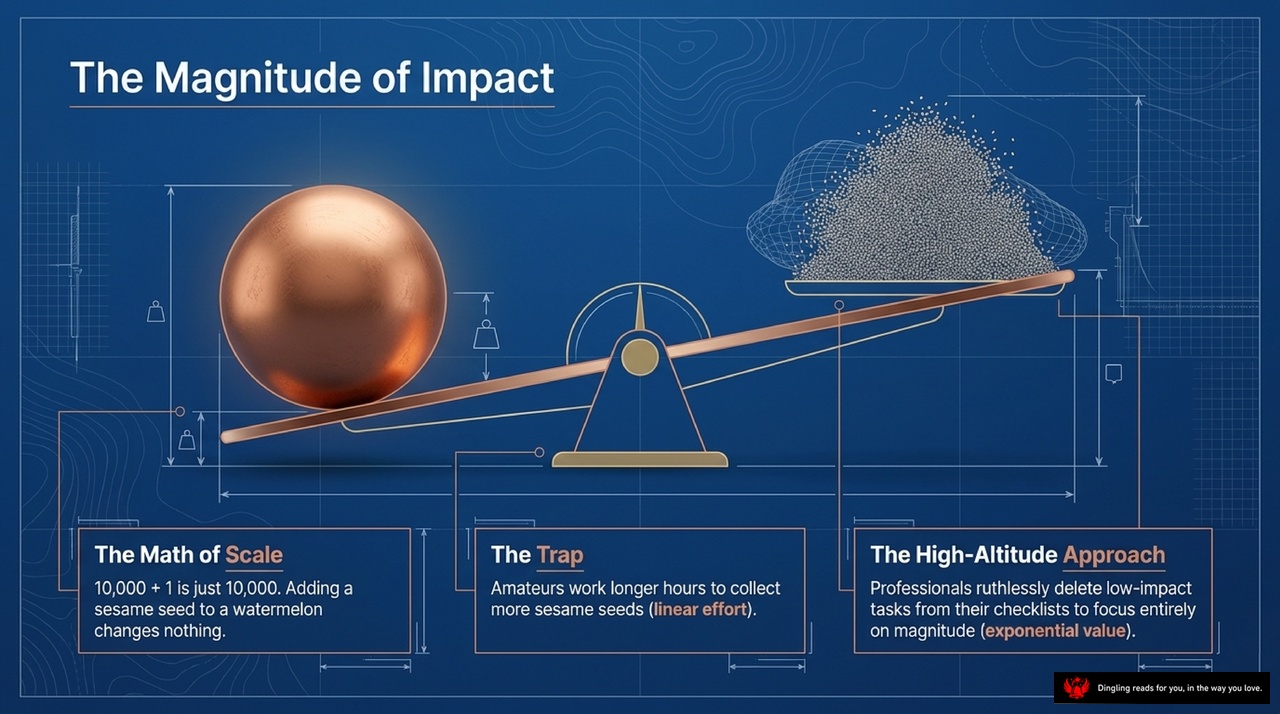
Look at this seesaw. On one side, we have a single, heavy copper ball. On the other, a massive pile of tiny sesame seeds. Even though there are millions of seeds, the single ball tips the scale. This visual perfectly illustrates the "Magnitude of Impact."
The slide breaks this down into three key insights. First, it's "The Math of Scale." Adding one sesame seed to a watermelon changes nothing. In business and life, simply adding more low-value tasks doesn't create breakthroughs. 10,000 plus one is just 10,000.
Second, we face "The Trap." Many people, often unknowingly, work longer hours just to collect more sesame seeds. They chase linear effort, believing that time equals results. But this is a trap. It leads to burnout without real progress.
The solution lies in "The High-Altitude Approach." True professionals don't just add more work; they ruthlessly delete low-impact tasks. They focus entirely on magnitude—on those few high-leverage actions that create exponential value. Instead of trying to be busy, be impactful. Choose the heavy ball over the pile of seeds.
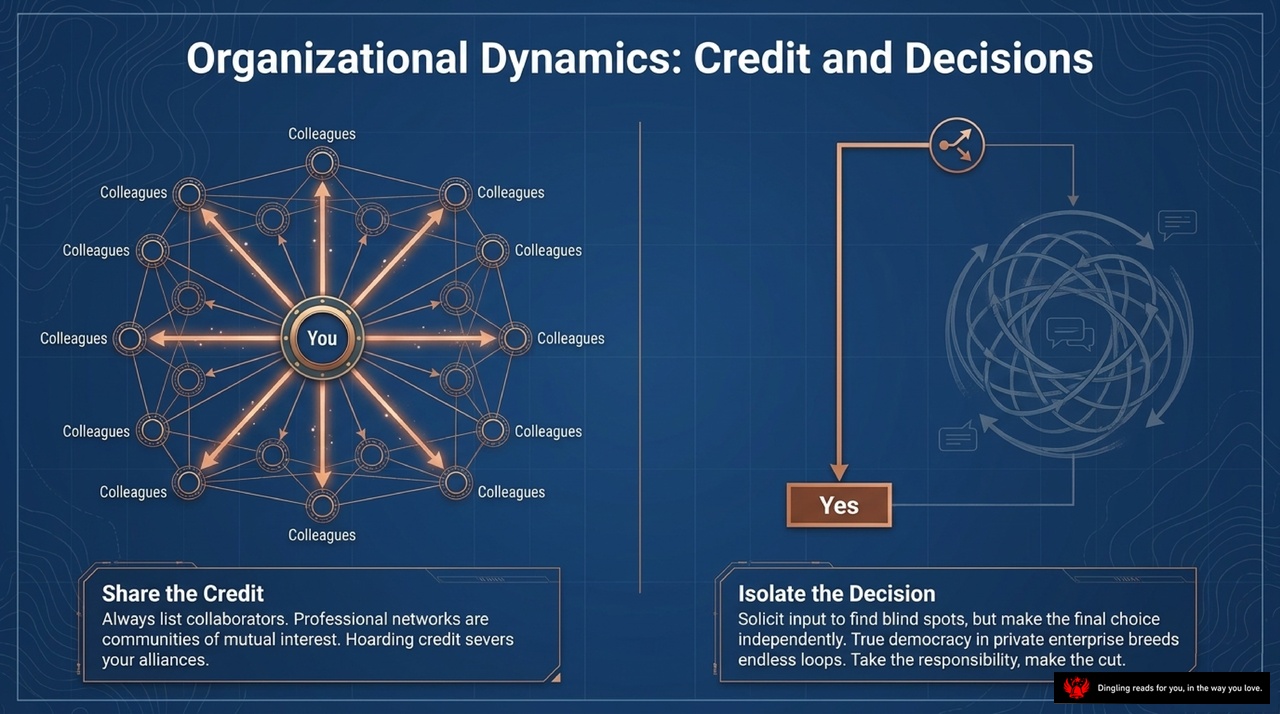
In today's fast-paced organizations, how you handle credit and make decisions can define your career trajectory. This slide breaks down two critical dynamics: sharing credit and isolating decisions.
On the left, we see a network radiating from "You" to your colleagues. The core principle here is "Share the Credit." In a professional ecosystem, your network is built on mutual interest. Always list your collaborators. When you hoard credit, you sever the alliances that could have helped you later. True success isn't about being the sole hero; it's about building a community where everyone feels valued for their contribution.
On the right, the focus shifts to "Isolate the Decision." While you should actively solicit input from others to find blind spots and avoid groupthink, the final choice must be yours alone. True democracy in a private enterprise can lead to endless loops if everyone votes on every detail. You need to take the responsibility and make the cut. By separating the collaborative brainstorming from the decisive action, you empower yourself to move forward efficiently without getting paralyzed by consensus.
Ultimately, great leaders listen to everyone but act alone. This balance between inclusive credit and decisive action is the key to driving real organizational momentum.

Communication Bandwidth, or Shannon's Theorem, is a powerful metaphor for how we connect with others. As the slide illustrates, if a sender transmits high-frequency information exceeding the receiver's capacity, the result is total noise—100% error rate. Just like a fast teacher speaking to a slow class, the knowledge transfer becomes zero. The law is clear: information speed cannot exceed the channel's inherent bandwidth.
So, what's the tactic? Adjust your transmission speed to match the receiver's capacity. Face-to-face communication remains the highest-bandwidth channel for establishing trust because it allows for real-time feedback and emotional nuance. Don't just shout louder; slow down and simplify until your message lands. In a world full of noise, the most effective communicator isn't the one who speaks fastest, but the one who ensures their message is actually received.

Look at this curve on the slide. It perfectly visualizes a harsh but essential truth about the information age: Ricardo's Law of Rent. Originally, David Ricardo used this to describe how the value of land spikes when it becomes scarce. Today, that same logic applies strictly to human talent.
The graph shows a dramatic divide. On the left, we have the "90% Average." In a hyper-connected world where information flows freely, average work gets heavily penalized. The market simply doesn't pay for sub-basement performance anymore. But look at the right side—the "10% Premium." This is where the magic happens. Being just slightly better than the average doesn't just give you a small edge; it triggers an exponential, winner-takes-all premium.
The reality is that the world no longer rewards mediocrity. If you are average, you are invisible. But if you can find a way to be that top 10%, you unlock a level of value that compounds rapidly. This isn't about being the smartest person in the room; it's about realizing that in an era of abundant information, your unique value and skill level are the only things that truly matter. To succeed, you must stop competing on volume and start competing on the quality of your contribution.
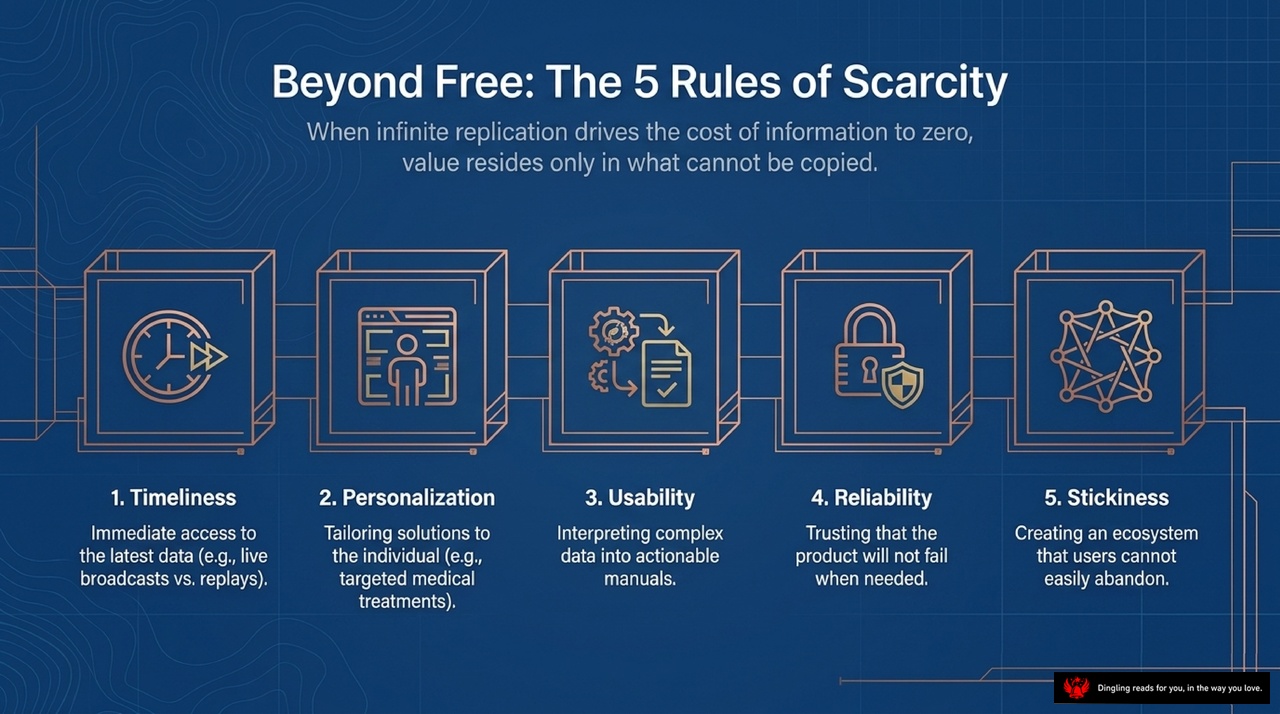
When infinite replication drives the cost of information to zero, value no longer lives in the content itself, but in what simply cannot be copied. This is the core of the "Beyond Free" concept.
To survive in this new economy, we must master five rules of scarcity. First is Timeliness. In a world of endless replays, immediate access to live data is the ultimate premium. Second is Personalization. Generic solutions are free; tailoring a solution to an individual, like a targeted medical treatment, is priceless. Third is Usability. We don't pay for raw data; we pay for complex data interpreted into actionable manuals that we can actually use. Fourth is Reliability. In an era of uncertainty, trusting that a product will not fail when you absolutely need it is the highest form of value. Finally, there is Stickiness. The most valuable companies create ecosystems so deeply integrated that users cannot easily abandon them.
These five rules—Timeliness, Personalization, Usability, Reliability, and Stickiness—are the only barriers that remain when everything else becomes free. If you want to thrive, stop trying to compete on price and start competing on these five non-replicable dimensions.

The Five Lifelong Pursuits aren't just abstract concepts; they are the architectural blueprint for a life that matters. Imagine your life as a pentagon, where every corner represents a vital pursuit that, if neglected, weakens the entire structure.
At the top sits **Love**. This isn't about superficial attention; it's about forging deep, meaningful connections that ground you when the world feels chaotic. Without love, the other pursuits lose their human context.
Moving to the right, we find **Hobbies**. These are pursuits that elevate your spirit beyond a purely transactional existence. They remind you that you are more than just a worker or a consumer; they are the playground where your soul gets to breathe and explore.
Below that is **Giving Back**. This is the act of acknowledging your luck and elevating others. It transforms your success from a solitary achievement into a shared benefit, creating a ripple effect that improves your community.
On the bottom left stands **Belief**. When logic and data fall short, you need a moral or philosophical anchor. This is your inner compass, guiding you through ethical dilemmas and giving your actions a deeper purpose beyond mere efficiency.
Finally, on the left, is **Legacy**. This is about building something that outlasts your physical presence—ensuring the world is different because you were here. It could be a child, a piece of art, or a system you built.
Notice how these five points connect to the center? That central hub represents the integration of all these pursuits. If you focus on only one, say, just building a legacy without love or belief, the structure collapses. True fulfillment comes from balancing all five, creating a life that is not only successful but also rich, connected, and enduring.

True altitude isn't about frantic, directionless acceleration. It's about calculating your exact coordinates, multiplying your high-magnitude impact, and executing your life with the precision of an engineer. As the world accelerates into an era of infinite noise, the critical question is: will you remain a slave to the pace of the machine, or will you become the architect of your own altitude? In a landscape defined by endless data and rapid shifts, the winners aren't those who run the fastest, but those who know exactly where they are going and have the discipline to get there. Don't just chase the noise; calculate your path, focus on what truly moves the needle, and build a career that stands tall regardless of the chaos around you.