
An Essay on the Principle of Population: Complete Chapter-by-Chapter Summary

Welcome to the beginning of one of the most provocative ideas in human history. Today, we're diving into Thomas Robert Malthus's masterpiece, *An Essay on the Principle of Population*.
Look at the image on your screen: on the left, a dense crowd of people, and on the right, vast fields of wheat stretching into the distance. This visual perfectly captures the central tension Malthus exposed. He argued that human progress is defined by an inescapable mathematical conflict between two forces: the explosive drive of reproduction and the slow, steady growth of food production.
Malthus established two undeniable truths. First, food is essential for survival. Second, the desire for reproduction is a constant part of human nature. When you combine these, a crisis emerges. If left unchecked, populations grow geometrically—doubling, then quadrupling. But food supply can only grow arithmetically, adding a fixed amount each year. Eventually, the number of mouths simply outstrips the amount of bread.
This book is the foundational treatise that shattered the dream of a perfect society. Malthus proved that no matter how much we try to adjust social systems or redistribute land, we cannot eliminate this pressure. The result? A natural check on population through poverty and vice, ensuring that humanity never reaches a state of effortless perfection. This is the harsh reality that redefined our understanding of human progress.

Imagine human history as a grand, ancient archway, built on two unshakeable pillars that have held firm since the very beginning of our knowledge. These are the two unalterable axioms of our existence. The first pillar is simple yet absolute: food is the necessary condition for human life. Without it, we do not exist. The second pillar is equally fundamental: the passion between the sexes is a constant force, remaining nearly unchanged throughout time.
These laws of nature are fixed. We have no right to assume they will ever change. But here lies the critical tension that shapes our world. While our desire to reproduce remains constant, the ability of the earth to produce food grows at a much slower rate. If left unchecked, population would grow geometrically, doubling with every generation, while food production only increases arithmetically, adding a fixed amount each time. This imbalance means that without some form of restraint, the population would inevitably outstrip the available resources.
Nature has a way of enforcing balance, and it does so through the harsh realities of poverty and vice. Whether it's through delayed marriages, the struggle to survive, or the tragic consequences of overpopulation, these pressures act as a brake on human growth. This is why, despite our dreams of a perfect society where everyone lives in abundance, the historical record shows that the lower classes have always been the ones bearing the brunt of this natural law. The gap between the limitless drive to multiply and the limited capacity of the land to feed us is what has driven the cycles of hardship and survival that have defined human history.

Imagine a pair of scissors slowly closing, trapping the future of humanity between two unstoppable forces. This graphic, titled "The Malthusian Scissors," perfectly captures the terrifying logic at the heart of our survival. On one side, we have geometric growth, represented by the steep, black curve labeled "Reproduction." This is the power of human nature: as long as there is food and a desire to procreate, the population doubles with predictable, explosive speed. On the other side, we have arithmetic growth, the gentle, gray line labeled "Agriculture." This represents our ability to produce food, which can only increase by a fixed amount each year. No matter how much we innovate or improve our farming, nature simply cannot keep up with the exponential surge of new mouths to feed.
The red area between these two lines is the "Point of Crisis." It is the inevitable gap that widens over time. As the text explains, "The power of population is indefinitely greater than the power in the earth to produce subsistence for man." If we let this imbalance play out, the result is not a utopia, but a crushing reality. The sheer force of population growth will eventually outstrip the earth's capacity to provide, forcing a brutal correction. This is why the text insists that "the effects of these two unequal powers must be kept equal." Nature has a strict rule: if population grows too fast, it must be checked by poverty, famine, disease, or war.
Many thinkers, including William Godwin, have dreamed of a perfect society where love and reason replace scarcity, believing that better institutions could feed everyone. But this graph shows why that dream is fragile. Even in a paradise, if the population doubles every few decades while food production only grows by a fixed amount, the system will collapse within a generation. The "Great Imbalance" isn't a failure of politics; it's a fundamental law of biology. The only way to maintain balance is to ensure that the number of people matches the amount of food available. If we ignore this limit, the "scissors" will close, and the consequences will be dire. This is the sobering truth that underpins all discussions of human progress.

Imagine a giant industrial machine, driven by the relentless pressure of "Excess Population," grinding toward three inevitable outcomes. As the diagram illustrates, nature has no off switch for human reproduction, so when population outpaces our food supply, the system forces a correction through misery, vice, or moral restraint.
First, we see the red pipe labeled "Misery." This is the harsh reality of famine, plague, and malnutrition. History proves that when resources can't keep up with growth, nature responds with suffering to balance the scales.
Second, there's the dark output of "Vice." When survival is at stake, the pressure breeds corruption, war, and murder. These aren't just random tragedies; they are the system's way of culling the population when resources are too scarce.
Finally, we have the white pipe labeled "Moral Restraint." This is the rational choice humans make when they see the future is bleak. People delay marriage, practice celibacy, or exercise foresight to avoid the poverty that would otherwise crush them.
The core message is simple and unavoidable: without these three mechanisms—suffering, sin, or self-control—humanity would simply consume itself. There is no escape from this natural law.
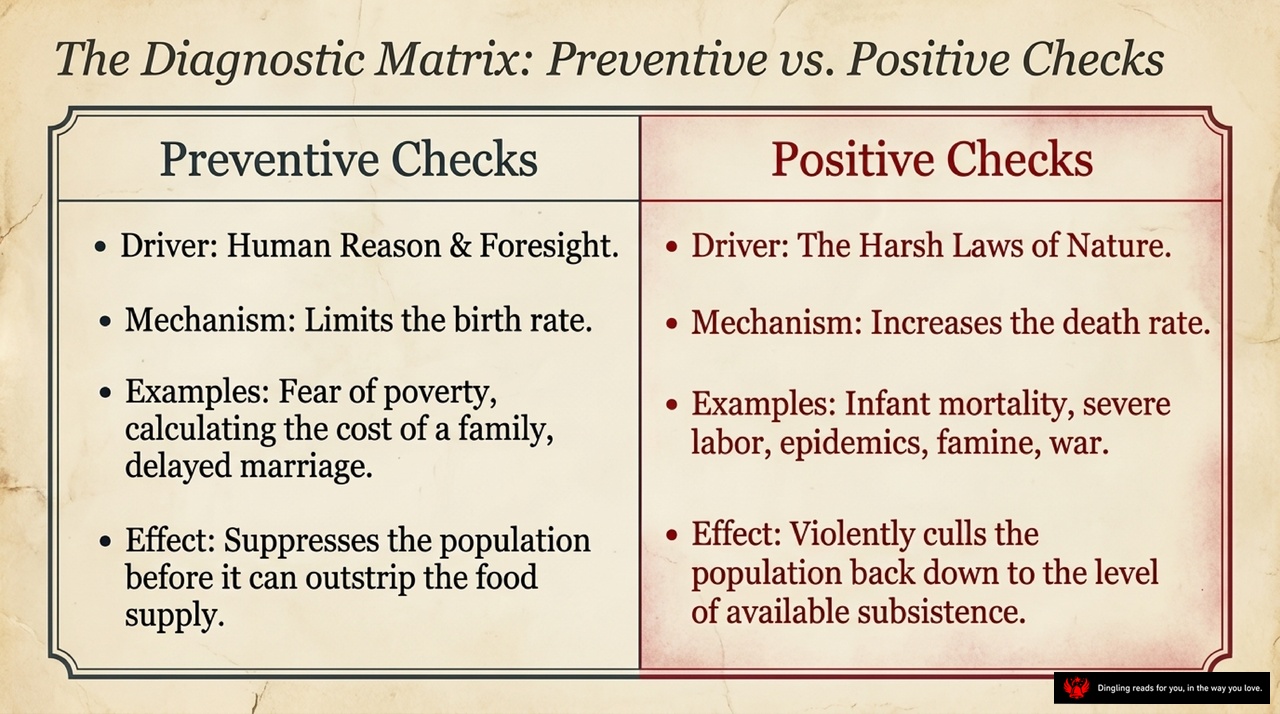
The Diagnostic Matrix: Preventive vs. Positive Checks. Let's break down how nature keeps our population in check. On the left, we have Preventive Checks, driven by human reason and foresight. This is the rational side of us. It works by limiting the birth rate. Think about it: the fear of poverty, calculating the real cost of raising a family, or simply deciding to delay marriage until you're stable. These are choices we make to suppress population growth before it outstrips our food supply. It's a proactive, human-driven solution.
Now, look at the right side: Positive Checks. Here, the driver is the harsh laws of nature, not our choices. The mechanism here is the opposite—it increases the death rate. When preventive checks fail and people keep having children, nature steps in with brutal reality. Examples include infant mortality, the physical toll of severe labor, epidemics, famine, and war. The effect is violent; it culls the population back down to the level of available subsistence. So, while we try to control growth through logic and planning, history shows that when we push too hard, nature often corrects the balance through suffering and loss.

Imagine society as a giant, invisible pendulum swinging between prosperity and stagnation. This cycle, often called "The Hidden Pendulum," is driven by a fundamental imbalance between how fast humans reproduce and how fast food can be produced.
The cycle begins when food is plentiful. This abundance allows the population to accelerate rapidly. As more people are born, the labor supply swells, driving wages down and causing food prices to rise. Suddenly, poverty sets in. With economic hardship and marriage becoming too expensive, birth rates halt. The population stabilizes or even shrinks.
But nature finds a way to reset the balance. As the population drops, the remaining workers become more valuable, and wages rise again. This encourages agricultural expansion, leading to abundant, cheap labor and a recovery in the food supply. With plenty of food once more, the cycle restarts, pushing society back into a boom.
This rhythm creates a perpetual oscillation. The laboring classes are caught in this swing, moving between relative comfort and severe distress. While history often focuses on the elite, this pendulum dictates the lives of everyone else. Ultimately, the struggle to balance our endless reproductive drive with the finite capacity of the land is the engine that drives the rise and fall of civilizations.

Look at this split screen: on the left, we have "The Dream" championed by thinkers like Godwin and Condorcet. It assumes infinite human perfectibility and a society free from anxiety. On the right stands "The Reality," represented by Malthus, who argues that biological laws would mathematically destroy any utopia within a single generation.
This isn't just about math; it's a clash of worldviews. The utopians believed poverty was caused by flawed human institutions and that a perfect society was possible if we just removed those barriers. They dreamed of a world where human passions eventually vanished, leaving only reason and equality. But Malthus saw something colder and more inevitable: the laws of nature. He pointed out that while food production grows arithmetically—slowly and steadily—population grows geometrically, doubling over time. No matter how perfect our institutions become, this biological imbalance ensures that poverty will always be the ultimate regulator.
In this vision, the dream of a painless, perfect future is an illusion. Malthus reminds us that even in a perfect, equal utopia, the sheer force of human reproduction would outstrip our food supply, leading to suffering that no amount of social reform could prevent. It's a stark reminder that our biological nature, not just our political choices, dictates our fate.

Imagine a society where wealth is perfectly shared, and no one fears poverty. Sounds like the ultimate utopia, right? But what happens when we remove the fear of starvation? Without that "preventive check," everyone starts marrying early, just to have children. Suddenly, the population explodes—doubling every 15 to 25 years.
Here's the problem: while people multiply geometrically, food production can only grow arithmetically. It simply can't keep up. In Step 4, agricultural output fails to match this massive population boom. And that leads to Step 5: what was once shared abundance instantly degenerates into shared starvation.
This is the Equality Paradox, or as we call it, the Tragedy of the Commons. The conclusion is stark and unavoidable: to survive the inevitable famine, society is forced to reinvent private property and self-interest. These aren't just moral choices; they are the only rational mechanisms we have to ration finite resources and keep the population in check. Without them, equality leads not to peace, but to chaos and mass starvation.

Look at this scale. On one side, we have a fixed supply of food—wheat and grain that the land can only produce so much of. On the other, we pile up money. The slide calls this "The Paradox of Poor Laws," and it highlights a brutal economic truth: if you give more money to the poor without actually increasing the total amount of food available, you don't eliminate poverty. Instead, you dilute the value of everyone's share.
Here is the mechanism at work. When you inject extra currency into a system with a fixed food supply, the result is price inflation. The laborer who previously survived independently suddenly finds that the price of bread has skyrocketed, while their wages haven't kept up. They can no longer afford the food they once could. This is exactly what artificial charity does. By removing the preventive check of foresight and reducing the purchasing power of the working class, it creates the very poverty it claims to solve. It trades the dignity of self-reliance for a cycle of dependency and rising costs, ultimately sustaining the poor by making them poorer.
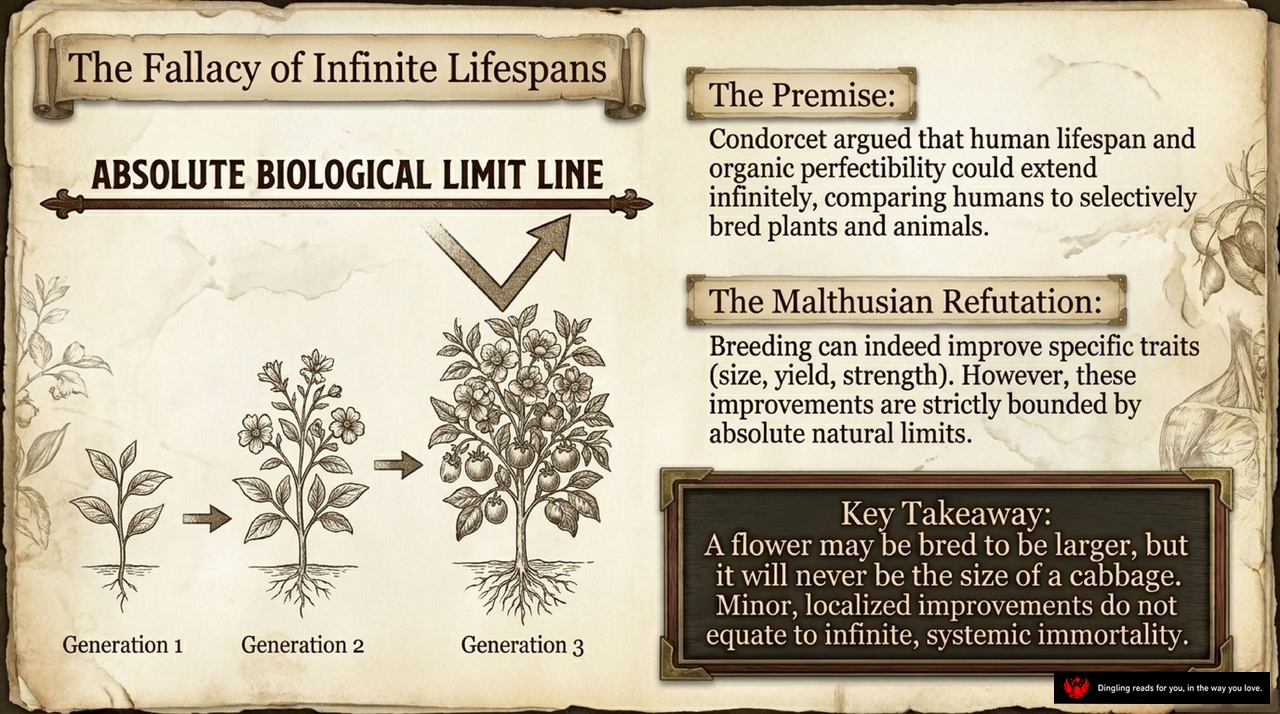
The Fallacy of Infinite Lifespans
Let's look at this slide, which challenges a very common and optimistic idea: the belief that human life could eventually become infinite. The premise here is rooted in the arguments of Condorcet, who believed that just like we can selectively breed plants and animals to make them bigger, stronger, or more productive, human biology could be improved without limit. He thought our lifespan could extend forever.
But the image on the left tells a different story. It shows an "Absolute Biological Limit Line." Think of it like a ceiling. The graphic illustrates this perfectly by showing a plant evolving from Generation 1 to Generation 3. Yes, through breeding, that flower can get larger and produce more fruit. But there is a hard stop. No matter how much you improve it, that flower will never grow to be the size of a cabbage. Its biology simply cannot support that volume.
This is the core of the Malthusian Refutation presented on the right. While breeding can indeed improve specific traits like size or yield, these improvements are strictly bounded by absolute natural limits. Minor, localized improvements do not equate to infinite, systemic immortality. Just because we can make a flower bigger doesn't mean we can turn it into a tree, or make a human live forever. There are fundamental biological constraints that no amount of progress can break. So, while we can make life better and longer, the idea of an infinite lifespan is a fallacy. We are bound by the same biological rules that keep a flower from becoming a cabbage.

Imagine a world where the only thing holding humanity back from perfection isn't bad laws or cruel leaders, but something far more ancient and unavoidable: the math of survival. This slide, titled "The Naturalist's View of Human History," maps out a brutal but logical timeline of why human society has never truly reached a utopian state.
Look at the left side, labeled "Nomadic Antiquity." Here, history isn't driven by great empires, but by a simple squeeze: depleted pastures and population pressure. When the land couldn't feed everyone, Scythian and Northern barbarian tribes were forced southward. They didn't conquer out of ambition; they moved out of desperation, crushing the Roman Empire simply because they needed subsistence. It was nature's way of balancing the books when the ledger went into the red.
Fast forward to the right side, "The Americas." Even with vast, open lands, Native populations were kept in check by what we call "positive checks." These were the harsh realities of misery, high infant mortality, and constant tribal warfare over resources. Despite having the space, nature ensured the population didn't outgrow the food supply through these painful mechanisms.
Finally, look at the bottom center: "Modern Europe." Here, the story changes slightly. As agriculture improved, the old "positive checks" like plague and famine began to recede. But nature found a new, subtler tool: the "preventive check." This is the delay of marriage driven by economic foresight. People simply waited to marry until they could afford a family. In modern times, poverty and the fear of poverty became the primary balancers, stopping population growth before it could overwhelm the food supply.
The core message here is undeniable: whether through war, famine, delayed marriage, or social collapse, humanity has always been governed by a single, unbreakable law. Population growth always outpaces food production, and nature ensures they eventually balance out. No amount of political reform or philosophical idealism can change this fundamental reality. As long as we are bound by the laws of nature, the struggle for subsistence will always be the engine of our history.

Malthus's worldview is often misunderstood as a doctrine of despair, but it is actually a profound theological framework. The harsh mathematical reality of population pressure isn't a design flaw in the universe; rather, it is a deliberate, divine mechanism.
Consider this: human nature is built on two unchangeable laws. First, food is essential for survival. Second, the drive for reproduction is constant and universal. When these two forces collide, the result is inevitable tension. While human population can grow geometrically—doubling with each generation—our ability to produce food only grows arithmetically, adding a fixed amount each time. Eventually, the gap between the two becomes unbridgeable.
This isn't just a crisis of resources; it's a spiritual test. Malthus argues that this struggle is the very engine of human progress. Without the pressure of scarcity, without the fear of poverty, humanity would never develop the resilience, reason, and moral character necessary to evolve. The Creator didn't make the world this way to punish us, but to stimulate our growth. It is through navigating these constraints that we transform from mere biological beings into conscious, spiritual beings. So, when we look at the "Philosophical Synthesis," we see not a grim prediction of doom, but a purposeful design for our ultimate perfection.
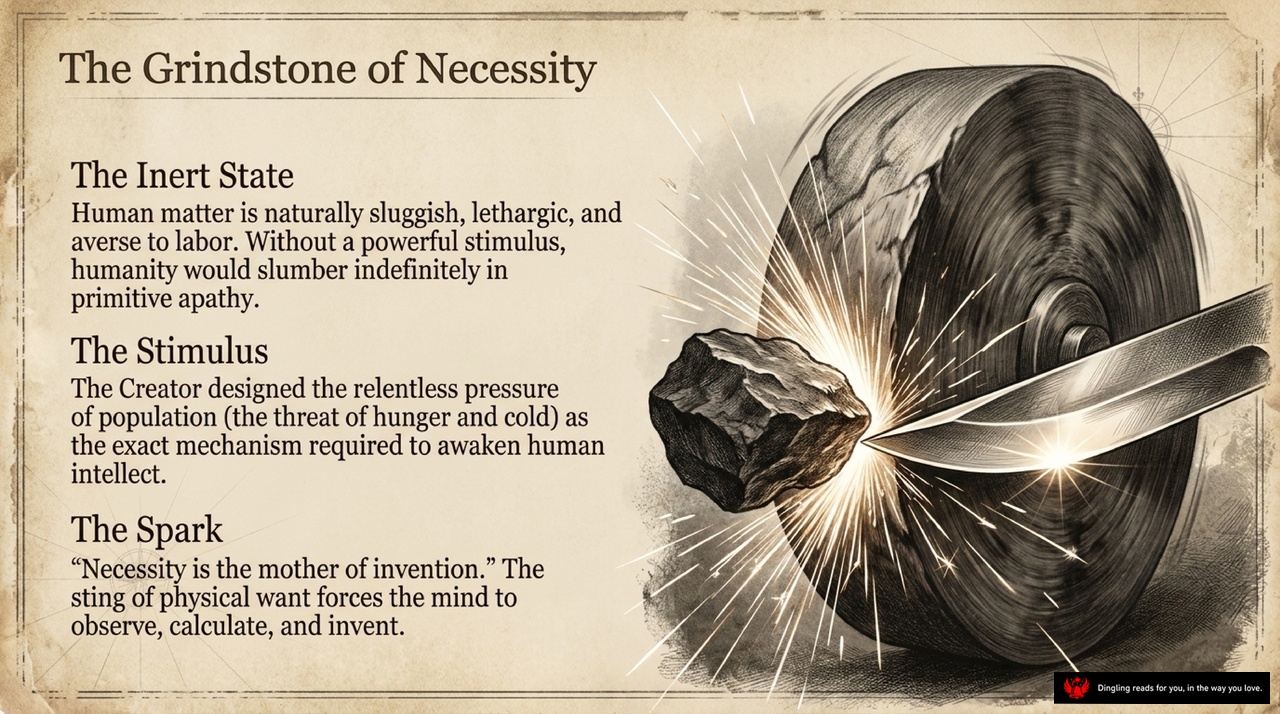
Imagine a world where humanity is naturally lazy, sluggish, and deeply averse to hard work. Without a powerful force to shake us from our slumber, we would remain forever trapped in a state of primitive apathy, content to do nothing. This is what Thomas Malthus calls "The Inert State." But how did we ever break free from this paralysis? The answer lies in "The Grindstone of Necessity."
The Creator, as Malthus argues, designed a relentless pressure system specifically to wake us up. He utilized the threat of hunger and cold, driven by unchecked population growth, as the exact mechanism required to awaken human intellect. When our natural desire for reproduction outpaces the land's ability to produce food, a crisis ensues. This scarcity forces the mind to stop wandering and start observing, calculating, and inventing.
This is the moment of "The Spark." As the slide beautifully illustrates, necessity is the mother of invention. The sting of physical want compels us to solve problems, build tools, and develop agriculture. It is the friction against the grindstone of reality that polishes our minds into the brilliant engines of progress we see today. Without the struggle against poverty and scarcity, our greatest inventions might never have been conceived.

Look at this grand architectural metaphor. At the very foundation, we see "The Pressure of Population," born from scarcity and hardship. This isn't just a burden; it's the bedrock upon which human civilization is built. Rising from this rocky base are three powerful pillars that define our progress: Agriculture and Industry, Science and Invention, and Morality.
Think about the first pillar. The urgent need to feed families forces humanity to cultivate the earth. This struggle for survival drives the invention of tools, the development of farming, and eventually, the industrial revolution. It's the engine that pushes us forward.
Next, we see Science and Invention. Scarcity drives technological breakthroughs. When resources are tight, human ingenuity kicks into high gear, leading to innovations that expand our capacity to produce food and goods.
Finally, look at the third pillar: Morality. The fear of poverty refines human behavior. It teaches us foresight, delayed gratification, and profound social responsibility. We learn to plan for the future and care for our community because the alternative is chaos.
The central idea here is profound: evil and hardship exist not to induce despair, but to stimulate activity. The struggle for survival is the very engine of human progress. Without these pressures, we might never have built the civilization we see today.

Look at this scale in the center of the slide. It represents the core tension that defines our entire history: the relentless balancing act between our infinite desires and the finite reality of the earth. As the text reminds us, human progress isn't driven by utopian dreams, but by the unyielding mathematics of scarcity. We are constantly pushed forward by the pressure of necessity, trying to balance what we want against what the planet can actually provide.
But here lies the profound question we must confront. If our greatest intellectual leaps and moral advancements were forged only in the fires of struggle and scarcity, what happens to humanity if we ever truly conquer those hardships? The slide challenges us to consider a terrifying possibility: if we eliminate poverty and struggle, will we also lose the very forces that drive us to grow? Without the friction of limitation, without the fear of hunger, will our creativity and our empathy wither? This isn't just about economics; it's about the very nature of the human spirit. Are we built to thrive in comfort, or do we need the struggle to become fully human?