
Animal Spirits: Complete Chapter-by-Chapter Summary

Welcome to our deep dive into *Animal Spirits* by George A. Akerlof and Robert J. Shiller. Today, we're exploring the hidden engine behind the global economy: not cold, hard data, but the hot, messy power of human psychology.
As the title suggests, "Animal Spirits" are the waves of confidence, fear, and intuition that drive our financial world. Traditional economics often assumes we are rational calculators, always making the perfect choice based on facts. But reality is far more chaotic. Think about it: when you invest your life savings, do you run the numbers like a computer, or do you follow your gut feeling? That gut feeling—what Keynes called "animal spirits"—is the real driver of economic booms and busts.
The book opens with a powerful story about a relative who bought a house in Norway for over a million dollars, seemingly just a normal transaction, but later revealed to be part of a massive global real estate bubble. This illustrates a core truth: economic cycles aren't just about supply and demand; they are about trust and belief. Confidence and credit come from the same Latin root, meaning "I believe." When that belief is strong, people buy and invest, creating a boom. When it evaporates, panic sets in, and the economy crashes.
We see this everywhere in history. Even the famously cautious Dutch fell for the Tulip Mania, and Isaac Newton, the great scientist, lost fortunes betting on the South Sea Bubble. These aren't just historical footnotes; they prove that human psychology is the heartbeat of capitalism. The authors argue that we need to replace old economic models with a new understanding that includes these emotional forces, fairness, and the stories we tell ourselves about the future. Because in the end, the economy isn't just a machine; it's a reflection of us.

Have you ever looked at a perfectly balanced scale and assumed it represents how the economy actually works? Classical economics tells us to think exactly that way. It paints a picture of the market as a flawless, rational machine where humans are like cold calculators, flawlessly weighing every option to maximize their wealth. This is what we call "The Rational Illusion." It's a beautiful, neat idea that suggests if everyone just plays by the rules, the economy will always stay stable.
But look at the other side of this slide. That jagged, chaotic line isn't just noise; it's the brutal reality of crashes. History doesn't respect our neat little models. From the Tulip Mania that even the famously cautious Dutch fell for, to Newton losing fortunes in the South Sea Bubble, human beings have repeatedly ignored "rational" advice. Why? Because behind every balance scale, there's a "ghost in the machine"—our emotions, our fears, and our irrational animal spirits.
Traditional models fail spectacularly during downturns because they completely ignore this psychological factor. They assume we act on data, but in reality, we act on confidence. When confidence is high, we spend and invest freely; when it vanishes, the entire system freezes. The crash isn't a mathematical error; it's a failure of faith. The blind spot of classical economics isn't a lack of data; it's a refusal to admit that we are not machines, but feeling, feeling beings who drive the engine of the global economy with our very minds.

The missing link that drives the market is often invisible, yet it dictates the rhythm of our entire economy. Look at this image: on the left, we see the human brain, and on the right, the industrial engine of the market. The bridge connecting them isn't logic or math, but something far more primal.
In 1936, John Maynard Keynes identified this missing engine as "Animal Spirits." He realized that when economic uncertainty is high—like when we don't know what the future holds—mathematical calculations of probability simply fail. You can't predict the future with a formula. Instead, decisions are driven by non-economic, irrational motives. Human psychology becomes the primary force moving capital, labor, and markets.
This is the essence of the "Engine of Uncertainty" shown on the right. When the fog of uncertainty lifts, we act on instinct. But when that fog thickens, we rely on "Animal Spirits"—that spontaneous, fundamental urge to action rather than inaction. It's the difference between a CEO who invests because they *feel* the market is ready, versus one who freezes because the data is unclear.
History proves that these irrational surges are the true drivers of economic booms and busts. While traditional models try to calculate everything, the real world runs on confidence, fairness, and stories. Without understanding this missing link between our minds and the market, we can never truly grasp why economies rise and fall.

So, let's cut through the noise and look at how we actually think versus how the old textbooks say we should think. The slide on your screen contrasts two very different ways of seeing the economy: the Classical Model and the Behavioral Model.
In the Classical view, everything is cold and logical. It assumes we are purely rational actors who sit down and calculate the maximum economic utility. It believes the market has an inherent stability, thanks to this "Invisible Hand" that naturally clears everything and ensures full employment. Because the market polices itself, the government's role is minimal—just a laissez-faire approach.
But the Behavioral Model tells a much more human story. It argues for bounded rationality, suggesting that our decisions aren't just math problems; we are driven by emotion, bias, and psychology. Because of this, markets aren't stable; they are inherently volatile, prone to those infectious booms and devastating busts you see in history. This volatility means the government can't just stand back. Instead, it needs to play an active role, regulating and intervening to set boundaries on extreme irrational behavior.
Think about the history we've discussed: from the panic of 1929 to the housing bubble of 2008. The Classical model would tell you these were just temporary glitches that would fix themselves. But the Behavioral model explains them as inevitable outcomes of human nature—our tendency to be swayed by stories, our obsession with fairness, and our susceptibility to corruption. It's not about fixing broken math; it's about managing broken human instincts. That's why understanding this shift from pure rationality to behavioral reality is so critical for anyone trying to make sense of the economy today.
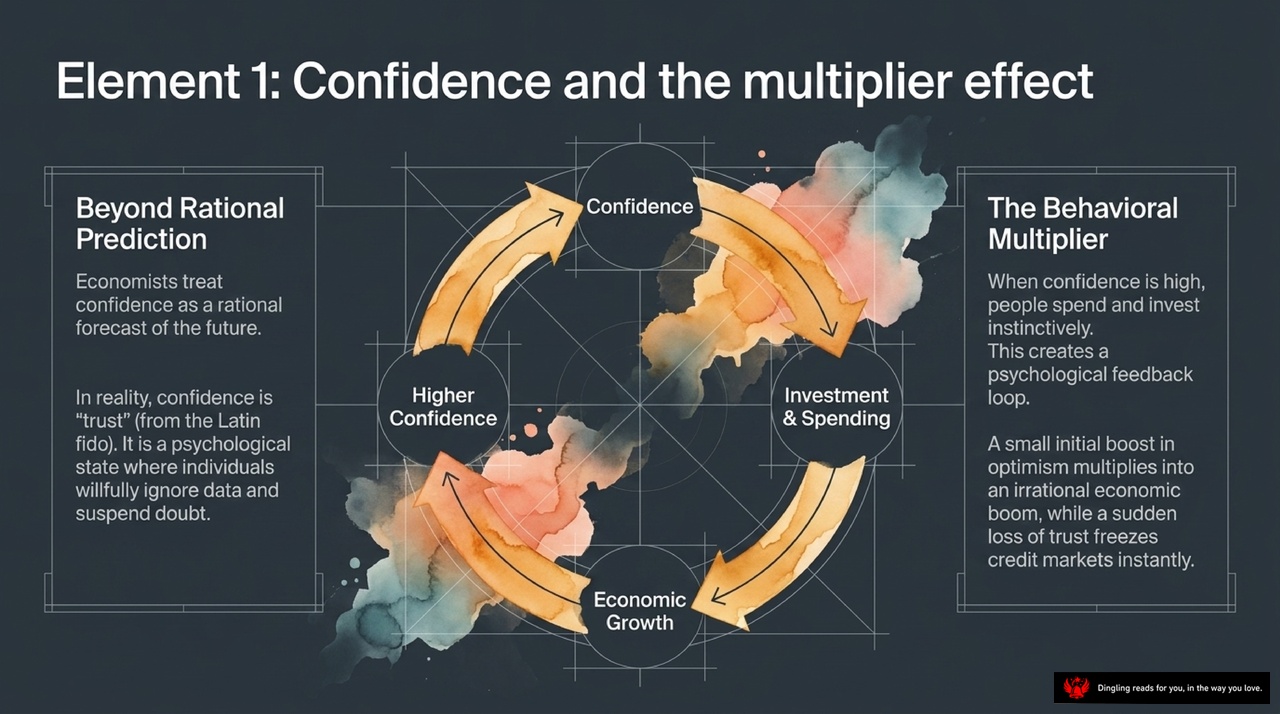
Element 1: Confidence and the Multiplier Effect.
Here's the core idea: traditional economics treats confidence as a rational forecast, but in reality, it's about trust—what the Romans called *fides*. When people trust the future, they spend and invest instinctively, creating a powerful psychological feedback loop. This is what we call the behavioral multiplier. A small boost in optimism can multiply into an irrational economic boom, while a sudden loss of trust can freeze credit markets instantly.
Look at the cycle here. High confidence leads to higher investment and spending, which drives economic growth. That growth reinforces confidence, creating a self-sustaining engine. But flip the switch, and the engine stalls. When confidence drops, people stop spending and pulling back on investments, causing the economy to shrink, which further destroys confidence. It's a vicious cycle that can spiral out of control.
This explains why economic downturns are so hard to predict and fix. It's not just about supply and demand; it's about the human story we're all buying into. When that story turns from "we're building a future" to "we're in a crisis," the entire economy reacts accordingly. Understanding this multiplier effect is key to grasping why confidence is the most critical variable in the economy.

Why do financial prices and corporate investment swing so wildly? It turns out no one truly believes these market rollercoasters are the result of rational calculation. Volatility is built right into the DNA of financial markets, and since investment is the engine of our economy, these wild swings are the primary driver of economic instability.
Look at the history of the U.S. stock market. From 1920 to 1929, real value surged more than fivefold, only to crash completely back to the starting line by 1932. Decades later, we saw similar frenzies and crashes. Economists have tried for years to explain these swings using fundamental economic data, but they have failed. Every time the market tanks, officials claim the fundamentals are still strong, which is a lie. Stock prices often detach from reality, acting like a crazy weather forecaster predicting temperatures that are impossible.
John Maynard Keynes famously compared the stock market to a beauty contest. Investors don't pick the face they think is most beautiful; they pick the face they think *others* will pick. It's all about guessing what everyone else expects. This creates a dangerous feedback loop. When prices rise, people feel wealthier and spend more, which drives prices up further. When they fall, panic sets in, and the spiral accelerates. Leverage makes this even worse. Banks lend more when prices are high, pushing them higher, but when prices drop, they are forced to sell assets, driving prices down even harder.
Consider the stark contrast between Japan's Toyota and Argentina's IKA. Toyota started with no industrial base, yet fueled by national confidence and patriotism, it grew into a giant. Meanwhile, the IKA company was government-subsidized but lacked a shared mission or belief. Constant strikes and internal conflict doomed it. This proves that confidence, culture, and a sense of fairness—elements of "animal spirit"—are just as important as raw capital.
Traditional models try to explain this with the "Tobin Q" ratio, but the data shows it's a weak predictor. Inflation and human psychology often override these formulas. We know that "free markets are self-correcting" is a myth that actually fuels these boom-and-bust cycles. We need better regulations that account for human nature, protecting consumers from predatory behavior. Whether it's the housing bubble driven by the story that "land only goes up" or the racial divide fueled by different narratives of fairness and injustice, the answer is always the same: the economy is driven by stories, not just numbers.

Welcome to Element 3: Anti-social behavior and the shadow market. Today, we're diving into the darker side of capitalism—the idea that the market doesn't just produce what we need, but what we will blindly buy.
Look at the concept of "Selling Snake Oil." When public confidence is blind, the market happily supplies deceptive, highly leveraged financial products. Think about the S&L crisis or the 2008 hedge fund collapse. It's not about innovation; it's about selling a lie that people are desperate to believe.
On the right, we see "The Erosion of Ethics." During market manias, our cultural standards of acceptable behavior simply degrade. Predatory lending and accounting fraud don't happen as anomalies anymore; they thrive as natural byproducts of unchecked greed in a high-trust environment.
This is the shadow market at work. It's where the rules are rewritten not by regulators, but by the collective madness of the crowd. When everyone believes the game is rigged in their favor, they stop playing fair and start playing to win, no matter the cost. That is the dangerous reality of the shadow market.
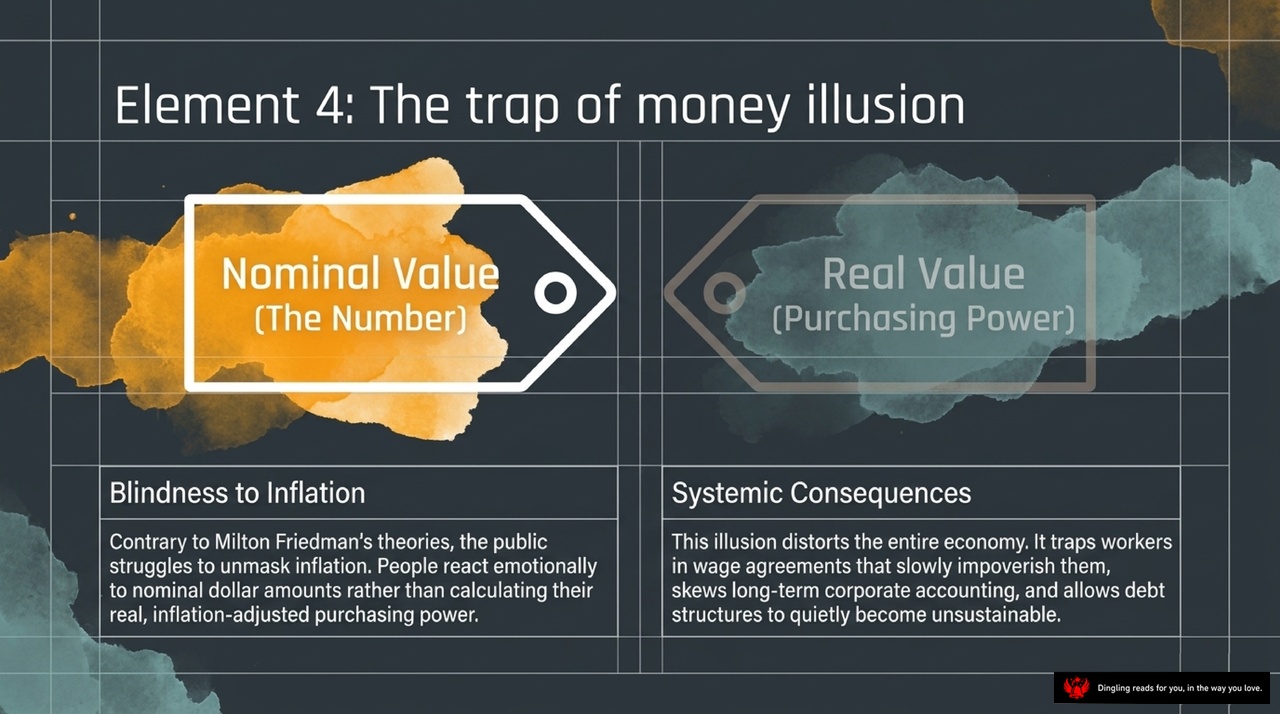
Let's talk about why your paycheck feels smaller every year, even if the number on the check stays the same. This slide introduces "Element 4: The trap of money illusion," a concept that explains why we often make bad financial decisions.
On the left, you see "Nominal Value," which is just the number. It's the face value of your salary or the price tag on an item. But on the right is "Real Value," which represents your actual purchasing power—the things you can actually buy with that money. The problem is our natural tendency toward "Blindness to Inflation." We get so focused on the nominal dollar amount that we fail to unmask inflation. We react emotionally to the number on the screen rather than calculating our real, inflation-adjusted purchasing power.
This blindness creates serious "Systemic Consequences." When we ignore inflation, it distorts the entire economy. It traps workers in wage agreements that slowly impoverish them because their nominal pay might rise, but their real value is falling. It skews long-term corporate accounting, making companies look healthier than they are. Worst of all, it allows debt structures to quietly become unsustainable, setting the stage for future crises. We need to stop looking at the number and start looking at what that number can actually buy.

Look at this chart. It captures a powerful truth about our economy: stories don't just explain the market; they drive it. On the left, we see the 1990s narrative: "The Internet changes everything." That wasn't just hype; it was a viral contagion. Just like a disease spreads from person to person, this story infected the market, convincing everyone that old rules no longer applied. This belief fueled massive, irrational investment in tech, creating a boom that felt permanent because the story felt true.
Fast forward to the right side of the timeline. The new story became: "Housing prices never fall." This was the "New Era" myth that defined the 2000s. Just like the internet boom, this narrative convinced people that traditional economic logic—where prices eventually correct downward—was dead. It provided the psychological justification for taking on huge risks in the housing market, from subprime loans to complex derivatives. When the story broke, the crash was inevitable.
The core lesson here is that human memory and confidence are organized around stories, not raw data. Economic narratives act like viruses, spreading rapidly and infecting market behavior. Every massive asset bubble, from tulips to tech to housing, is fueled by a belief in a "New Era" where the past doesn't matter. Understanding this viral power of stories is the key to understanding why our economy booms and busts.
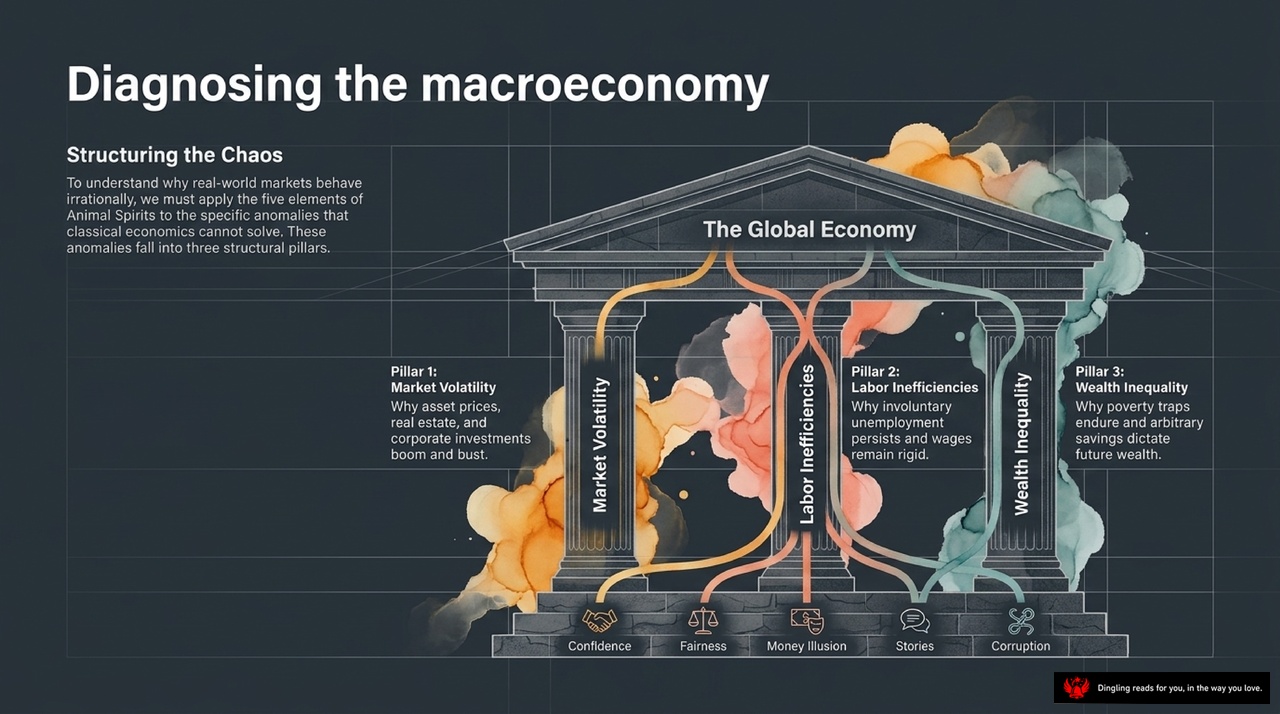
Diagnosing the macroeconomy isn't about finding a single magic bullet; it's about understanding the three structural pillars holding up the global economy. As we see here, these pillars—Market Volatility, Labor Inefficiencies, and Wealth Inequality—are actually the result of deeper, irrational forces we call "Animal Spirits."
First, look at Market Volatility. Why do asset prices boom and bust so wildly? It's not just about supply and demand; it's driven by confidence and stories. Just like in the 1920s or the recent housing crisis, when people believe a "new era" story, confidence skyrockets, and prices detach from reality. This is the confidence multiplier at work.
Second, consider Labor Inefficiencies. Why does unemployment persist even when there are jobs available? Traditional economics can't explain this, but the concept of fairness can. Workers often refuse to accept lower nominal wages, even if it makes sense financially, because they feel it's unfair. This "money illusion" and a sense of injustice create wage rigidity, trapping people in unemployment.
Finally, we have Wealth Inequality. Why do poverty traps endure? This is where corruption and arbitrary savings come into play. When the system feels rigged or when wealth is concentrated, it creates a feedback loop that makes it nearly impossible for those at the bottom to climb out.
So, the chaos we see in the real world—crashes, persistent joblessness, and deep inequality—aren't random glitches. They are the direct result of how human psychology, fairness, and storytelling interact with the economy. To fix the macroeconomy, we first have to understand these three pillars.
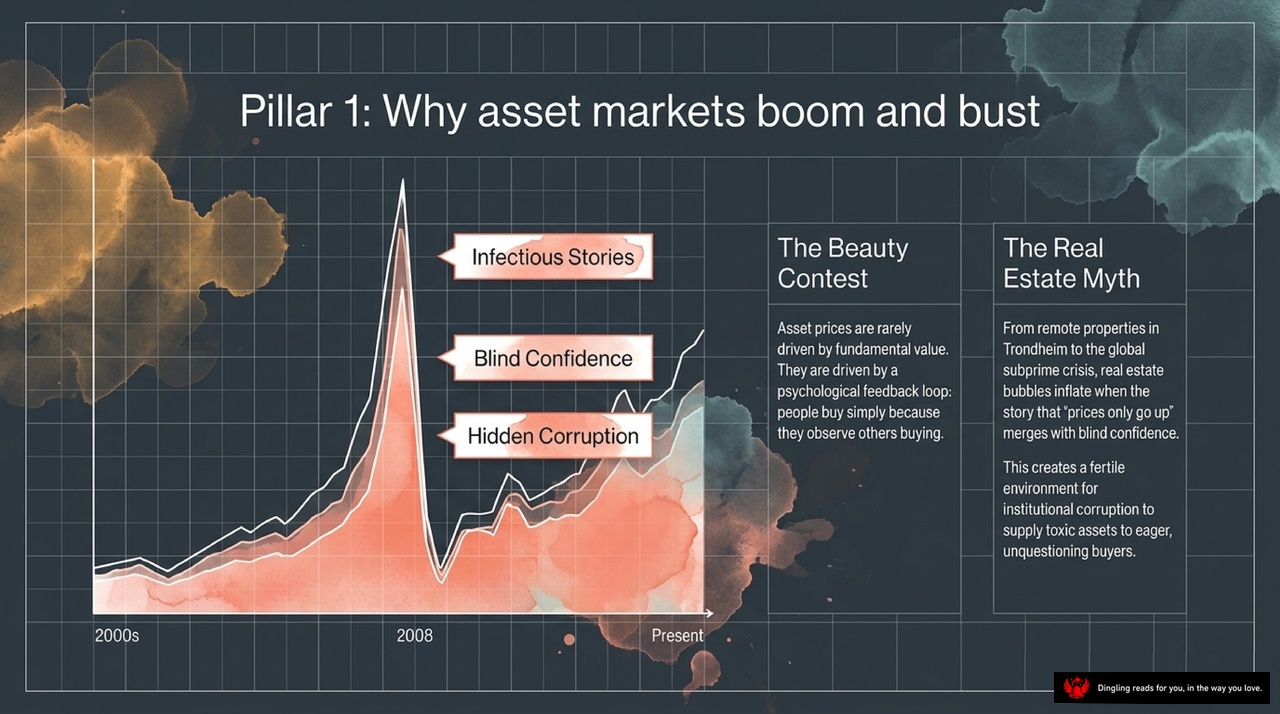
Why do asset markets boom and then inevitably bust? The answer isn't found in cold numbers or rational calculations, but in the human heart. As we explore Pillar 1, we see that asset prices are rarely driven by fundamental value. Instead, they are fueled by a psychological feedback loop where people buy simply because they see others buying. This creates a dangerous cycle of infectious stories and blind confidence, often masked by hidden corruption.
Look at the graph here. From the 2000s to the present, we see massive spikes, like the one in 2008. These aren't accidents; they are the result of what we call "The Beauty Contest," where investors try to guess what everyone else will do, ignoring reality. And consider "The Real Estate Myth." From remote properties in Trondheim to the global subprime crisis, bubbles inflate whenever the story that "prices only go up" merges with blind confidence. This fertile environment allows institutional corruption to supply toxic assets to eager, unquestioning buyers. When the story breaks, the confidence evaporates, and the crash begins.

Here is the spoken script for Slide 11, tailored for an American audience with a natural, engaging tone.
**Slide 11 Script:**
"Let's talk about the real logic behind layoffs. In traditional economics, you might think the smartest move during a recession is to cut everyone's wages by 10% to keep everyone employed. But as you can see on the left, that path simply doesn't work; output crashes because it violates our human sense of fairness. If you slash pay across the board, it feels like a direct insult, destroying morale and productivity.
Instead, look at Path 2 on the right. The rational choice for managers is often to fire 10% of the workforce rather than cutting wages for everyone. Why? Because of something called 'Money Illusion.' Employees don't just care about the real value of their paycheck; they care about the nominal number. A 10% pay cut feels like a personal attack, whereas losing a job feels like a market correction.
This is the core of 'Morale Over Math.' When you preserve the salary of the remaining workers, you protect their psychological drive and keep them motivated. If you keep everyone on the payroll but underpay them, you create a toxic environment where no one wants to give their best. So, while it seems counterintuitive, firing a portion of the team is often the only way to maintain the output of the rest. It's not just about the numbers on the spreadsheet; it's about how people feel about fairness in their workplace."

Pillar 3: Arbitrary savings and the wealth gap. Look at these two contrasting worlds. On the left, we see the "Illusion of Planning." It shows a clean, linear path: Payroll flows into Deductions, then an Investment Account, finally compounding into wealth. It looks rational, doesn't it? But the text reveals the harsh truth: savings decisions are rarely the result of rational calculations. Instead, they are highly arbitrary, driven entirely by environmental cues, institutional defaults, and cultural stories about consumption. We don't save because we've done the math; we save because the system tells us to, or because we feel like it.
Now, look at the right side: Generational Disenfranchisement. This isn't just about math; it's about psychology and access. The image shows a chaotic tangle of credit cards, debt, and a paycheck that just pays the next paycheck, ending in zero savings. This psychological gap is compounded for marginalized groups. When populations are subjected to systemic "Us versus Them" narratives, it limits their access to financial resources and institutional trust. It cements generational poverty across minority communities. While the wealthy might follow that neat line on the left, others are trapped in a cycle of arbitrary debt and exclusion. This is the core of the wealth gap: it's not just about income; it's about who gets to play the game and who is left watching from the sidelines.
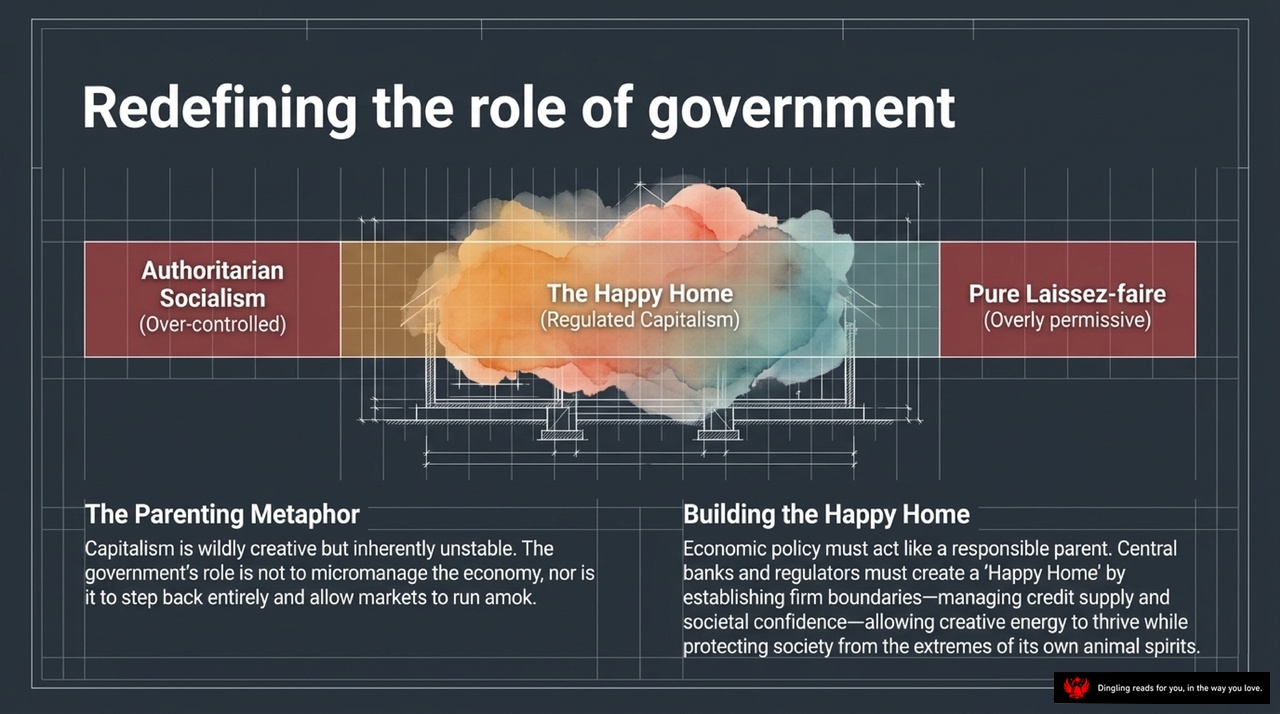
Let's talk about how we actually think about the economy. It's not just about cold, hard numbers or perfect rationality. It's about the "Happy Home"—a metaphor for how government should act. Imagine the economy as a family. On one side, you have "Authoritarian Socialism," where everything is over-controlled, like a parent who never lets their child make a choice. On the other side, you have "Pure Laissez-faire," where the government steps back completely and lets the market run amok, which is just as dangerous as a parent who never sets any boundaries.
Neither extreme works. The middle path is "Regulated Capitalism," or what we call the Happy Home. Think of the government as a responsible parent. Just like a parent doesn't micromanage every step their child takes, but also doesn't ignore them while they play in the street, the government needs to establish firm boundaries. Central banks and regulators must manage credit supply and protect societal confidence. This creates a safe environment where creative energy can thrive. But crucially, this system must also protect society from the extremes of its own "animal spirits"—the wild swings of confidence, corruption, and fraud that can otherwise destroy the economy. It's about finding that balance where the economy is free to be wildly creative, but stable enough to last.

True economic stability cannot be achieved by relying on the myth of the perfectly rational human; we must build systems that account for the volatile, emotional, and psychological realities of Animal Spirits.
Think about it: if our markets are ultimately governed by human psychology rather than mathematical certainty, are our current economic policies designing for the humans we wish we were, or the humans we actually are?
Traditional models often assume we make decisions based on cold, hard logic. But reality is messier. We don't just calculate; we feel. We react to stories, we crave fairness, and we fall prey to corruption. When confidence evaporates, as it did during the Great Depression or the 2008 crisis, even the best mathematical models fail because they ignore the human element. We need policies that acknowledge our fears, our biases, and our need for a fair playing field. Only then can we build an economy that is truly stable and resilient.