
Anna Karenina: Complete Chapter-by-Chapter Summary

Good evening, everyone. Welcome to our book club session. Today, we're diving into one of the most powerful stories ever written: *Anna Karenina* by Leo Tolstoy.
The image on your screen captures the very soul of this novel—a steam train cutting through a stormy, snow-blanketed night. It's not just a picture; it's a metaphor for the journey Anna takes. This story is a timeless exploration of destructive passion, societal hypocrisy, and the desperate search for authentic meaning in nineteenth-century Russia.
As we begin, remember that this isn't just a romance; it's a profound look at how rigid social rules clash with human desires. Anna's tragedy isn't just about an affair; it's about a woman trying to find her own identity in a world that offers her no place to belong. Join me as we turn the page and step into this world of love, loss, and the relentless pursuit of truth.
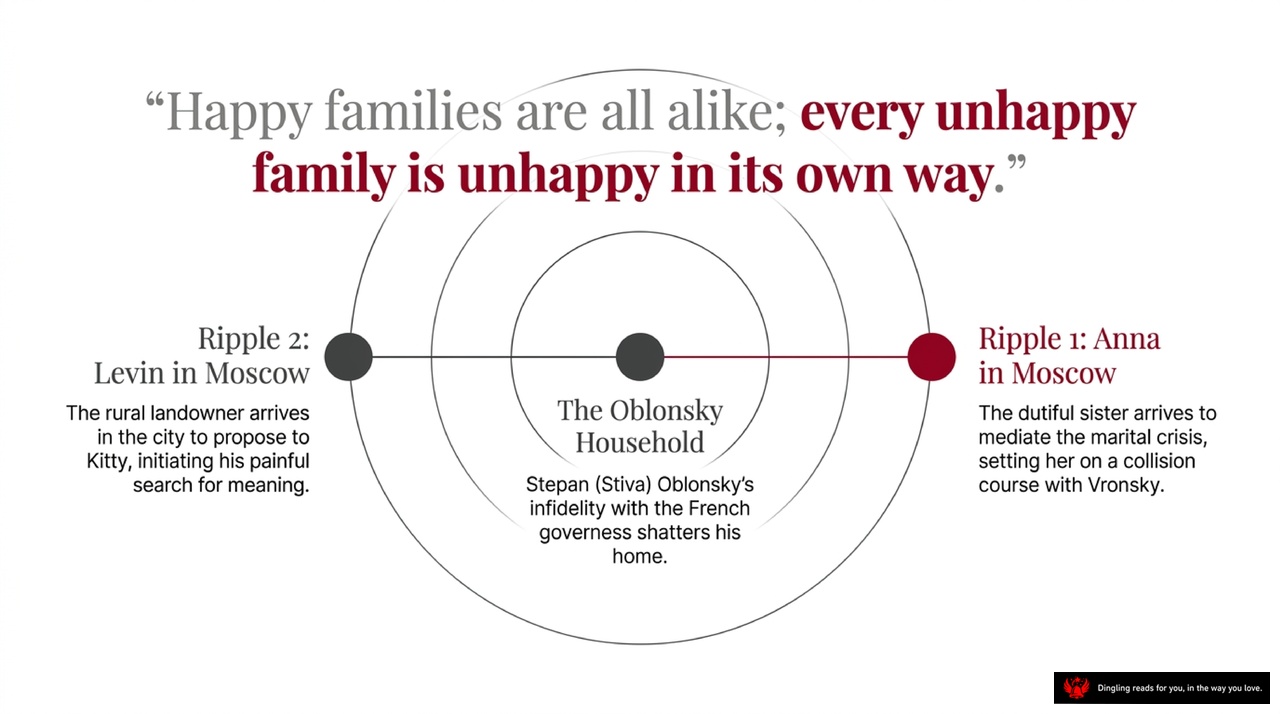
"Happy families are all alike; every unhappy family is unhappy in its own way." This famous opening line sets the stage for a story of two worlds colliding. At the center of this storm is the Oblonsky household, where Stepan's infidelity with a French governess has already shattered the family's peace.
But the real drama begins when two ripples hit Moscow. On one side, we have Anna. As the dutiful sister, she arrives to mediate her brother's marital crisis, only to find herself on a collision course with Vronsky. Their chance encounter at the station ignites a passion that will consume her life. On the other side, we have Levin, a rural landowner arriving in the city with a simple, noble goal: to propose to Kitty. Yet, his journey is anything but simple. He faces his own painful search for meaning, battling insecurities about his social status while navigating a competitive love triangle with the charming but shallow Vronsky.
As these two storylines unfold, we see how one family's unhappiness ripples outward, affecting everyone around them. The Oblonsky household's decay creates the conditions for Anna's tragedy, while Levin's personal struggles mirror the broader search for truth in a changing society. This is not just a story about love and betrayal; it is a profound exploration of how individual choices create chains of consequences that bind us all together.
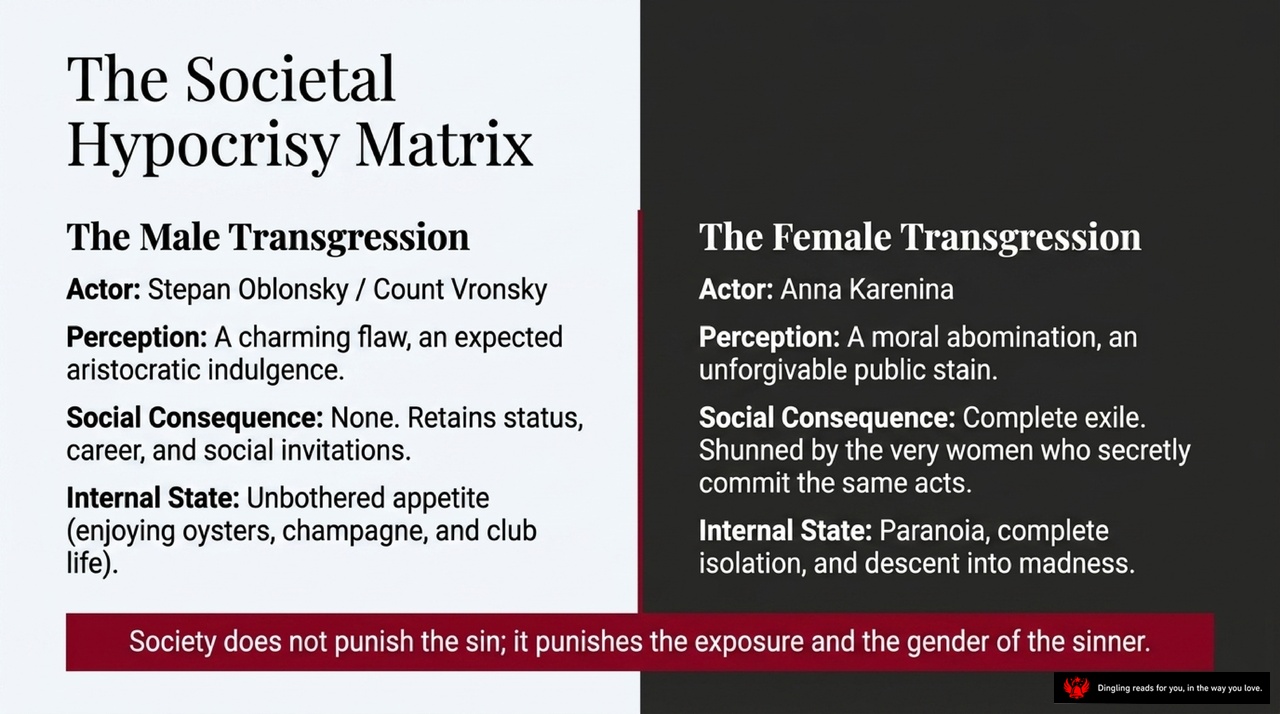
Look at this stark contrast. On the left, we have "The Male Transgression." Take Stepan Oblonsky or Count Vronsky. To society, their affairs are just charming flaws, a sort of expected aristocratic indulgence. The social consequence? None. They keep their status, their careers, and their invitations. Inside, they remain unbothered, enjoying oysters, champagne, and club life as if nothing happened.
But look at the right side: "The Female Transgression." The actor is Anna Karenina. Her perception? A moral abomination, an unforgivable public stain. The social consequence is complete exile. She is shunned by the very women who secretly commit the same acts. Internally, she spirals into paranoia, complete isolation, and a descent into madness.
The matrix reveals a brutal truth at the bottom: Society does not punish the sin itself; it punishes the exposure and the gender of the sinner.
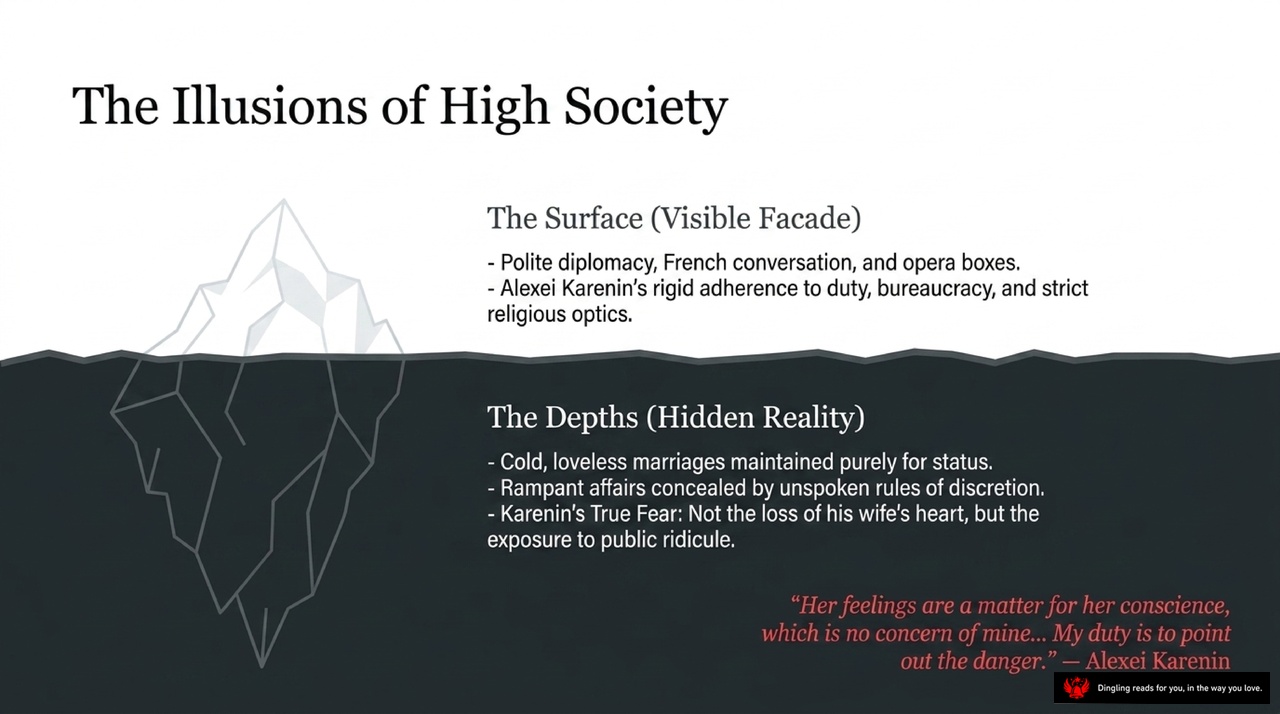
The illusions of high society are often just a beautiful facade, hiding a much darker reality beneath the surface. Think of it like an iceberg: the visible part is polished and elegant, filled with polite diplomacy, sophisticated French conversation, and the glitter of opera boxes. This is the world Alexei Karenin lives in, a rigid shell of duty, bureaucracy, and strict religious optics.
But dive deeper, into the hidden depths, and you find something entirely different. Beneath that perfect exterior lies a cold, loveless marriage sustained only for social status. Scandals and affairs are swept under the rug by unspoken rules of discretion. And here is the terrifying truth: Karenin's true fear isn't losing his wife's heart; it's the exposure to public ridicule. He cares more about his reputation than her feelings. As he famously says, "Her feelings are a matter for her conscience, which is no concern of mine... My duty is to point out the danger." In this world, a person is nothing more than a prop in a play, and the soul is left far behind the ice line.

When we look at the intersection of Anna and Vronsky's story, we see it wasn't a happy romance, but a collision with death and the cold machinery of modern life. It all starts at the Moscow Train Station, where a railway worker is crushed by a backing train. For Anna, this isn't just an accident; it's an evil omen, a dark sign of things to come.
This train becomes the ultimate symbol of their fate. It represents a relentless, mechanical force that, once set in motion, becomes unstoppable and destructive. It frames their passion not as a beautiful love story, but as a tragedy driven by an uncontrollable momentum. As they fall deeper into their affair, they realize they are trapped on this track, heading toward a crash that will ultimately crush them both. The train doesn't just move them forward; it dictates their destiny, turning their desire into a force that no amount of love or reason can stop.
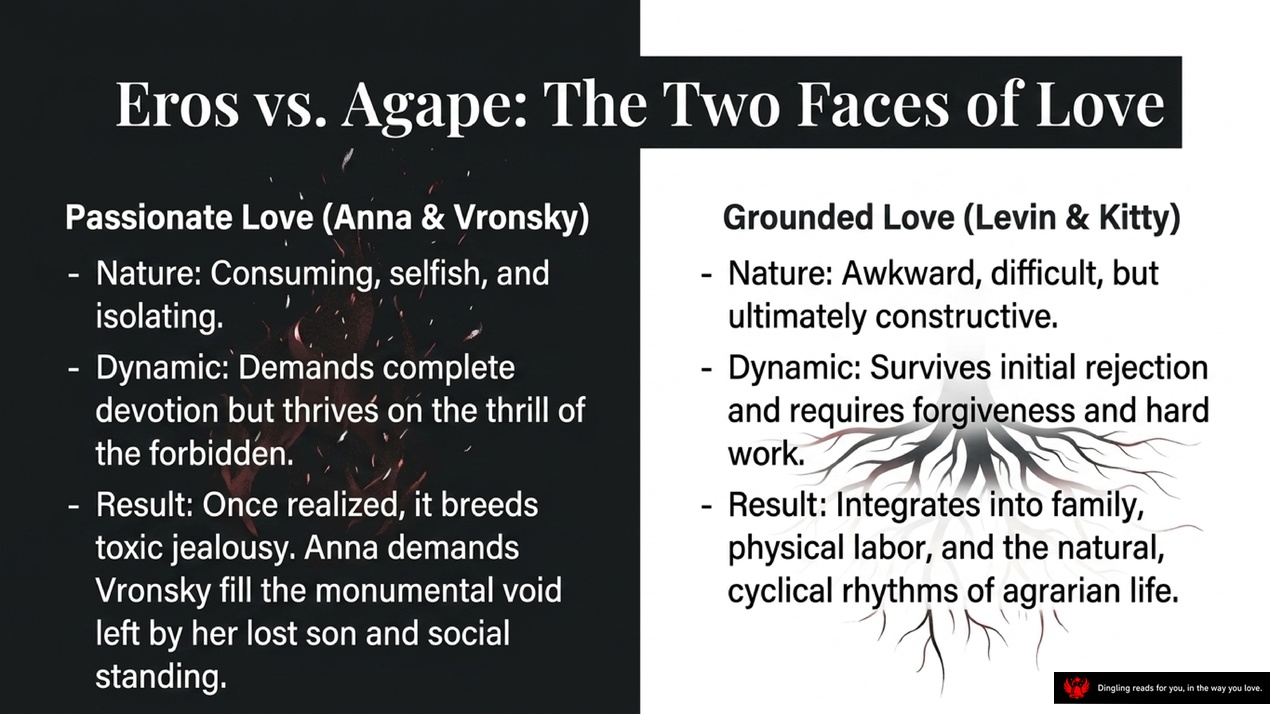
Eros versus Agape: The Two Faces of Love. Tonight, we contrast two very different ways of loving, using the most dramatic examples from the story: Anna and Vronsky versus Levin and Kitty. On the left, we see Passionate Love. Look at the imagery here—consuming, selfish, and isolating. This is exactly what happens with Anna and Vronsky. Their dynamic thrives on the thrill of the forbidden, demanding complete devotion but ultimately breeding toxic jealousy. Anna demands Vronsky fill the monumental void left by her lost son and social standing, creating a destructive cycle where they destroy each other.
On the right, we see Grounded Love. It looks different: awkward, difficult, and rooted deep like those roots in the background. This is Levin and Kitty's path. Their dynamic survives initial rejection and requires forgiveness and hard work. Instead of burning out, this love integrates into family, physical labor, and the natural, cyclical rhythms of agrarian life. It is constructive because it is built on reality, not just passion. One face consumes the self; the other builds a life. Which one do you choose?
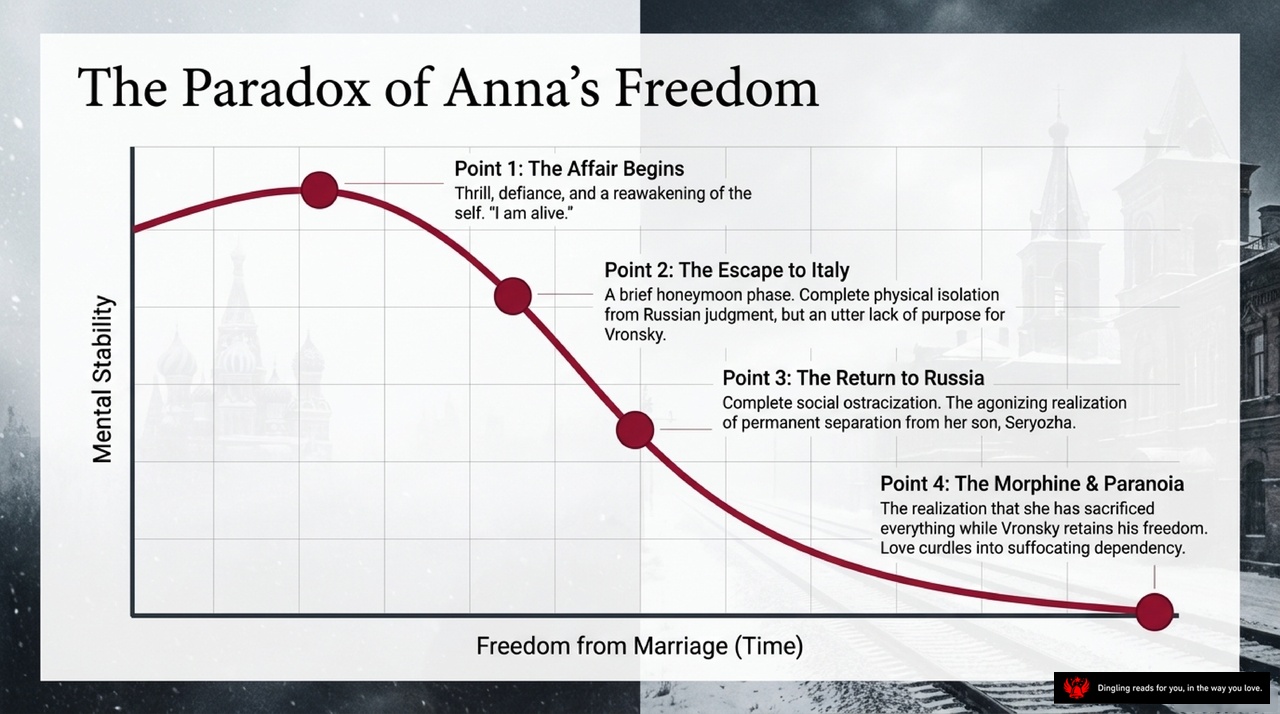
So, we hit the breaking point. After months of wandering Italy, chasing a love that feels more like a dependency than a partnership, Anna realizes the truth: she has sacrificed everything, while Vronsky retains his freedom. The slide calls it "The Morphine & Paranoia"—and that's exactly where she is. The thrill is gone. The escape to Italy was just a brief honeymoon phase, a physical isolation from Russian judgment, but it left her with no real purpose. Now, back in Moscow, the reality crashes down. She sees Vronsky smiling at another woman, and suddenly, love curdles into suffocating dependency. He's free to leave her at any moment, while she is trapped, paralyzed by the fear of what her son, Seryozha, might think, and terrified of her own irrelevance. She realizes she has lost her identity, her social standing, and her child, all for a man who no longer needs her. That is the paradox of her freedom: the more "free" she became from her marriage, the less free she became in her own life, ending in a desperate, silent despair that drives her toward the tracks.
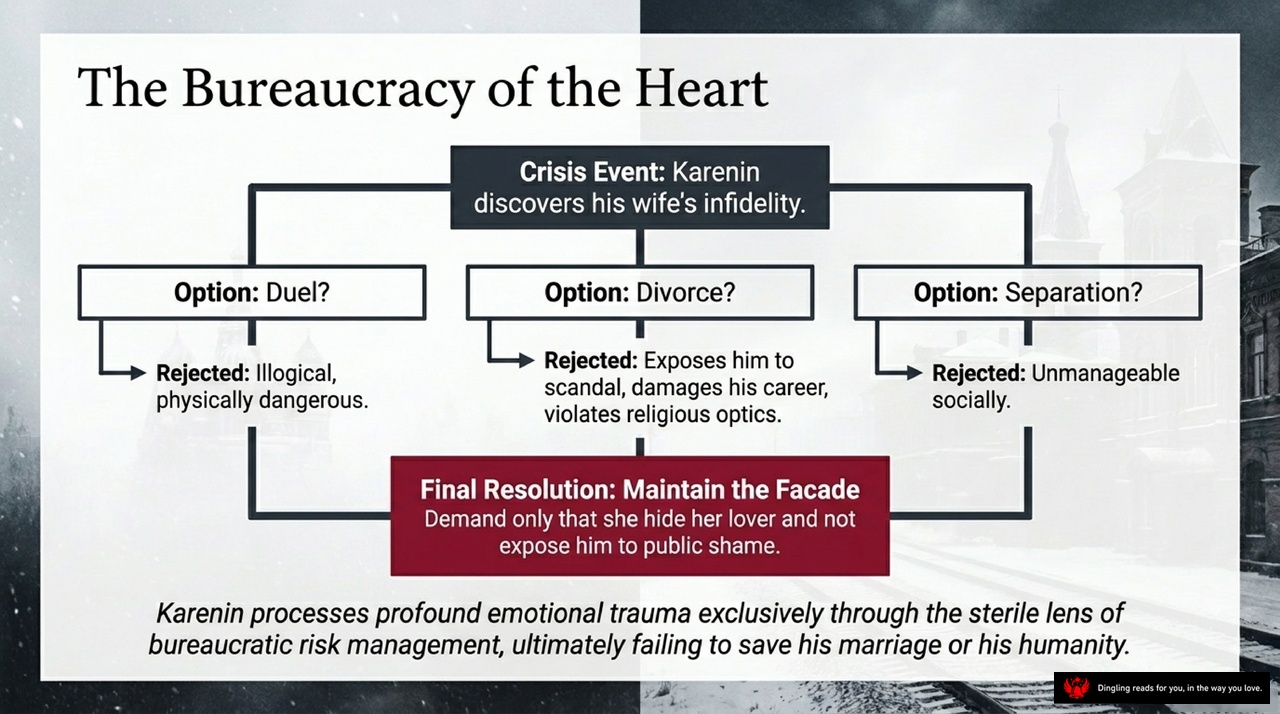
The slide we're looking at captures a tragic but very human moment: the "Bureaucracy of the Heart." It maps out Karenin's reaction to discovering his wife Anna's affair. Instead of reacting as a man in love, he reacts like a risk manager. When the crisis hits, he rejects every emotional solution. A duel is "illogical and physically dangerous." Divorce is out because it would expose him to scandal and ruin his career. Separation is "unmanageable socially." So, what does he do? He chooses the path of least resistance: maintain the facade. He demands only that she hide her lover and not expose him to public shame. This diagram shows how Karenin processes profound emotional trauma exclusively through the sterile lens of bureaucratic risk management. He fails to save his marriage or his humanity, because he treats a broken heart like a corporate merger that just needs to be managed, not healed.
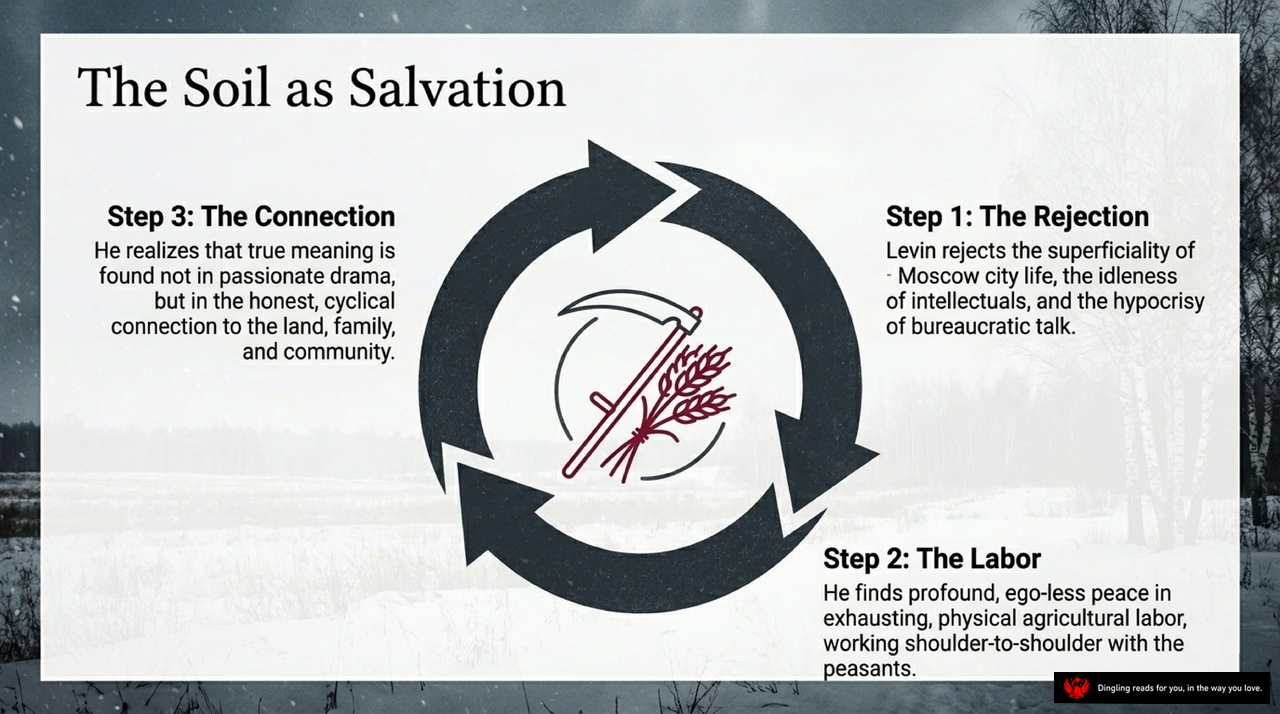
The Soil as Salvation isn't just a title; it's the very heartbeat of Levin's journey. Look at this cycle in the center: it starts with Step 1, The Rejection. Levin turns his back on the hollow life of Moscow—the fake city chatter, the idle intellectuals, and the bureaucratic lies that have no soul. He realizes that true meaning can't be found in grand dramas or passionate romances that end in tragedy.
Instead, he finds his salvation in Step 2, The Labor. It's about getting his hands dirty. Working shoulder-to-shoulder with the peasants in the fields, he discovers a profound, ego-less peace. The hard physical work of agriculture becomes a spiritual practice, grounding him in reality. And finally, this leads to Step 3, The Connection. By embracing this honest, cyclical rhythm of the land, family, and community, Levin realizes that salvation isn't about escaping the world, but finding your place within it. It's a simple, powerful truth: when you stop fighting the soil, the soil heals you.

Look at this scale. It perfectly captures the tragic math of Anna's life: an impossible equation where the weight on one side simply crushes the feather on the other.
On the heavy side, we see Anna's Sacrifice. It's not just about her love for Vronsky; it's the crushing weight of her beloved son, Seryozha, her shattered social standing, and her entire future in Russian society—all lost in an instant. She expects Vronsky's love to be infinite, enough to fill that massive void.
But on the other side? Just "The Inadequate Weight: Vronsky's Love." He offers his devotion, yet he is still a man who needs a career, independence, and his own social circle. He cannot balance the scale. Because no single human can truly fill that void, Anna perceives his need for personal space not as a flaw, but as a waning of his love. That realization drives her to madness. This imbalance isn't just a relationship problem; it's the moment she realizes she has traded her entire world for a love that was never big enough to hold it.
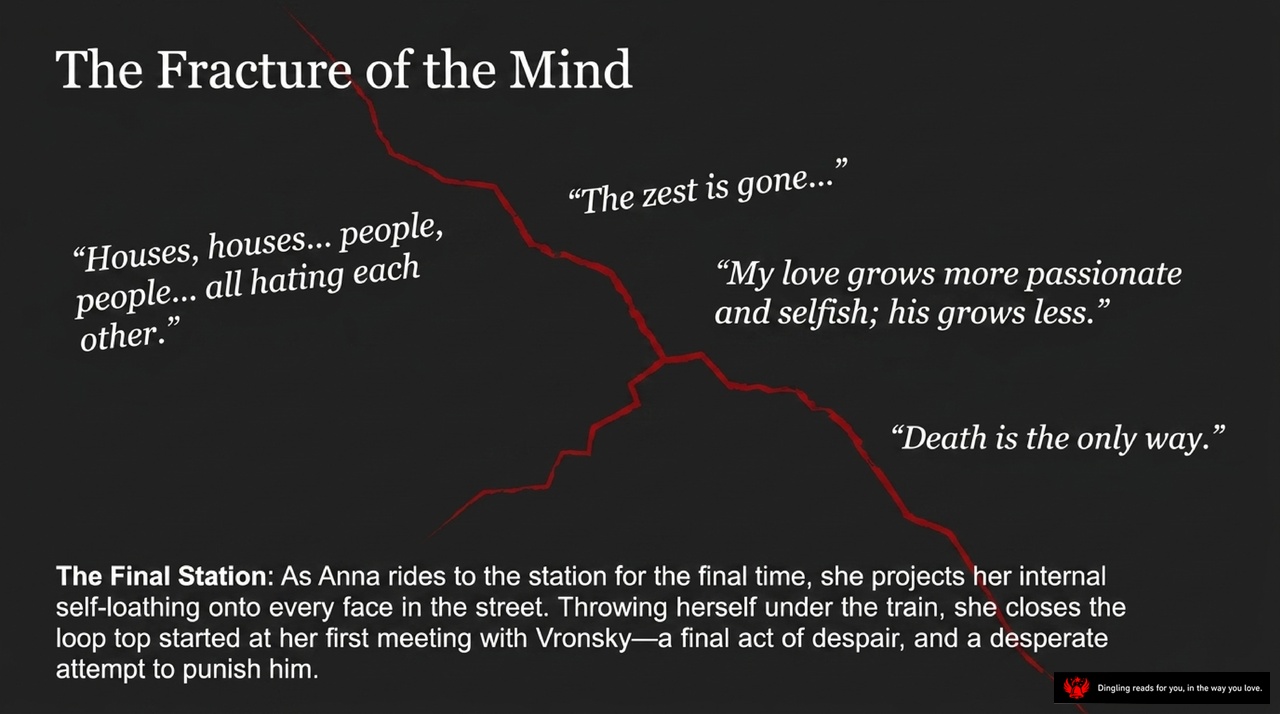
The Final Station: As Anna rides to the station for the final time, she projects her internal self-loathing onto every face in the street. Throwing herself under the train, she closes the loop top started at her first meeting with Vronsky—a final act of despair, and a desperate attempt to punish him.
Her journey ends in silence. "The zest is gone..." she realizes, as the world around her feels hollow. "Houses, houses... people, people... all hating each other." In that moment, the city transforms into a prison of judgment and cruelty. Her love, once fierce, now feels only selfish; Vronsky's has long since faded. "My love grows more passionate and selfish; his grows less."
With no way out, she whispers, "Death is the only way." It is not just an escape—it is a weapon, a final statement against the life that destroyed her. As the train roars past, she becomes one with the tracks, erasing the pain, the shame, and the endless questions of why it all had to end this way.

Look at this slide titled "The Divergent Tracks." It beautifully captures the ultimate split in Tolstoy's masterpiece: the two paths of Anna Karenina and Konstantin Levin.
On the left, we see Anna's track. Her drive is defined by individual passion and rebellion against the rigid structures of society. She chases her own desires, but this leads to tragedy. She becomes consumed by the self, isolated by the hypocrisy of a world that demands conformity. The conclusion is stark: total destruction under the weight of modern, relentless machinery. Anna's story is a warning about what happens when we try to live entirely for ourselves, disconnected from the community and the natural order.
On the right, we see Konstantin Levin's track. His drive is the search for absolute truth and integration with nature. While Anna spirals into isolation, Levin finds a triumph. He overcomes his existential dread not through grand gestures, but through genuine connection to others and honest, hard labor. His conclusion is one of spiritual awakening. He realizes that living for the soul is the ultimate truth.
These divergent tracks show us that while one path leads to the abyss of self-obsession, the other leads to peace through service and humility.
Tolstoy draws a sharp line between two ways of living. On one side, we see a life consumed by forbidden passion and the heavy mask of social hypocrisy; on the other, a path redeemed by quiet, honest labor and deep spiritual faith. As we chase our own version of happiness, we must ask ourselves a hard question: are we building tracks that lead to salvation, or are we paving our own road to destruction? The choice isn't just about grand gestures; it's about whether we find our purpose in the authentic work of daily life or in the fleeting fires of desire that ultimately leave us isolated.