
Asking the Right Questions: Complete Chapter-by-Chapter Summary
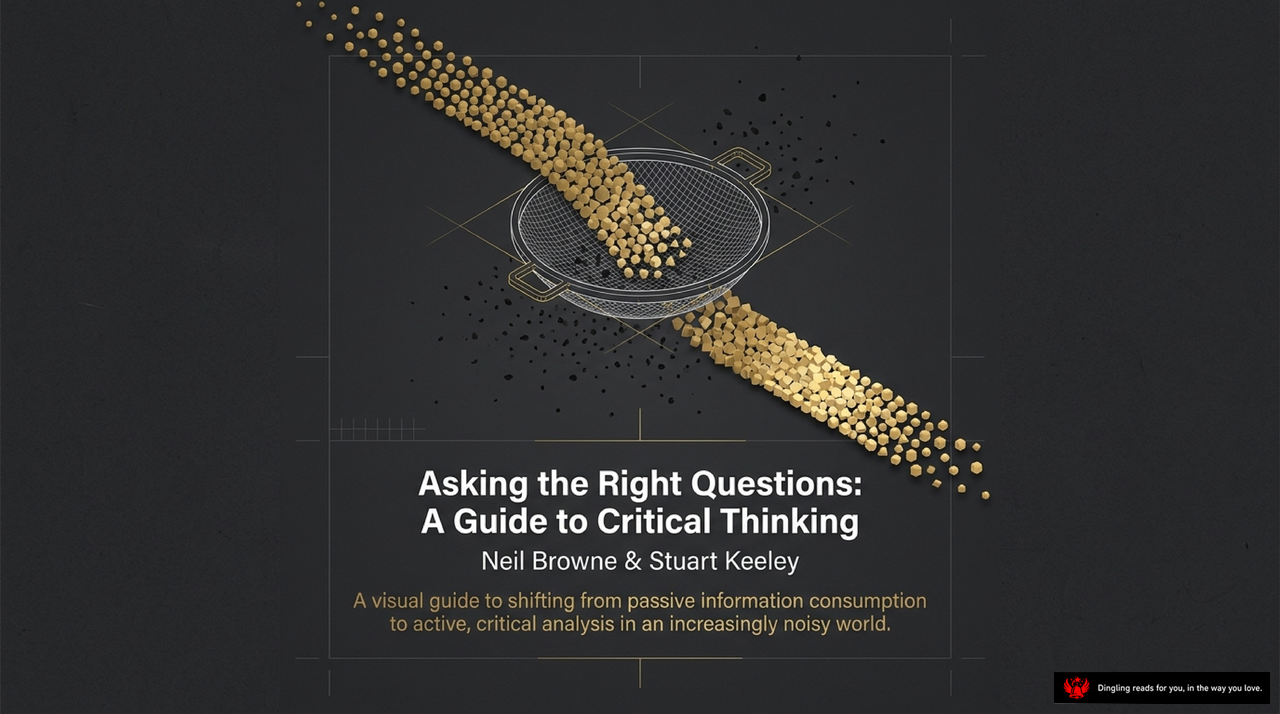
Welcome to 'Asking the Right Questions'. In a noisy world, we consume info passively. But what if we could shift to active, critical analysis? This book is your visual guide. It helps you break free.
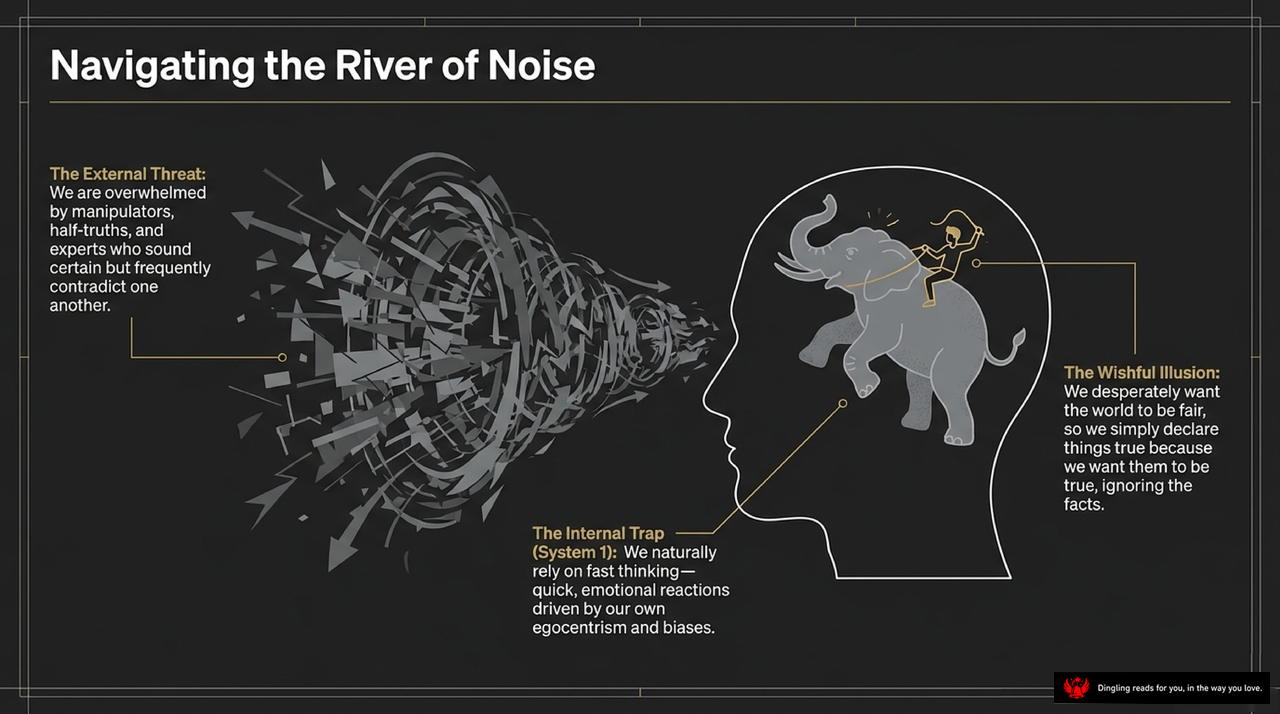
Welcome to today's session. Look at this slide titled "Navigating the River of Noise." It perfectly captures where we all find ourselves right now in the modern age. On the left side, we see "The External Threat." We are constantly bombarded by manipulators, half-truths, and even experts who sound so certain but contradict each other. It's like trying to find a clear signal in a chaotic storm. You might trust an expert today, only to find their advice completely opposite tomorrow. This uncertainty breaks our trust and leaves us feeling lost and helpless.
But the noise isn't just outside. The bigger battle is often internal. Look at the right side. We have "The Internal Trap," labeled System 1. This is our brain's autopilot. We naturally rely on fast thinking—quick, emotional reactions driven by our own egocentrism and biases. Imagine that elephant in the head. It represents our emotions, and the rider represents our logic. Often, that elephant just charges forward, dragging us into decisions we don't actually want to make. We react before we think, letting our feelings dictate our reality instead of our facts.
Then there's "The Wishful Illusion." This is perhaps the most insidious trap of all. We desperately want the world to be fair and just. Because of this, we simply declare things true because we want them to be true, ignoring the facts. We twist reality to fit our comfort zones. We tell ourselves a story that feels good, even if it isn't real. We avoid uncomfortable truths because they threaten our sense of order and safety.
So, what do we do? We need a tool to cut through this chaos. That tool is Critical Thinking. It's not about being cynical or doubting everything blindly. It's about learning how to rationally control our beliefs and conclusions. It allows us to move from being passive recipients of information to active, self-directed thinkers. It encourages us to question not just the experts, but our own instincts. In a world this noisy, the only way to find the truth is to navigate the river with intention, not just drift with the current. It's about reclaiming your mind from the noise and taking back the power to think for yourself. It is the difference between being a slave to information and becoming the master of your own mind.
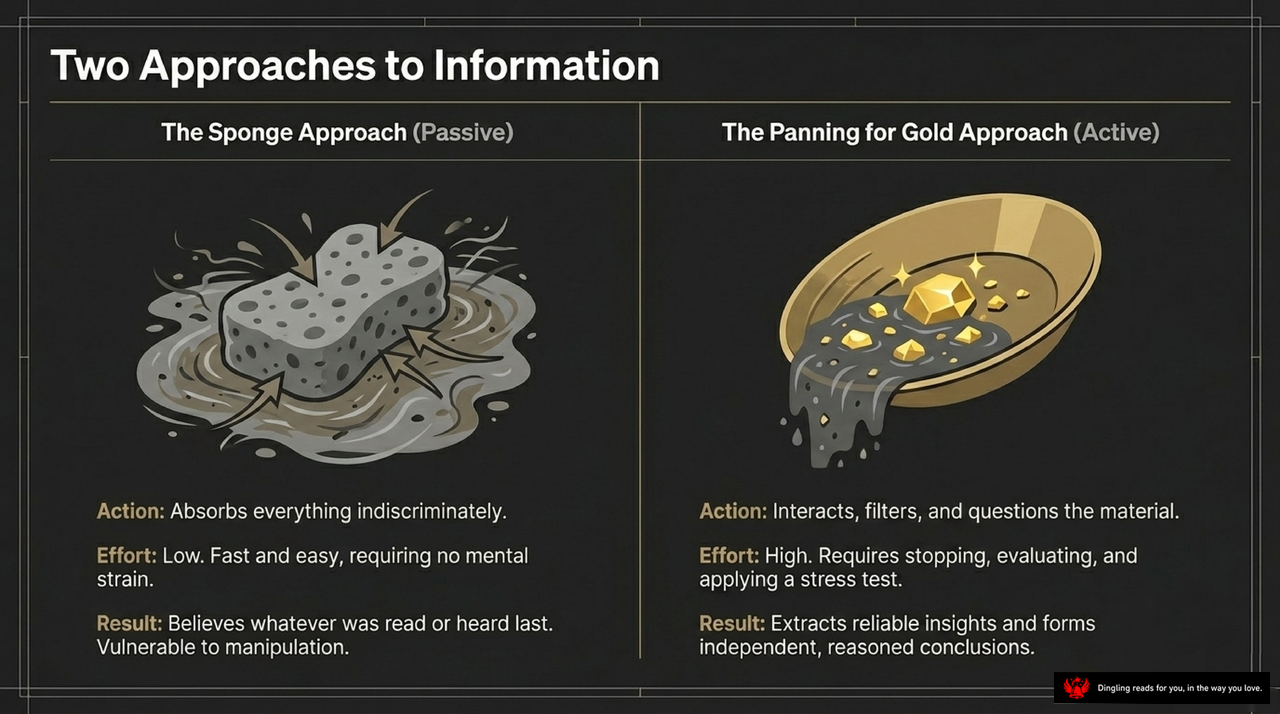
Welcome back. In today's information age, we are bombarded with data every second. How we handle this data determines our reality. Today we're exploring a crucial distinction from our book regarding how we process information. Take a look at this visual. It outlines two distinct approaches that define our thinking.
On the left, we have the Sponge Approach. It's labeled as Passive. Imagine you're just sitting there and letting information wash over you like water. The action is simple: you absorb everything indiscriminately. You don't filter. You don't question. The effort is low. It's fast and easy, requiring absolutely no mental strain. That's why it's so tempting in our busy lives. Because it feels effortless, we often fall into this trap without realizing the cost. But what's the result? You end up believing whatever was read or heard last. You become a container for other people's ideas. You are vulnerable to manipulation because you never stopped to check if the information is actually true or valuable.
Now, look at the right side. This is the Panning for Gold Approach. It's Active. Instead of just soaking up the mud, you're using a pan to filter out the gold. The action is different: you interact, you filter, and you question the material. You don't just accept it; you challenge it. The effort is high. It requires you to stop, to evaluate, and to apply a stress test to the information you're consuming. It's work. It takes mental energy. But the result is transformative. You extract reliable insights. You form independent, reasoned conclusions. You are no longer a slave to the information stream; you are the master of it.
So, the question isn't just about how much information you consume, but how you process it. The sponge is comfortable, but the panner is free. In a world full of noise, the sponge is dangerous because it accumulates data but lacks wisdom. The panning approach filters noise to find signal. We need to shift from passive consumption to active engagement. This is the core of critical thinking. Which one are you choosing to be today? The book emphasizes that critical thinking isn't just about knowing facts, but about the method we use to find them. So, are you ready to switch from the sponge to the panner?
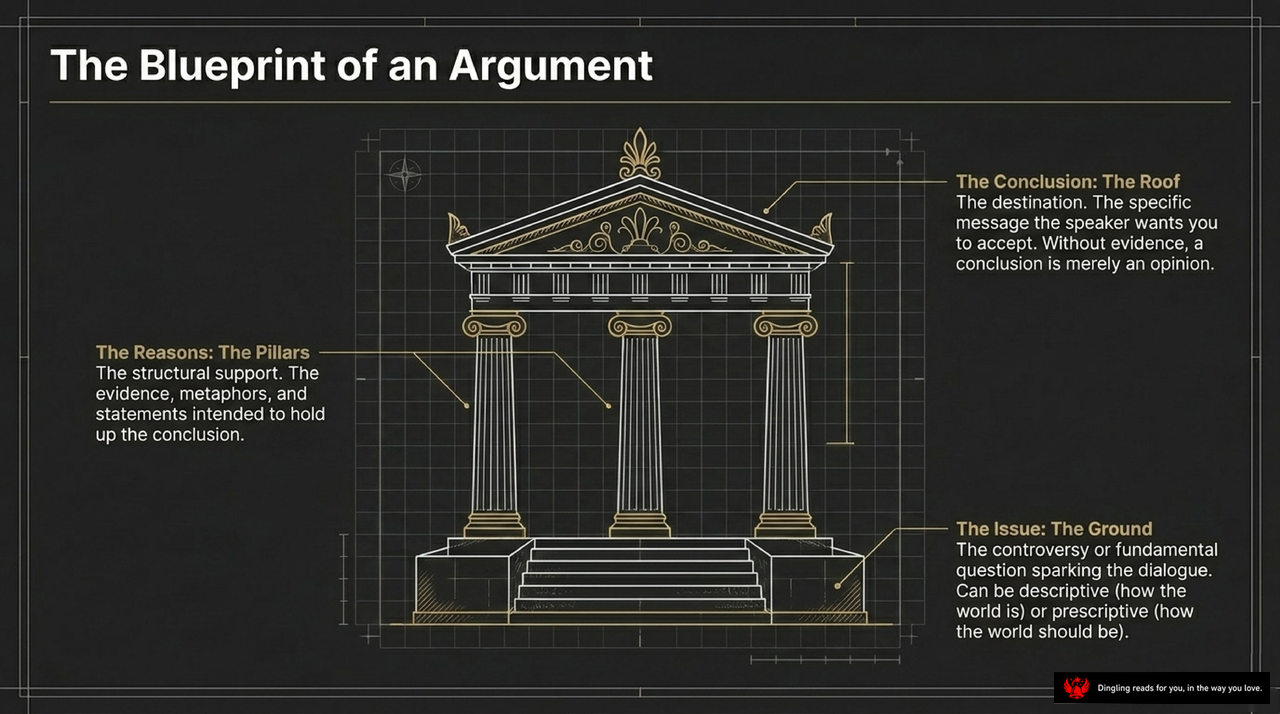
So, let's visualize how an argument works. Think of it as a structure, like a building. To make sure it stands up to scrutiny, you need a blueprint with three main parts.
First, the foundation. In our diagram, this is labeled "The Issue: The Ground." It's the controversy or the fundamental question sparking the dialogue. Is it a question of fact, like "what is happening," or a question of value, like "what should we do"? Without this ground, the structure floats in thin air. You need to know exactly what problem you are solving before proposing a solution. Identifying this core issue is the first step in critical thinking. We need to distinguish between descriptive questions about how the world is, and prescriptive questions about how it should be. This distinction helps us know what kind of evidence we need to find.
Next, the middle. These are the pillars, labeled "The Reasons: The Pillars." These are the structural supports holding the roof up. In an argument, these are the evidence, data, and statements intended to support your claim. If you just say something without backing it up, it's just an opinion. But if you provide solid reasons—like statistics or logical connections—you give your argument weight. These pillars must be strong; if they crumble, the whole argument collapses.
Finally, the top. This is "The Conclusion: The Roof." It is the specific message the speaker wants you to accept. It's the final claim you are trying to prove. But here is the catch: without the pillars underneath, the roof is just an opinion. A conclusion needs evidence to be valid. It's not just what you want to say, but what you can prove.
So, when listening to someone or building your own argument, check this blueprint. Does the roof make sense? Do the pillars actually support it? And is it all built on solid ground? This simple structure helps us move away from shouting opinions and start having real, rational discussions. By understanding these three components, we can better evaluate the strength of any claim we encounter in our daily lives.
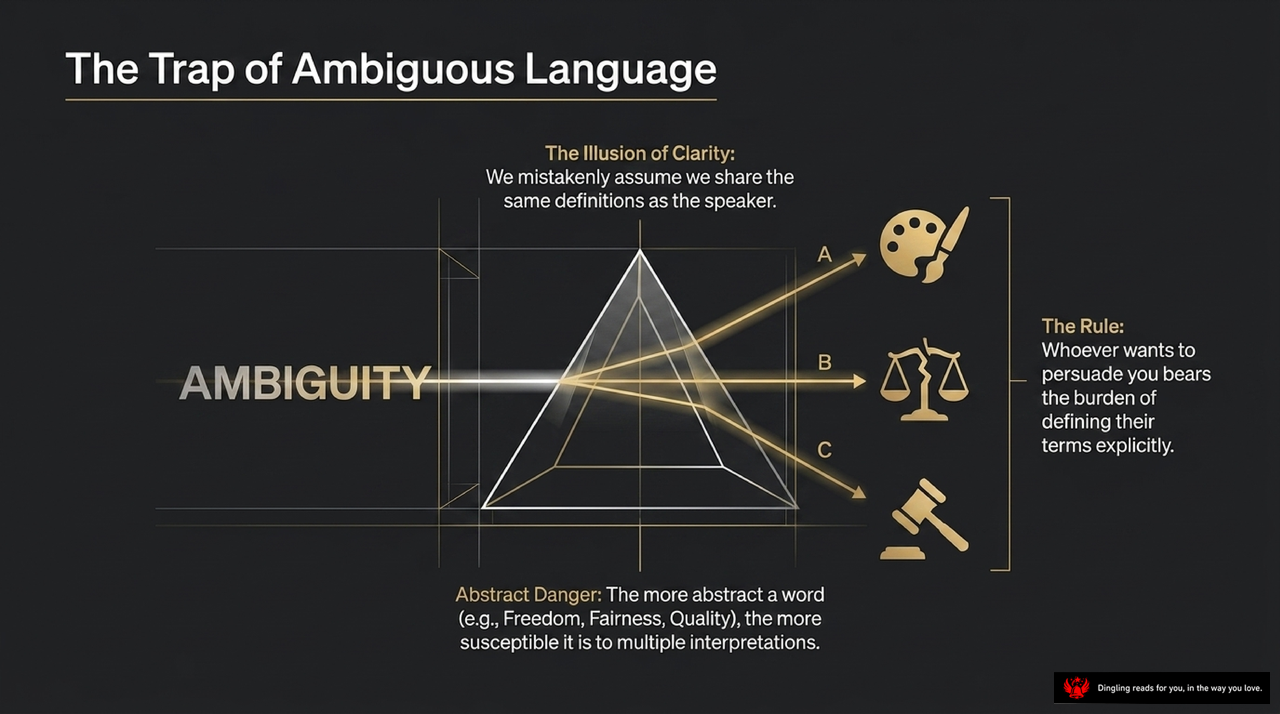
Welcome to the next slide. Today we're tackling a concept that often trips us up without us even realizing it: The Trap of Ambiguous Language.
Look at this visual. It shows a beam of light hitting a prism and splitting into different paths labeled A, B, and C. This represents how a single word or idea can be interpreted in multiple ways. The slide calls this "The Illusion of Clarity." Here is the core problem: we mistakenly assume we share the same definitions as the speaker. We think, "Oh, I understand what you mean," but often, we are talking about completely different things. Think about a time you argued with a friend. You said, "This is unfair." They said, "No, it's fair." Who was right? You both used the same word, but you meant different things.
Consider the concept of "Abstract Danger." The slide points this out directly. Words like "Freedom," "Fairness," or "Quality" are abstract. They don't have a single, fixed definition. One person's idea of "freedom" might be the right to do anything, while another's is the right to not harm others. One person's "quality" might mean high durability, while another's means high aesthetics. The more abstract a word is, the more susceptible it is to multiple interpretations. This is why so many debates end up nowhere. We think we're arguing about the same thing, but we're actually arguing about different definitions. This is dangerous because it allows people to say whatever they want without being held accountable for their specific meaning.
So, how do we fix this? The slide gives us a powerful rule on the right side: "Whoever wants to persuade you bears the burden of defining their terms explicitly." This is crucial. If someone is trying to convince you of something, they cannot just use vague words and expect you to fill in the blanks. They have the responsibility to define their terms clearly. If a politician says, "We need to secure our borders," and never defines what that means, you have the right to ask, "Secure how? And at what cost?"
As critical thinkers, we need to be the ones who ask these questions. We shouldn't just accept the speaker's definition. If we keep asking for clarity, we force the speaker to be precise. This simple habit can save us from being misled by manipulative language. It turns a vague argument into a testable claim.
In summary, don't fall for the illusion of clarity. Watch out for abstract words. And remember the rule: if you are being persuaded, the persuader must define their terms. That is the only way to have a productive conversation.
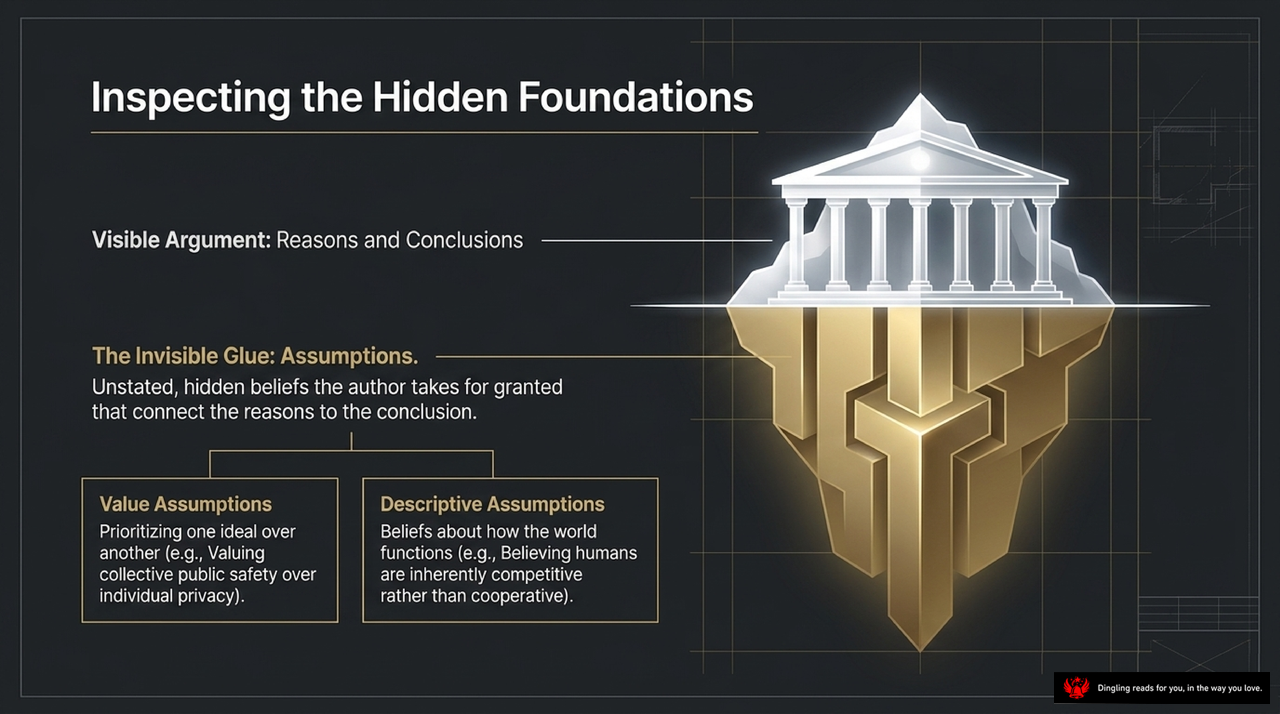
Welcome to the next level of critical thinking. Look at this slide. We often focus entirely on the "Visible Argument"—the reasons and conclusions we see on the surface. But just like an iceberg, there is a massive foundation hidden beneath the waterline. This is where the real work happens.
The slide calls this "The Invisible Glue: Assumptions." These are the unstated, hidden beliefs the author takes for granted to connect their reasons to their conclusion. If you don't inspect these foundations, your argument might crumble.
There are two main types of assumptions you need to catch. First, Value Assumptions. This is about prioritizing one ideal over another. Think about it: is collective public safety more important than individual privacy? Or is personal freedom the priority? Every argument rests on a specific hierarchy of values. If the author values safety over liberty, their argument will look very different than someone who values liberty above all.
Second, Descriptive Assumptions. These are beliefs about how the world actually functions. It’s not about what *should* be, but what we *think* is true about reality. For example, does the author believe humans are inherently competitive rather than cooperative? Or do they believe society is naturally collaborative? These underlying beliefs about human nature dictate how we interpret the evidence.
When you evaluate an argument, don't just check the facts. Ask yourself: What hidden beliefs is the speaker relying on? Are they assuming a specific moral framework? Are they assuming a specific view of human nature?
By digging into these hidden foundations, you stop being a passive consumer of information and start becoming an active investigator. You realize that every conclusion is built on a specific set of premises. Sometimes, you might agree with the conclusion, but disagree with the hidden assumptions. That is where the real critical thinking begins. Don't just accept the argument; inspect the foundation.
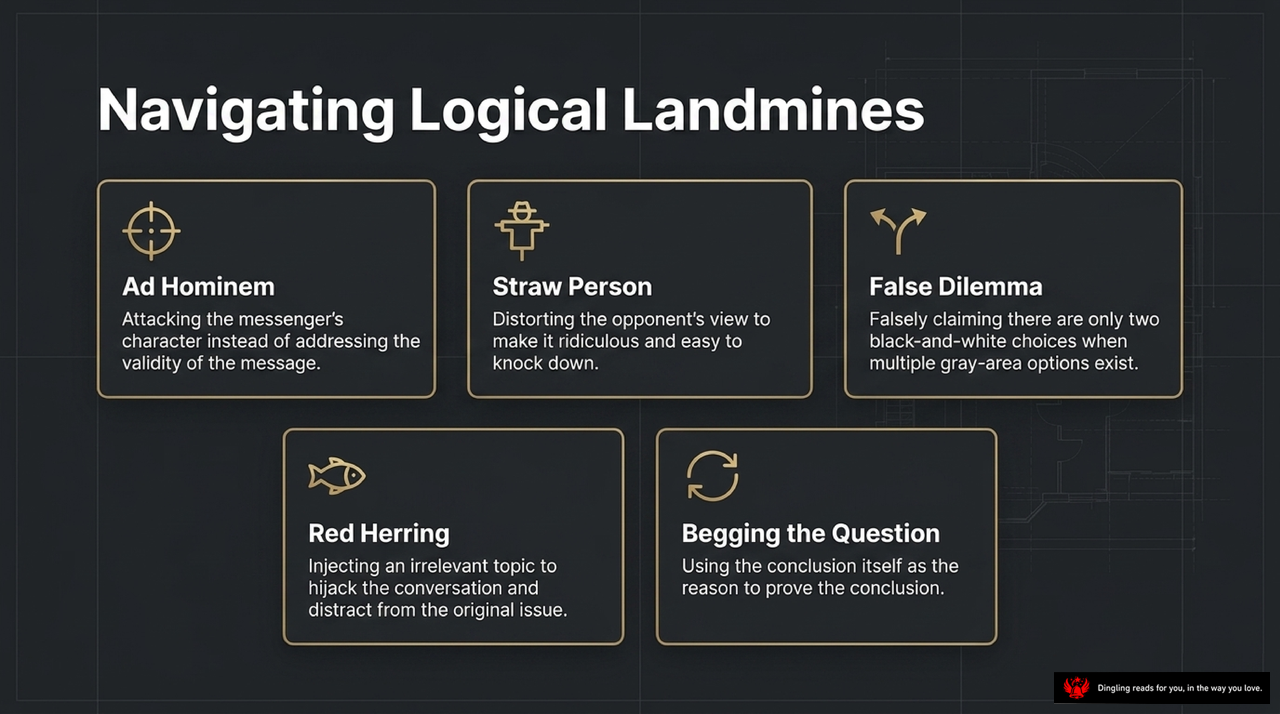
So, today we're diving into a critical concept: Navigating Logical Landmines. Think of every argument you encounter as a minefield. If you step on the wrong spot, your logic collapses. That's exactly what happens when we fall for these common traps.
First up, Ad Hominem. This happens when the focus shifts from the idea to the person. Instead of debating the actual point, they attack your character or background. It's a distraction. Next, the Straw Person. Here, the opponent doesn't address your real argument. They twist it into something ridiculous and easy to knock down. It's like building a scarecrow to shoot at, rather than facing the real enemy.
Then we have the False Dilemma. This is the "black and white" trap. The speaker claims there are only two options, usually extreme ones, ignoring the gray areas in between. Life isn't binary, but this fallacy forces you to choose sides when nuance exists.
Don't forget the Red Herring. This is the classic distraction tactic. The speaker injects an irrelevant topic to hijack the conversation. Suddenly, we're talking about something else entirely, leaving the original issue unaddressed. Finally, there's Begging the Question. This is circular logic. You use the conclusion itself as the reason to prove the conclusion. It's like saying, "The book is true because it says so."
Why does this matter? As we've explored in the text, these fallacies use misleading reasoning and emotional manipulation to make us accept unreasonable conclusions. They distort facts or simplify complex problems. Recognizing them isn't just about winning an argument; it's about protecting your mind from being manipulated. The book emphasizes that we must avoid being emotional slaves. These fallacies are tools used to manipulate our emotions rather than our reason. By learning to spot these patterns, you take control of your own thinking process. You stop being a victim of persuasion and start being a master of logic.
Ultimately, the goal isn't to defeat others, but to find the truth. That requires us to stay alert to these traps and demand better reasoning from everyone. When you spot these landmines, you stop being a passive receiver of information. You become an active thinker. You navigate the chaos of modern information with clarity and confidence. This aligns with the core goal of critical thinking: to move from passive acceptance to active judgment.
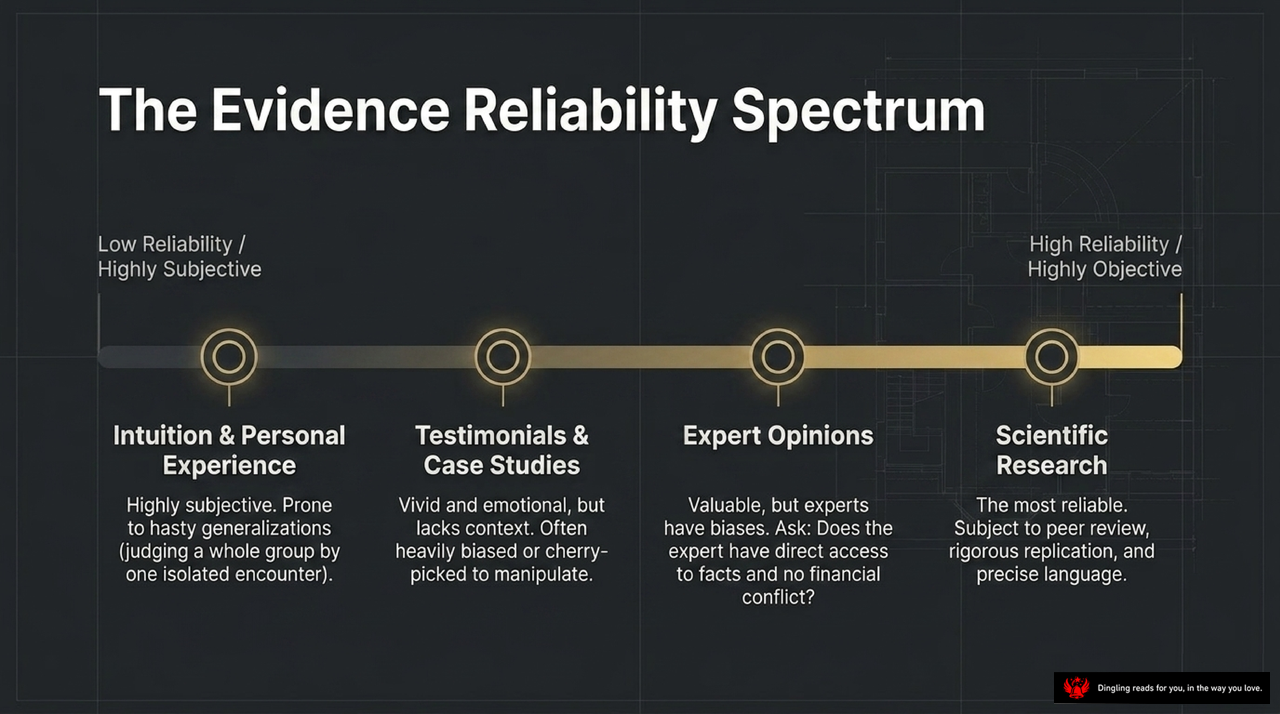
So, look at this Evidence Reliability Spectrum. It's a visual guide to help us navigate the chaotic world of information we face every day. The main idea is that not all evidence is created equal.
On the far left, we have Intuition and Personal Experience. This is the most subjective area. It's highly prone to hasty generalizations. Think about it: do you judge an entire group based on one isolated encounter? That's the trap here. It's emotional and limited. Relying on your gut feeling or a single memory often leads us astray because it lacks the broad context needed for a true understanding.
Moving right, we hit Testimonials and Case Studies. These are vivid and emotional, which makes them feel real and convincing. But the book warns they lack context. They are often heavily biased or cherry-picked to manipulate us. Just because a story feels true doesn't mean it's representative of reality. A single success story doesn't prove a cure works for everyone, and relying on one person's experience is rarely enough to make a solid decision.
Next, we have Expert Opinions. This is valuable, but experts have biases. The slide asks us to ask: Does the expert have direct access to facts and no financial conflict? If an expert is paid by the company they're reviewing, their opinion is compromised. We need to dig deeper to see if their advice is driven by truth or profit.
Finally, on the far right, we have Scientific Research. This is the high reliability end. It is the most reliable source available. Why? Because it is subject to peer review, rigorous replication, and precise language. It's not just one person's word; it's a process that has been tested by others over time.
The takeaway is about shifting your mindset. Instead of relying on what feels right or what a single person says, you should strive for objective evidence. Critical thinking isn't about doubting everything, but about knowing which evidence to trust. By understanding this spectrum, you stop being a passive container for information and start being an active filter for truth. This is how we cut through the noise and find answers we can actually rely on in our daily lives.
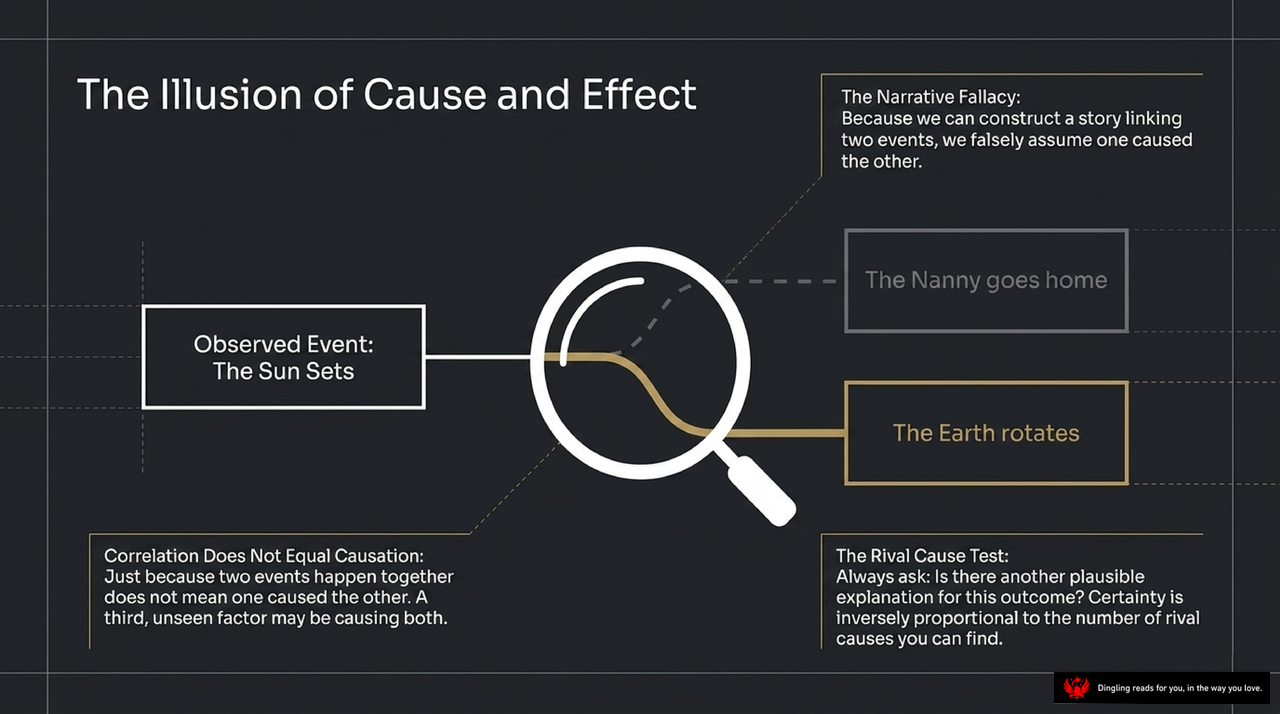
So, let's talk about a huge trap we all fall into: The Illusion of Cause and Effect. Look at that magnifying glass connecting the sun setting to the earth rotating. It feels obvious, right? The sun goes down, so the earth must rotate. But that's a story we tell ourselves. That's what we call the Narrative Fallacy. Just because we can link two events in a story doesn't mean one actually caused the other. We are wired to create connections, but often we're just seeing patterns where there are none.
Think about real life. We see ice cream sales go up, and crime rates go up. Our brain screams, "Ice cream causes crime!" But what's the third factor? It's the heat. Both happen because it's summer. That's the core point here: Correlation Does Not Equal Causation. Just because two events happen together does not mean one caused the other. A third, unseen factor may be causing both.
Or take the example of smoking and flu resistance. Maybe smokers are just more careful about hygiene? Or maybe it's pure coincidence. We need to stop assuming that because A comes before B, A caused B. That's the Post-hoc fallacy. We often ignore the fact that many factors work together.
Here's the tool to fix this: The Rival Cause Test. Whenever you see two things linked, ask yourself: Is there another plausible explanation? How many other reasons could explain this outcome? The more rival causes you find, the less certain you should be. Don't settle for a single culprit. The world is complex, not a simple line of dominoes.
When you find a single cause, you might be oversimplifying. Human behavior and events are usually the result of multiple factors pushing together. If you only focus on one, you miss the real picture. So, next time you hear someone say "X caused Y," pause and ask: What else could be going on? Challenge the story they are telling you. Don't let the narrative fool you. Keep digging for rival causes until you feel comfortable with your conclusion. That's how you move from illusion to understanding.
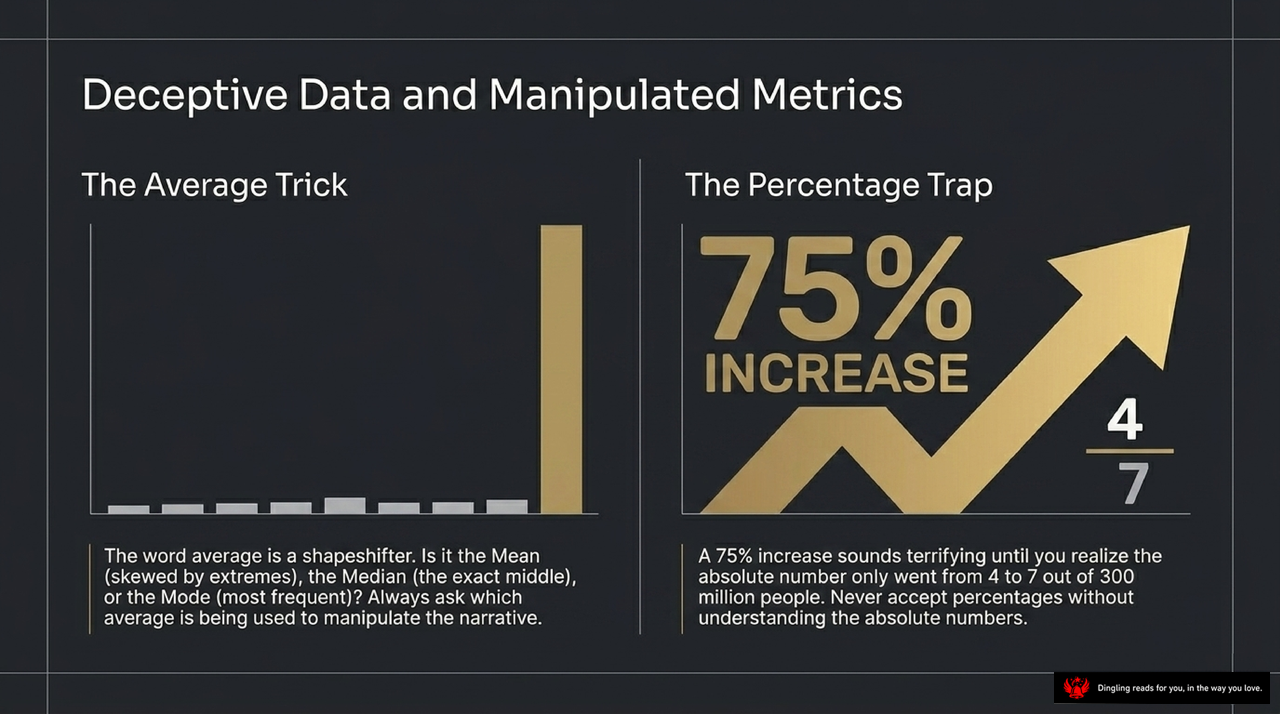
Welcome to the next section. Today we're looking at a very powerful tool used by persuaders: Deceptive Data and Manipulated Metrics. The slide breaks this down into two specific tricks: The Average Trick and The Percentage Trap.
Let's start with the Average Trick. The text calls the word "average" a shapeshifter. Why? Because it can mean three very different things: the Mean, the Median, or the Mode. Look at the chart on the left. It shows a few small bars and one massive bar. If you calculate the Mean, that one huge bar pulls the number up significantly. It makes the data look much higher than it actually is for most people. Think about it. If a company says their average salary is $200,000, you might think everyone is rich. But if one CEO makes $10 million and everyone else makes $30,000, the average is still $200,000. That's the trap. The text asks us to always ask: which average is being used to manipulate the narrative? If you're looking at income or test scores, a high average might just be hiding the fact that most people are actually doing poorly. That's why the Median—the exact middle—is often a truer reflection of reality. The Mean is skewed by extremes, so it's easy to lie with it. Always ask which average is being used to manipulate the narrative.
Now, let's look at the Percentage Trap. The image shows a bold 75% Increase arrow. That sounds terrifying, doesn't it? It sounds like massive growth. But look at the small text on the right: 4 to 7 out of 300 million people. Mathematically, that is a 75% jump. But contextually, going from 4 cases to 7 cases in a population of 300 million is barely a blip. The text warns us explicitly: "Never accept percentages without understanding the absolute numbers." A 75% increase in a tiny number is often less significant than a 1% increase in a massive one. Percentages are often used to create fear or excitement without giving you the real scale of the problem. It's a classic trick to make small changes look huge.
So, how do we protect ourselves? We need to be active thinkers, not passive receivers. When you see a number, don't just accept it. Ask for the context. Ask for the absolute numbers. Ask what the average actually means. By doing this, you stop being a victim of data manipulation and start being an active thinker. You take control of the data instead of letting it control you. This is the essence of critical thinking. In a world full of noise, understanding these tricks helps you find the truth.
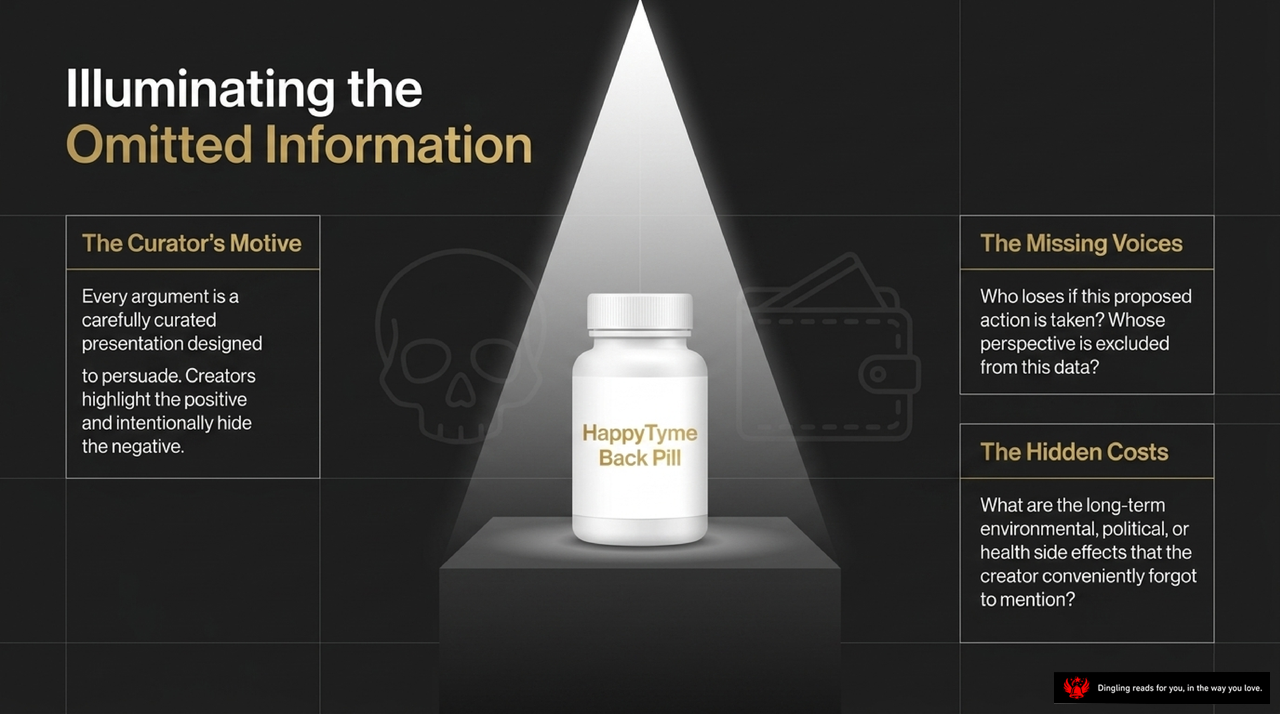
Look at this bottle. It says 'HappyTyme Back Pill.' It looks like a magic fix, right? But in the real world, almost every argument we encounter is trying to sell us a pill like that. This slide is all about 'Illuminating the Omitted Information.'
Think about it. When someone presents an argument, they are essentially the curator of a story. They highlight the good stuff and intentionally hide the bad stuff. This is what we call the 'Curator's Motive.' It's not always malicious, but it's rarely neutral. They are curating the narrative to persuade you. They show you the benefits but leave out the risks. This happens because our brains are wired for 'fast thinking,' making us accept the shiny surface without digging deeper.
But here's the danger: When we focus only on the pill, we miss the missing voices. Who loses if we take this action? Whose perspective is completely excluded from this data? Maybe it's the environment, maybe it's a marginalized group, maybe it's the long-term health of a community. These are the voices that get silenced in a polished presentation. For example, when we build a new school, we celebrate the education levels rising. But who talks about the trees being cut down or the tax burden on families? We see the immediate win, but we ignore the long-term cost.
Then there are the hidden costs. We see the immediate benefits—like a new product launch or a policy change—but we often ignore the long-term side effects. What about the environmental damage? The political instability down the road? The health consequences for future generations? The creator conveniently forgets to mention these because they don't fit the sales pitch.
So, how do we see through this? We have to stop accepting the pill at face value. We need to ask the hard questions. Who didn't get to speak here? What are the consequences we aren't seeing? Is this data complete, or is it cherry-picked?
Critical thinking isn't about being cynical; it's about being complete. It's about looking at the full picture, including the side effects and the people who aren't being heard. Don't just take the pill. Read the fine print. Because the truth is often found in what isn't being said. By illuminating these gaps, we stop being passive consumers of information and become active architects of our own understanding. We take back the power to decide what is truly good for us. Remember, a complete argument includes the shadows, not just the light.

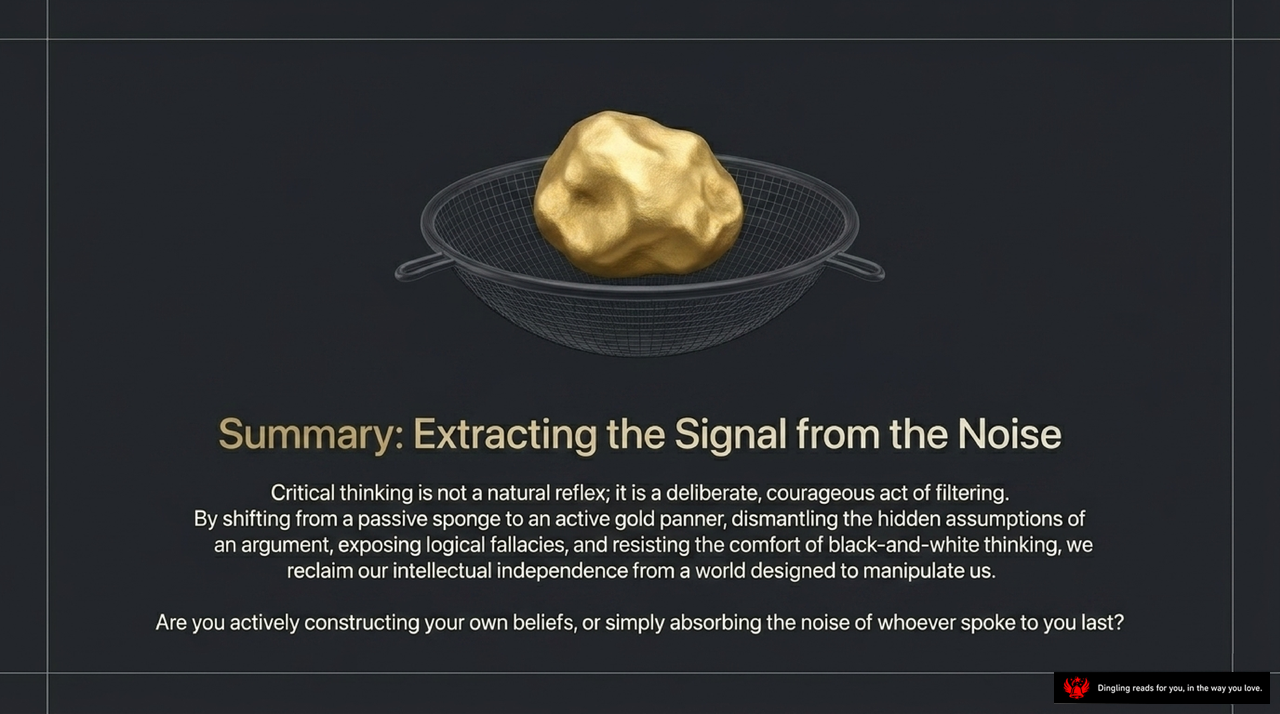
Welcome to the summary. Look at this image of a gold nugget on a sieve. It perfectly captures our main takeaway today: Extracting the Signal from the Noise.
Let's be honest with ourselves. Critical thinking is not a natural reflex. We don't wake up and start filtering information automatically. It is actually a deliberate, courageous act of filtering. We live in a world that is far from clear. Persuaders claim to hold the truth, but they often hide key details. Experts contradict each other. We rely on fast thinking, which is easily swayed by emotion. In this environment, if we just let the noise in, we become passive sponges, absorbing everything without question. We lose our ability to choose.
The real power comes from shifting from a passive sponge to an active gold panner. You are no longer just collecting data; you are sifting through it. You are actively asking questions. You are dismantling hidden assumptions and exposing logical fallacies. You are resisting the comfort of black-and-white thinking. By doing this, we reclaim our intellectual independence from a world designed to manipulate us.
So, as we wrap up this section, I want you to pause and ask yourself a crucial question: Are you actively constructing your own beliefs, or are you simply absorbing the noise of whoever spoke to you last? The difference between a sponge and a gold panner is the difference between being controlled and being free. Take that choice seriously.