
Attitude: Complete Chapter-by-Chapter Summary

Welcome to today's session on "Attitude," a timeless guide by Wu Jun. Imagine life as a journey guided by an ancient compass, where direction matters more than speed. This book isn't just about philosophy or wealth; it's a father's heartfelt letters to his daughter, offering a framework for shaping destiny.
Wu Jun shares a profound truth: happiness isn't tightly linked to money. He recalls his own childhood in poverty, where he felt no lack, contrasting it with the stress he sees in Silicon Valley despite its riches. He teaches us that true joy comes from a stable home, a豁达 heart, and an optimistic mindset. To build this, he suggests four pillars: continuous learning, pursuing ideals with action, respecting others, and seeing life's ups and downs as normal.
But life also throws us obstacles. Wu Jun warns against the trap of instant gratification, like video games, which steal our focus from long-term goals. He advocates for "doing the smart things the hard way"—like writing out every math step or leaving extra time for traffic. These "stupid" habits build resilience and prevent costly mistakes.
He also touches on money, not as an end, but as a tool. Don't chase every small discount; focus on high-value opportunities that build real skills. And in relationships, he advises us to be inclusive, recognizing that even difficult people have value if placed in the right context.
Ultimately, this book invites you to cultivate a strong inner compass. By mastering your habits, managing your resources wisely, and maintaining a positive attitude, you can navigate life's uncertainties with confidence. Let's dive into how these principles can transform your daily life.

Look at this blueprint titled "The Cascade of Destiny." It visualizes a fascinating chain reaction that shapes our lives, starting from the very top: Attitude.
As the diagram shows, your attitude flows directly into your Thoughts. It's the foundation. From there, your thoughts dictate your Words and Actions. These aren't just random moments; they are the building blocks that solidify into Habits. Over time, these habits carve out your Character, which ultimately determines your Destiny.
The text on the right highlights a crucial insight: "From a certain perspective, a child's destiny is already determined the moment bad habits are passed down." This means that the small choices we make today—how we think, what we say, and how we act—are silently constructing the future we will inherit or create.
Think about it: if you start with a positive, open attitude, it triggers a chain of constructive thoughts and actions, leading to good habits and a strong character. Conversely, a negative mindset can cascade downward, creating destructive patterns that limit your potential. This isn't about grand gestures; it's about mastering the cascade from the very top. Your attitude is the steering wheel; everything else follows the path you choose to drive on.

Look at this visual contrast between the Idealist and the Pragmatist. On the left, we see a machine locked in chains and covered in cobwebs, representing the person paralyzed by the wait for a 100% perfect solution. On the right, gears are turning freely, symbolizing the Pragmatist who ships a 46% solution and iterates.
This isn't just about engineering; it's about life philosophy. Happiness, as we see here, is an internal environment, not just a financial metric. Many of us fall into the trap of the Idealist, believing that if we just wait for the perfect conditions, everything will fall into place. But that waiting leads to zero progress.
Consider the case study at the bottom: Google's anti-spam team captured only 46% of violators in six months. It wasn't perfect, but it was real progress. The lesson is clear: better is the enemy of best. If you are waiting for the best, you will never start. True success comes from taking action with what you have today, accepting that the current solution is a stepping stone, not the final destination. Stop waiting for perfection and start building momentum with the 46% you have right now.

Look at this diagram. It illustrates the "Momentum of Success." The core message is clear: young people must achieve concrete successes early to learn the methodology of succeeding.
On the left, we see a downward spiral. It starts with failure, which leads to a loss of confidence. That loss of confidence triggers the next failure, creating a vicious cycle where you get stuck in a loop of negativity.
But look at the right side. This is the upward spiral. It begins with small success. This small win teaches you methods learned. As you apply these methods, you achieve larger success, which builds even more confidence and propels you higher.
Think of it like climbing Fragrant Hills. Pushing through exhaustion to reach that 500-meter peak teaches you the blueprint for overcoming all future mountains. That first concrete victory gives you the tools and the belief to tackle anything else. Don't let failure trap you in a cycle; instead, seize every small win to build the momentum that carries you to greater heights.

Today, we're diving into the concept of "Scope and Boundary"—a powerful framework for understanding how to navigate the world with clarity and foresight. As you see on this slide, true insight isn't just about raw intelligence or technical skill; it's about choosing the right game and seeing far enough into the future to make it count.
Think of it this way: Skill is your engine—your raw intelligence and technical ability. But having a powerful engine doesn't guarantee you'll reach the destination if you're driving the wrong car. That's where **Scope** comes in. It's about picking the right game. Would you spend your life high-frequency trading pennies, or would you build a paradigm-shifting company like Google or Apple? The difference between scraping crumbs and building an empire often comes down to the scope of your ambition.
However, even the best game means nothing if you can't see the finish line. That's the power of **Boundary**—how far into the future you can see. It's the difference between short-term wealth extraction and building a long-term legacy. Consider Napoleon: his military conquests were temporary, but his enduring Civil Code reshaped the world for centuries. True success requires the courage to trade short-term glory for long-term impact.
In a world full of noise, mastering these dimensions—Skill, Scope, and Boundary—is what separates those who merely survive from those who shape the future.

Luck isn't just a random roll of the dice; it's a calculated strategy you can build. Think of it as a formula: your base effort multiplied by three, plus the power of contingency planning.
This equation rests on two pillars. First, the Van Fleet Principle. Named after a U.S. General who used five times the standard ammunition to ensure victory, it teaches us that if you want a ten-point result, you need to prepare thirty points of effort. Second, the concept of over-preparation. Luck consistently favors those who assume they will face worse odds than everyone else and plan accordingly.
So, don't wait for luck to find you. Instead, stack the deck in your favor by working harder than you think you need to and preparing for the worst-case scenario. That's how you turn uncertainty into your greatest advantage.

Look at these three red lines on the screen. They aren't just rules; they are the survival guide for anyone serious about building real wealth. The core message here is simple but powerful: you cannot beat the market. Your best strategy isn't to pick individual stocks or time the market, but to simply buy the S&P 500 Index and stay invested.
But why does the chart warn us against shorting, leverage, and blind investing? Let's break it down. First, never short the market. Shorting creates infinite downside risk. If a stock is worth $50 and spikes unexpectedly, your loss could balloon to $950. It's a trap with no floor. Second, avoid leverage completely. Leverage magnifies losses, and when the inevitable market drop hits, it guarantees a total wipe-out. No amount of experience can save you from that.
Finally, the third red line is perhaps the most important: never invest in anything you cannot understand within a single day. If a financial product takes more than a day to grasp, it is a trap. These three principles—no shorting, no leverage, and no blind investing—are the golden rules that protect your capital from catastrophic failure. By sticking to the S&P 500 and respecting these boundaries, you stop gambling and start building a solid foundation for your future.

Imagine money not just as cash in your pocket, but as a three-tiered structure of your life. Think of it like a pyramid. At the very bottom is Survival—this is your financial dignity, the baseline where you simply have enough to eat and live without shame. Above that sits Comfort, which isn't about luxury, but the freedom from daily worry. You're no longer stressed about the next paycheck. And at the peak is Development, where your focus shifts to societal impact and leaving a lasting legacy.
Here's the crucial mindset shift: don't pick up sesame seeds while you're dropping watermelons. We often get obsessed with trivial savings or chasing every small dollar, wasting hours on low-impact tasks. True wealth comes from pushing your capabilities to the absolute extreme and making decisions that maximize your impact. Whether you're building a business, investing, or creating art, aim for the big picture. Don't settle for being good at many small things when you could be exceptional at one thing that changes the world. Your attitude toward wealth should always be: what is the biggest opportunity right now, and how do I seize it?

Look at this "Colleague Matrix." It maps out the complex dynamics of working with others based on two simple axes: Capability and Relational Alignment.
In the top-left quadrant, we have "The Talleyrand Archetype." These are individuals with high capability but low personal alignment. Think of the historical figure Talleyrand himself—brilliant, adaptable, and politically astute, yet notoriously unlikable. In a modern workplace, these are the high-performers who might be difficult to get along with, perhaps due to their sharp edges or lack of emotional warmth. Yet, the matrix tells us something counterintuitive: these are your ideal partners.
Why? Because achieving great things often requires discarding what we call "moral mysophobia"—the irrational fear of people we don't personally like. To build something massive, you must be willing to unite with and utilize people you don't naturally gravitate toward. You cannot afford to let personal dislike dictate professional collaboration.
Conversely, the bottom-left quadrant warns us to avoid people entirely. These individuals lack both capability and alignment; they simply drag everyone down. The bottom-right represents those who are loyal but limited. They are safe and friendly, but they lack the drive or skill to take us to the next level.
The key takeaway here is clear: success isn't about finding people you love. It's about finding people who can help you win, regardless of whether you like them. In the end, it's about impact and foresight, not just friendship.

When a request lands on your desk, how you respond defines your boundaries and your character. This slide outlines a clear framework for navigating those moments. Start by assessing your reality: if you simply can't help, reject immediately and politely, giving them time to find someone else. If you can help but the cost is too high, reject early to protect your own bandwidth. When you are willing but uncertain, promise effort but strictly manage expectations downward. Only when you are truly willing and able should you commit fully and deliver.
Remember the warning at the bottom: never offer cheap consolations or agree to help with unethical tasks. True professionalism isn't about saying yes to everyone; it's about making thoughtful, principled choices that align with your capabilities and values.
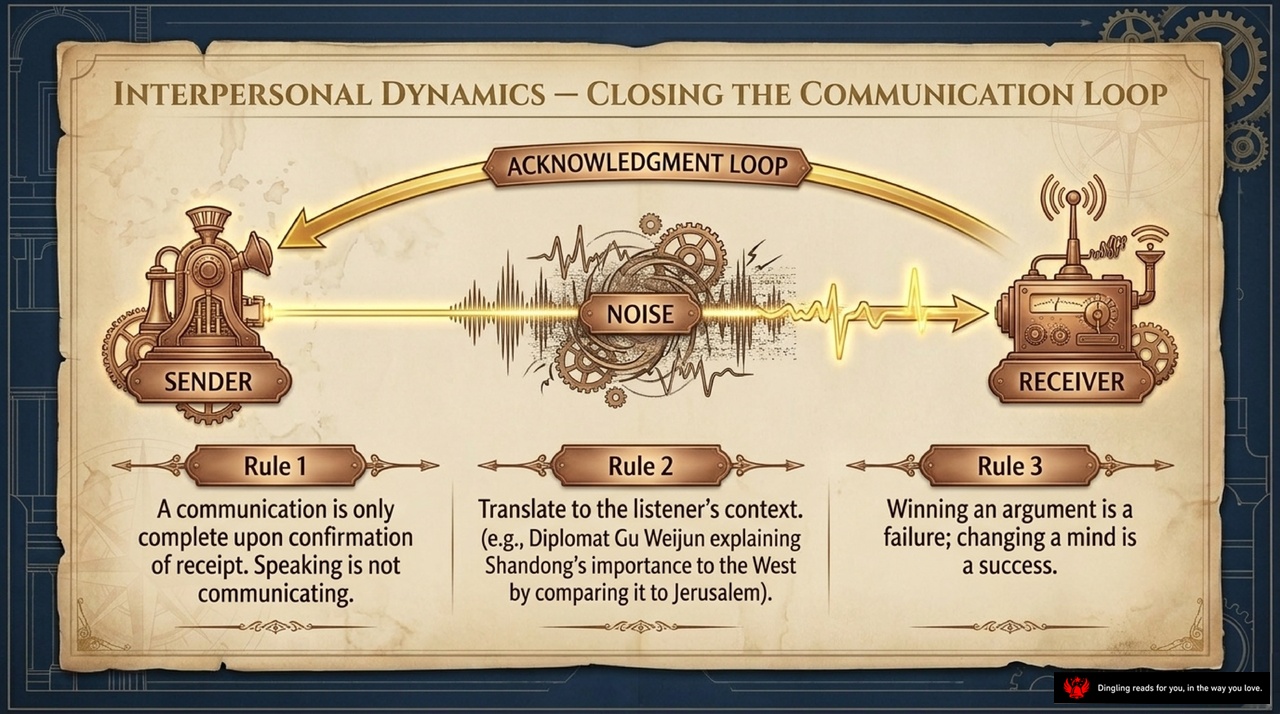
Interpersonal Dynamics—Closing the Communication Loop.
Look at this diagram. It illustrates the true nature of human interaction: it's not just about sending a message, but about closing the loop.
First, notice the **Sender** and the **Receiver**. Communication doesn't end the moment you speak; it only becomes complete upon confirmation of receipt. That's **Rule 1**: Speaking is not communicating unless you verify the other person actually got it and understood it.
But there's an obstacle in the middle: **Noise**. This isn't just background sound; it's any barrier that distorts your message. To overcome this, **Rule 2** tells us to translate your message into the listener's context. Think about it: if you're explaining a complex concept to someone unfamiliar with it, you must adapt your language. For instance, a diplomat might compare a foreign region to a concept the listener already knows, like comparing a Chinese province to Jerusalem, to instantly bridge the gap.
Finally, look at **Rule 3**. This is a crucial mindset shift. We often think winning an argument is a victory. But in reality, winning an argument is a failure. True success comes from changing a mind. If you just prove someone wrong, you've created more noise and resistance. If you help them see a new perspective, you've truly closed the communication loop.
So, remember: be the sender who seeks confirmation, adapt your message to the receiver's world, and prioritize understanding over being right. That is how you master interpersonal dynamics.

Effective learning isn't about accumulating facts; it's about mastering the truth. And here is the most important rule: science is not a final, religious conclusion. It is a process of constant testing.
Look at the slide. On the left, we see "Confirmation Bias." This is the trap where we only gather evidence that supports what we already believe, like pouring stones into a funnel just to fill it up. But on the right, we see the real engine of progress: Falsifiability. This means actively trying to break your own theory. It's like taking a hammer to your own gears to see if they hold up under pressure.
Why does this matter? Because history warns us that experts can be wrong. Heroin was once prescribed as a safe cough medicine by leading scientists, and DDT was a Nobel-winning miracle pesticide before it was banned. If we only seek what confirms our beliefs, we repeat these mistakes. To truly learn, you must stop defending your ideas and start stress-testing them. Embrace being a rational skeptic. What experts believe today might be disproven tomorrow, and that is exactly how we move forward.

Effective learning isn't about being the smartest person in the room; it's about mastering the system behind the work. Look at the two paths here: on the left, we see "The Trap of Intelligence." It depicts floating, broken steps crumbling into the void. This represents how smart people often fail. They rely solely on their raw intellect, skipping foundational steps and cutting corners. They try to jump to conclusions without doing the hard work of building a solid foundation. It's a fragile path that leads nowhere.
Now, look at the right side: "The Power of Systems." Here, we see sturdy, mechanical stairs with gears and rails. This is what I call doing things the "dumb way." It means sticking to step-by-step logic, manually processing data, and refusing to skip a single beat. It feels slow, even inefficient. But this method builds deeper, unbreakable comprehension. When you follow a robust system, you create a structure that can handle any challenge.
The takeaway is clear: rely on robust systems, not momentary brilliance. True mastery comes from the discipline of the "dumb way," not the arrogance of the "smart" shortcut.

Look at this chart. It's a professional diagnostic tool that cuts straight to the chase: it separates the amateur from the true professional. And the difference isn't just about working harder; it's about how you drive, process, execute, and scope your work.
First, look at **Drive**. The amateur is motivated by their mood—when they feel like it, they work. But the professional prioritizes the work regardless of how they feel. That's the discipline gap.
Next, **Process**. Amateurs skip protocols just to move fast, thinking speed is everything. Professionals strictly adhere to industry standards. They know that skipping a step doesn't save time; it creates risk.
Then, **Execution**. Here's where it gets interesting. Amateurs ignore the simple basics, thinking they're too easy. But professionals execute even simple tasks with extraordinary, unexpected brilliance. Think of a master musician like Mitsuko Uchida playing a basic Mozart sonata. The notes are simple, but the execution is flawless and transcendent.
Finally, **Scope**. Amateurs rely on one specific skill. Professionals build systematic, holistic domain knowledge. They don't just know how to do one thing; they understand the entire landscape of their field.
So, are you working like an amateur, or are you building the foundation of a true professional?

True success isn't about having a moment of brilliance; it's about the compounding result of a pragmatic attitude, professional execution, boundless vision, and the continuous pursuit of better methods. Think of it this way: if your destiny is simply the final shadow cast by your daily habits, what kind of shadow are you casting today?
We often chase quick wins, but real impact comes from showing up consistently with a clear plan. Whether you're refining your craft, leading a team, or building a product, the details matter. It's not about being perfect every day; it's about always moving forward, improving your approach, and staying focused on what truly drives long-term value.
So ask yourself: are you building habits that compound into greatness? Because the shadow you cast today will define the world you create tomorrow.