
Austerlitz: Complete Chapter-by-Chapter Summary

Welcome to the world of *Austerlitz*, a haunting exploration of European memory, monumental architecture, and a solitary man's descent into the labyrinth of his own repressed past. Written by W.G. Sebald, this story begins not with a person, but with a place: the grand, oppressive dome of Antwerp Central Station. It stands as a silent monument to colonial ambition, a glass cage where time itself feels trapped. Here, we meet our protagonist, a photographer obsessed with capturing the ghosts of the past. His journey leads him from the sterile corridors of Brussels courts to the rusting industrial zones of Liège, and eventually to the heart of London. But it is in the ruins of Terezín and the shadow of the Holocaust that the true weight of his identity is revealed. As he pieces together a fragmented childhood lost to war and displacement, he discovers that the buildings he studies are not just structures of stone and steel, but vessels holding the screams of history. From the frozen time of a billiard room in an abandoned estate to the chilling silence of a Jewish ghetto, *Austerlitz* invites us to look past the surface of the world and see the deep, often painful scars etched into our collective memory.

Meet Jacques Austerlitz, a man who seems to walk through history rather than live in the present. He is an architectural historian and a transient observer, constantly roaming the railway stations of Europe. But what defines him isn't just his profession; it's the physical weight he carries. He walks with a ten-shilling canvas rucksack and heavy hiking boots, dressed in an outdated, custom-tailored suit jacket and faded blue cotton workman's trousers. In his hand, he holds a vintage Ensign camera with leather bellows, always ready to capture the past.
This image captures his enigmatic nature. He studies the physical weight of history while remaining entirely disconnected from his own life. He shares a striking resemblance to the philosopher Ludwig Wittgenstein: both carry their rucksacks everywhere, both exist in a state of self-imposed austerity, and both are imprisoned by the painful tension between lucid logical thought and deep, unresolvable emotional bewilderment. For Austerlitz, the world is a series of frozen moments, a collection of ruins and memories he cannot let go of, trapped in the silence of his own mind.
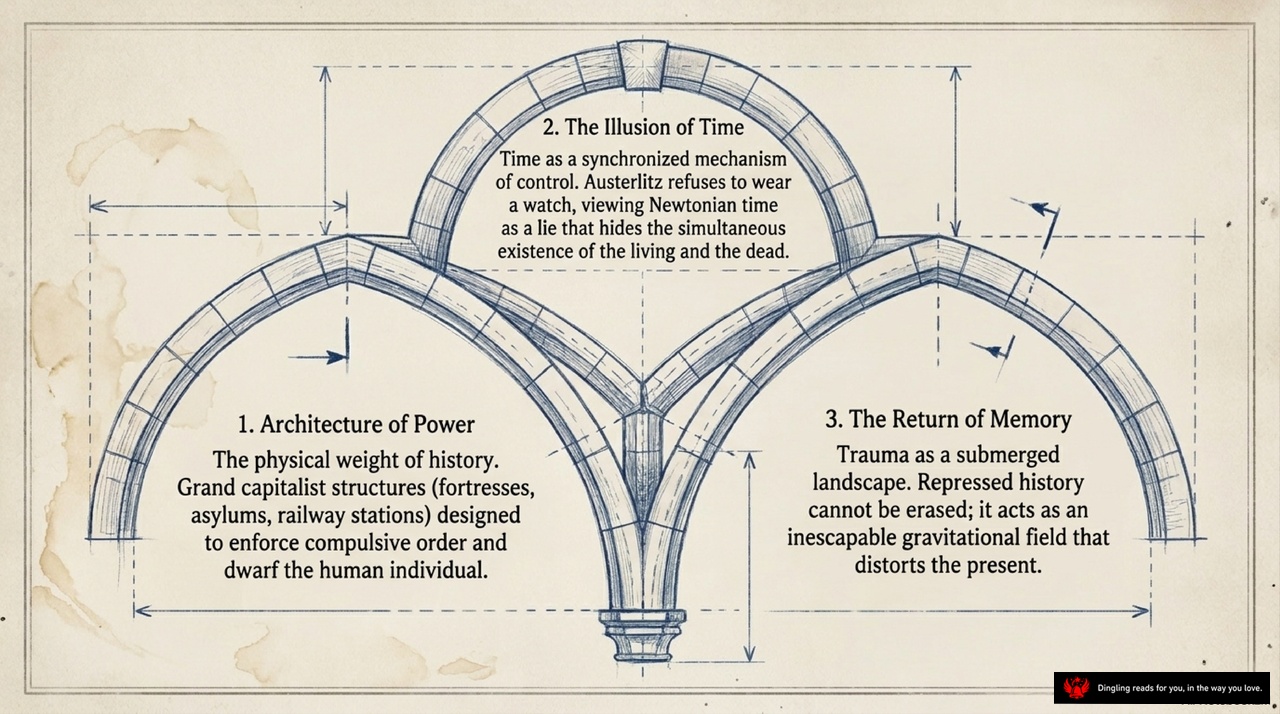
Look at this architectural blueprint. It's not just a drawing; it's a map of how history traps us. The diagram breaks down three powerful forces that shape our reality. First, we have the "Architecture of Power." Think about grand capitalist structures like fortresses, asylums, or railway stations. These aren't just buildings; they are physical weights of history designed to enforce order and make the individual feel small. They dwarf us.
But there's a deeper layer here: the "Illusion of Time." As we see in the top arch, time is often presented as a synchronized mechanism of control. Austerlitz refuses to wear a watch because he sees Newtonian time as a lie. It hides the truth that the living and the dead exist simultaneously. He wants to step out of that rigid clock.
Finally, we have the "Return of Memory." Trauma acts like a submerged landscape. You can't erase repressed history; it creates an inescapable gravitational field that distorts your present. Just like those sunken villages or the ghosts in the walls, the past pulls you down no matter how hard you try to float above it. This is the invisible force that makes the present feel unstable.

Standing in the quiet, octagonal room of the Greenwich Observatory, we looked out at the water, but Ostertitz saw something far more unsettling: the very concept of time itself. He told me that time isn't a natural force like the growth of a tree or the erosion of stone; it's a human invention, a rigid cage we built to trap our lives. He pointed to the Thames, asking where the river's banks are, and then asked where the banks of time are. We assume time flows in a straight line, but he argued that for many people—those who are dead, sick, or simply trapped in tragedy—time stops. They live in a timeless present, severed from the past and future.
Later, we visited Iver Grove, a crumbling estate where the house itself seemed terrified of its own end. We found a billiard room frozen exactly as it was 150 years ago, untouched by history. But the real shock came from the master's childhood bedroom, hidden behind a false wall. When he opened the door, he saw his own childhood toys, the scratch marks he'd made on the night he was forced to leave home. It was a violent reminder that the past isn't gone; it's just waiting for us to look at it. He described the room as a separate universe, a place where time had been paused, yet for him, stepping into it meant crashing back into the pain of being uprooted.

Welcome to the hidden architecture of power. Look closely at these four drawings. They aren't just buildings; they are the physical manifestation of a specific kind of fear. Austerlitz calls this "The Architecture of Capitalism & Paranoia." He argues that the monumental structures of the 19th century, driven by the dizzying wealth of markets like Brussels, share a terrifying, common intent.
First, notice the sheer scale. The first image shows a massive dome. This isn't about beauty; it's about "Supreme Scale." These structures are designed to evoke terror and awe, turning humans into insignificant shadows. You feel small because the building is trying to make you feel that way.
Then, look at the second structure, featuring a central clock. Think about the Antwerp Station. That clock sits above the royal coat of arms. Time itself is positioned as the ultimate dictator. It is surveilling and synchronizing every single passenger's movement, trapping everyone in a rigid schedule that no one can escape.
Finally, examine the last two images. One is a circular fortress, and the other is a star-shaped labyrinth. This represents "The Hidden Labyrinth." Just like the Brussels Palace of Justice, which contains seven hundred thousand cubic meters of stone, these monuments are filled with dead-end corridors and inaccessible rooms. They aren't just buildings; they are symbols of deep, impenetrable secrets and absolute authority.
Austerlitz studies the family resemblance between these structures—a grand station, a cathedral, a prison, and a fortress. They all look different, but they share the same DNA: a design meant to control, intimidate, and hide the machinery of power behind walls of stone and silence.
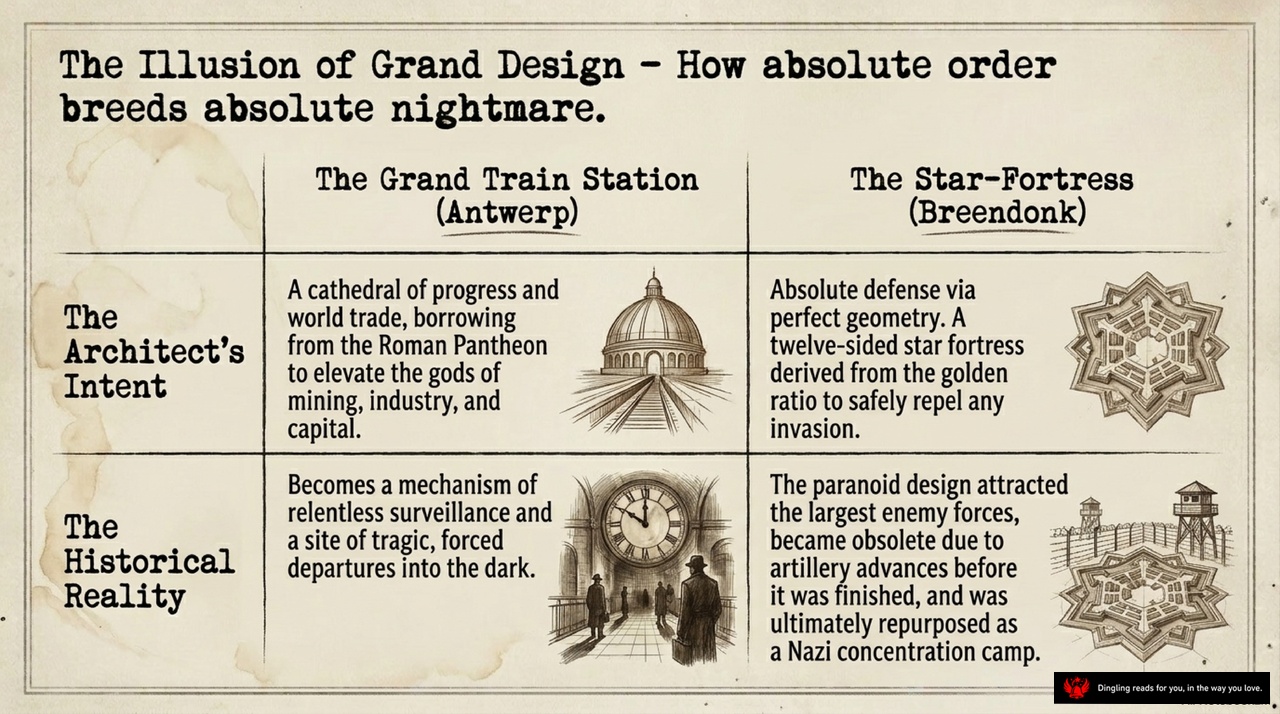
The illusion of grand design isn't just about beautiful buildings; it's about how absolute order can breed absolute nightmare. Look at this slide: we have two starkly different examples of this tragic logic. On the left, the Grand Train Station in Antwerp. The architect's intent was noble—a cathedral of progress, borrowing from the Roman Pantheon to elevate the gods of mining and capital. But the historical reality? It became a mechanism of relentless surveillance, a place where time itself felt like a prison, forcing people into the dark.
On the right, we see the Star-Fortress in Breendonk. Designed with perfect geometry based on the golden ratio, it was supposed to be an impenetrable shield against invasion. Yet, that paranoid obsession made it obsolete before it was even finished. Instead of defending the city, it attracted enemy forces and was ultimately repurposed as a Nazi concentration camp.
Both structures reveal a terrifying truth: when we try to impose rigid, absolute order on the world, we don't create safety. We create a blueprint for our own destruction. Whether it's a station built to glorify empire or a fortress built to repel armies, the result is often a vessel for human suffering. Absolute order, as we see here, is nothing more than an absolute nightmare.
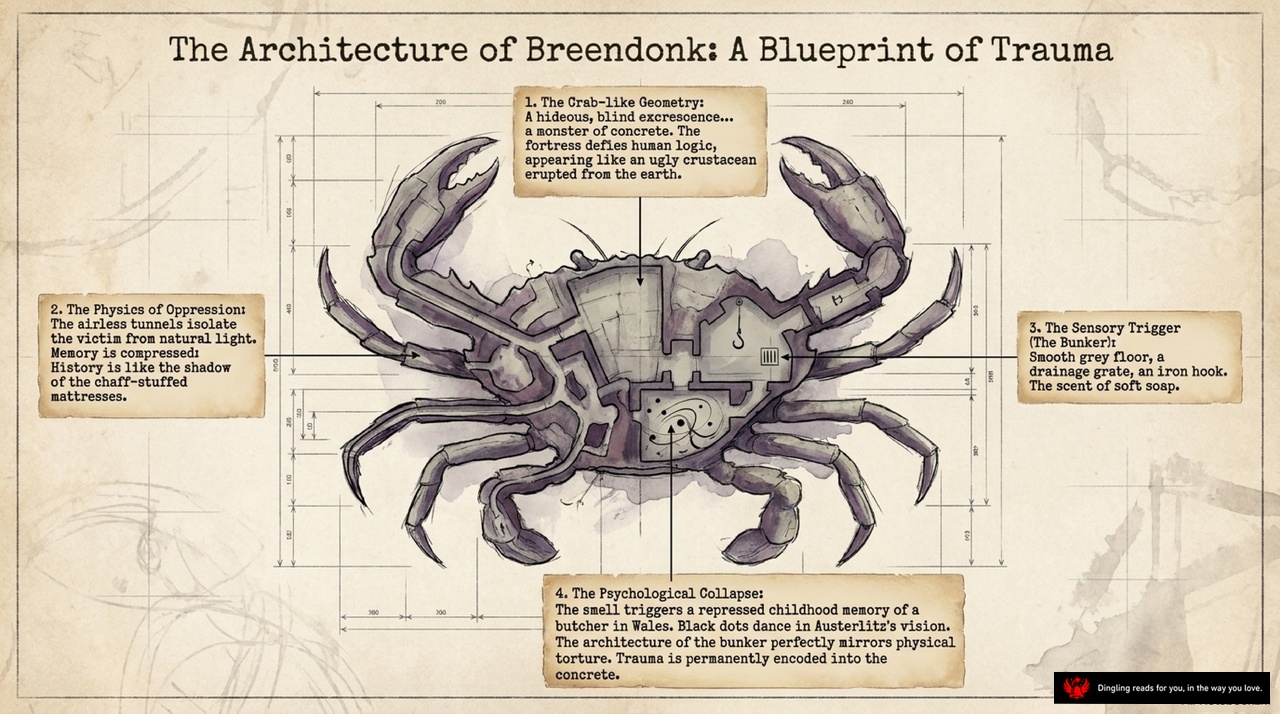
Look at this blueprint of Breendonk. It's not just a map; it's a blueprint of trauma, designed to look like a crab. The first thing you notice is the geometry itself—a hideous, blind excretion that defies human logic, appearing like an ugly crustacean erupted from the earth. This isn't accidental design; it's the architecture of oppression. The airless tunnels isolate the victim from natural light, compressing memory until it feels like the shadow of chaff-stuffed mattresses.
Then, look at the sensory triggers inside the bunker. Smooth grey floors, a drainage grate, an iron hook, and the lingering scent of soft soap. These aren't just details; they are psychological collapse points. That specific smell triggers a repressed childhood memory for someone like Austerlitz, conjuring visions of a butcher in Wales. The black dots dancing in his vision are no accident. The architecture of the bunker perfectly mirrors physical torture, permanently encoding trauma into the concrete. This fortress was built to trap the mind as surely as it trapped the body.

The Newtonian River represents the artificial, rigid time imposed upon the world in the nineteenth century—a standardized mechanism born from the need to synchronize railway schedules. It was a construct of anxiety and control, forcing the chaotic flow of nature into a predictable, linear track. But beneath this surface lies The Sebaldian Strata, where time behaves differently. Here, time does not pass; it layers. It is simultaneous, a landscape already populated by the past. In this reality, the dead are exempt from time, and moments of extreme agony or joy are preserved eternally in specific spaces. We are not moving forward through a single timeline; we are merely navigating a complex terrain where history, memory, and the present collide, allowing us to see that the past is not gone, but simply waiting to be encountered again.
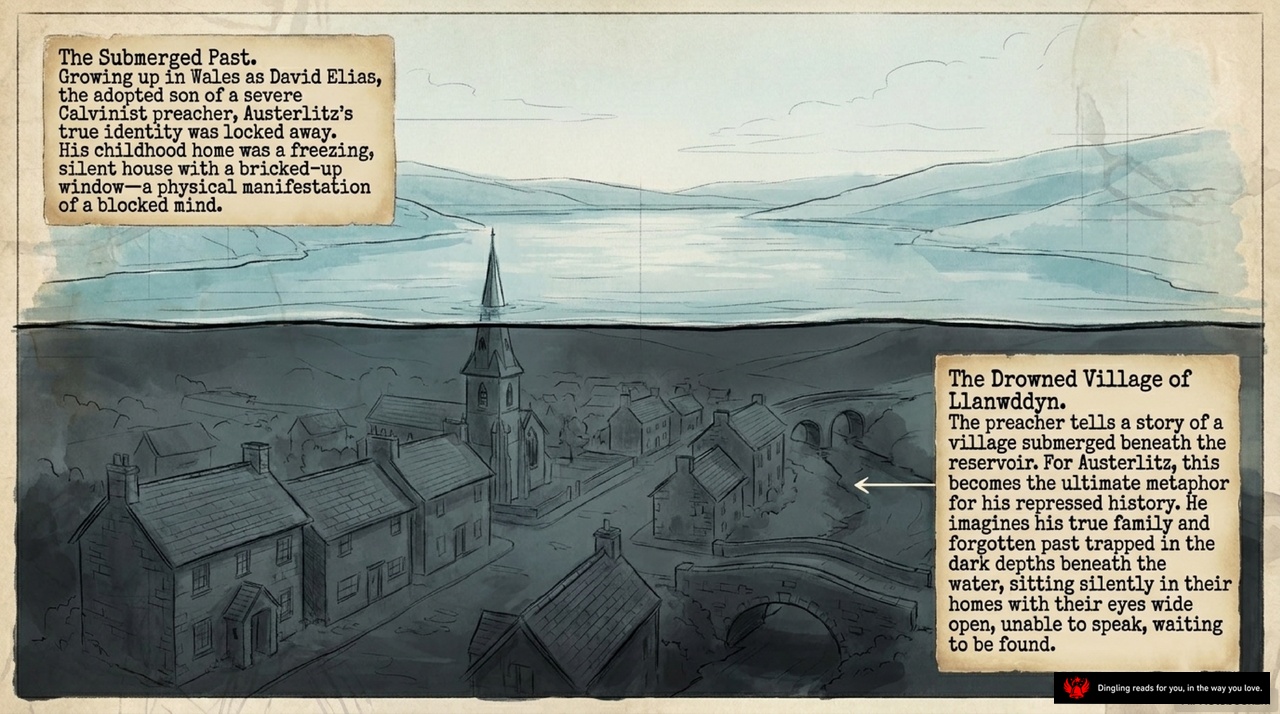
Welcome to the submerged past of David Elias, the man who would become Austerlitz. Growing up in Wales as the adopted son of a severe Calvinist preacher, his true identity was locked away, buried deep beneath the surface of his own life. His childhood home was a freezing, silent house with a bricked-up window—a physical manifestation of a blocked mind, a metaphor for the secrets he couldn't speak.
This repression wasn't just personal; it was echoed in the landscape itself. The preacher tells a story of a village submerged beneath the reservoir, Llanwddyn. For Austerlitz, this becomes the ultimate metaphor for his repressed history. He imagines his true family and forgotten past trapped in the dark depths beneath the water, sitting silently in their homes with their eyes wide open, unable to speak, waiting to be found. Just like the village, his own life feels like a sunken world, where the past is alive but silenced, drowning in the quiet depths of memory.
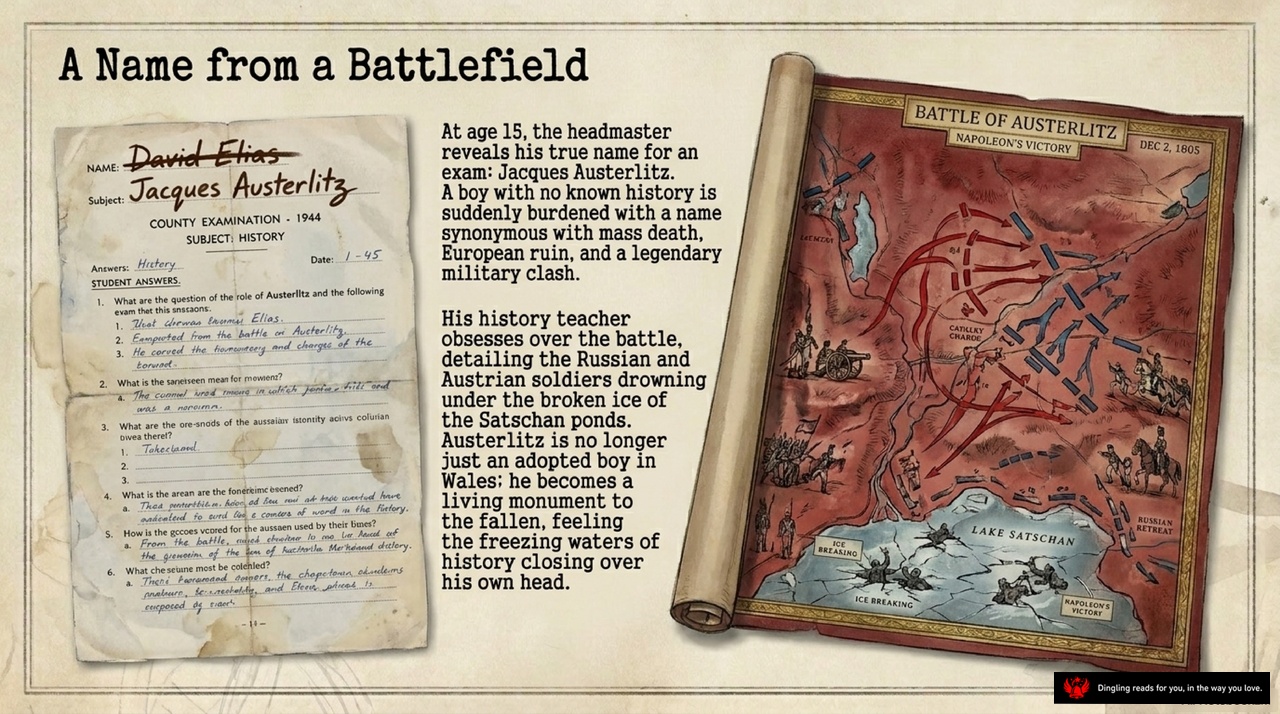
At age fifteen, a pivotal moment reshaped Jacques Austrelitz's identity forever. During a history exam, his headmaster revealed his true name: Jacques Austrelitz. Suddenly, a boy with no known past was burdened with a name synonymous with mass death, European ruin, and a legendary military clash. The weight of this legacy pressed down on him, transforming him from an adopted boy in Wales into a living monument to the fallen. He began to feel the freezing waters of history closing over his own head, haunted by the memory of Russian and Austrian soldiers drowning under the broken ice of the Satschan ponds during Napoleon's victory. This sense of being a historical echo drove him to obsess over the Battle of Austerlitz, studying maps and details until the name itself became an inescapable part of his soul.

In this dark, atmospheric scene, we see the mind of Austerlitz laid bare. On the left, a moth rests in a small box, labeled "Nocturnal Wanderers." The text explains that these insects, like traumatized humans, are trapped in a small box, representing dead time preserved. Their erratic, dust-like decay mirrors the fragile, fragmented nature of human memory trying to survive the dark. This isn't just about an insect; it's a metaphor for Austerlitz's own life—a creature kept in a cage, unable to fully fly, surviving on the edges of perception.
On the right, we find "The Delayed Image." Here, a developing photograph sits in a tray, its face emerging slowly from the blank paper. The caption notes that developing photos mimic the delayed surfacing of repressed memory. Just as an image crystallizes from the subconscions depths, Austerlitz's forgotten faces and terrifying truths slowly come into focus. It's a visual representation of his internal struggle: the slow, painful process of pulling the past out of the dark, demanding to be seen.
Together, these two elements capture the core of Austerlitz's experience. He is a nocturnal wanderer, haunted by a past he cannot fully grasp, while simultaneously searching for clarity in the foggy, delayed images of his own life. He is stuck between the safety of the box and the terrifying freedom of the light, forever caught in the moment between memory and reality.

The Rose Queen's Page. When Austerlitz returns to Prague, he finds his former nanny, Věra. As they speak, the Czech language—buried for 60 years—suddenly rushes back to his lips. Věra presents him with a photograph of himself at age five. It is not a moment of joyful rediscovery, but of sheer panic. The boy in the photo stares back with a demanding, piercing gaze. He stands in the pale dawn light, a ghost from 1939, waiting to challenge the adult Austerlitz to uncover the tragedy that befell his parents. Time collapses; the past confronts the present.

On the left, you see a chaotic wall of German compound words—nonsense terms like "surcharge calculation receipts" and "vermin eradication"—stacked like the bricks of a prison. This visual perfectly captures the second paragraph of our text: the Nazis didn't just commit mass murder; they transformed it into an architectural and bureaucratic labyrinth. They categorized suffering into absurd, endless compound words, turning human agony into administrative data.
This leads us to the title on the right: "The Bureaucracy of Horror: Theresienstadt." To truly understand his mother's fate, Austerlitz dives into H.G. Adler's 800-page study of this ghetto. What he discovers isn't chaos, but a terrifying, futuristic dystopia of total administration. It was a grotesque realization of 19th-century capitalist efficiency applied to human extermination. In this place, suffering was processed with cold precision, categorized through endless receipts and worthless repair shops, creating a system where the machinery of death ran as smoothly as a factory.
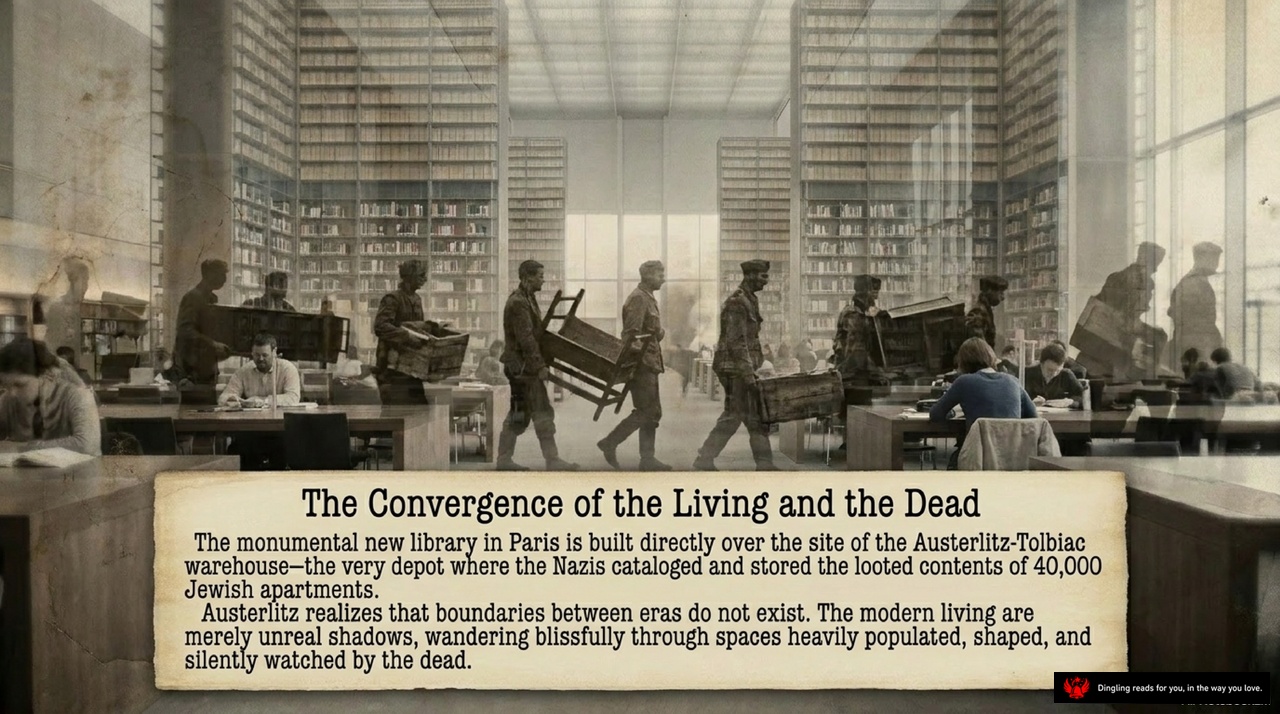
Look at this image. It shows a modern library in Paris, bustling with life. People are reading, studying, and moving about in a bright, airy space. But look closer. Faintly superimposed over this modern scene are the ghostly figures of soldiers from the past, carrying crates and boxes. This visual perfectly captures the book's profound concept: The Convergence of the Living and the Dead.
The text on the slide reveals the shocking reality behind this architecture. This monumental new library was built directly over the site of the Austerlitz-Tolbiac warehouse. That warehouse was the very depot where the Nazis cataloged and stored the looted contents of 40,000 Jewish apartments. It was a place of systematic destruction, yet today, it is a place of knowledge and light.
As the slide explains, Austerlitz realizes that boundaries between eras do not exist. The modern living are merely unreal shadows, wandering blissfully through spaces heavily populated, shaped, and silently watched by the dead. The books on these shelves were once stolen from homes; the quiet study halls were once sites of chaos and horror. The living walk through a landscape that is fundamentally haunted, unaware that their present is built upon the buried past. The past is not gone; it is simply layered beneath the present, waiting to be felt.

Jacques Austerlitz's lifelong wanderings reveal that human history is not a march of progress, but a labyrinth of trauma where repressed memories, monumental ruins, and the ghosts of the past wait eternally in the shadows to reclaim the present. If our grandest structures are monuments to our paranoia, and our synchronized clocks are merely illusions to hide our mortality, how can we ever truly escape the weight of the dead who silently watch our every move? Standing on these abandoned tracks, you can feel the crushing pressure of time itself. The rails stretch endlessly into the fog, mirroring a journey that never truly ends. Just as the great clock at the Central Station in Antwerp once sought to imprison the world in rigid schedules, we too are trapped by our own need for order. We build walls, towers, and fortresses to feel safe, only to find they become cages that hold us captive to our own fears. The past isn't gone; it's just waiting in the mist, ready to step forward whenever we least expect it.