
Bad Blood: Complete Chapter-by-Chapter Summary

Welcome to *Bad Blood* by John Carreyrou. Imagine a single, perfect drop of red blood suspended in stark white space—a powerful visual for a story that begins with a promise to heal, but ends in a tragedy of deception. This book chronicles the rise and fall of Theranos, a Silicon Valley healthcare unicorn built on secrets, lies, and systemic fraud. It's the true story of Elizabeth Holmes, a woman whose childhood ambition grew into a dangerous obsession, convincing the world that she could revolutionize medicine with just a drop of blood, when in reality, she was selling them nothing but lies.

Imagine a sleek, black device sitting on a white pedestal—clean, minimalist, and undeniably cool. This isn't just a prototype; it's the vision of Theranos, billed as the "iPod of Healthcare." The slide captures the core promise: democratizing blood testing, eliminating the fear of needles, and catching terminal diseases early with just one tiny drop.
But how did this vision take shape? The inspiration was drawn directly from Steve Jobs' "reality distortion field." Notice the design cues on the screen: the all-black aesthetic, the high-collared turtlenecks, and even the decision to hire Apple's top ad agency. It was a deliberate attempt to transplant Apple's design language and cultural mystique into the chaotic world of biotech.
However, this vision came with a dangerous price tag. While the marketing promised a seamless, user-friendly experience modeled after the iPhone, the reality was far more complex. The drive to make the device look as simple as an iPod led to engineering nightmares. The team struggled to fit complex chemistry into a tiny box, often relying on diluting blood samples to make the numbers work—a practice that fundamentally compromised patient safety.
This slide highlights the pivotal moment when ambition outpaced reality. The "one tiny drop" slogan was a powerful marketing hook, but it masked a system that was neither ready nor reliable. As we move forward, we'll see how this gap between the polished exterior and the broken interior eventually led to one of the most significant scandals in Silicon Valley's history.
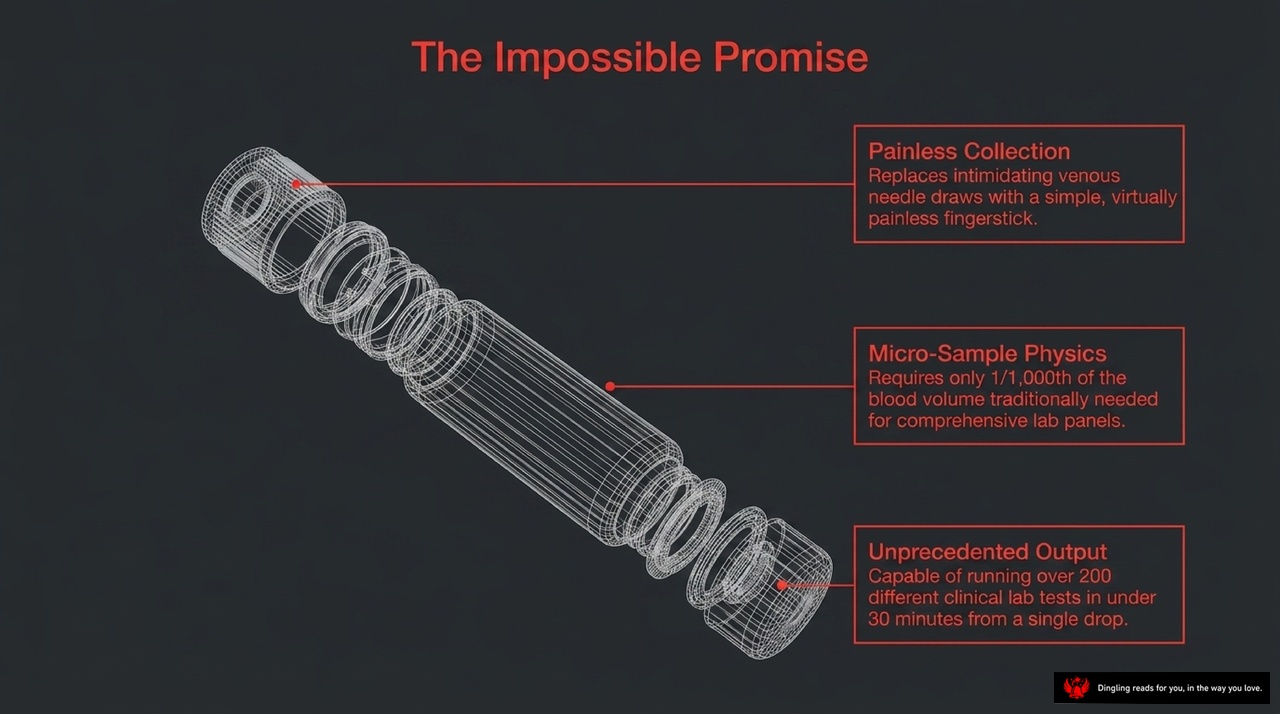
The Impossible Promise: Painless Collection, Micro-Sample Physics, and Unprecedented Output.
Imagine a world where the fear of needles disappears forever. That is exactly what Theranos promised. Instead of intimidating venous needle draws, they offered a simple, virtually painless fingerstick. But the real magic lies in what happens next. Thanks to their micro-sample physics, the device requires only one-thousandth of the blood volume traditionally needed for comprehensive lab panels. It's like getting a full health checkup from a single drop.
And the speed? It's nothing short of revolutionary. Capable of running over 200 different clinical lab tests in under 30 minutes from that single drop. This unprecedented output was the engine behind their early hype, convincing investors and partners like Walgreens that they were on the verge of a medical revolution. They promised a future where diagnostics were fast, cheap, and accessible to everyone. Yet, as we will see, this impossible promise was built on a foundation that couldn't hold up under the weight of reality.

The Shield of Credibility. Look at this diagram. At the center sits Elizabeth Holmes, but notice who surrounds her. On one side, you have the military and political titans: George Shultz, Henry Kissinger, and General James "Mad Dog" Mattis. On the other, the financial heavyweights: media mogul Rupert Murdoch and prominent VC Tim Draper.
This wasn't just a board of directors; it was a carefully constructed shield. By stacking the board with these elite statesmen rather than actual scientists, Theranos successfully replaced rigorous clinical peer review with sheer elite prestige. The logic was simple yet devastatingly effective: if you are backed by the former Secretary of State, a four-star General, and the owner of Fox News, who are you going to believe? A scientist with a lab coat, or a visionary with the most powerful people in the world on her payroll?
The result was a complete blind spot. These titans provided an aura of absolute patriotic integrity and financial validation that silenced any doubts. They didn't question the technology because they were too busy validating the person behind it. The "scientific peer review" circles at the bottom of the chart were effectively bypassed. Instead of asking "Does this technology work?", the board asked "Who is running this company?" And the answer was someone nobody wanted to oppose. This strategy allowed Theranos to inflate its valuation to astronomical levels while hiding its fundamental technical failures behind a wall of unassailable credibility.

Weaponizing FOMO: The Trap of Walgreens and Safeway
Look at this timeline. This is where the fiction became a financial disaster. On the left, you see two massive retail giants: Walgreens and Safeway. They didn't just invest; they went all in. Walgreens poured over $50 million into inventory and loans, while Safeway committed more than $30 million. But here is the critical part—the logic behind the money.
Notice the second column. Walgreens ignored explicit internal warnings from their own lab consultant. Why? Because they were terrified that CVS would steal the deal. It was pure fear of missing out. Safeway, on the other hand, retrofitted their grocery stores with high-end clinics based solely on emotional executive demos. They built entire health centers on a foundation of nothing but a promise.
And then, look at the red lock on the right. This is "The Trap." Both companies signed extreme Non-Disclosure Agreements. They locked themselves in. They deployed capital without their executives ever being allowed inside Theranos's actual testing labs. They were paying millions to see a lie, and the contract made it impossible for them to walk away. This wasn't just a bad investment; it was a calculated cage built by Elizabeth Holmes to secure her valuation, trapping these giants in a cycle of denial.
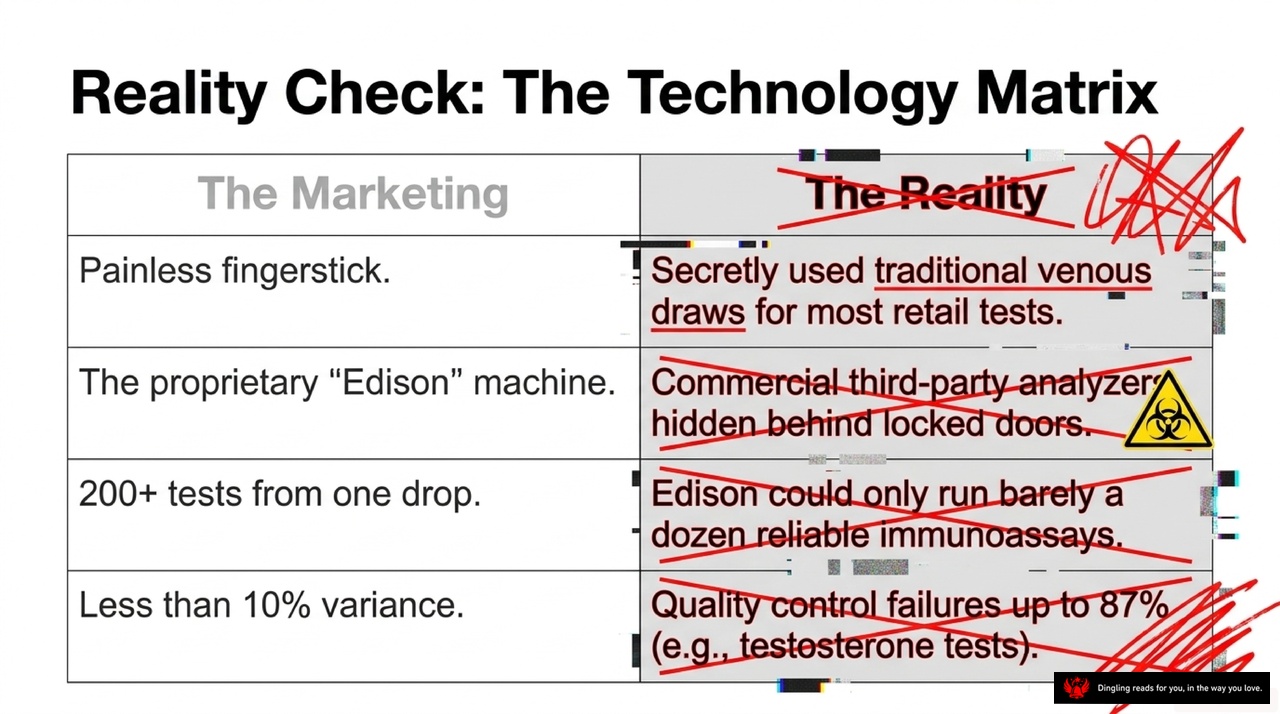
Reality Check: The Technology Matrix. Look at this slide. On the left, we have the glossy marketing pitch: painless fingersticks, a proprietary "Edison" machine, 200+ tests from a single drop, and less than 10% variance. It sounds like magic, right? But look at the right side—this is the brutal reality.
Forget the painless fingerstick. In reality, for most retail tests, they were secretly using traditional venous draws, hiding the needles behind the scenes. That "proprietary Edison machine" wasn't a miracle invention; it was a commercial third-party analyzer hidden behind locked doors, often modified to look different. And don't believe the claim of 200+ tests from one drop. The Edison machine could only reliably run a dozen immunoassays at best. The rest? They were running on borrowed time with commercial equipment.
Finally, that promise of less than 10% variance? It was a lie. Quality control failures were rampant, reaching up to 87% for tests like testosterone. The system wasn't just imperfect; it was dangerously broken. This slide isn't just about a failed company; it's a stark reminder of what happens when marketing completely overrides science. When the story is too good to be true, it usually is.

The Dilution Deception: How a Tiny Blood Sample Was Sabotaged
Imagine this: a simple fingerstick, a drop of blood meant to reveal your health status. But in Theranos's world, that tiny sample was never the same. Let's walk through the five-step lie that ruined thousands of lives.
Step 1 is Collection. A micro-sample is drawn via fingerstick into a Nanotainer. It looks harmless, right? But Step 2 is where the real trouble begins. The sample is rushed to the restricted "Normandy" lab—a secret room where the truth could be erased.
Step 3 is The Hack. This is the core of the fraud. Tecan robots flood the tiny blood sample with excessive saline to artificially increase the liquid volume. Why? Because the real machines needed more fluid than a fingerstick could provide. By diluting the blood, they were essentially watering it down, altering the chemical concentrations before they were even tested.
Step 4 involves Third-Party Machines. This diluted, fake sample is fed into hacked Siemens ADVIA 1800 machines. These aren't Theranos's own technology; they are standard hospital analyzers that Theranos had secretly modified or bypassed to accept the diluted fluid. The machine sees a normal volume of liquid and spits out a normal result, completely unaware that the blood inside has been tampered with.
Finally, Step 5 delivers The Result. Because the chemical concentrations were irreparably altered by the dilution, the system generates wildly inaccurate and clinically dangerous patient results. A healthy person might look sick, or a sick person might appear healthy. This deception wasn't just a technical glitch; it was a systematic failure that put patients at risk every single day.
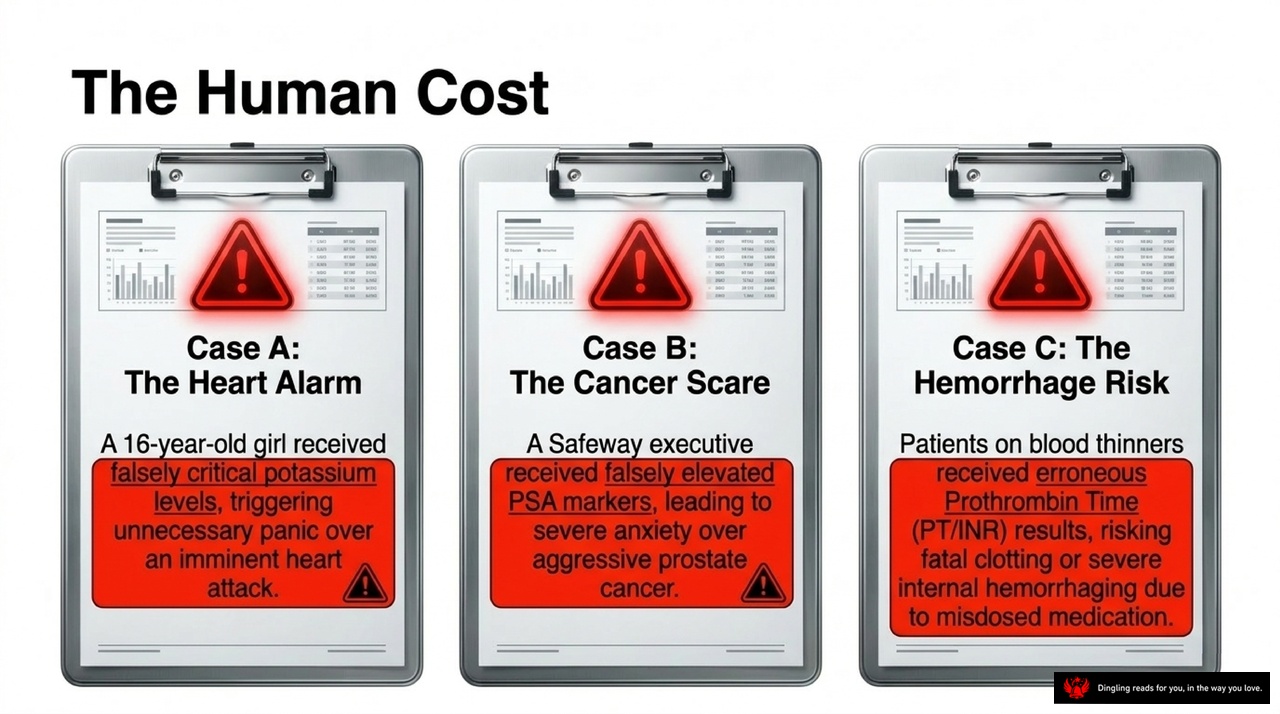
The Human Cost. Look at these three clipboards. They aren't just data points; they are the real-life price of Theranos's lies.
Case A is the Heart Alarm. A 16-year-old girl received falsely critical potassium levels. Because the test was wrong, she panicked over an imminent heart attack that didn't exist.
Case B is the Cancer Scare. A Safeway executive saw falsely elevated PSA markers. That false data led to severe anxiety and a terrifying fear of aggressive prostate cancer.
And Case C is the Hemorrhage Risk. Patients on blood thinners received erroneous Prothrombin Time results. Because the numbers were fabricated, they risked fatal clotting or severe internal bleeding due to misdosed medication.
These aren't hypothetical scenarios. They are the direct consequences of diluting samples and using commercial machines to fake results. When you prioritize a lie over a patient's safety, the human cost is measured in shattered lives, unnecessary surgeries, and preventable tragedies. This slide reminds us that in healthcare, accuracy isn't just a metric—it's a matter of life and death.
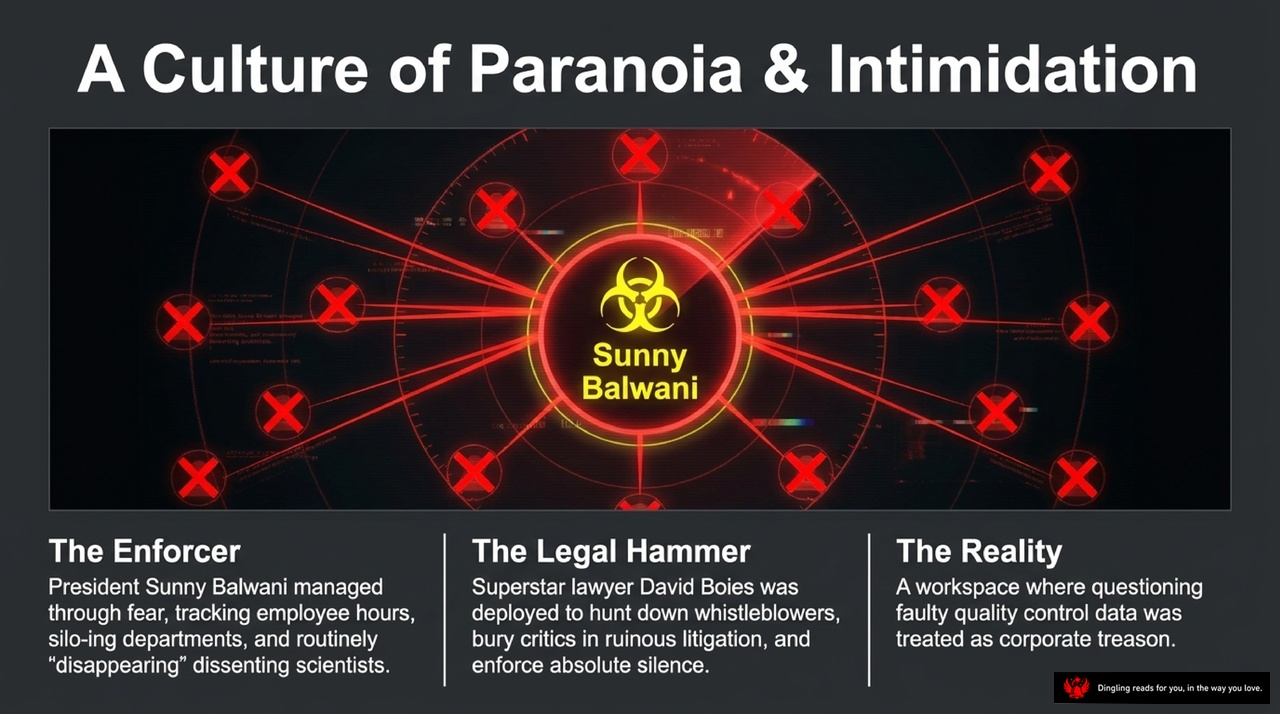
Look at this striking image. At the center, surrounded by a biohazard symbol and red warning lines, is the name Sunny Balwani. This graphic perfectly captures the terrifying reality of the Theranos workplace: a culture of paranoia and intimidation where dissent was treated as corporate treason.
Sunny wasn't just an employee; he was the ultimate enforcer. He managed the company through sheer fear, tracking every employee hour, siloing departments to prevent communication, and routinely "disappearing" scientists who dared to disagree with Elizabeth Holmes. His management style was brutal and absolute.
But Sunny wasn't acting alone. He wielded the legal hammer. He deployed superstar lawyer David Boies specifically to hunt down whistleblowers, bury critics in ruinous litigation, and enforce a silence so absolute it felt like a stranglehold. The goal was simple: crush anyone who questioned the faulty quality control data.
The reality of this environment was a nightmare. In a place where asking about basic safety or data accuracy was framed as treason, employees lived in constant anxiety. This wasn't just a failing company; it was a toxic ecosystem built on lies, where the only way to survive was to stay terrified and stay silent.
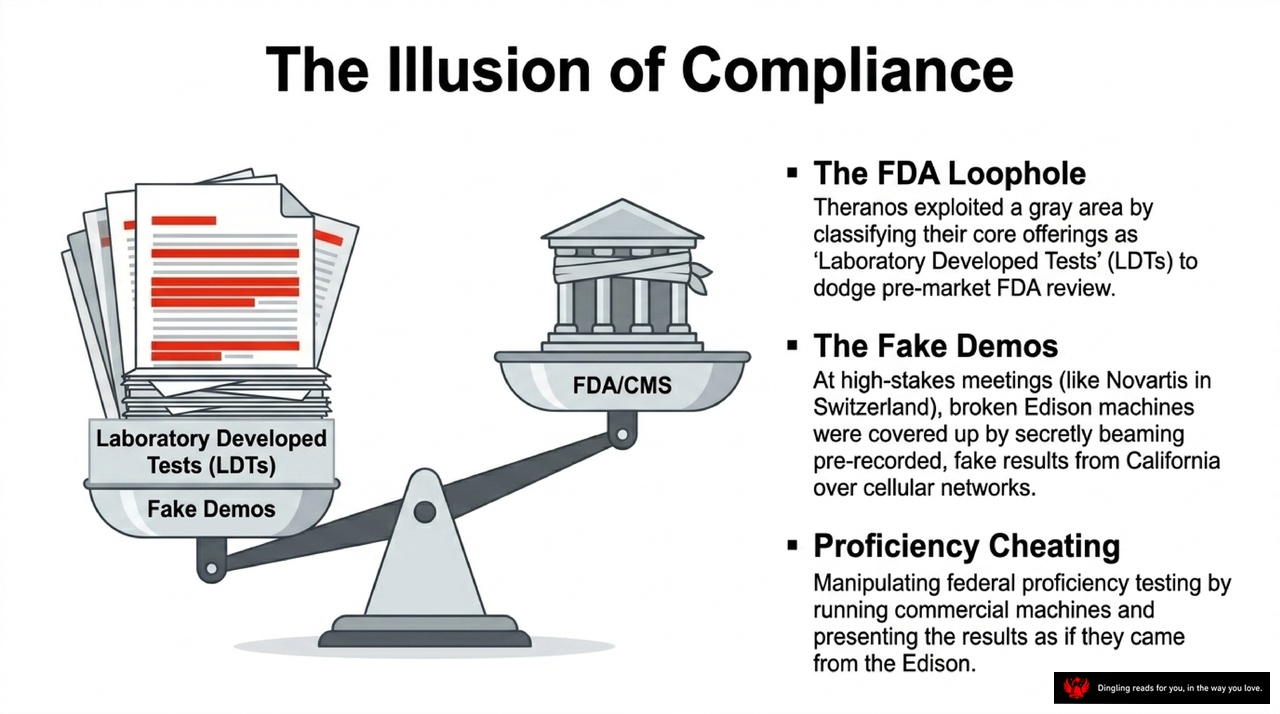
The Illusion of Compliance isn't just a buzzword; it was the very engine that powered Theranos's rise and its eventual collapse. As this slide illustrates, Elizabeth Holmes didn't just fail at building a better machine; she mastered the art of hiding the lack of one.
Look at the left side of the scale: "Laboratory Developed Tests," or LDTs. This was the FDA's loophole. Theranos exploited a gray area by classifying their core offerings as LDTs, effectively dodging the rigorous pre-market FDA review that every other medical device manufacturer must pass. It was a clever, albeit dangerous, way to bypass regulation.
But the real deception happened in the room, not just on paper. Enter "The Fake Demos." At high-stakes meetings with giants like Novartis, broken Edison machines were covered up by secretly beaming pre-recorded, fake results from California over cellular networks. Investors and partners saw perfect data on screens, while the actual device in front of them was a paperweight.
Finally, there was "Proficiency Cheating." When federal inspectors sent tests to verify the quality of their labs, Theranos didn't run them on their own equipment. Instead, they ran the samples on commercial machines, manipulated the results, and presented them as if they came from the Edison. They were essentially lying to the government to keep their CLIA certification.
The result? A massive imbalance. While the FDA/CMS sat on the right side of the scale, seemingly unaware, the weight of lies on the left side grew until the entire structure of the company tipped into fraud.

The Whistleblowers' Dilemma. On this slide, we see three figures: Tyler Shultz, Erika Cheung, and Dr. Alan Beam. These three individuals represent the breaking point for Theranos. They were the ones who saw the cracks in the foundation and tried to sound the alarm, only to face an impossible choice.
Tyler Shultz, the grandson of former Secretary of State George Shultz, was brought into the company believing he was part of a medical revolution. But as he worked on the Edison machine, he discovered the harsh reality. The data was being cherry-picked. Failed tests were deleted, and sensitivity rates were inflated from 65% to a claimed 95%. When Tyler tried to speak up, he wasn't just told to apologize; he was threatened with extreme legal consequences from his own grandfather. He realized that the cost of telling the truth was his family's entire legacy.
Then there is Erika Cheung, a lab associate who refused to run the Hepatitis C tests on the faulty machines because she knew the results would be dangerously wrong. When she reported this to the company, she was fired and threatened with lawsuits. Her dilemma was simple: protect the patients from a lethal lie, or keep her job and stay silent. She chose the harder path, but the retaliation was swift and severe.
Finally, we have Dr. Alan Beam, the Lab Director. He was the one who forwarded damning emails to his personal account, exposing the systemic fraud. He saw the dilution of blood samples, the use of commercial equipment, and the cover-ups. When he tried to leave, he was forced to delete his own evidence and sign documents admitting to nothing. His dilemma was a battle for his soul against a company that valued silence over safety.
These three stories highlight a terrifying truth: when a company becomes a cult, the truth-tellers aren't celebrated as heroes. They are isolated, threatened, and silenced. The Whistleblowers' Dilemma isn't just about corporate policy; it's about the moral courage required to stand alone against a machine built on lies.
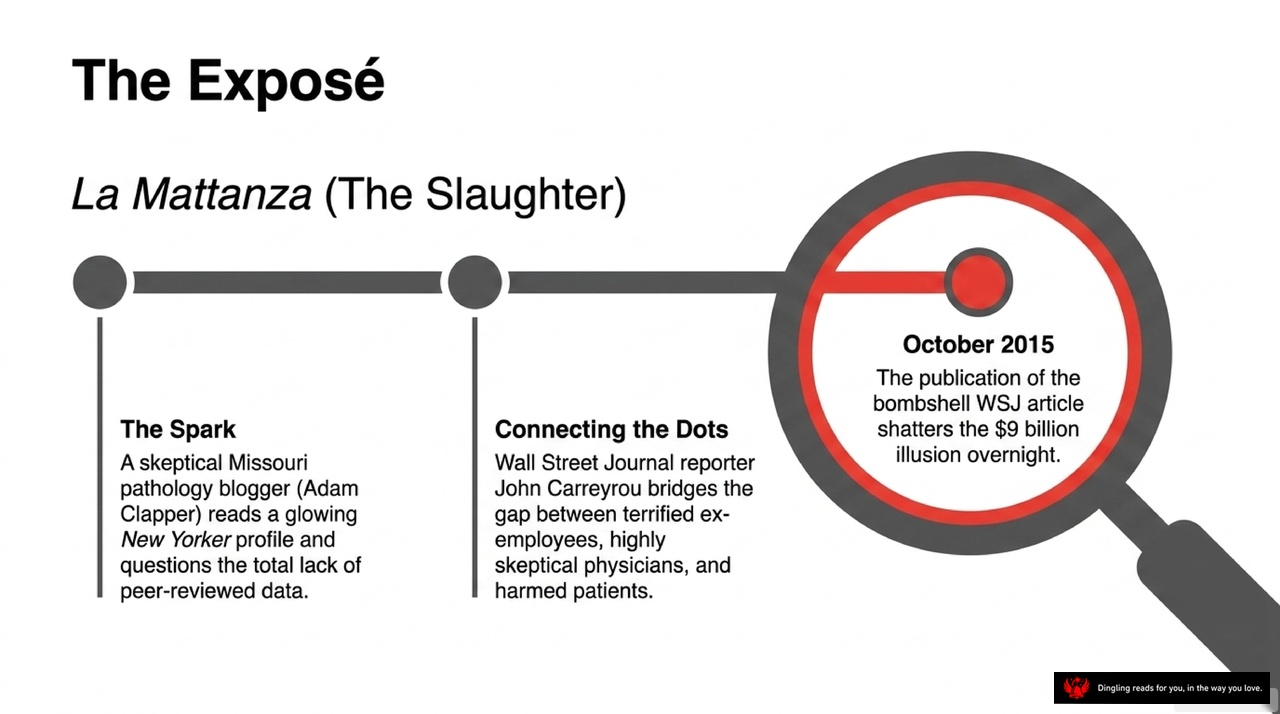
The Spark: A skeptical Missouri pathology blogger, Adam Clapper, reads a glowing New Yorker profile and questions the total lack of peer-reviewed data.
Connecting the Dots: Wall Street Journal reporter John Carreyrou bridges the gap between terrified ex-employees, highly skeptical physicians, and harmed patients.
October 2015: The publication of the bombshell WSJ article shatters the $9 billion illusion overnight.
This timeline captures the exact moment Theranos fell from grace. For years, the company had built a fortress of silence around its technology, relying on fear and secrecy to keep its secrets buried. But that changed when Adam Clapper, a pathologist who knew the industry better than anyone, looked at the hype and saw the holes. He reached out to a journalist who was ready to listen.
John Carreyrou didn't just report on a company; he investigated a lie that had cost thousands of patients their health. By connecting the whispers of former employees with the alarming stories from doctors who saw wrong results, he exposed the truth: Theranos wasn't revolutionizing medicine; it was endangering lives with fake tests.
When that October 2015 article hit the front page of the Wall Street Journal, the illusion of a $9 billion unicorn evaporated instantly. The stock crashed, investors fled, and the carefully constructed narrative of Elizabeth Holmes as a visionary leader collapsed into the wreckage of a massive fraud. It was a day that changed everything, proving that no amount of marketing or political connections can hide the truth when the evidence is finally brought to light.

The Unraveling. What started as a soaring trajectory to a $9 billion valuation ended in a dramatic, irreversible crash. This slide maps the exact moment Theranos lost its grip on reality.
It began with the FDA stepping in. They declared the proprietary nanotainer an "uncleared medical device," effectively killing the company's most ambitious vision. Without that technology, the entire business model collapsed.
Next came the CMS sanctions. Elizabeth Holmes was banned from operating any clinical laboratory for two years. This wasn't just a fine; it was a death sentence for her career in healthcare.
Then, the retail exodus. Walgreens, once a proud partner, abruptly terminated its agreement and shut down all in-store wellness centers. The public trust evaporated overnight.
And finally, the ultimate admission. Theranos was forced to void or correct over 1 million patient test results in California and Arizona. This was the moment the company admitted that for years, it had been sending patients wrong data, putting their health at serious risk.
From a billion-dollar unicorn to a fraud exposed to the world. The unraveling was complete.
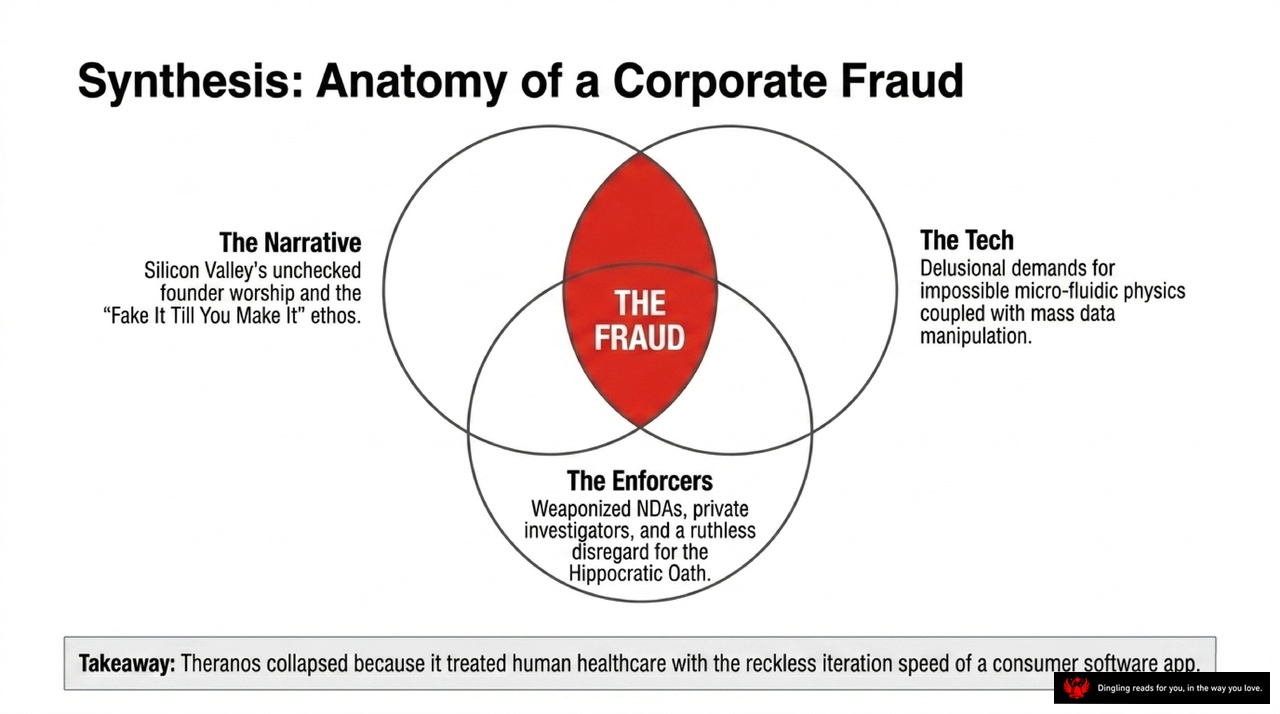
Synthesis: Anatomy of a Corporate Fraud. Look at this Venn diagram. The fraud at Theranos didn't happen because of one single mistake; it happened because three distinct circles collided perfectly.
First, we have the Narrative. This is the Silicon Valley dream of unchecked founder worship. The "Fake It Till You Make It" ethos that tells us success is just a matter of belief and charisma, regardless of the product.
Second, we have the Tech. This is the delusion of impossible micro-fluidic physics, coupled with mass data manipulation. They promised the world a magic pill that could diagnose hundreds of diseases from a single drop of blood, a technology that simply didn't exist.
And finally, the Enforcers. This is the weaponized silence. Private investigators, aggressive NDAs, and a ruthless disregard for the Hippocratic Oath that kept the truth buried deep.
When these three forces overlap, you get the fraud. Theranos collapsed because it treated human healthcare with the reckless iteration speed of a consumer software app. It was a perfect storm of arrogance, impossible science, and silence.
Theranos weaponized Silicon Valley's culture of visionary hype to construct a $9 billion empire on a foundation of faulty technology, relentless intimidation, and dangerous medical deception, ultimately collapsing under the weight of its own lies.
When the relentless pursuit of innovation intersects with human lives, at what point does 'faking it until you make it' cease to be a business strategy and become a crime?