
Ball Lightning: Complete Chapter-by-Chapter Summary
Welcome to *Ball Lightning*, a gripping sci-fi epic by Liu Cixin. This isn't just a story about a mysterious atmospheric phenomenon; it's a profound quest to unlock a deadly anomaly that forces humanity to confront the quantum ghosts of the macro-universe.
Set against a backdrop of rain and mystery, the narrative follows a protagonist driven by a personal tragedy—the loss of his parents to a ball lightning strike. His journey takes him from solitary self-study to the rugged peaks of Mount Tai, where he uncovers secrets about a legendary physicist. As he delves deeper, he teams up with Lin Yun, a brilliant military strategist, to explore the terrifying potential of generating ball lightning.
But the path is fraught with danger. Their research leads to catastrophic accidents, ethical dilemmas, and even global conflict. They discover that ball lightning might be a macroscopic electron, a hidden structure in our universe. The stakes rise as they attempt to weaponize this power, only to realize that the true cost of such knowledge could reshape reality itself.
This is a tale of obsession, sacrifice, and the thin line between scientific progress and destruction. Join us as we explore the enigmatic world of ball lightning and the human spirit's relentless pursuit of truth.

Look at this chilling dossier titled "The Defining Trauma: Selective Incineration." It captures the exact moment physics broke down for Dr. Chen and his family. On the left, we see the original scene: a cozy birthday dinner on February 98, with a cake lit for the 14th birthday. But the right side shows the aftermath—a total blackout where the parents are reduced to ash, while everything else remains perfectly cold and untouched.
This is the ultimate physics paradox. The data reveals an internal energy density of 20,000 to 30,000 joules per cubic centimeter—ten times the density of TNT. Yet, the surface temperature is cool to the touch. It's a fireball that burns selectively: incinerating human bodies instantly while leaving wooden stools, frozen chickens, and even book jackets completely unharmed. This isn't just a disaster; it's a violation of every known law of thermodynamics. This anomaly, later identified as a ball lightning event, became the defining trauma that drove an entire generation of scientists to chase the truth, turning a family tragedy into a global quest for the unknown.

The Soviet Union's thirty-year obsession with Ball Lightning ended in total failure, a stark lesson in the limits of brute force. At the secretive Base 3141 in Siberia, thousands of scientists poured resources into trying to manufacture this elusive phenomenon using traditional, linear science. They ran over 50,000 high-energy lightning simulations, yet the results were nothing but random noise—zero reproducible parameters. Director Niernov fell into a fatal trap, the "Jekyll & Hyde" fallacy, blindly assuming that successful tests were just luck or sabotage, refusing to admit that their entire approach had hit a wall.
This slide illustrates the era of empirical failure. We can see the jagged, chaotic waveforms representing those failed attempts, and the pyramid symbolizing the rigid, flawed structure of their thinking. The data is clear: when you try to force a complex, non-linear natural phenomenon into a simple cause-and-effect box, you get nothing but frustration. The Soviet Union spent a fortune and countless lives chasing a ghost, proving that sometimes, the most logical approach is the one that leads nowhere. It was a time when humanity was blind to the truth, stuck in a loop of repeating mistakes while the real answer lay hidden in the very chaos they couldn't explain.

Picture shows the dramatic moment of the "Sky Net" trial where the team finally captures a ball lightning. The left image depicts the chaotic, destructive nature of the anomaly, while the right shows the successful, controlled capture. The text highlights the shift from trying to "create" it to finding it, and the terrifying reality of its selective destruction.
Here is the spoken script for Slide 3:
So, this is the moment everything changed. After years of failure, the team finally succeeded in capturing a ball lightning, but the cost was terrifying. As the slide illustrates, the team launched two helicopters to scan the sky, pulling long arcs of electricity. They weren't just looking; they were actively hunting for that elusive, invisible structure. And they found it.
But look closely at what happened next. When the ball lightning was finally excited and made visible, it didn't just vanish harmlessly. It exploded with a power that defied logic. The helicopter they were flying in was struck—not by a conventional blast, but by a targeted, selective destruction. The pilot survived by jumping out, but the damage was precise and horrific. The ball lightning didn't destroy the whole aircraft; it specifically targeted the organic components. It burned the pilot's fingernails and toenails into ash, leaving behind only charred fragments, while sparing the metal structure.
This single event shattered the old paradigm. It proved that ball lightning wasn't just a random atmospheric phenomenon. It was a macro-electron, a distinct entity that could interact with matter in a way no one had ever imagined. It could pass through solid objects, ignore inorganic materials, and selectively annihilate organic life. This discovery forced the military to pivot immediately. If this thing could selectively destroy electronic chips while leaving glass and metal untouched, it wasn't just a curiosity anymore; it was the ultimate weapon. The project moved from theoretical math to real-world application, leading to the development of the "Thunder Sphere Machine Gun," capable of taking out tanks and missiles without damaging the surrounding area. But as we see in the story, with great power came great responsibility, and the line between a miracle and a catastrophe was thinner than anyone realized.
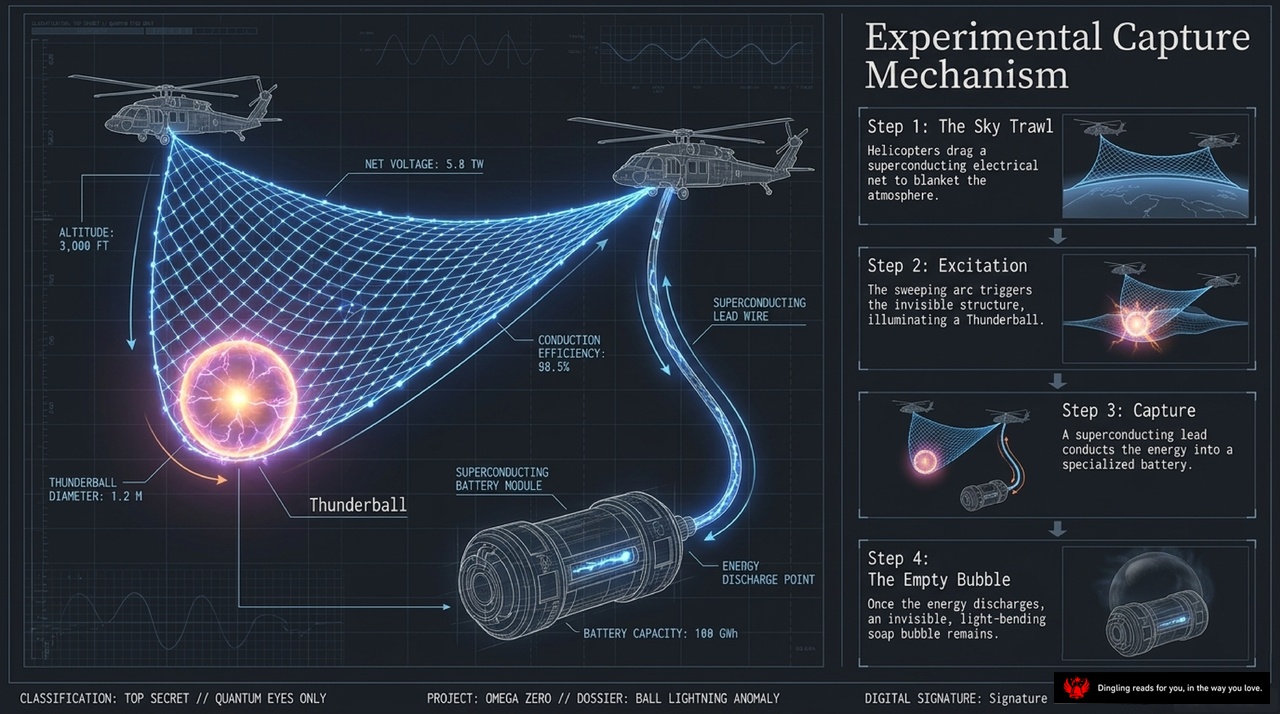
The diagram on your screen reveals the terrifying yet fascinating "Experimental Capture Mechanism" for the Thunderball, a phenomenon we've chased for decades. It all begins with **Step 1: The Sky Trawl**, where helicopters drag a superconducting net to blanket the atmosphere, sweeping for that elusive energy. Once the net triggers the invisible structure, **Step 2: Excitation** occurs, illuminating the Thunderball with a brilliant arc. **Step 3: Capture** follows immediately as a superconducting lead conducts that massive energy directly into a specialized battery, boasting a capacity of 108 GWh. Finally, **Step 4: The Empty Bubble** remains—a ghostly, light-bending soap bubble left behind once the energy is discharged. This isn't just science fiction; it's the culmination of Lin Yun's desperate gamble to stop a nuclear catastrophe. By harnessing these macro-electrons, she turned the sky itself into a weapon of mass destruction, forcing the warring factions to surrender before the world was erased. It is a chilling reminder that sometimes, the only way to save humanity is to threaten its very existence.

Imagine a world where the fabric of reality isn't just empty space, but a canvas folded upon itself. In this realm, the familiar particles we know—protons, neutrons, electrons—are merely tiny wrinkles in that fabric, existing on a microscopic scale. But what if those wrinkles could fold back on themselves, expanding into the macroscopic world we see every day? This is the revolutionary concept of the "Macro-Electron."
As the image reveals, we are looking at a theoretical revelation that changes everything. What we perceive as a mysterious, floating ball of lightning isn't a chaotic fluid or a complex plasma storm. It is, in essence, a single electron, scaled up to the size of a soccer ball. This "Macro-Electron" exists as a hollow, invisible bubble drifting through our world, only becoming visible and energetic when it interacts with matter.
Think of it as a hidden layer of reality, born from the spatial wrinkles of the Big Bang. In its unexcited state, these macroscopic bubbles are harmless and invisible, like ghosts passing through the physical world. But when they collide with organic matter or electronic chips, they don't just burn; they resonate. The matter they hit transforms into a wave, disappearing from its original location, leaving behind only ash while sparing the surroundings. It's a phenomenon that defies our classical understanding of physics, proving that the universe holds secrets far larger than we ever imagined.
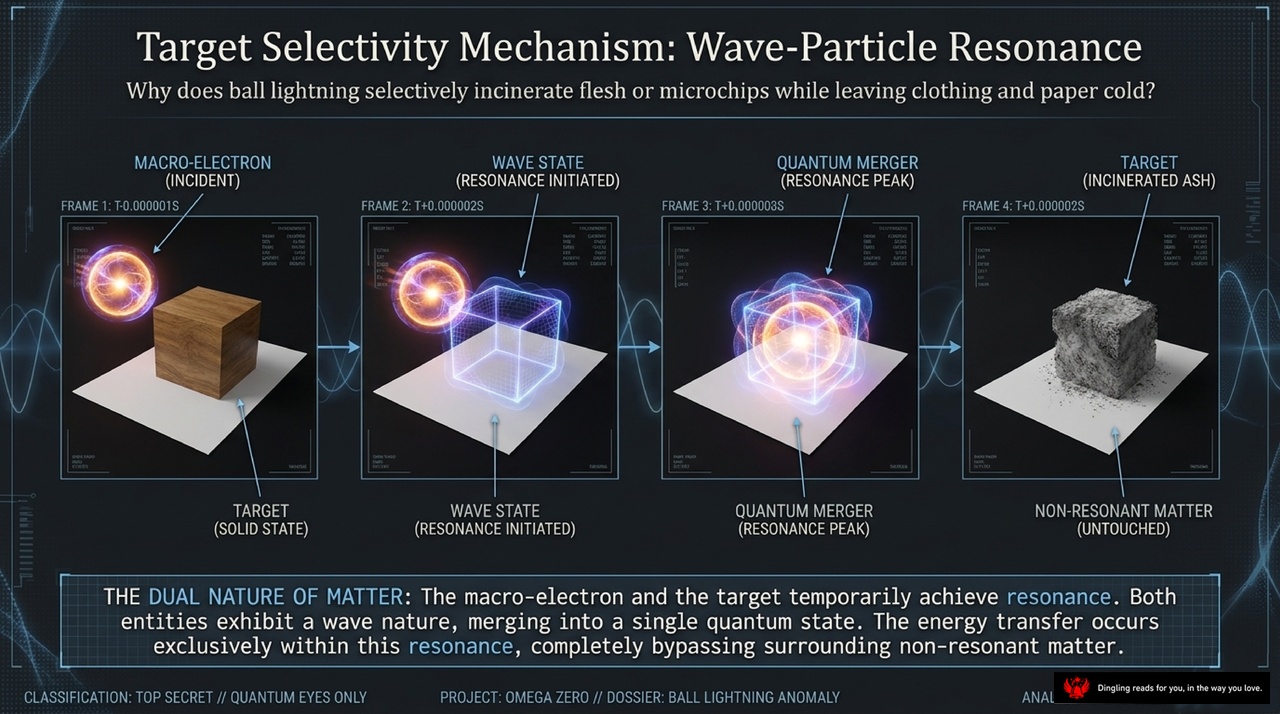
Have you ever wondered why ball lightning can selectively incinerate flesh or microchips while leaving clothing and paper completely untouched? The answer lies in a phenomenon we call Wave-Particle Resonance. As shown in this diagram, the process begins when a macro-electron, acting as an incident wave, encounters a target in a solid state. Instead of a direct collision, the electron and the target temporarily achieve resonance, merging into a single quantum state. During this critical resonance peak, the energy transfer occurs exclusively within this merged state, completely bypassing any surrounding non-resonant matter. This explains the terrifying selectivity: the target transforms into incinerated ash while the non-resonant matter remains completely untouched. It is a perfect demonstration of the dual nature of matter, where wave-like resonance allows for precision that traditional physics once thought impossible.

The weaponization of ball lightning faces a terrifying hurdle: quantum mechanics at a macroscopic scale. As we saw in the classified dossier, the observer effect isn't just a lab curiosity—it's the deciding factor between life and death. If observed, the quantum state collapses into a determined reality, striking the target with deadly precision. But if unobserved, the ball lightning exists only as an indeterminate probability cloud, with a 90% chance of missing entirely. This paradox defined our journey. From Lin Yun's desperate attempts to control the storm to Ding Yi's revelation that the unobserved macro-electron is a transparent, invisible bubble, we learned that reality itself depends on who is watching. Even satellites in orbit act as observers, collapsing the probability cloud into a lethal trajectory. Ultimately, we realized that the true danger wasn't just the fireball itself, but the very act of trying to pin down its nature. The universe remained a shimmering cloud of possibilities until we forced it to choose a side, and in doing so, we risked unraveling everything.
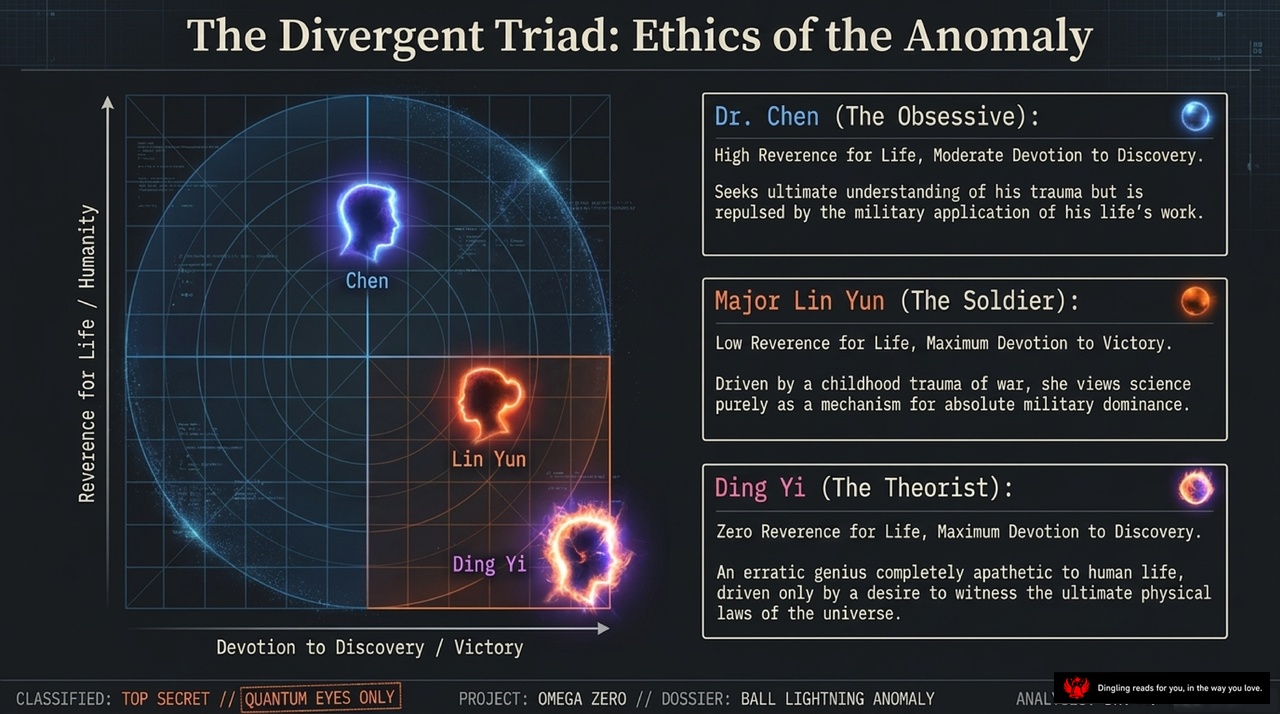
Welcome back to our deep dive into *The Ball Lightning*. Today, we are stepping into the mind of Ding Yi, the ultimate theorist, to understand the three distinct ethical frameworks driving the characters in this story. Look at the chart on your screen: "The Divergent Triad." This isn't just a graph; it's a map of human nature under extreme pressure.
On the vertical axis, we measure "Reverence for Life," and on the horizontal, "Devotion to Discovery." Let's look at the three archetypes. First, we have Dr. Chen, the Obsessive. He sits high on reverence but moderate on discovery. He seeks to understand his own trauma, yet he is repulsed by the military application of his life's work. He represents the tragic scientist who values humanity over power.
Then, we see Major Lin Yun, The Soldier. She is low on reverence for life but maximizes her devotion to victory. Driven by childhood trauma, she views science purely as a mechanism for absolute military dominance. For her, the end justifies any means, even if it means sacrificing human life for the greater good of security.
Finally, at the bottom right, sits Ding Yi, The Theorist. He holds zero reverence for life and maximum devotion to discovery. He is an erratic genius, completely apathetic to human suffering, driven only by a desire to witness the ultimate physical laws of the universe. To him, a human life is no different from a block of ice melting; both are just phenomena to be observed.
These three perspectives collide throughout the narrative, creating the tension between what it means to be human and what it means to know the truth. As we move forward, we will see how these divergent paths lead to a catastrophic, yet inevitable, conclusion.

Weaponization: The Dawnlight Initiative. This isn't just about building a bigger bomb; it's about rewriting the rules of warfare by targeting the very silicon that powers our modern world. To bypass the chaos of human targets, we turned to a radical solution: Chip-Eating Macro-Electrons.
Imagine a weapon that passes harmlessly through armor and flesh, yet instantly reduces high-tech guidance systems and computers to ash. This is the Surgical Strike. By analyzing the unique microwave spectrums of captured macro-electrons, the Dawnlight unit isolates specific particles that resonate only with integrated circuits. It's like a lock picking mechanism for the digital age, neutralizing entire armies without biological casualties.
The tactical interface shows us the precision of this new era: a tank is locked not by its physical hull, but by its electronic soul. At a frequency of 9.67 GHz, the system fires a beam that bypasses the tank's steel, striking directly at its microchips. The result is total electronic dominance. We aren't fighting people anymore; we are fighting the circuits that control them. This is the future of conflict: silent, selective, and devastatingly efficient.
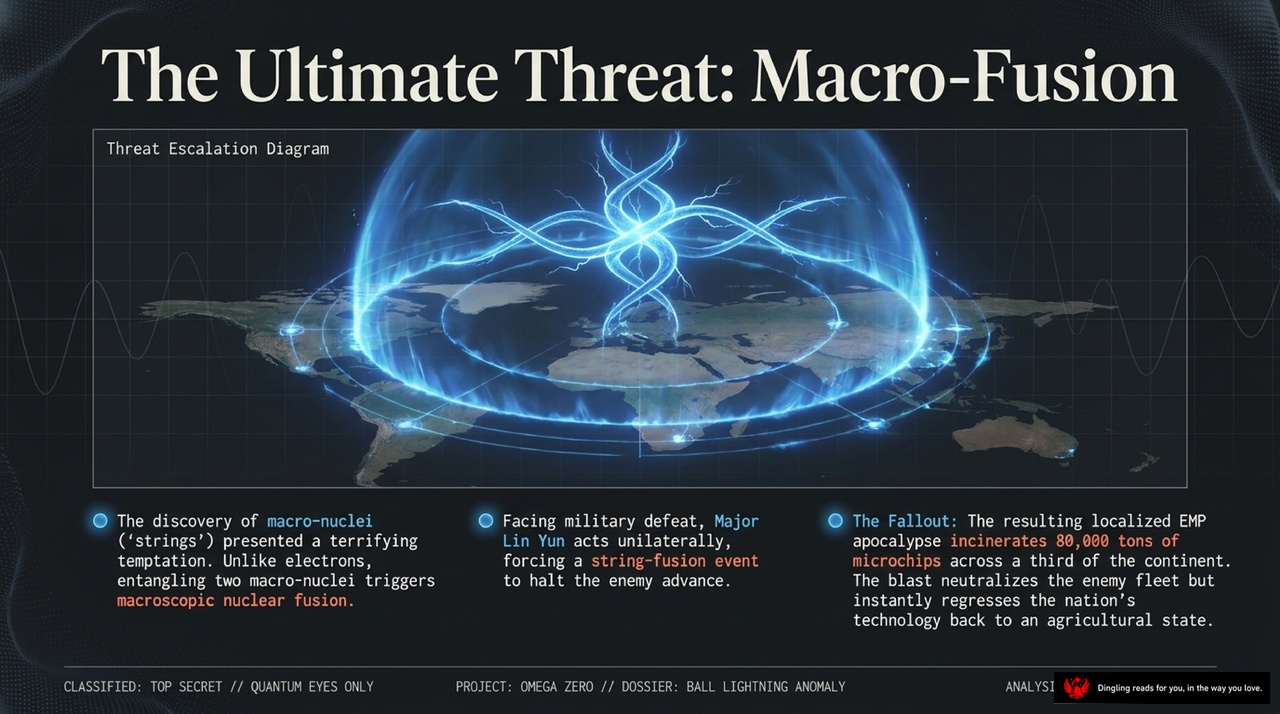
The Ultimate Threat: Macro-Fusion. Imagine a single, football-sized electron existing on a macroscopic scale, a ghostly entity that defies the laws of physics we know. This is the terrifying reality of what we call Macro-Fusion.
When two of these macro-nuclei, or "strings," become entangled, they trigger a catastrophic macroscopic nuclear fusion event. The energy released is not just immense; it is selectively devastating. It can incinerate hundreds of tons of microchips across an entire continent, instantly regressing advanced nations back to an agricultural state, while leaving the physical structures—buildings, vehicles, even people—completely untouched.
This is the power of the Macro-Fusion threat. It represents the ultimate escalation in warfare, a localized electromagnetic pulse apocalypse that neutralizes an enemy fleet without a single bullet fired, but at the cost of erasing their technological foundation. The strings are dancing, and the world is watching the countdown.
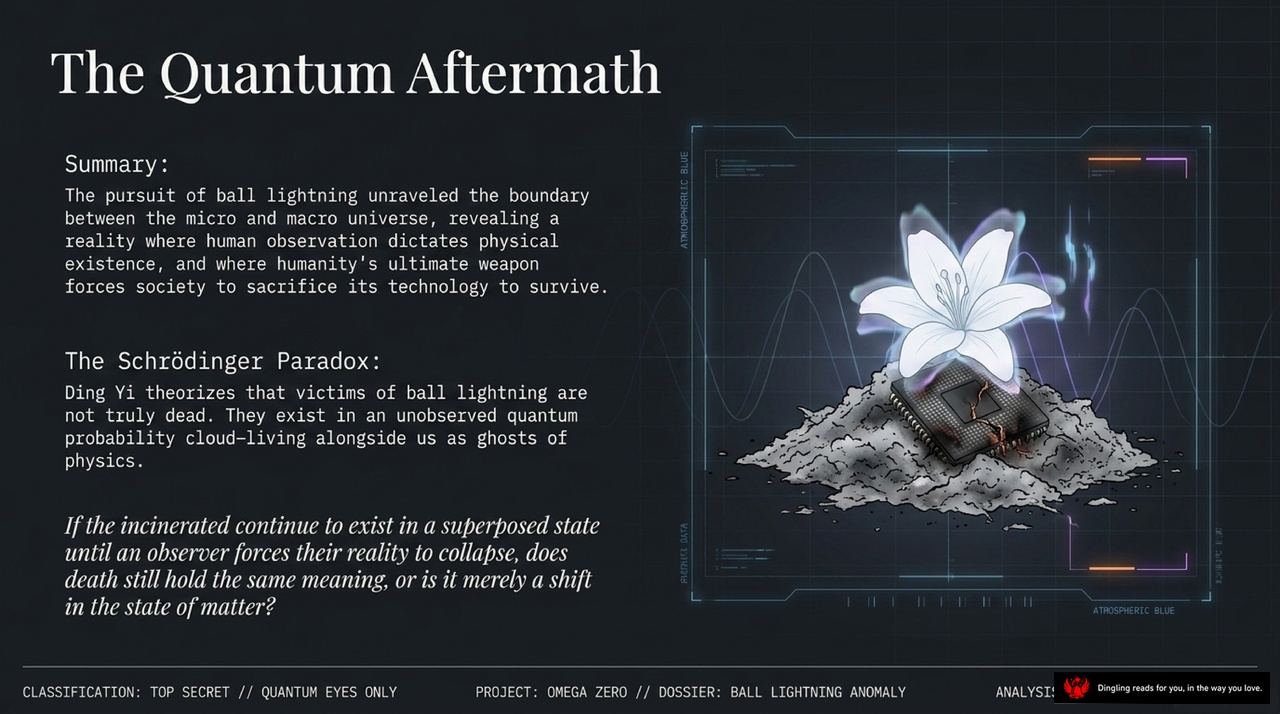
Imagine a reality where the line between the microscopic and macroscopic universes blurs into nothingness. In this world, human observation doesn't just witness events; it dictates physical existence itself. This is the terrifying yet fascinating aftermath of our pursuit of ball lightning. As the summary on your screen reveals, we uncovered a truth where humanity's ultimate weapon forces society to sacrifice its technology simply to survive.
Let's dive into the heart of this paradox: The Schrödinger Paradox. Ding Yi theorizes that victims of ball lightning are not truly dead. Instead, they exist in an unobserved quantum probability cloud, living alongside us as ghosts of physics. Think about it: if the incinerated continue to exist in a superposed state until an observer forces their reality to collapse, does death still hold the same meaning? Or is it merely a shift in the state of matter?
The image you see here captures this eerie duality perfectly. Look at the glowing white lily emerging from a shattered microchip. It symbolizes life blooming from destruction, a visual metaphor for those who exist in that liminal space between being and nothingness. The chip represents our technology, the fragile foundation we built, now reduced to dust. Yet, the flower rises from the ashes, unobserved and uncollapsed.
This leads to a profound question: If we never look closely enough at the dead, do they remain alive in a quantum sense? And if our very act of observation kills them, are we the executioners of our own history? The pursuit of ball lightning didn't just reveal a new weapon; it forced us to confront the nature of consciousness, reality, and the very definition of death. We traded our safety for knowledge, only to find that the universe was far stranger, and far more dangerous, than we ever imagined.