
Beyond the Suburbs and Temples: Complete Chapter-by-Chapter Summary
Welcome everyone. Today we're diving into Lei Wen's "Beyond the Suburbs and Temples." For a long time, scholars believed that ancient Chinese state rituals were purely official affairs, completely disconnected from what regular people actually believed. Think of Max Weber or other theorists who argued that official ceremonies were just social customs, devoid of real religious feeling for the masses.
But Lei Wen flips this script. This book is a groundbreaking exploration of the Sui and Tang dynasties. It shows how state sacrificial rituals, institutional religions like Buddhism and Daoism, and local folk beliefs didn't just exist side by side—they dynamically intertwined. It's about how these different layers shaped the ideological landscape of that era. We're moving past the idea of a strict separation between the "official" and the "folk" to see a much more complex, shared belief system. Let's get started.
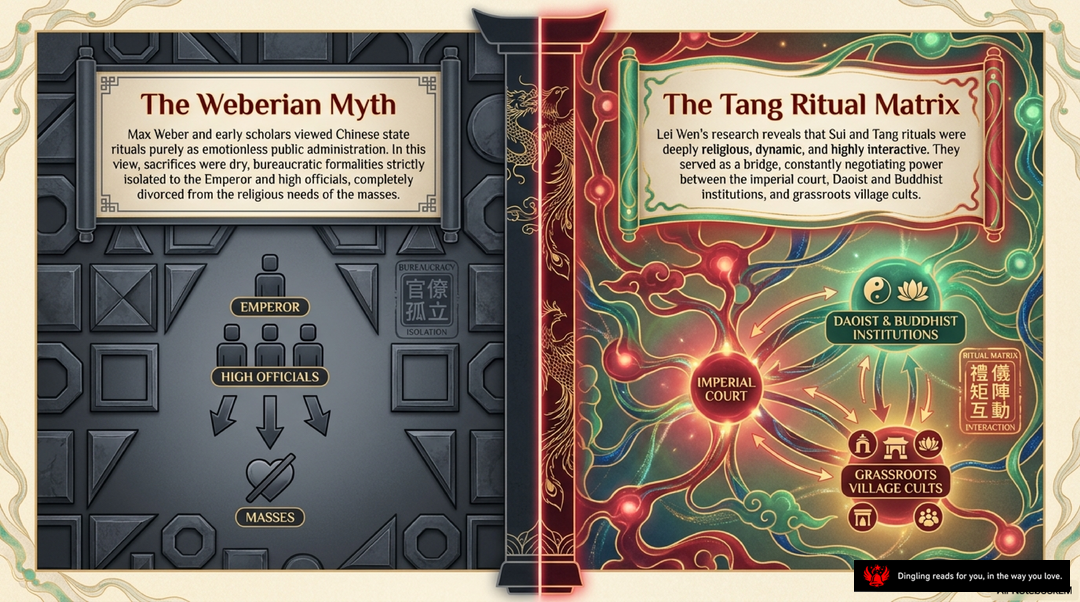
On the left, we see the "Weberian Myth." For decades, scholars like Max Weber held a specific view about Chinese history. They believed that state rituals were purely emotionless public administration. In their eyes, sacrifices were dry, bureaucratic formalities strictly isolated to the Emperor and high officials. They thought these rituals were completely divorced from the religious needs of the masses. It was a top-down system where the state and the people lived in separate worlds.
However, look at the right side: "The Tang Ritual Matrix." This image presents a completely different reality. Research by Lei Wen reveals that during the Sui and Tang dynasties, these rituals were actually deeply religious, dynamic, and highly interactive. They weren't just administrative tasks; they served as a vital bridge. They constantly negotiated power and meaning between the Imperial Court, Daoist and Buddhist institutions, and grassroots village cults.
Think about the visual difference. The left side shows a rigid hierarchy with arrows pointing down, suggesting isolation. The right side shows a vibrant, glowing network. The Imperial Court is connected through a "Ritual Matrix" to the institutions below. This interaction meant that state rituals weren't just top-down commands. They were shared belief systems.
For instance, consider the worship of mountain and river gods. Under the old view, these were just bureaucratic categories. But in the Tang, they became anthropomorphic deities. The state recognized these gods, built shrines, and protected their images. This made official worship feel familiar to the common people, who were already praying to these same gods for rain, wealth, or children. The state and the people were actually participating in the same faith, just at different levels.
So, instead of a wall separating the state from society, the Tang rituals created a space where both could meet. The "Weberian Myth" suggests isolation, but the Tang Ritual Matrix shows integration. It proves that in ancient China, the state's power was legitimized not just by force, but by shared religious participation. The rituals were the glue that held the empire together, connecting the throne to the village through a living, breathing spiritual network. This dynamic interaction transformed the ritual system from a rigid bureaucracy into a living part of daily life, proving that the state and society were inextricably linked through faith. The "Ritual Matrix" wasn't just a diagram; it was a functional reality where the divine and the political overlapped, ensuring that the Emperor's authority was seen not just as power, but as a sacred trust shared by all.
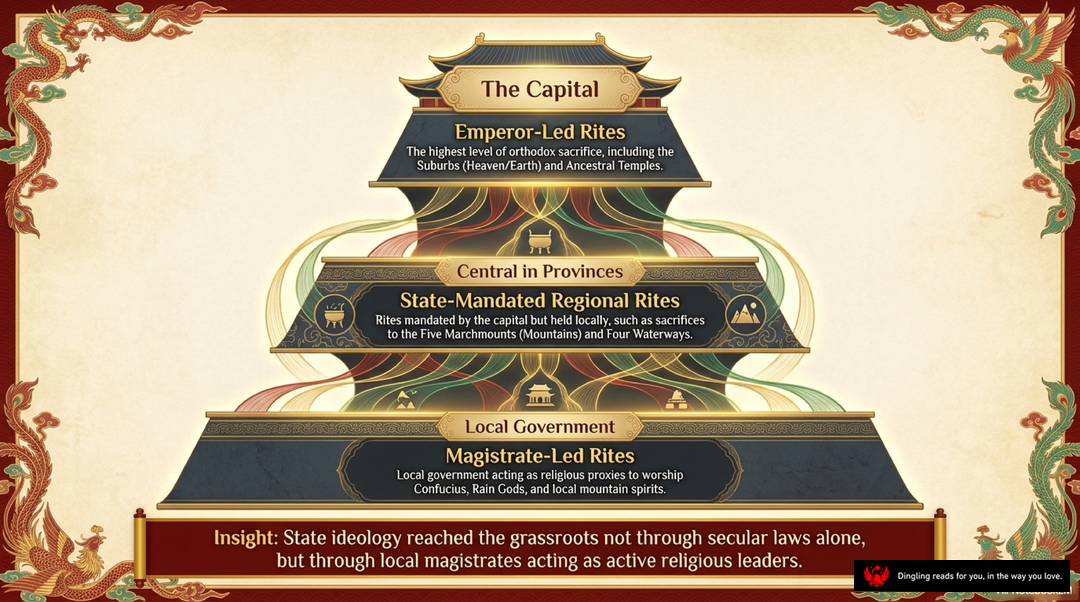
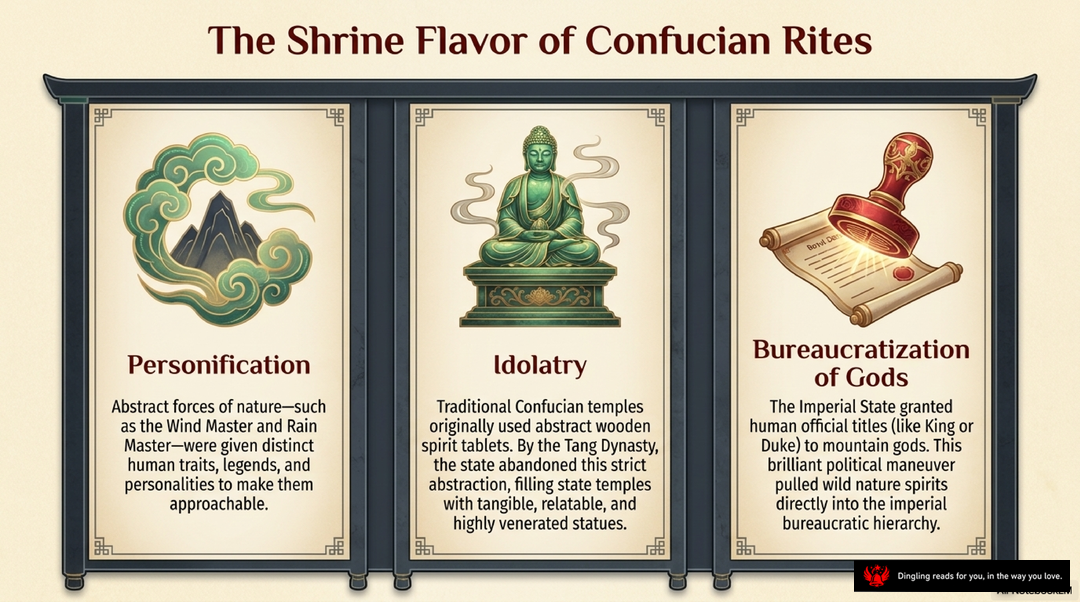
So, let's dive into this slide, titled "The Shrine Flavor of Confucian Rites." This concept is absolutely crucial for understanding how the Tang Dynasty transformed state rituals into something that actually resonated with the common people. It wasn't just about following rules; it was about making the state feel divine and the divine feel human.
First, look at the left panel: Personification. In the past, nature forces like the Wind Master or Rain Master were just abstract concepts. You couldn't really connect with them. But the state gave them distinct human traits, legends, and personalities. This made them approachable. Instead of worshipping a force of nature, you were worshipping a character with a story. This humanization made the rituals feel less cold and more personal, bridging the gap between the abstract and the everyday.
Moving to the center, we see Idolatry. Traditional Confucian temples originally used abstract wooden spirit tablets—just names on wood, no faces. But by the Tang Dynasty, the state abandoned this strict abstraction. They started filling state temples with tangible, relatable, and highly venerated statues. This was a massive shift. It meant the divine had a face, and it looked exactly like the statues people saw in local shrines. This visual connection helped people feel closer to the gods, bridging the gap between the official court and the local village.
Finally, on the right, we have the Bureaucratization of Gods. This is where the state got really creative. The Imperial State granted human official titles, like King or Duke, to mountain gods. This brilliant political maneuver pulled wild nature spirits directly into the imperial bureaucratic hierarchy. It wasn't just about worship; it was about management. The gods became part of the government structure, with ranks and duties. For example, a mountain god could be promoted to a Duke, just like a human official.
The big takeaway here is that the Tang state didn't just impose rules from above. It adopted the "Shrine Flavor" that people already loved. By personifying gods, adding statues, and giving them official titles, the state made its rituals feel less like distant laws and more like a shared community faith. This strategy successfully blended official Confucian rituals with folk beliefs, creating a unified religious system that everyone could understand and participate in. It turned the state religion into a bridge between the government and the people, ensuring that the sacred was not just for the elite, but for everyone. This was a smart way to legitimize the state by making it feel like a natural part of the community's spiritual life.

The diagram in front of us captures a fundamental truth about the Tang Dynasty: the state and institutional religion weren't separate entities fighting for power; they were locked in a loop of mutual reinforcement.
On the left, we see 'State Uses Religion.' The state didn't just rule through laws; it borrowed religious power to legitimize its rule. In the Tang Dynasty, emperors strategically placed their own portraits and statues inside Daoist and Buddhist temples. By putting imperial power inside religious spaces, they transformed the Emperor into a literal target of worship for the common people. It made political authority feel divine and accessible. It made imperial power feel like a tangible object of religious devotion.
On the right, we see 'Religion Uses State.' Institutional religions, especially Daoism, used the state to elevate their own status. Daoist priests were commissioned as imperial envoys for major mountain sacrifices. This gave them a unique position, allowing Daoism to place its own deities above traditional state gods. The establishment of 'True Lord Temples' for the Five Sacred Mountains is a perfect example. It integrated Daoist theology into the national ritual framework, ensuring its deities were treated with the highest honor. This elevated Daoism's spiritual authority to match the state's political power.
In the center, we see 'Mutual Reinforcement of Sacred Authority.' This is the core of the argument. The state gained legitimacy by appearing sacred, while religion gained power by appearing official. This intersection broke down the traditional wall between 'official ritual' and 'folk belief.' It created a shared belief system where the state and the people could meet on common ground. Ultimately, this relationship shows that in the Tang Dynasty, religion was a public tool that helped the state rule and the people pray, binding the empire together through a shared sense of the sacred.
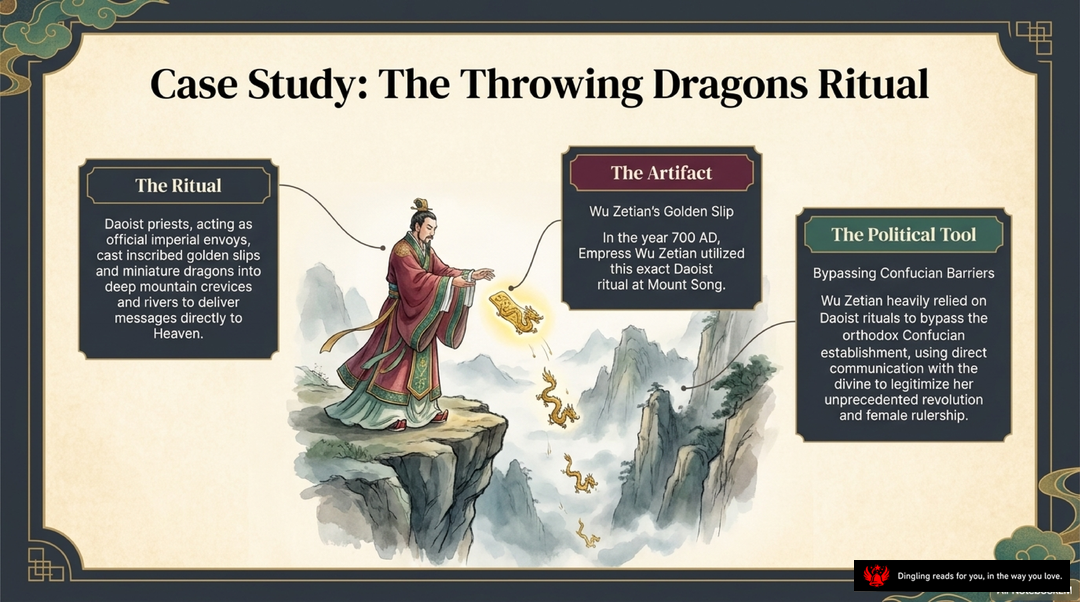
Let's look at a specific case study that really brings the Tang Dynasty's religious politics to life: The Throwing Dragons Ritual.
On the left side of the slide, under 'The Ritual', you'll see the mechanics. Daoist priests, acting as official imperial envoys, would cast inscribed golden slips and miniature dragons into deep mountain crevices and rivers. They believed this delivered messages directly to Heaven.
But this wasn't just about praying. Look at the center box, 'The Artifact'. In the year 700 AD, Empress Wu Zetian utilized this exact Daoist ritual at Mount Song.
This timing is crucial. Wu Zetian was the first female emperor in Chinese history, and she faced massive opposition. The orthodox Confucian establishment was deeply skeptical of female rule.
So, look at the right side, 'The Political Tool'. Wu Zetian heavily relied on Daoist rituals to bypass the orthodox Confucian establishment.
By using this ritual, she wasn't just asking for rain or peace. She was using direct communication with the divine to legitimize her unprecedented revolution and female rulership.
The text tells us that this series of activities, including the throwing dragon rituals at the Five Mountains and Four Rivers, was a core part of her political propaganda. It was about publicizing the mandate of legitimacy of the Wu Zhou regime.
She was essentially using the Daoist gods to validate her power, effectively bypassing the traditional Confucian hierarchy that usually controlled access to heaven.
This is a powerful example of how state rituals functioned. They weren't just abstract ceremonies. They were tools used to integrate religious beliefs into political power structures.
By combining the sacredness of Daoism with the authority of the state, Wu Zetian made her rule feel divine and unchallengeable. This interaction shows us that in the Tang Dynasty, religion wasn't separate from politics. It was the very foundation of how the state claimed its right to rule.
In fact, the text notes that these rituals were often conducted by Daoist priests who also participated in the political landscape. They weren't just monks; they were advisors who helped shape the narrative of legitimacy.
This ritual, therefore, serves as a perfect case study for understanding how the Tang state used religion to manage its relationship with the heavens and the people. It shows that the 'divine mandate' was a flexible tool that could be adapted to serve the needs of the ruler, regardless of gender or tradition.
Ultimately, this case study highlights how the Tang government used religious rituals to bridge the gap between the state and the people, making the ruler's authority seem like a natural part of the cosmic order.
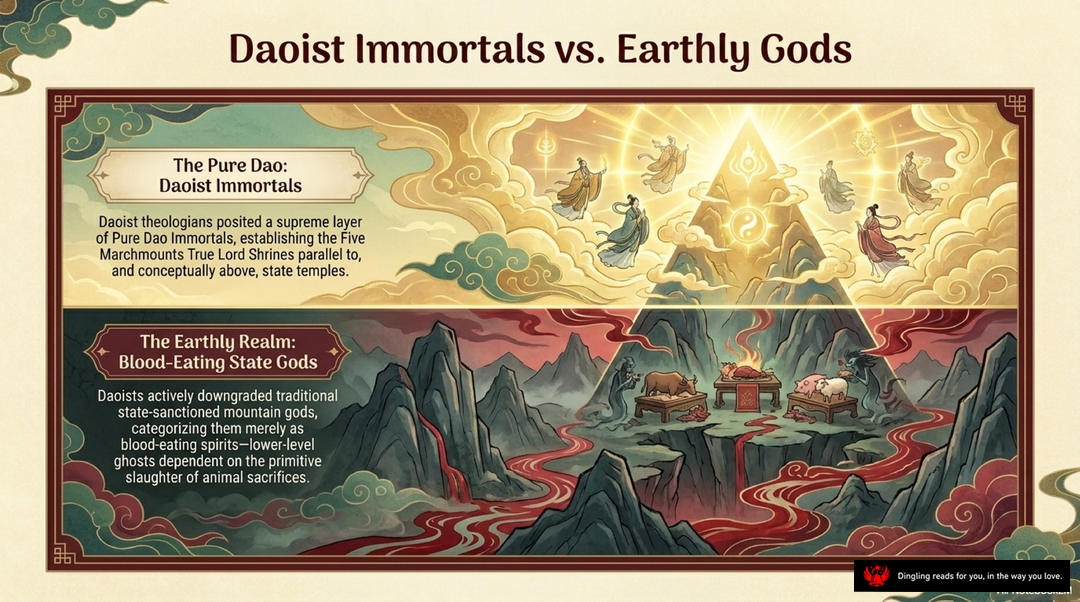
Let's look at this slide, which captures a fascinating conflict in Tang Dynasty spirituality: The Daoist Immortals versus the Earthly Gods.
The top half is labeled 'The Pure Dao: Daoist Immortals.' This represents the Daoist vision of a higher spiritual reality. Daoist theologians posited a supreme layer of Pure Dao Immortals. They didn't just accept the government's definitions of divinity. Instead, they established the Five Marchmounts True Lord Shrines parallel to, and conceptually above, state temples. This meant that while the state controlled the physical land, the Daoists controlled the spiritual realm. They were essentially saying, 'The true power lies in the Dao, not just in the state's altars.' This was a way for Daoism to claim a higher spiritual authority than the state itself.
Now, look at the bottom half, 'The Earthly Realm: Blood-Eating State Gods.' This represents the traditional Confucian state rituals. Daoists actively downgraded traditional state-sanctioned mountain gods. They categorized them merely as blood-eating spirits—lower-level ghosts dependent on the primitive slaughter of animal sacrifices. If you look at the illustration, you see the sacrificial animals. To the Daoists, these gods weren't noble; they were low-tier entities that fed on blood and were essentially 'six heaven old qi'—low-level evil spirits compared to the true Daoist immortals. This was a direct critique of the Confucian ritual system which required animal sacrifice.
So, how did the Tang Dynasty handle this? It wasn't a simple replacement. The state kept the traditional mountain gods for political legitimacy, using the blood sacrifices to maintain order. But the Daoists, led by figures like Sima Chengzhen, built their own True Lord Shrines to offer a 'pure' alternative. Sima Chengzhen famously argued that the Five Marchmounts shrines were just 'mountain forest gods' and not true gods. He pushed for new shrines with Daoist deities to replace the old ones.
The result was a complex dual system. The pyramid in the image visually divides the celestial from the mortal. It shows how the Tang state managed to integrate these two competing belief systems. One focused on blood sacrifice and earthly power, the other on spiritual purity and immortal authority. This allowed the government to maintain control while giving the people a spiritual outlet that felt 'pure' and distinct from the bloody state rituals. This tension ultimately shaped the religious landscape, allowing both the government and the people to find what they needed in their own way.
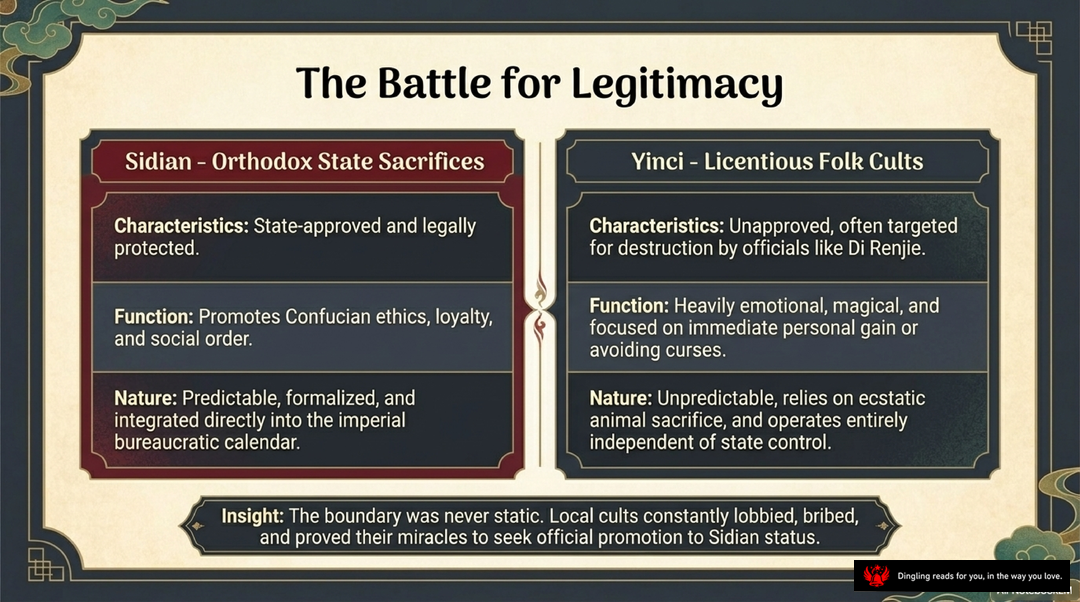
Let's talk about the battle for legitimacy in ancient China. It wasn't just about following rules; it was a constant negotiation between the state and the people.
On the left, we have the Sidian—Orthodox State Sacrifices. Think of this as the official playbook. These were state-approved and legally protected. Their function was to promote Confucian ethics, loyalty, and social order. They were predictable, formalized, and integrated directly into the imperial bureaucratic calendar. It was the government's way of saying, "This is how we worship."
On the right, we have the Yinci—Licentious Folk Cults. This is the wild side. These were unapproved, often targeted for destruction by officials like Di Renjie, who famously burned over 1,700 temples in the Jiangnan region. These cults were heavily emotional, magical, and focused on immediate personal gain or avoiding curses. They were unpredictable, relied on ecstatic animal sacrifice, and operated entirely independent of state control.
But here is the most critical insight at the bottom: The boundary was never static. This wasn't a simple black-and-white war. It was a dynamic negotiation. Local cults constantly lobbied, bribed, and proved their miracles to seek official promotion to Sidian status.
For example, consider the practice of rain prayer. When a drought hit, officials would pray to folk deities. If the deity showed a miracle—like rain falling—the local cult gained legitimacy. The state couldn't just ignore it; they had to acknowledge it. Di Renjie might burn a temple, but if the people prayed there and got rain, that temple often got rebuilt. Or look at the Shengci, or living temples. Officials could be celebrated by the people, and eventually, those local cults became part of the official system.
So, the Sidian and Yinci weren't separate worlds. They were part of the same ecosystem. The state tried to control the narrative, but the people's belief in the miraculous power of local gods forced the state to adapt. This constant push and pull is what shaped the religious landscape of the Tang Dynasty. It shows that legitimacy wasn't just about laws; it was about proving you were useful to the people. This fluidity is what made the ancient Chinese religious system so resilient and complex.
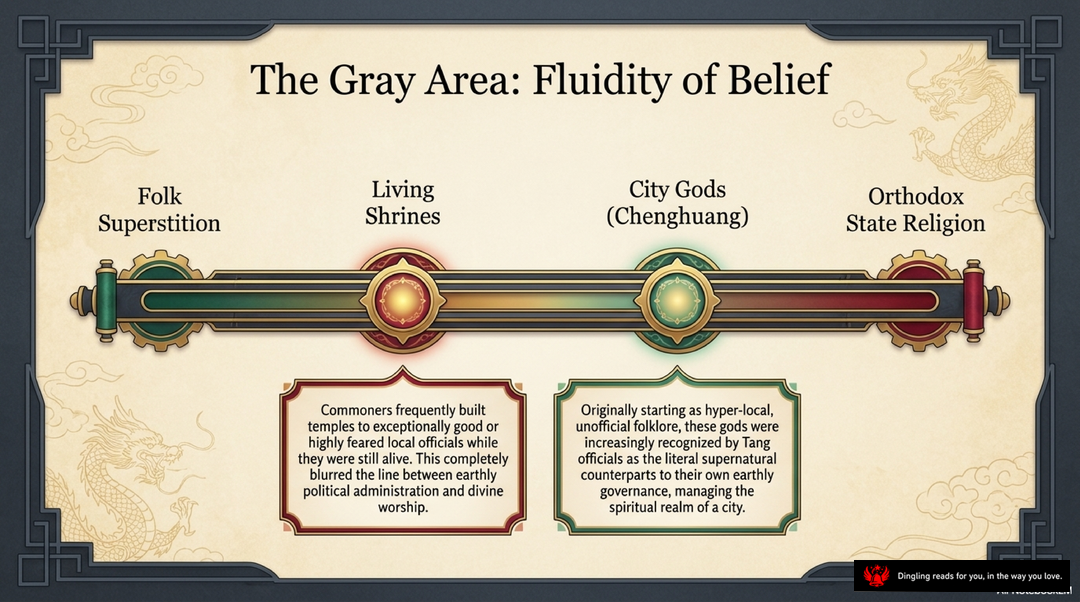
So, look at this spectrum we are building here. We often assume there is a hard wall separating "Orthodox State Religion" from "Folk Superstition." But in the Tang Dynasty, that wall didn't exist. Instead, we have this "Gray Area" where the two constantly bleed into each other.
Let's start with the Living Shrines. The text on the slide notes that commoners frequently built temples to exceptionally good or highly feared local officials while they were still alive. That is a massive shift from how we usually think about religion. You don't typically worship a living politician. But in Tang China, the line between earthly political administration and divine worship was completely blurred. Take Di Renjie, for example. He was a famous official, but people built a shrine for him with a statue, treating him like a god. This wasn't just flattery; it was a way for the community to seek divine protection from a figure of authority. It turned the bureaucracy into a spiritual hierarchy.
Now, look at the City Gods, or Chenghuang. These started as hyper-local, unofficial folklore. You know, the spirits of the land that local people believed in. But the Tang officials increasingly recognized these gods as the literal supernatural counterparts to their own earthly governance. Basically, the City God was the spiritual manager of the city, managing the spiritual realm of a city just like the magistrate managed the physical one.
This middle ground is crucial. It shows that the state didn't just impose a cold, rigid Confucian ritual on the people. Instead, they absorbed these folk beliefs. By recognizing the Living Shrines and the City Gods, the state made its power feel more divine and real to the average person. At the same time, these folk shrines gained a layer of official legitimacy.
So, this fluidity of belief is what allowed the Tang Dynasty to maintain control. It wasn't just about laws and taxes; it was about a shared belief system. Whether you were praying to a living official or a city god, you were interacting with the same power structure. This is why the Tang state could be so effective—it wasn't fighting against the people's beliefs; it was weaving its own authority right into the fabric of their daily spiritual life.
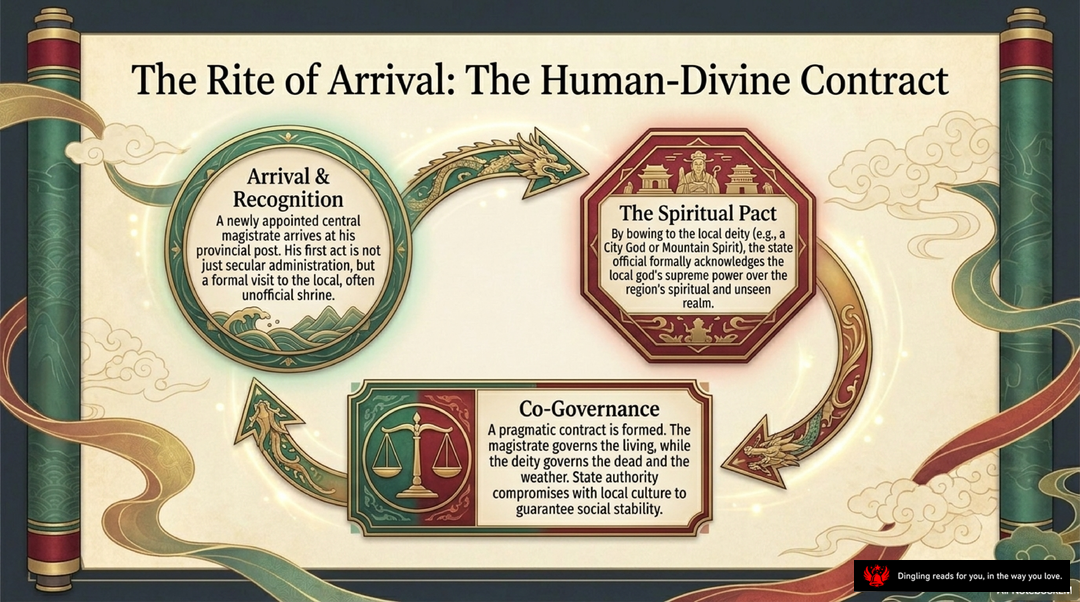
Imagine you're a new governor arriving in a province thousands of miles from the capital. You've got your official mandate, but there's something more important than your decree. Before you even try to fix taxes or build roads, you do something very different. You visit the local shrine.
In Tang Dynasty China, this wasn't just a polite gesture. It was the first real test of a new official. When a central magistrate landed in a new post, his first act was often to pay respects to the local deity. Maybe it was a City God, a Mountain Spirit, or a river guardian. These weren't just decorations; they were believed to hold real power over the land and the people.
By bowing to these local gods, the official was making a formal deal. He was acknowledging that while he held the government's power, the local spirits held the spiritual authority. It was a mutual recognition.
This created a unique system of co-governance. Think of it as a partnership. The human official handled the living world—laws, taxes, and order. But the deity? They were in charge of the unseen stuff: the weather, the harvest, and even the dead. If the crops failed or the river flooded, the people blamed the gods, not just the government. So, the state had to compromise. They had to respect local traditions and let these local shrines exist, even if they weren't strictly part of the official state religion.
Why did this work? Because it stabilized the region. The local people felt their gods were protected by the state, and the state gained the people's trust because they respected local culture. It wasn't about conquering the local belief; it was about integrating it.
This 'Human-Divine Contract' shows that ancient governance wasn't just about top-down control. It was a negotiation. The state needed the gods to keep the peace, and the gods needed the state to keep their reputation. It was a pragmatic way to rule a diverse empire without constant conflict. It turned a potentially rebellious local culture into a partner in maintaining social stability. This approach allowed the Tang dynasty to manage vast territories with a mix of imperial authority and local belief, creating a system where the government and the divine worked together to keep the peace. By blending imperial power with local spiritual needs, the state ensured that its rule was accepted not just by force, but by the very fabric of daily life. This flexibility is what allowed the dynasty to endure for centuries, proving that respecting the unseen world was just as important as ruling the visible one.

Picture a drought. Not just a weather event, but a crisis that threatened the entire empire. In the Tang Dynasty, this was the 'Ultimate Crisis,' as our slide shows. When the rain stopped, the whole society had to act, and they did it in three distinct but connected layers.
First, look at the top box: The Emperor. This is the 'Capital Response.' The text tells us that the Emperor didn't hide. He took the blame. He issued edicts of self-blame, reduced his personal meals, and even considered stepping down from his throne. He held the 'Dayu' sacrifice, a grand, orthodox Confucian ritual. It wasn't just about following rules; it was a public performance of piety, signaling that the ruler was accountable to Heaven. If the rain didn't come, it was his fault.
Next, look at the left box: Local Officials. This is the 'Bureaucratic Response.' The text describes a specific set of actions. Officials would close local markets and order bans on animal slaughter. But it went deeper. They mobilized religious figures. Daoist and Buddhist monks were called in for mass chanting. The book mentions a famous official, Li Deyu, who believed that 'moving heaven and earth, touching ghosts and spirits, nothing surpasses sincerity.' He would fast and pray personally if his subordinates failed. So, the bureaucracy wasn't just about laws; it was about using religious power to fix the weather.
Finally, look at the right box: The Commoners. This is the 'Folk Response.' This is where things got intense. The slide describes 'desperate, emotional, and sometimes violent folk rituals.' The text supports this by mentioning that people worshipped dragons, giving them human personalities, and that shamans played a key role in communicating with the gods. People would pray at local mountain shrines, sometimes dancing with shamans, sometimes using violent acts to force the rain gods to act. It was a raw, emotional connection to the divine that the state couldn't fully control but had to acknowledge.
The real story here is the 'Convergence.' The Emperor, the Officials, and the Commoners were all part of the same system. The state's legitimacy depended on the rain, and the people's survival depended on the state's ability to pray. This is why drought was the ultimate crisis. It forced everyone to align, blending Confucian ritual, Buddhist/Daoist practices, and folk beliefs into one unified effort to save the empire. The text highlights that even local officials would recognize folk shrines if they were effective, blurring the line between official and folk religion. This convergence made the Tang Dynasty's prayer system unique, uniting the state and the people in a desperate, unified act of faith.

Let's take a closer look at how intellectual thought evolved during the Tang Dynasty. As you can see on the screen, we have a clear timeline split into two distinct phases. On the left, we have 'Early Tang Magic.' During this period, rituals were primarily viewed as literal mechanisms. It wasn't just about spiritual belief; people genuinely believed that performing specific actions could manipulate the weather and appease angry gods. It was a time when the state and society relied on these rituals as functional tools to control nature. The goal was direct intervention through magical means.
However, look at the right side: 'Mid-to-Late Tang Humanism.' This represents a major intellectual shift. Intellectuals like Bai Juyi sparked a paradigm shift in how we understood these ceremonies. They recognized a critical reality: while the Emperor must perform rain rituals to quell psychological panic among the people, the rituals themselves cannot actually solve the physical disasters. A drought is a physical reality that magic cannot fix, but the fear it causes can tear society apart.
So, what was the solution? As the scroll at the bottom suggests, the focus shifted from appeasing gods to aiding the starving populace. Rituals didn't vanish; they transformed. They became a deliberate tool of psychological comfort and social cohesion. Instead of trying to trick the heavens, the state used rituals to keep the society stable during crises. This was a move from viewing rituals as magical spells to viewing them as a way to manage human society and care for the common folk. Specifically, the focus shifted from appeasing gods to aiding the starving populace.
Bai Juyi, for instance, argued that while rituals could offer some relief, avoiding the chaos of a great drought required solving the people's livelihood problems first. This shows that the Tang Dynasty was evolving from blind faith into a more pragmatic approach. The rituals provided reassurance, but the government had to take responsibility for the people's survival. This evolution shows us that the Tang Dynasty wasn't just about blind faith. It was a transition from viewing rituals as magical spells to viewing them as a way to manage human society and care for the common folk. It was a move from magic to humanity. This shift reflects a deeper understanding of governance, where the state acknowledges its duty to protect the people, not just the gods. By focusing on the human element, the Tang government recognized that stability comes from caring for the people, not just pleasing the divine. This is a profound lesson for us today about the balance between faith and practical governance.

Welcome to slide twelve. Let's look at this visual: The Platform of Power. It illustrates how the Tang Dynasty fundamentally redefined what it meant to rule.
The diagram shows three overlapping circles. At the top is Confucian State Ethics, focused on Order and Hierarchy. On the left, we have Local Folk Beliefs—grassroots superstition and survival. And on the right, Institutional Religion, specifically Daoism and Buddhism.
Here is the critical insight. The Tang state did not attempt to destroy these opposing beliefs. It absorbed them. Instead of trying to separate the government from the people's spiritual lives, the rulers made them merge into one system.
Imperial state rituals became an open platform—a grand matrix where the Emperor positioned himself as the ultimate arbiter, manager, and consumer of the divine.
Think about what that means in practice. The state recognized that folk beliefs, like worshipping local mountain gods or wind deities, were powerful. So, instead of banning them, the government gave these gods official titles and statues. They became part of the state religion. For instance, mountain gods were even promoted to the rank of emperors and queens, with families given titles too.
Similarly, the state embraced religion. We see emperors' images placed in Buddhist and Taoist temples. The Emperor wasn't just a man; he was a divine figure in the eyes of the people. By putting his image in a temple, he made the state feel tangible and close to everyone.
This created a shared belief system. When a farmer prayed for rain at a local shrine, he was participating in the same ritual framework as the Emperor. It wasn't just about politics; it was about connecting the human world with the divine.
So, the Tang Dynasty didn't just impose Confucian rules from above. It built a flexible platform where the government, the people, and the gods all worked together. This integration is what made the Tang system so resilient. It wasn't a rigid hierarchy; it was a living, breathing matrix of power.
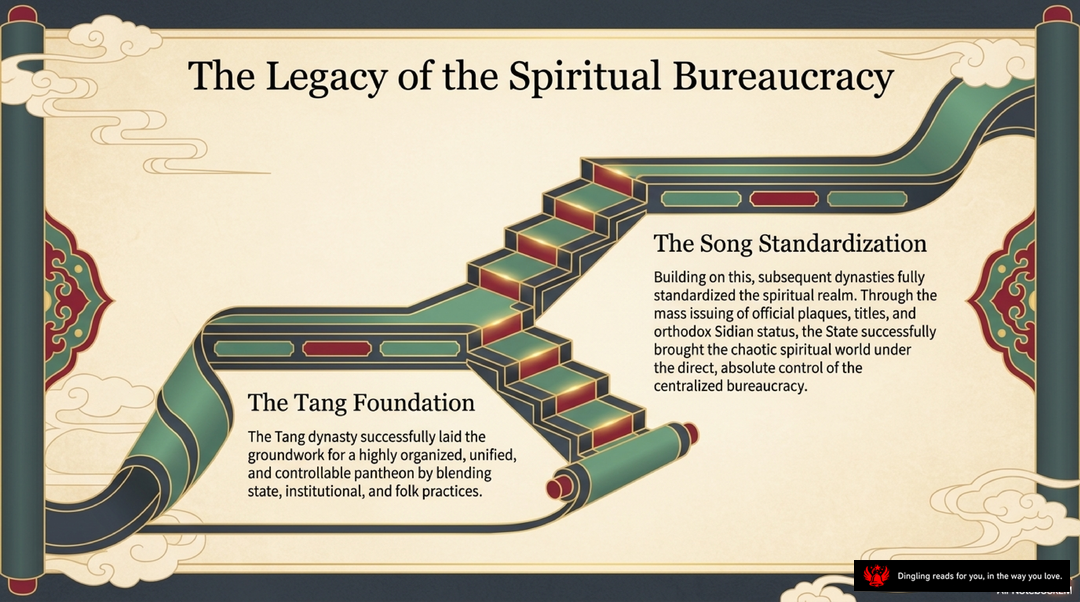
Let's dive into the legacy of the spiritual bureaucracy. As you see on the slide, we have a clear progression from the Tang Foundation to the Song Standardization. This path shows how the state transformed from a loose manager of rituals into a strict controller of the divine.
First, let's look at the Tang Foundation. The Tang dynasty didn't just impose rules; they successfully laid the groundwork for a highly organized, unified, and controllable pantheon. They did this by blending state, institutional, and folk practices. Imagine a time when the government recognized that people believed in local gods. So, they took natural gods like mountains and rivers—Yue and Du—and gave them human traits. They became anthropomorphic figures with titles, statues, and even families. This wasn't just a top-down order; it was a bottom-up acceptance. The state rituals and folk worship became the same thing, just on different levels. This made the spiritual world feel less like a distant official ceremony and more like a shared community belief.
Now, fast forward to the Song Standardization. The Tang laid the path, but the Song dynasty took it further. They fully standardized the spiritual realm. How? By mass issuing official plaques and titles. They gave gods specific ranks—like "Hou" or "Gong"—and established the orthodox "Sidian" status. This wasn't just about religion; it was about control. The state successfully brought the chaotic spiritual world under the direct, absolute control of the centralized bureaucracy. In the Song, the distinction became clear: there were official "Si Dian" records and there were "Yin Chi" or profane temples. The state granted titles to gods—ranking them as Dukes or Marquis—turning the spiritual world into a hierarchy that mirrored the human government.
So, why does this matter? It shows that the ancient Chinese state was incredibly pragmatic. They didn't fight folk religion; they managed it. By the Song, the spiritual world was no longer a wild, uncontrolled place. It was a managed part of the government. This "Spiritual Bureaucracy" ensured that the state's legitimacy was reinforced by a unified, controllable system of gods and rituals that everyone, from the emperor to the commoner, recognized. This integration is what allowed the dynasty to maintain stability for centuries.
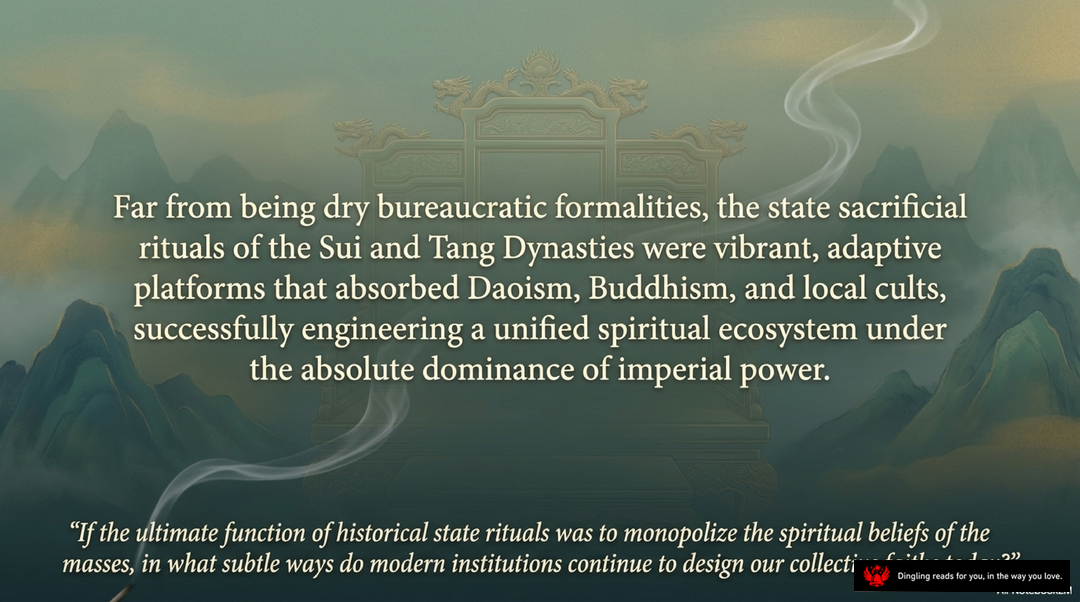
Let's take a closer look at this slide. It challenges a very common historical assumption. For a long time, scholars like Max Weber believed that ancient state rituals were just dry bureaucratic formalities. They thought these ceremonies were cold, impersonal, and completely disconnected from the everyday lives of regular people. But the reality in the Sui and Tang Dynasties was much more dynamic.
These weren't rigid, disconnected ceremonies. They were vibrant, adaptive platforms. The state didn't just impose rules from above; it actually absorbed the popular culture around it. It took Daoism, Buddhism, and local folk cults and wove them into the official state ritual system.
A great example of this is what we can call the "Shen Ci" color—essentially, the "temple" aesthetic. In the Confucian classics, nature gods like the Mountain and River deities were just ranked officials. But in the Sui and Tang, they became real, living entities. Take the Lo River God or Mount Song. They weren't just abstract concepts anymore; they were given imperial titles like "King of Heaven" or even "Emperor." The state even protected their statues. This meant that the gods of the state were the same gods the common people worshipped.
Common people would visit these temples to pray for children, wealth, or good harvests. The same places where officials performed grand ceremonies were also filled with the prayers of the masses. Even weather gods like the Wind and Rain Deities were treated as powerful, personified figures. Local officials would even blame them for droughts, treating them like responsible managers who could be held accountable.
This created a unified spiritual ecosystem. It wasn't a top-down imposition; it was a shared belief system. The imperial power used these rituals to unify the spiritual world, but it did so by making the state's gods accessible and relatable to the people. By allowing statues and titles, the state legitimized folk beliefs while giving itself a spiritual monopoly.
The slide ends with a provocative question: If the ultimate function of these historical rituals was to monopolize spiritual beliefs, how do modern institutions continue to design our collective faith today? This connection between ancient ritual and modern belief is something we should all consider. It reminds us that faith is never just private; it's always shaped by the structures of power around us. Whether it's in the past or today, the way we organize our rituals often reflects how we want to organize our society.