
Big Data: Complete Chapter-by-Chapter Summary
Welcome to the book that is changing how we see the world. This is *Big Data: A Revolution That Will Transform How We Live, Work, and Think* by Viktor Mayer-Schönberger and Kenneth Cukier.
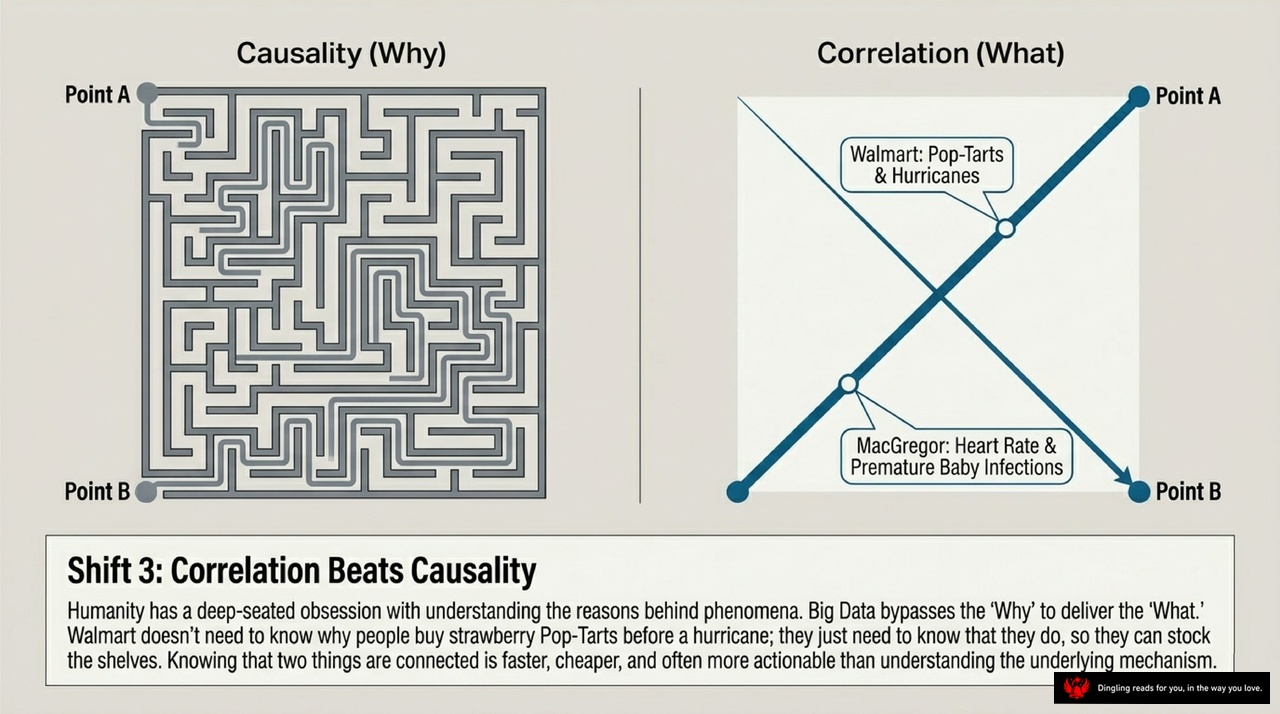
Today, we are standing at the edge of a massive shift. For over a century, our world ran on "small data"—we made decisions based on random samples. Think of it like tasting a spoonful of soup to judge the whole pot. But here is the core truth the authors reveal: we are moving from a paradigm of causality to one of correlation. In this era of total information, we no longer need to guess what the whole looks like by studying a tiny part of it. Instead, we have the power to analyze everything.
Imagine a world where you don't just predict the weather based on a few weather stations, but you track every single sensor in the sky. That is the promise of big data. It's not about being more precise in the old sense; it's about embracing the messy, complex reality of the whole. It's a revolution that moves us from asking "why" something happens to simply understanding "what" is happening, giving us a clarity that was previously impossible.
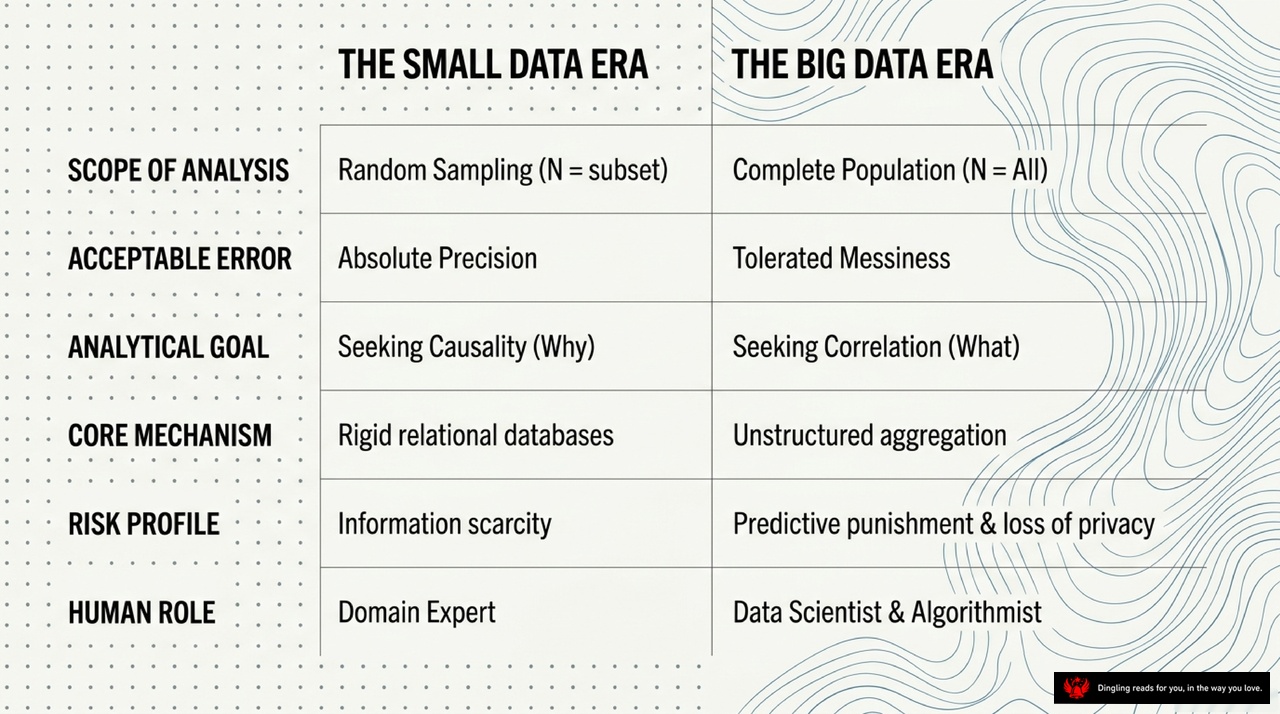
Imagine a world where knowing exactly *why* something happened matters less than simply knowing *what* is happening next. This slide captures the fundamental shift from the Small Data Era to the Big Data Era, redefining how we analyze reality.
In the past, we relied on random sampling—looking at a small subset to guess the whole. We demanded absolute precision and obsessed over finding the root cause, the "Why." We built rigid databases to store perfect, structured records, fearing any messiness. If we missed a data point, it was a crisis. We trusted domain experts to make these judgments, accepting that information scarcity was our biggest risk.
But today, we've moved to the Big Data Era. We no longer sample; we analyze the complete population. We stop asking "Why" and start asking "What." We don't need perfect precision; we can tolerate messiness because the sheer volume of data makes individual errors irrelevant. Instead of rigid databases, we now use unstructured aggregation, embracing chaos to find patterns.
This shift changes everything. The risk isn't anymore about missing information, but about predictive punishment and the loss of privacy as algorithms guess our next move. Consequently, the human role has transformed. We are no longer just domain experts relying on intuition; we are data scientists and algorithmists, using correlation to predict the future rather than relying on causation to explain the past. It's a move from seeking certainty to embracing probability, from explaining the world to predicting it.
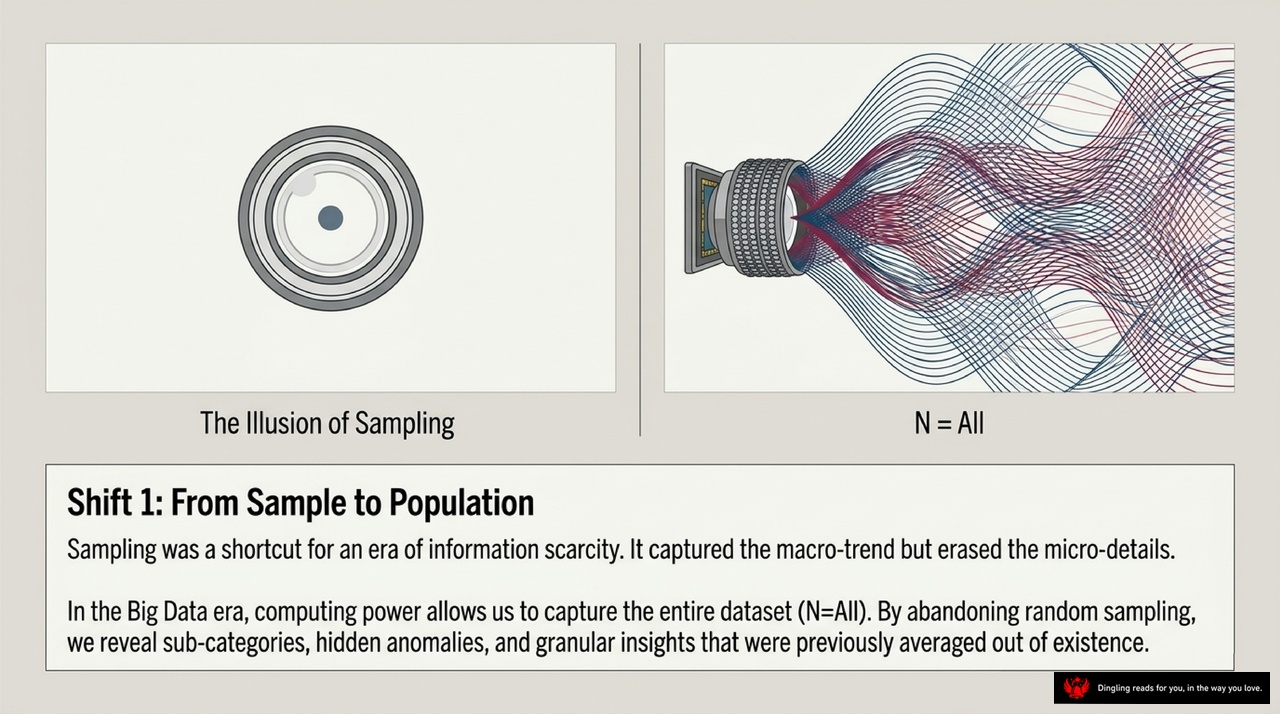
Welcome to the next shift in our data revolution: moving from a sample-based mindset to a population-based reality. Look at the visual on the left, labeled "The Illusion of Sampling." For over a century, we relied on random sampling as a clever shortcut. In an era of information scarcity, we couldn't process everything, so we took a tiny slice of the pie to guess the whole. It was efficient, but it came with a heavy cost: it erased the micro-details. It gave us the macro-trend but blinded us to the unique stories hidden in the margins.
But the right side of the slide, marked "N = All," represents the seismic shift happening today. In the Big Data era, computing power has finally allowed us to capture the entire dataset. By abandoning the limitations of random sampling, we stop averaging out existence. Instead, we reveal sub-categories, hidden anomalies, and granular insights that were previously invisible. Think about it: sampling tells you the average temperature of a city, but full data tells you exactly which neighborhood is overheating right now. This shift from a sample to the full population isn't just a technical upgrade; it's a fundamental change in how we understand the world, moving from fuzzy generalizations to precise, actionable truth.
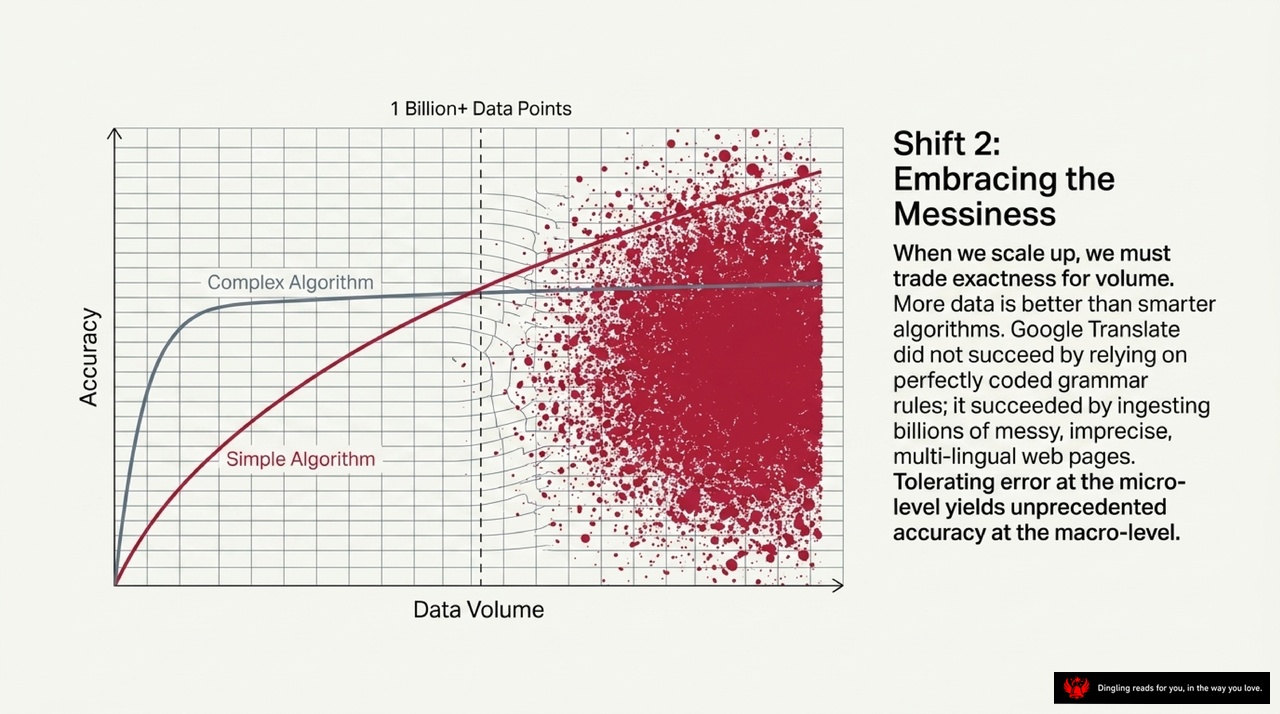
Look at this graph. It illustrates a fundamental shift in how we build intelligence: Shift 2, Embracing the Messiness.
Notice the two lines here. The blue curve represents a "Complex Algorithm." In the past, we believed that to get accuracy, we needed perfect rules and sophisticated math. But look at its trajectory—it hits a ceiling. No matter how smart the algorithm gets, it stalls once the data volume grows.
Now, watch the red line labeled "Simple Algorithm." It starts lower, but as we move right into the "1 Billion+ Data Points" zone, it rockets upward, eventually surpassing the complex approach. The text on the right explains why: when we scale up, we must trade exactness for volume.
Google Translate is the perfect example. They didn't succeed by coding perfect grammar rules. They succeeded by ingesting billions of messy, imprecise, multi-lingual web pages. By tolerating error at the micro-level, they achieved unprecedented accuracy at the macro-level.
The lesson is clear: in the era of big data, more data is better than smarter algorithms. We stop trying to filter out the noise, because that noise is actually where the hidden patterns live.
Understanding the difference between digitization and datafication is the key to unlocking the true power of big data. While digitization simply moves information into the digital realm, datafication transforms that information into actionable value. It's about shifting from just recording facts to actually mining them for insights.
Think about the history of measurement. For centuries, humans relied on recording things—like transactions or distances—to predict the future. But true value only emerged when we moved beyond simple records into structured, reusable data. Take Google's Ngram Viewer, for instance. By converting scanned book images into searchable text, they didn't just store books; they created a tool to track cultural trends over centuries, revealing how the concept of "causality" has shifted in favor of "correlation" in our modern thinking.
Similarly, consider how location data has evolved. It started with basic grid systems, but with GPS, we transformed raw coordinates into a dynamic layer of reality. This allowed for new business models, like usage-based car insurance, where your driving habits directly impact your premiums. Or look at how "self-quantification" is changing healthcare. From sensors monitoring sleep patterns to apps tracking Parkinson's tremors, we are turning our own bodies into sources of continuous, valuable data.
The lesson here is clear: in the age of big data, having digital information isn't enough. You must actively datafy it—turning every piece of digital noise into a signal that can drive decisions, improve services, and create new opportunities. That's where the real energy lies.
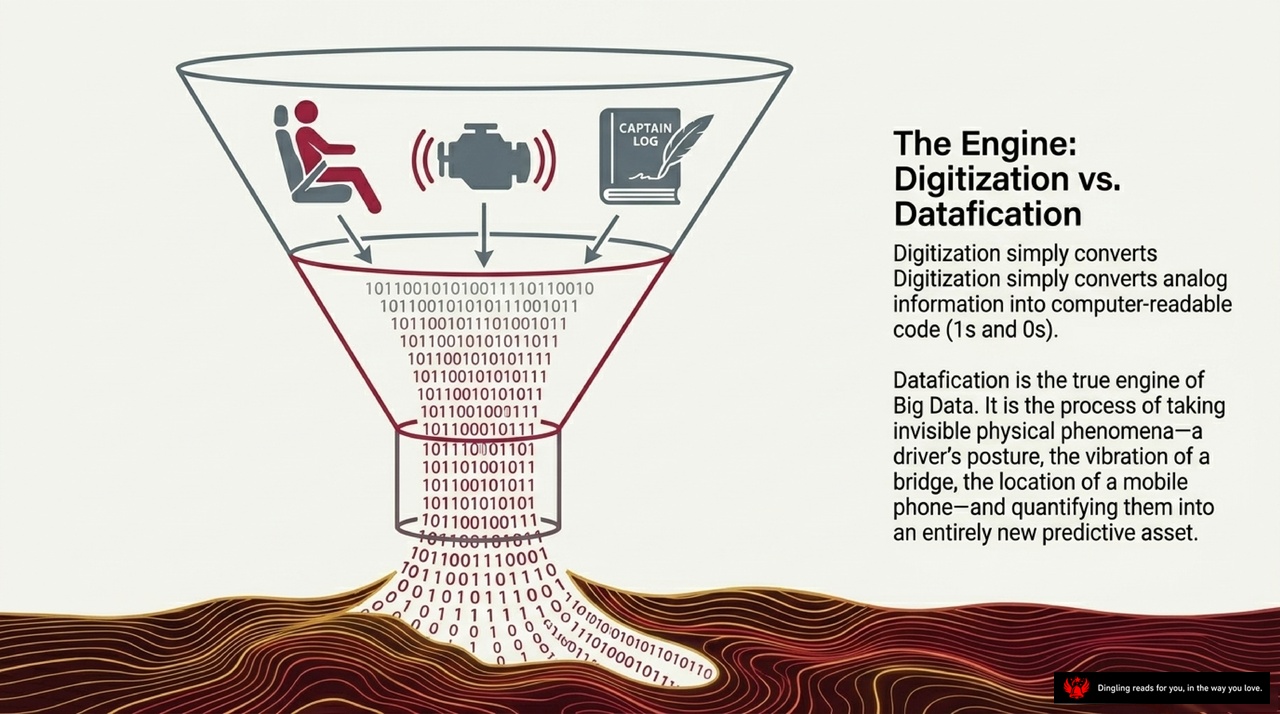
The slide highlights the concept of "Digitization vs. Datafication," a crucial distinction that defines how we extract value from information today.
Let's break this down. The funnel on the left represents the transformation process. At the top, we have analog inputs—like a person sitting in a seat, a vibrating bridge, or a captain's handwritten log. These are physical realities. The first step, Digitization, is simply converting these analog signals into computer-readable code, essentially turning the world into 1s and 0s. It's the act of making information digital.
However, the slide emphasizes that Digitization is just the engine's fuel, not the engine itself. True value comes from Datafication. As the text explains, Datafication is the process of taking invisible physical phenomena—things we can't easily measure like a driver's posture, the specific vibration of a bridge, or even the location of a mobile phone—and quantifying them into a new predictive asset.
Think of it this way: Digitization gives you a digital copy of the world, but Datafication gives you a new kind of reality where everything is measurable and predictable. It's the difference between just having a photo of a car and having a system that tracks its speed, engine health, and exact location in real-time. This shift is what powers the modern data economy, turning raw numbers into actionable insights that were previously impossible to see.
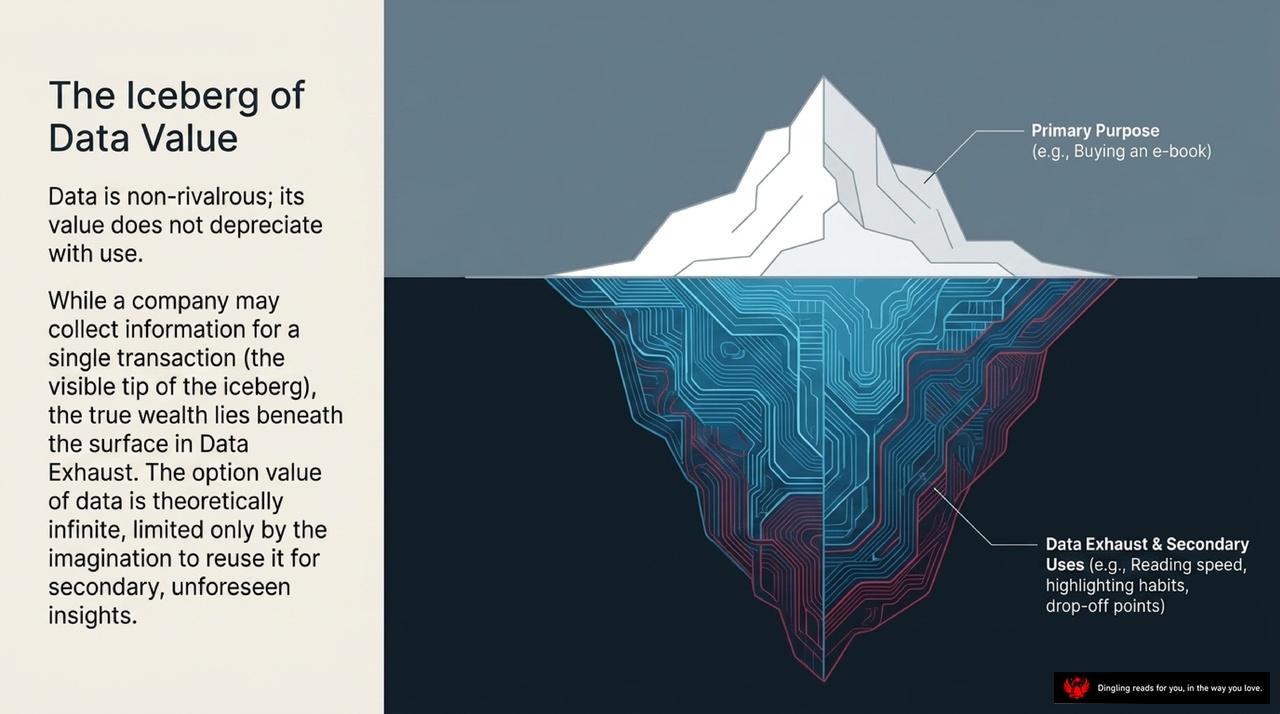
The Iceberg of Data Value shows us that the true wealth of data lies far beneath the surface. While buying an e-book is just the visible tip, the real value is hidden in the vast "Data Exhaust" below—your reading speed, highlighting habits, and drop-off points. Unlike traditional data that loses value after use, this information is non-rivalrous; it doesn't depreciate. In fact, its option value is theoretically infinite, limited only by our imagination to reuse it for unforeseen insights.
Think about it: a single transaction might seem simple, but the patterns hidden in how you interact with that content can predict your next move, improve a product, or even revolutionize an industry. This is why giants like Amazon and Google don't just sell you things or show you ads; they harvest these subtle behavioral signals to build smarter, more personalized experiences. The data you leave behind isn't waste; it's a renewable resource that grows more valuable the more you use it.
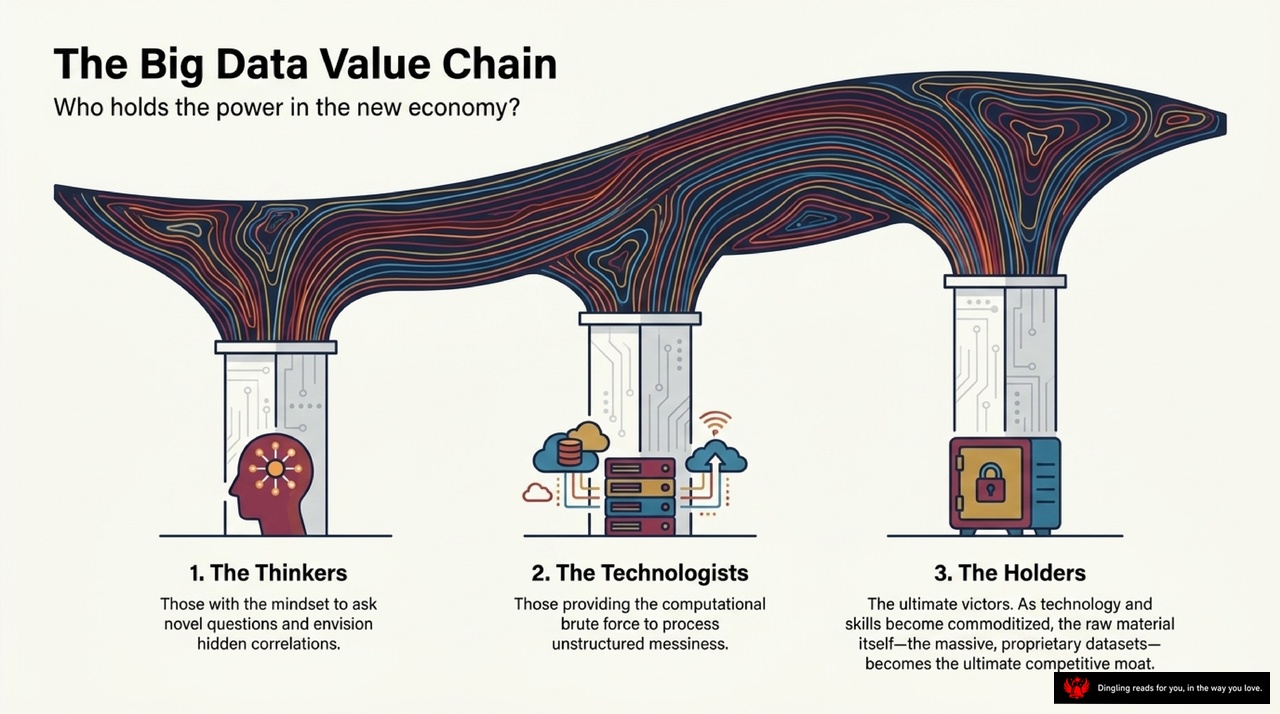
Welcome to the final chapter of our deep dive into the Big Data Value Chain. We've just explored how data, technology, and innovative thinking combine to create massive value, and now we need to face the elephant in the room: the risks.
As we've seen, the power of big data often comes from reusing data in ways we didn't originally intend. But this "secondary use" is a double-edged sword. It unlocks incredible insights, but it also erodes the very privacy we thought we protected. The old rules of "notice and consent" are broken because no one can predict all future uses of your data, and asking for permission for everything would stop innovation in its tracks.
Even "anonymization" isn't safe anymore. When you combine massive datasets from different sources, you can easily re-identify people who were supposedly anonymous. The threat isn't just about stealing your identity; it's about predicting your life. From predicting where you'll be sick to forecasting if you'll commit a crime, algorithms are turning probability into a form of pre-emptive judgment. This shifts us from being responsible for our actions to being judged for our potential, which is a dangerous slide into a "data dictatorship."
History warns us. In the past, leaders like McNamara treated data as absolute truth, ignoring the human reality behind the numbers and leading to disaster. Today, we face a similar trap where algorithms become untransparent black boxes that make life-altering decisions we can't understand or contest.
So, how do we move forward? We can't stop the data, but we must change the rules. We need a new paradigm where the responsibility shifts from the individual to the user of the data. We need technologies like "differential privacy" that protect identities while keeping data useful. We need clear rules on how long data can be kept before it's deleted. And we absolutely need a new profession: the "algorithm auditor." These experts act as the conscience of the data world, ensuring that these powerful systems remain fair, transparent, and accountable to humanity.
The goal isn't to stop the flow of information, but to build a framework where innovation and human rights can coexist. As we've learned, data is a tool, not a master. It's up to us to ensure it serves us, rather than ruling over us.

The traditional privacy shield is completely obsolete.
For decades, we relied on a simple promise: "Notice and Consent." Companies would tell you how they'd use your data, and you'd say yes. But in the big data era, this model has collapsed. Why? Because the real value of your data lies in its unforeseen secondary uses. Companies collect your information today, but they can't ask for permission for analyses they haven't even invented yet.
Look at this graphic. On the left, you have a "Primary Service"—the specific reason you gave your data, protected by that green "Notice and Consent" gate. But on the right, that single stream explodes into a chaotic web of red and gold lines. This represents the dark side: the death of notice and consent.
Because data is so cheap and abundant, companies repurpose it constantly. Your search history, your location, your clicks—they get stitched together into new products, sold to new partners, or used to predict things you never agreed to. The traditional privacy framework assumes we know what we're consenting to. But when the future applications are unknown, that consent is meaningless. We've moved from a world of controlled data to one of uncontrolled, unforeseen datafication. The old rules simply don't work anymore.
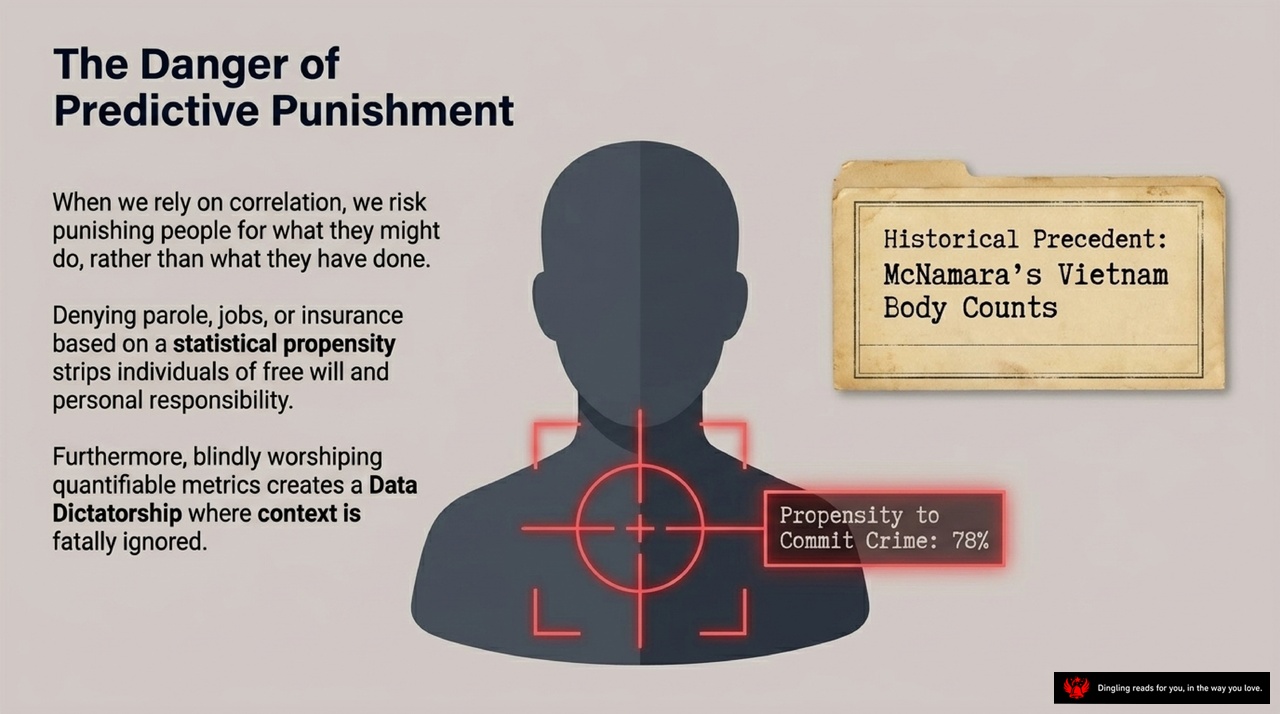
The Danger of Predictive Punishment is a stark warning about the cost of relying too heavily on correlation over context. As the slide illustrates, when we base decisions on statistical propensity rather than actual behavior, we risk punishing people for what they might do, not what they have done. This approach strips individuals of their free will and personal responsibility, effectively turning them into data points in a formula rather than people with choices.
Consider the chilling example on the screen: a silhouette marked with a red targeting reticle, labeled with a "Propensity to Commit Crime: 78%." This isn't a judgment of a specific crime committed today; it's a pre-emptive label based on past patterns. If we accept this logic, we create a Data Dictatorship where context is fatally ignored. Just as McNamara's reliance on body counts in Vietnam blinded leaders to the reality on the ground, our obsession with quantifiable metrics can blind us to the nuance of human behavior.
Denying parole, jobs, or insurance based on these statistical probabilities feels efficient, but it is fundamentally unjust. It assumes that because a group has a certain risk profile, every individual within that group shares that fate. We must resist the urge to let algorithms dictate our future. True fairness requires us to look at the person in front of us, understand their unique story, and judge them on their actual actions, not on a probability score that ignores their capacity for change.

Imagine a seesaw representing the future of governance. On one side, we have the heavy, crushing weight of the past: the "Individual Burden of Consent." For decades, you've been the one struggling under this rock, forced to sign away your rights in incomprehensible terms just to participate in the digital world. On the other side, we see the future: the "Corporate Burden of Accountability." Here, the scale tips in our favor. Instead of you defending your privacy, the responsibility shifts to the companies who profit from your data.
This isn't just about shifting blame; it's about a fundamental change in how we protect ourselves. We need to move away from asking for permission before every single use of your data. Instead, we must legally hold data users accountable for the downstream impact of their actions. This means enforcing "Data Depreciation"—a mandatory rule that limits how long companies can store your information. By setting a hard time limit on data storage, we prevent the creation of a permanent, inescapable digital memory. In this new paradigm, the power to define your digital future finally moves from the corporation to you.
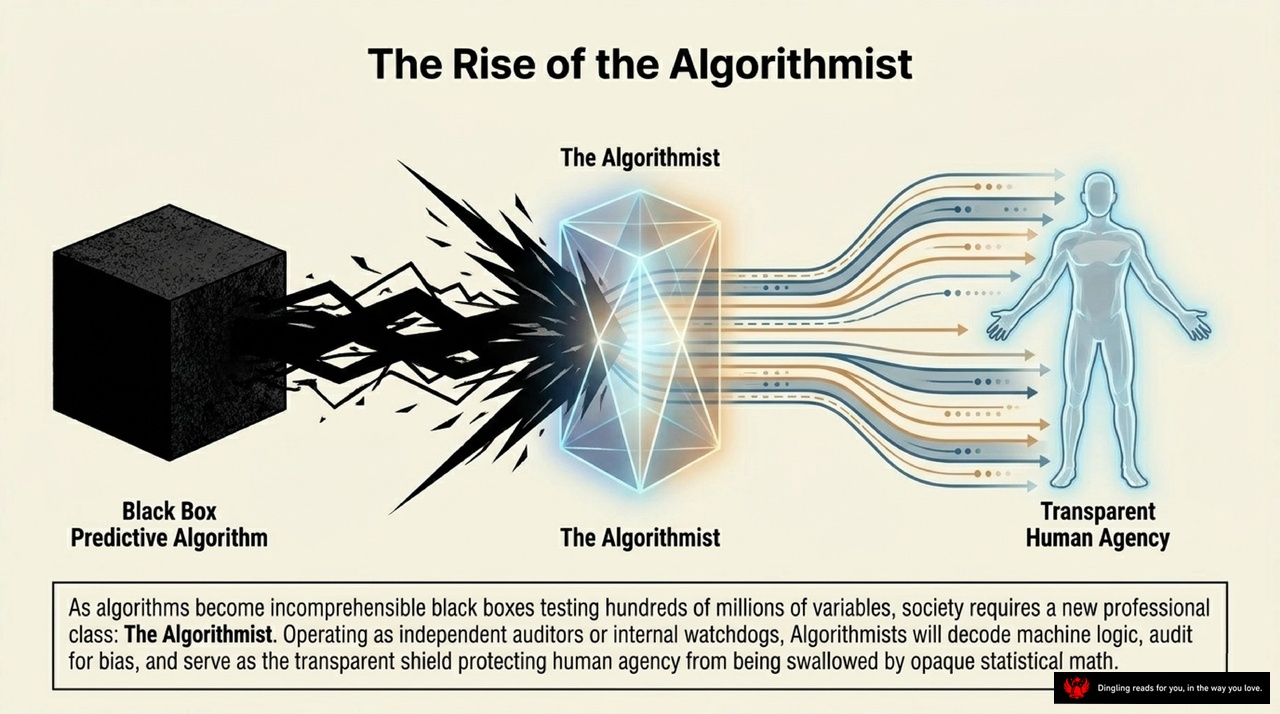
Look at this diagram: we're moving from a "Black Box Predictive Algorithm" to "The Algorithmist," and finally to "Transparent Human Agency." This visual perfectly captures the urgent need for a new professional class in the data age.
As algorithms become incomprehensible black boxes testing hundreds of millions of variables, society requires a new role: The Algorithmist. Imagine these professionals as independent auditors or internal watchdogs. Their job is to decode machine logic and audit for hidden bias. They serve as a transparent shield, protecting human agency from being swallowed by opaque statistical math.
Think about it: when a complex algorithm decides your loan approval or your news feed, who is watching the watchers? Without an Algorithmist, we risk losing control to code we don't understand. This role bridges the gap between raw data and ethical human action, ensuring that technology serves us rather than silently manipulating us. It's about bringing clarity to the chaos and keeping the final decision-making power firmly in human hands.

Look at this striking image: "Intuition in the Age of Algorithms." It captures a profound truth about our modern world—data informs, but it does not create. Algorithms can process vast amounts of information, yet they cannot replicate human intuition, intellectual ambition, or the sheer willingness to defy the odds.
Think about history. If Henry Ford had run a Big Data analysis on horses, he would have concluded that building a faster horse was the logical next step. But he didn't. He trusted his intuition to imagine the automobile. Similarly, Steve Jobs never consulted an algorithm to invent the iPad. He relied on a gut feeling about what the future should look like.
True progress often hides in the unquantifiable void—the messy, unpredictable spaces that data simply cannot see. We must deliberately carve out space for human instinct and the courage to ignore the data when it points the wrong way. In an era dominated by algorithms, our most valuable asset isn't the data itself, but the human intuition to know when to trust it, and when to boldly walk away from it.

The Canvas of Tomorrow isn't just about mapping the present; it's about deciding our future. Big Data gives us unprecedented power to reveal hidden correlations, but here's the catch: it operates on a single, dangerous premise—that our past behavior dictates our future actions. When algorithms can perfectly predict who we are based on who we were, we face a critical choice. Will we use that insight to break our patterns and evolve, or will we simply allow the data to become our destiny? The slide asks this directly: if we let the past define us completely, do we lose the ability to be something new? The challenge isn't just technical; it's deeply human. We must decide whether to be the architects of our future or just the subjects of our own history.