
Big History, Small World: Complete Chapter-by-Chapter Summary
Welcome to the journey of a lifetime. Tonight, we step off the familiar ground of our daily lives and look up, out into the vast, dark expanse of the cosmos.
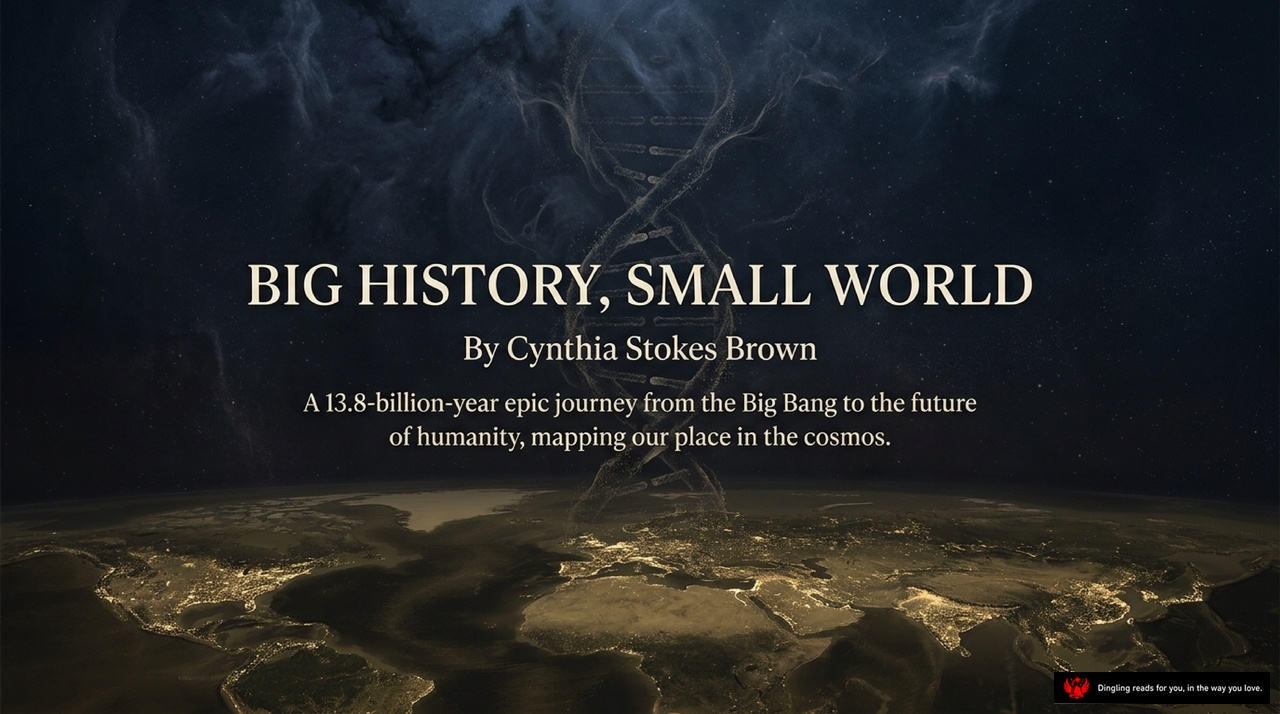
This presentation is titled "Big History, Small World," by Cynthia Stokes Brown. As you see on the screen, a glowing DNA strand rises from our planet, reaching up into the starry void. It perfectly captures the book's core promise: a 13.8-billion-year epic journey from the Big Bang to the future of humanity.
We are here to map our place in the cosmos. We often feel small, but understanding the story of the universe—from the initial explosion of energy to the formation of stars, planets, and life itself—reveals something profound. We are not just random accidents floating in space. We are the direct result of a cosmic history that has been building for nearly 14 billion years.
From the very first spark of the Big Bang to the complex web of life on Earth, every atom in our bodies was forged in the hearts of dying stars. This book connects the grandest events in the universe with the most intimate moments of human experience. It invites us to see ourselves not as separate from nature, but as an integral part of a single, unfolding story.
So, let's begin our exploration of how we got here, and where we might be going next.

Imagine time not as a series of disconnected chapters, but as a single, unified globe. Traditional history often gives us separate street maps for different fields—astronomy, physics, biology, geology, and the humanities—leaving us with fragmented stories. But Big History offers something far more powerful: The Ultimate Map of Time.
Think of it like a giant, interlocking puzzle. On one side, you have the hard sciences: Astronomy, Physics, Biology, Geology. On the other, you have the Humanities. For centuries, we treated these as separate worlds. But Big History merges them, creating a single, cohesive framework that explains everything we know. It traces the incredible journey from a simple, chaotic early universe to the incredibly complex phenomena we see today—ultimately leading to us.
By blending empirical science with human stories, this map allows us to see the full picture. It connects the explosion of the Big Bang 13.8 billion years ago to the formation of stars, the rise of life on Earth, the evolution of humanity, and the emergence of global civilization. It shows how a tiny, hot, dense point of energy expanded and cooled, eventually creating the conditions for atoms, then stars, then planets, and finally, life.
This unified view helps us understand that we are not just observers of history; we are the result of it. Every element in our bodies, every law of physics we rely on, and every cultural idea we hold was forged in this grand, continuous process. By merging these disciplines, Big History doesn't just tell us what happened; it reveals the deep, underlying connections that bind the cosmos, the earth, and ourselves into one magnificent story.

The universe naturally drifts toward chaos, but life emerged when the cosmos hit a perfect formula: raw materials, optimal energy flow, and just-right conditions. Think of it like a recipe for complexity. The universe provides the ingredients and the heat, but only when conditions are "Goldilocks"—not too hot, not too cold—does emergent complexity take hold.
To understand this scale, imagine time as a roll of toilet paper. One sheet covers just 5 million years. A full roll stretches to 5 billion years—the age of our solar system. If you unroll 2.75 rolls, you cover 13.8 billion years, the entire age of the universe. And if you zoom in on the very last fraction of that final sheet, you find the entire history of humanity. We are the absolute last fraction of the final sheet. This timeline shows that while the universe is vast and ancient, our story is a tiny, precious spark at the very end.
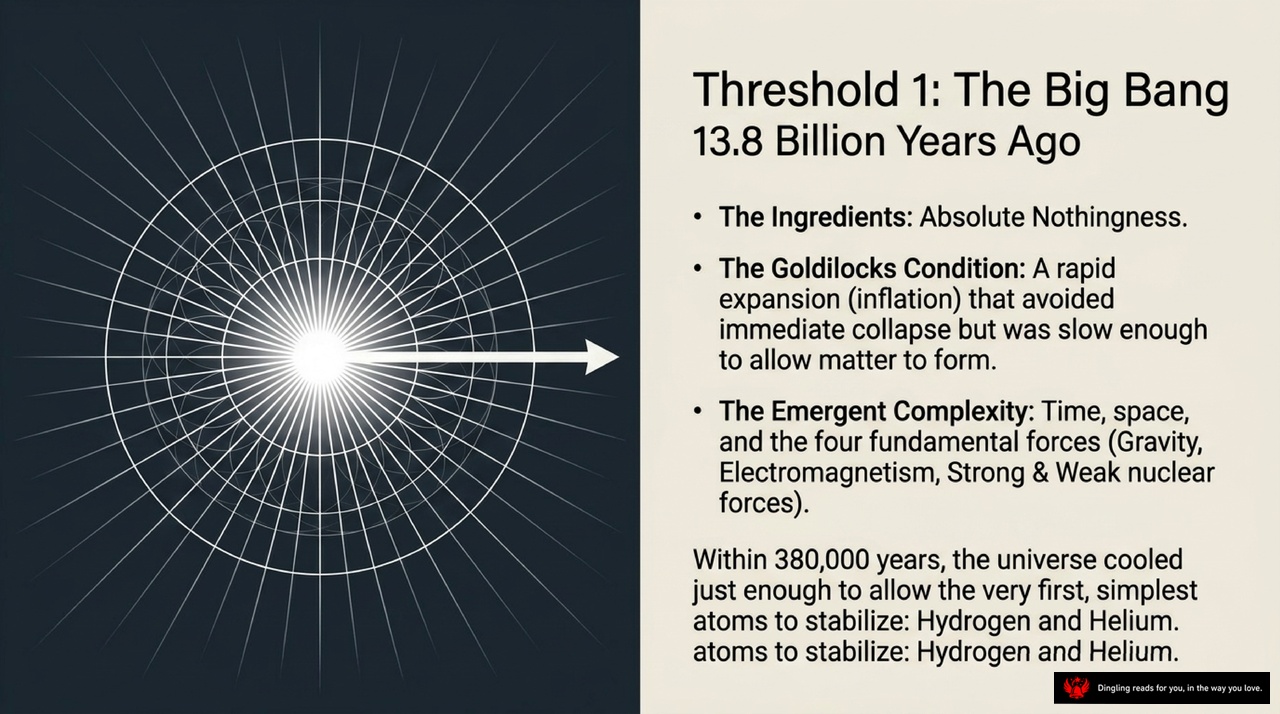
Imagine the universe not as an empty void waiting to happen, but as a story that began with absolute nothingness. Exactly 13.8 billion years ago, the first chapter of our existence started with a singular, explosive event: The Big Bang. It wasn't an explosion *in* space, but an explosion *of* space itself, tearing reality apart from a point of infinite density and heat.
Think of this moment as the ultimate "Goldilocks" scenario. The universe expanded so rapidly—what we call cosmic inflation—that it avoided collapsing back into chaos immediately, yet slowed down just enough to allow matter to actually form. From this primordial energy, something magical emerged: the fundamental building blocks of reality. Time, space, and the four forces that govern our world—gravity, electromagnetism, and the strong and weak nuclear forces—crystallized into existence.
But the story didn't end with just energy. Within just 380,000 years, the universe cooled down enough for the very first atoms to stabilize. Hydrogen and Helium locked together, creating the first solid matter. This was the birth of the ingredients we see today. So, from absolute nothingness, through a rapid, delicate expansion, we arrived at the complex, structured cosmos that allows for stars, planets, and eventually, life. This is the threshold where everything began.

The rise of empires wasn't just about conquest; it was a masterclass in managing scale and diversity. Think about it: how do you rule a vast territory without losing control? Ancient empires like Rome and China cracked the code with layered management. They ruled the core directly with unified laws, while letting border regions keep their local customs through indirect control. It was a delicate balance of central power and local flexibility.
But an empire's longevity depends on more than just borders. Culture played a massive role. To hold people together, empires promoted a shared language and religion—like Latin in Rome or Islam in the Arab Caliphate. Yet, they were smart enough to absorb local traditions too. Look at the Taj Mahal: it's a perfect blend of Islamic architecture and Indian aesthetics, showing how cultural fusion could actually strengthen an empire instead of tearing it apart.
However, empires are fragile. Their fall is rarely caused by one thing. Often, it's a perfect storm of over-expansion, economic mismanagement, and internal corruption. When an empire stretches too thin, like the Mongols or the late Roman Empire, rebellion becomes inevitable. Add to that the greed of the ruling class and external pressures, and the structure collapses.
Then there's the Silk Road, the ultimate connector of our ancient world. It wasn't just a trade route for silk and spices; it was the internet of its day, transmitting ideas and technologies. Imagine the ripple effects: Chinese papermaking reaching Europe to fuel the Renaissance, or Indian cotton changing the fashion of the Middle East. Religions like Buddhism traveled this path, adapting to new cultures along the way.
This era of exchange laid the groundwork for what came next. The stability and wealth generated by these great empires eventually fueled the Industrial Revolution. When Britain harnessed steam power, it didn't just change how things were made; it reshaped the entire global order. Suddenly, the center of gravity shifted from the Mediterranean to the Atlantic, and the world was forever changed.
Imagine a world where a single moment, 138 billion years ago, sparked everything we see today. That's the Big Bang—the explosive birth of our universe from a tiny, infinitely hot point. As space expanded and cooled, energy condensed into particles, eventually forming the atoms that built stars and planets.
Fast forward to Earth. About 4.6 billion years ago, our planet formed from swirling cosmic dust. It was a chaotic place of molten rock and toxic gases, but life began to stir. First came simple single-celled organisms, surviving in the primordial oceans. Over millions of years, these tiny life forms evolved into complex cells, then into the first plants and animals. They learned to harness sunlight, breathe oxygen, and eventually, walk on land.
Then came the explosion of life itself. Around 540 million years ago, the Cambrian Explosion gave rise to countless species, from fish to early arthropods. This diversity paved the way for the rise of mammals, dinosaurs, and eventually, us.
Our story continues with the rise of agriculture. Around 10,000 years ago, humans stopped hunting and gathering, instead cultivating crops and domesticating animals. This shift allowed us to settle in one place, build villages, and eventually, cities. With stable food sources, populations grew, and societies became more complex. We developed writing, laws, and governments, laying the foundation for the great civilizations of the ancient world.
From the fertile crescent of Mesopotamia to the rivers of Egypt and China, these early societies thrived through innovation and cooperation. They built pyramids, temples, and empires, leaving behind a legacy that still shapes our world today.
As we look back at this incredible journey—from a single spark in the cosmos to the rise of human civilization—we realize how interconnected our story is. Every step, from the formation of the Earth to the invention of the wheel, was a crucial piece of the puzzle. And now, as we stand on the brink of a new era, the question remains: what will we create next?

Imagine the universe not just as a vast emptiness, but as a story of incredible resilience and transformation. We are here because of a series of cosmic accidents that turned chaos into order. It started with the Big Bang, a violent explosion that set the stage for everything we see today. As the universe cooled, simple atoms like hydrogen and helium formed, eventually clumping together under gravity to create the first stars.
These stars were the ultimate alchemists. Inside their fiery cores, they forged heavier elements like carbon, oxygen, and iron. When massive stars died in spectacular supernova explosions, they scattered these essential building blocks across the cosmos. This debris eventually coalesced to form our solar system and our planet, Earth. Without those ancient stellar deaths, the ingredients for life simply wouldn't exist.
But the story doesn't end with the planet forming. Life itself had to emerge from this chemical soup. Around 3.5 billion years ago, simple molecules began to self-organize, creating the first single-celled organisms. These early microbes were tiny, yet they changed everything. Through photosynthesis, they began pumping oxygen into the atmosphere, transforming our world from a toxic environment into one capable of supporting complex life.
Over eons, these single cells learned to cooperate. Through a process called endosymbiosis, some bacteria were engulfed by others but not digested. Instead, they formed a symbiotic relationship, evolving into the mitochondria and chloroplasts we find in our cells today. This was the spark that allowed life to move from simple, solitary cells to complex, multicellular organisms.
This journey from a single cell to the diverse web of life we see now is the foundation of our existence. Every breath we take, every thought we have, traces back to those ancient stars and the first spark of biology. We are literally stardust, given a second chance to exist through the miracle of evolution.
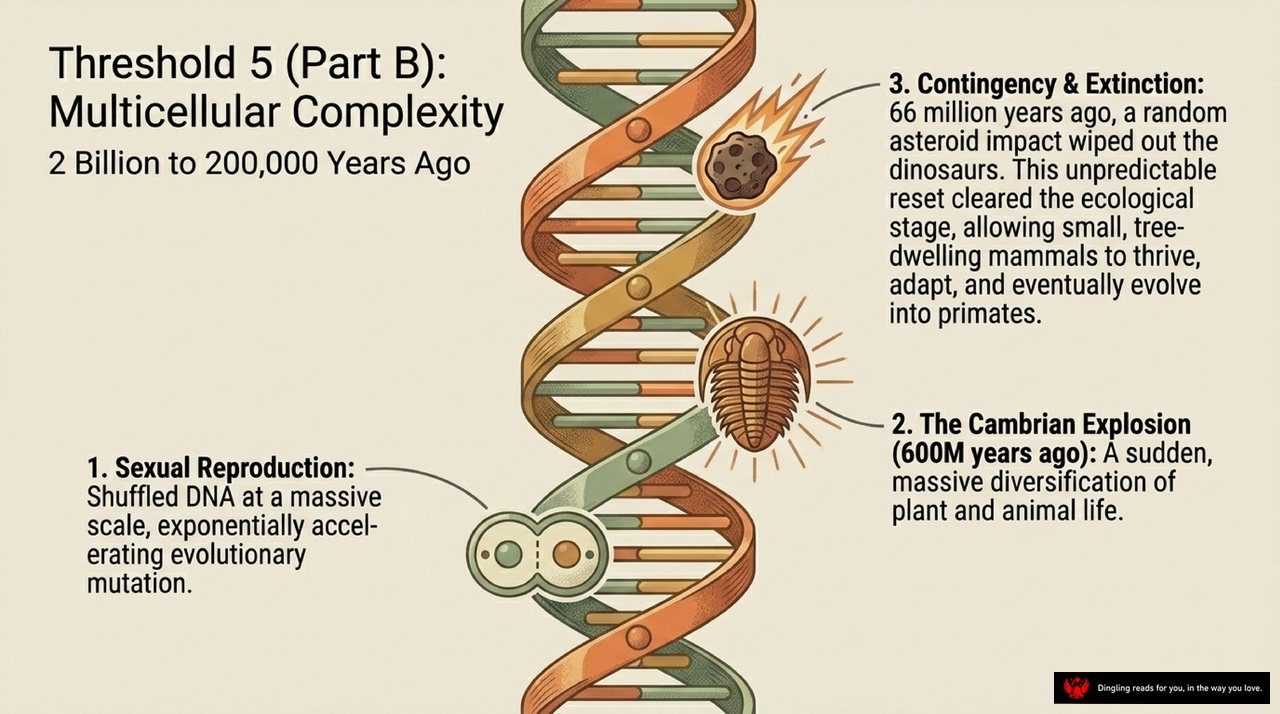
Let's dive into the pivotal moment that changed everything: the rise of multicellular complexity. This slide covers the period from 2 billion to just 200,000 years ago, marking a massive leap in life's evolution.
It all starts with sexual reproduction. As shown on the left, this wasn't just about making more babies; it was a game-changer. By shuffling DNA on a massive scale, it exponentially accelerated evolutionary mutation. This genetic mixing gave life the raw material to get smarter, stronger, and more complex.
But evolution doesn't happen in a straight line. Look at the middle of the DNA strand. Around 600 million years ago, we hit the Cambrian Explosion. This was a sudden, massive diversification of plant and animal life. Life went from simple to incredibly varied in a blink of geological time, laying the groundwork for everything that came after.
Then, we hit a major plot twist: contingency and extinction. About 66 million years ago, a random asteroid impact wiped out the dinosaurs. This unpredictable reset cleared the ecological stage. It was a disaster for one group, but a golden opportunity for another. Small, tree-dwelling mammals thrived, adapted, and eventually evolved into primates. This chance event is what ultimately led to our own ancestors.
So, from the power of sexual reproduction to the chaos of the Cambrian Explosion, and finally to the luck of an asteroid strike, these three forces combined to build the complex, multicellular world we live in today.

Welcome to Threshold 6: The Emergence of Humans, dating back 200,000 years ago. This slide asks a profound question: what truly makes *Homo sapiens* unique? It wasn't just our ability to use tools or master fire. The real game-changer was the development of precise, symbolic language. This cognitive leap allowed us to communicate abstract ideas, plan for the future, and build complex societies that no other species could match.
But the story doesn't end there. Look at the illustration of our brain; it represents something even more powerful: collective learning. We are the first species capable of accumulating, storing, and passing down complex information across generations. Instead of starting from scratch every single time, each new generation builds directly on the mental maps of the last. This is the secret to our success. While other animals rely heavily on biological evolution to adapt, humans have essentially bypassed it. Through cultural evolution, we can upgrade our "software"—our knowledge, skills, and technologies—much faster than our genes can change. This ability to stand on the shoulders of giants is what allowed us to go from small tribes in Africa to dominating every corner of the globe.
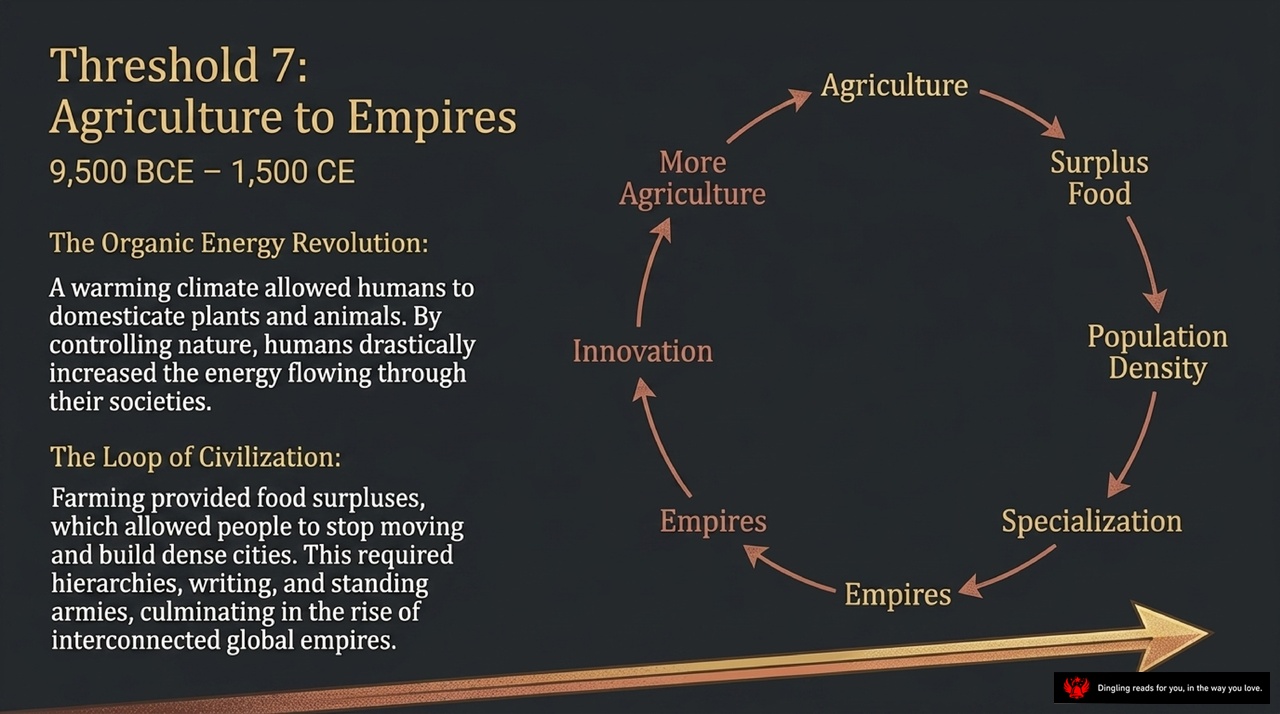
Welcome back to our journey through the grand timeline of human history. We are now at Threshold 7, a pivotal era spanning from 9,500 BCE to 1,500 CE, often called the "Organic Energy Revolution." As you can see in this diagram, it all started with a warming climate that allowed humans to finally domesticate plants and animals. By controlling nature, we drastically increased the energy flowing through our societies.
This shift kicked off what we call "The Loop of Civilization." Farming provided food surpluses, which allowed people to stop moving and build dense cities. But this wasn't just about settling down; it required hierarchies, writing, and standing armies. This cycle—moving from agriculture to surplus food, then to higher population density, specialization, and eventually the rise of interconnected global empires—created the foundation for the complex world we live in today. It was the moment humanity transitioned from small, scattered bands into powerful, organized empires that would shape the rest of history.

Look at this explosive curve. We are currently living in the Anthropocene, a brand new geological epoch where humanity has become the dominant force reshaping the Earth's biosphere. This shift didn't happen gradually; it was triggered by what the slide calls "The Fossil Fuel Spike." By tapping into buried solar energy—coal, oil, and gas—we shattered all previous limits on what our planet could carry.
The result? In just 250 years, our population skyrocketed from 750 million to over 7.4 billion. And look at that energy line; it didn't just go up, it exploded. In the 20th century alone, global energy use multiplied by 16 times. This massive spike in energy and population is what defines our current reality. We are no longer just inhabitants of Earth; we are its architects, driving an era of globalization that connects every corner of the globe while fundamentally altering the natural world.

Let's talk about where we stand in the grand timeline of our existence. The slide you see right now maps out the eight critical thresholds that shaped our reality, starting from the very beginning of time.
We begin at T1, the Big Bang, roughly 13.8 billion years ago. From a state of "nothingness," extreme inflation gave birth to time, space, and the fundamental forces of nature. Just a short 100 million years later, at T2 and T3, gravity and hydrogen ignited the first stars, forging the 92 chemical elements we know today through intense heat and fusion.
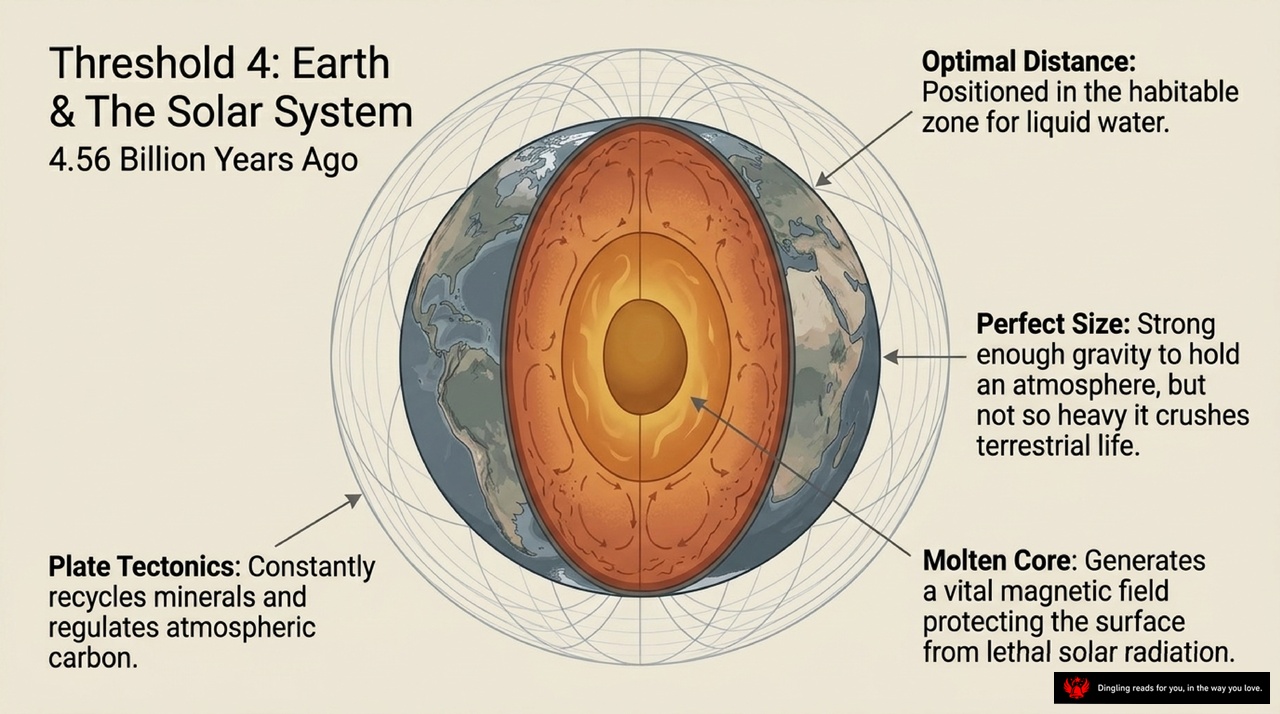
By 4.56 billion years ago, T4, Earth formed as a rocky planet protected by a magnetic shield, sitting in the habitable zone. Then came T5, Life, appearing 3.5 billion years ago when complex chemicals, liquid water, and optimal energy combined to create metabolism and reproduction.
The story accelerates dramatically at T6, Humans, appearing just 200,000 years ago. Our emergence as primates with big brains and vocal cords unlocked symbolic language and collective learning. By 9.5 thousand years BCE, T7, Agriculture transformed us into Homo sapiens capable of building cities, empires, and writing systems, fueled by a stable, warming climate.
Finally, we arrived at T8, the Anthropocene, around 1500 CE. Driven by global networks and buried fossil fuels, we entered an era of hyper-complex global civilization. This table isn't just a list of dates; it's the roadmap of how the universe went from nothing to everything, ending with us.

The modern dilemma we face isn't just about technology; it's about the terrifying trade-off between complexity and fragility. Look at that scale: on one side, we have exponential innovation—AI, the internet, and our global networks driving us forward at breakneck speed. But on the other side, we are paying the price with biosphere collapse. As we build more intricate systems, they become increasingly brittle.
The text reminds us of a chilling thermodynamic truth: as complexity increases, so does fragility. We are currently in what experts call "Threshold 8 civilization," a stage that demands unimaginable, continuous energy flows just to keep our structures running. We are rapidly approaching planetary boundaries, a biological state known as "overshoot," where we have consumed more than the Earth can regenerate.
It's a profound question: we possess the collective learning to understand our 13.8-billion-year cosmic origin, from the Big Bang to the formation of our solar system. Yet, do we have the wisdom to prevent our own collapse? We have the power to create, but we must now learn the harder skill of survival.
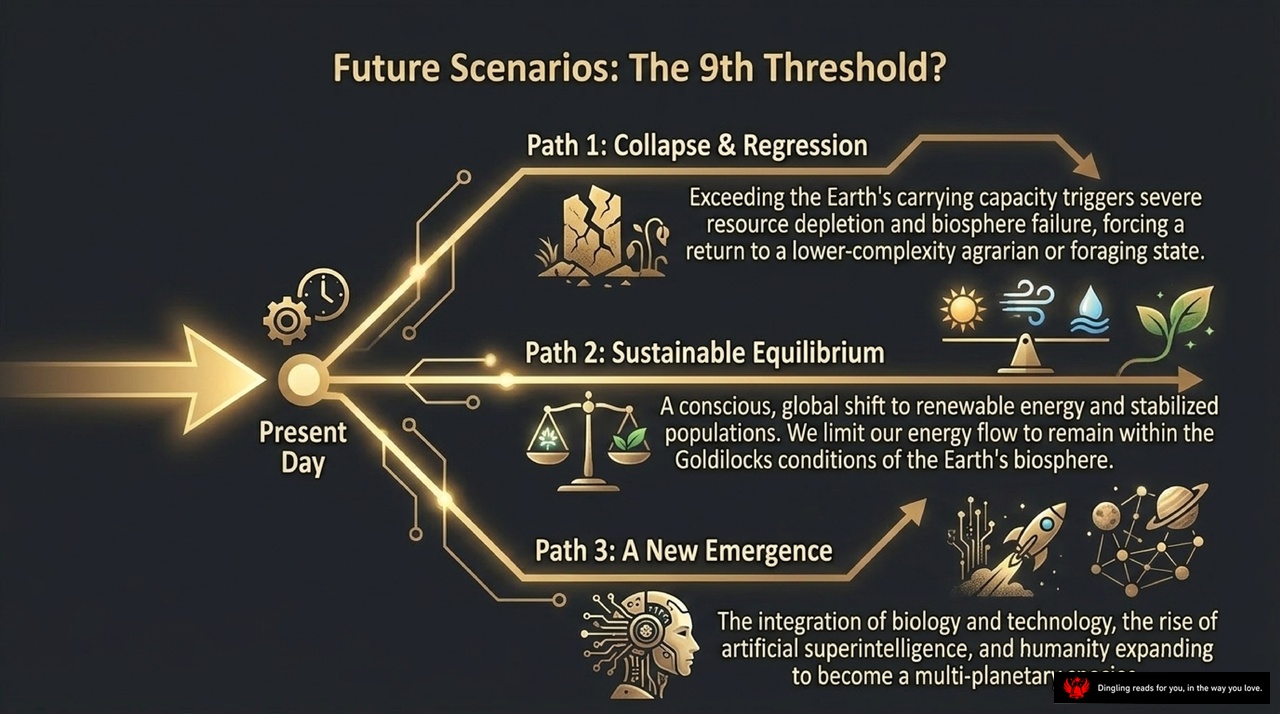
Today's slide presents a critical fork in our road, asking us to confront the ultimate question: What is the 9th Threshold for humanity? The image maps out three distinct future scenarios branching from our present day.
First, we face the path of Collapse and Regression. This occurs if we exceed the Earth's carrying capacity, triggering severe resource depletion and biosphere failure. The consequence is a forced return to a lower-complexity agrarian or foraging state, essentially undoing centuries of progress.
Second, there is the path of Sustainable Equilibrium. This requires a conscious, global shift toward renewable energy and stabilized populations. We must limit our energy flow to remain within the "Goldilocks conditions" of our biosphere—neither too hot nor too cold, just right for life to thrive indefinitely.
Finally, we have the path of A New Emergence. This is the most transformative option, envisioning the deep integration of biology and technology. It includes the rise of artificial superintelligence and humanity expanding beyond Earth to become a multi-planetary species.
The choice isn't just theoretical; it defines whether we fade into the past, stabilize in the present, or leap into a new cosmic future.

Look at this image of our planet, framed by a delicate, glowing network of connections. It perfectly captures the essence of our current chapter: we are no longer just passive observers of the cosmos; we are the universe experiencing itself, holding the fate of our biosphere in our hands.
The summary on this slide asks a profound question: As the first species capable of understanding our own 13.8-billion-year origin story, will we allow our unprecedented power to destroy our fragile world, or will we consciously steer our evolution toward a sustainable, thriving future?
This isn't just a hypothetical scenario; it's the defining moment of our existence. We are stardust forged in ancient suns, shaped by billions of years of evolution, and now empowered by collective learning. But with this power comes a heavy responsibility.
Think about the trajectory we've traveled. From the chaotic energy of the Big Bang to the formation of galaxies, from the first single-celled organisms to the complex civilizations we see today. We have moved from survival to sustainability, from scarcity to abundance, and now, we stand at a crossroads.
The question is no longer "can we survive?" but "what kind of future do we choose to build?" Will we continue on a path of exploitation, consuming our resources until the network around our planet frays and breaks? Or will we use our unique cognitive abilities to solve the challenges of climate change, resource depletion, and social inequality?
The image shows us connected, interlinked, and fragile. Our future depends entirely on the choices we make right now. Are we ready to be the stewards of this planet, ensuring that the next generation inherits a world that is not just surviving, but thriving? The power is in our hands. The question is, will we use it wisely?